How to Start a Resume: A Strategic Guide for the 2026 Job Market
Nearly every employer in 2026 uses an Applicant Tracking System (ATS) to screen your application before a human ever sees it. You likely feel the pressure of the blank page while wondering how to start a resume that actually works. It is frustrating to guess if your experience will pass an automated filter or meet specific North American standards. You need a clear starting point that leads to a high resume score and real interviews.
Starting a resume is no longer about writing a simple bio. It is about engineering a data-backed document for two audiences: AI and humans. This guide provides the exact steps to move from a blank screen to a polished, ATS-optimized document. You will gain the confidence to build a resume that performs in a competitive market.
We will break down the reverse-chronological format, show you how to quantify your wins, and explain the importance of a skills-first approach. You will see how to use clean layouts that AI can read and recruiters value. Let's replace the anxiety of the job search with a proven, data-driven strategy.
Key Takeaways
- Learn how to start a resume by framing it as a strategic marketing document instead of a simple work history.
- Select the right format and use US Letter size to align with standard North American hiring practices.
- Build a high-impact professional summary that hooks recruiters within the first six seconds of their review.
- Apply the STAR method to quantify your achievements and show employers exactly what you can deliver.
- Finalize your document with a strict proofreading process and save it as a PDF to protect your layout.
Stop Staring at the Blank Page: How to Start a Resume for the 2026 Job Market
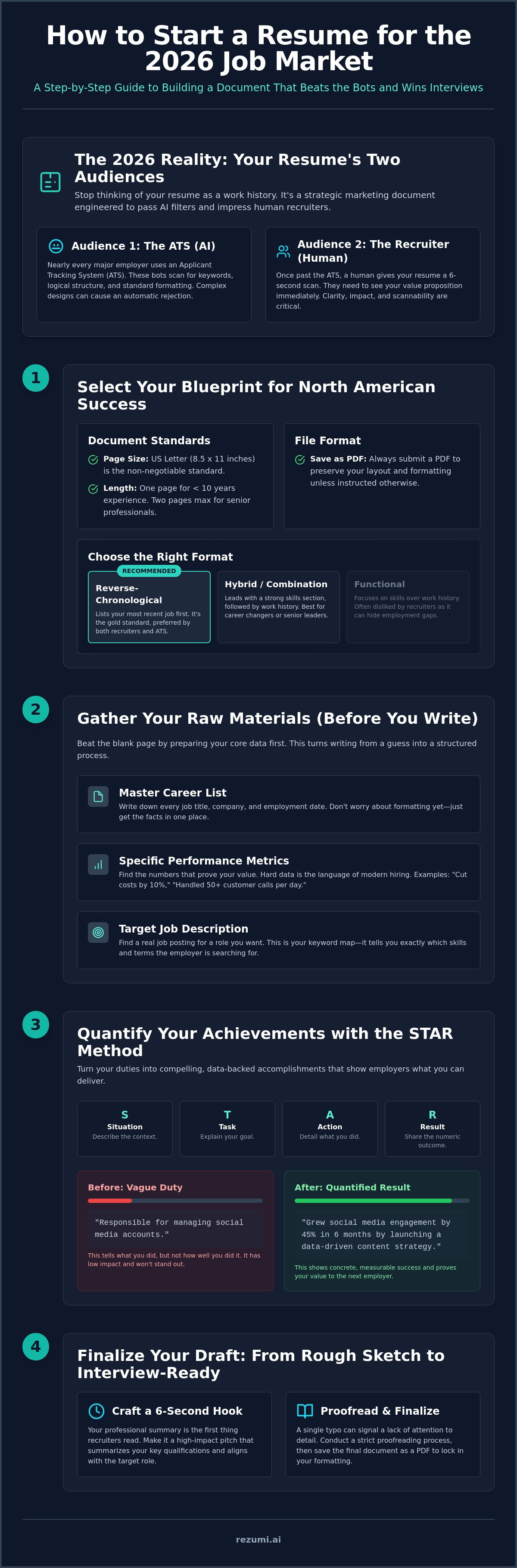
Stop thinking of your resume as a life story or a biography. It isn't a list of every task you've ever performed. Instead, treat it as a strategic marketing document designed to sell your skills to a specific buyer. Your resume has one job: to prove you can solve a company's problems. In the 2026 job market, you're writing for two distinct audiences. You must satisfy high-speed AI filters while still being readable for a human recruiter. This dual-audience reality is the most important thing to remember when learning how to start a resume. You can find a comprehensive overview of resumes to understand their traditional roots, but modern success requires a data-driven approach.
The 2026 ATS Reality Check
Nearly every major employer uses an Applicant Tracking System (ATS) to manage the flood of applications. These systems have become much more sophisticated. They scan for specific keywords, but they also look for logical career progression and clear formatting. If you use complex graphics or multi-column layouts, the ATS might fail to parse your data correctly. This leads to an automatic rejection before a human ever sees your name. Using an ATS resume checker allows you to see your document through the eyes of the machine. It identifies gaps in your keywords and formatting errors that could cost you an interview. A simple, standard layout is always better than a creative design that breaks the system.
Gathering Your Raw Materials
The biggest hurdle is often the blank page. You can beat this by gathering your raw materials before you try to write a single sentence. Think of this as the research phase. You need three things ready to go:
- A Master Career List: Write down every job title, company, and set of dates from your past. Don't worry about formatting yet. Just get the facts in one place.
- Specific Performance Metrics: Find the numbers that prove your value. Did you cut costs by 10%? Did you handle 50 calls a day? Hard data is the language of 2026 hiring.
- A Target Job Description: Find a posting for a role you actually want. This is your keyword map. It tells you exactly which skills the employer values most.
The goal of your first draft is simply to get your core data on paper. Don't aim for perfection. Aim for a complete inventory of your professional value. Once you have the facts, you can begin the process of tailoring and optimization. This approach replaces the anxiety of writing with the efficiency of a structured process. You aren't guessing what to write; you're assembling a high-performance tool.
Selecting Your Resume Format: The Blueprint for North American Success
Picking your layout is the first technical decision you'll make when learning how to start a resume. In the North American market, your choice determines how easily a recruiter can scan your history in six seconds. You have three main options: chronological, functional, and hybrid. Most employers in the US and Canada prefer the reverse-chronological format because it shows your most recent wins first. If you're targeting a government role, you might need a more detailed approach, so check this federal resume writing guide for specific requirements.
Your document must be set to US Letter size (8.5 by 11 inches). This is a non-negotiable standard in North America. Using A4 size, which is common in Europe and Asia, can cause printing issues and may even confuse some older ATS software. Keep your length to exactly one page if you have less than 10 years of experience. Senior professionals with extensive, relevant data can move to two pages, but every line must earn its place. If you aren't sure which style fits your career path, you can explore our deep-dive on the best resume format for more templates.
Chronological vs. Functional vs. Hybrid
The reverse-chronological format is the gold standard for a reason. It is easy for both humans and AI to follow because it lists your work history starting with your current or most recent job. Recruiters often dislike the functional format because it hides the timeline of your experience. This can look like you're trying to cover up employment gaps. The hybrid format is the best choice for career changers or senior leaders. It allows you to lead with a strong skills section before diving into your chronological history. This ensures your most relevant abilities are seen immediately.
North American Formatting Standards
White space is your friend. Keep your margins between 0.5 and 1 inch on all sides to prevent your resume from looking crowded. A wall of text is an immediate turn-off for recruiters. Use clean, sans-serif fonts like Inter, Source Sans Pro, or Calibri. These fonts are highly readable for ATS scanners and look professional on a screen. You can access these optimized layouts through our professional resume building tools to ensure your design meets 2026 standards.
Never include a photo on a North American resume. Including a headshot can lead to immediate rejection because of strict anti-discrimination laws. Your contact information should be simple. Include your full name, phone number, professional email address, and your general location (city and state or province only). You don't need to provide your full home address. Add a link to your LinkedIn profile or a professional portfolio—for instance, musicians can highlight their independent work through commission free music distribution—to give recruiters a way to see more of your work.
Writing Your Contact Info and Professional Summary: The 6-Second Hook
Recruiters spend an average of six seconds scanning your application before making a "yes" or "no" decision. This makes the top third of your page the most valuable real estate you own. When you are learning how to start a resume, you must treat this section as your primary sales pitch. The goal is to hook the reader immediately by proving you are the exact match for their needs. Outdated objective statements that explain what you want are now a red flag. Modern employers only care about the value you bring to their team. You can find more detail on structuring these sections in the University of Wisconsin-Madison's guide to resume writing.
The Modern Professional Header
Your header should be clean and easy to read. Start with your full name in a larger, bold font. Directly below your name, include a professional title that matches the specific job you are applying for. If you are applying for a "Senior Project Manager" role, that should be your title. Don't include your full home address. North American standards only require your city and state or province. Use a professional email address that uses your name. Avoid nicknames or unprofessional handles that might signal a lack of seriousness. Finally, add a link to your LinkedIn profile. Ensure the URL is clean and customized so it doesn't take up too much space.
Crafting a Data-Backed Summary
A high-impact professional summary follows a specific formula: [Your Title] + [Years of Experience] + [Your Biggest Achievement]. This 3-line paragraph replaces the old objective statement. It should be packed with industry keywords found in the job description. Don't use empty fluff words like "motivated" or "team player." These terms don't help you pass an ATS filter and they don't impress recruiters. Focus on facts that prove your expertise rather than making vague claims about your personality.
Focus on results. Write one sentence that highlights a major win using real numbers. For example, instead of saying you are "good at sales," write that you "exceeded annual sales targets by 22% for three consecutive years." This provides concrete evidence of your skills. It tells the recruiter exactly what you can do for them. By starting with your strongest data, you eliminate the need for long, wordy introductions. This is the most strategic way to handle how to start a resume for the 2026 market. It ensures your most impressive work is visible the moment a human or a machine opens your file.
Mapping Your Professional History: How to Quantify and Optimize
The experience section is the engine of your application. Most North American recruiters expect to see your history in reverse-chronological order. This means you list your current or most recent role at the top and work backward. This structure is the most effective way to show your career growth and current skill level. It also makes it easier for an ATS to map your timeline. Once you understand how to start a resume with a strong header and summary, this section provides the evidence that backs up your claims.
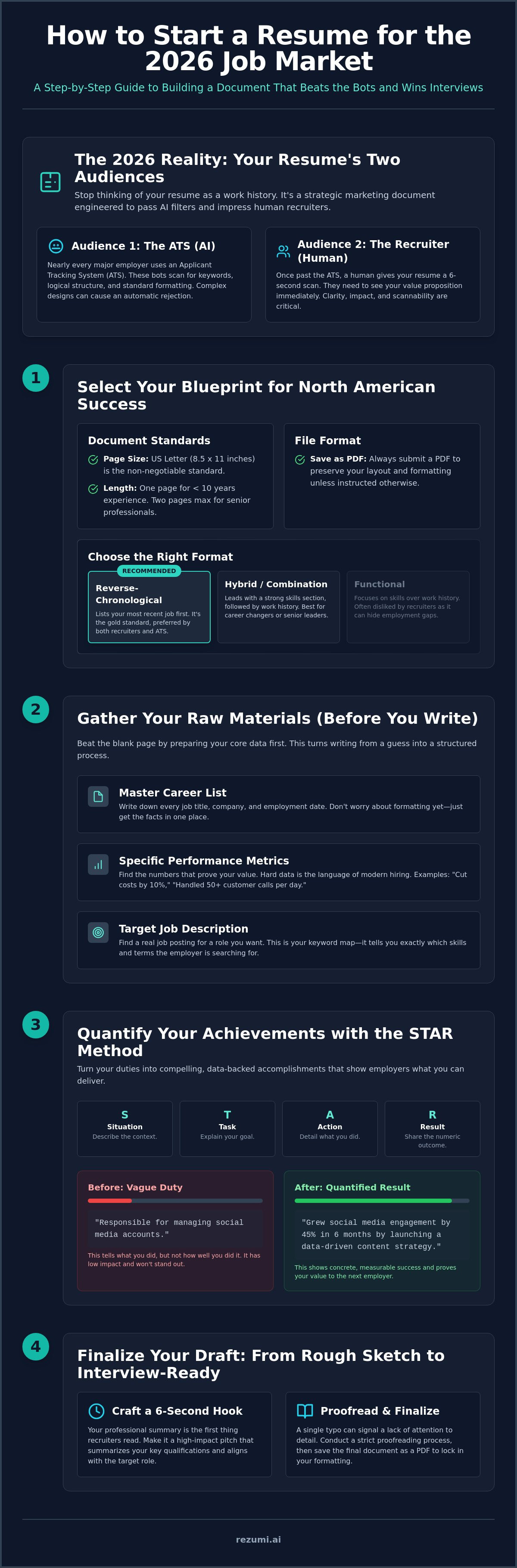
You must use the STAR method to write your bullet points. STAR stands for Situation, Task, Action, and Result. This framework ensures you don't just list your daily chores. Instead, you describe a specific challenge, the steps you took to solve it, and the measurable outcome. If you are a new graduate or changing careers, you can include internships, volunteer work, or major academic projects. The key is to treat every entry as a proof point of your professional capability.
The Power of Quantification
Numbers are the most persuasive tool in your arsenal. Employers in 2026 want to see exactly how much value you can add to their bottom line. You should never just say you "managed a team." Instead, you should say you "led a team of 12 to exceed annual sales targets by 20%." This provides a clear scale of your responsibility and success. Use specific metrics like percentages, dollar amounts, and time saved to make your achievements feel real. You can use impact verbs to start your bullets and grab attention immediately. Consider these examples:
- Generated: Produced $50,000 in new revenue through targeted email campaigns.
- Reduced: Cut department overhead by 15% by automating manual data entry.
- Optimized: Improved website load speeds by 40% using advanced caching techniques.
- Directed: Overset a $200,000 project budget with zero overages over six months.
Tailoring for Every Application
A generic resume is a rejected resume. You must tailor your history for every job you target. Start by identifying the top five skills mentioned in the job description. These are usually the requirements listed in the first few bullet points of the posting. You should naturally weave these exact keywords into your own experience section. If the job asks for "cross-functional leadership," make sure that phrase appears in your history. This is how you satisfy both the AI filters and the human hiring manager. You can use an ai resume builder to automate this process and ensure your keywords align perfectly with the role.
Quantifying your wins takes time, but it is the only way to secure high-tier interviews. If you find yourself stuck on the wording, remember that results matter more than responsibilities. You can access our full suite of ATS optimization tools to score your experience section against real-world job descriptions. This ensures your professional history isn't just a list of jobs, but a powerful argument for your next promotion.
Finalizing Your Draft: From Rough Sketch to Interview-Ready
You have done the heavy lifting of gathering data and mapping your career wins. You now know how to start a resume that speaks to both AI and human recruiters. But a great draft can still fail if it lacks a final technical review. Errors in grammar or inconsistent formatting can trigger a rejection before you get a chance to explain your value. Precision is the final step in turning a rough sketch into a document that secures interviews.
Always save your final document as a PDF before you send it. This format is the gold standard for 2026 because it preserves your layout and prevents your text from shifting on different screens. It also ensures that ATS scanners can read your keywords without the glitches that sometimes happen with Word files. Use a professional file name that includes your full name and the job title (for example, Jane_Doe_Sales_Manager_Resume.pdf). This makes it easy for recruiters to find your file in their database later.
The Final Polish Checklist
Consistency is your best tool for looking professional. Check every date and bullet point to ensure they match throughout the page. If you use "Oct 2025" in one entry, don't switch to "10/2025" in another. Every bullet point should start with an impact verb and follow the same indentation rules. Perform the "White Space" test by looking at your resume from a distance. If the page looks like a solid wall of text, you need to add margins or break up long paragraphs. A clean, skimmable layout is essential for passing the 6-second recruiter scan. Avoid using images, charts, or complex columns that might break the ATS parsing process.
Ready to Launch Your Search
Your document is now a high-performance marketing tool. Don't rely on subjective advice from friends who don't understand modern hiring technology. You need a data-backed strategy to ensure your resume score is high enough to beat the competition. You can explore our pricing options to get real-time feedback on your draft's quality and alignment with North American standards.
Once your resume is optimized, use our AI tools to build a matching cover letter. This ensures your entire application package uses a consistent professional voice. You have moved from a blank page to a document that is ready for the most competitive roles. Now that you've mastered how to start a resume and finish it with precision, you can start your search with the confidence that you're built to win.
Secure Your Next Interview with a Data-Backed Strategy
You now have the framework to move from a blank page to a high-scoring application. By treating your history as a marketing document and using the STAR method, you satisfy both AI filters and human recruiters. Success in 2026 depends on your ability to quantify your wins while following strict North American formatting standards. Knowing how to start a resume is only the first step. The final advantage comes from precise optimization and real-time feedback.
Don't leave your career to chance or subjective peer reviews. You can start your ATS-optimized resume for free with Rezumi to ensure your document meets every technical requirement. Our platform provides a real-time resume score and allows you to tailor your resume to any job description in seconds. Every template is specifically built for the North American market to help you bypass automated hurdles. You have the skills and the strategy. It's time to get your document into the hands of a hiring manager. You're ready to take the next step in your professional journey.
Frequently Asked Questions
How do I start a resume if I have no work experience?
Focus on your education, certifications, and academic projects to show your potential. You should also include volunteer work, club leadership, or freelance gigs to prove you have a strong work ethic. A hybrid format works best here because it highlights your skills rather than a long timeline. This is the most effective way to handle how to start a resume when you are just entering the job market.
Should I use a resume objective or a professional summary?
Always use a professional summary to highlight the value you bring to a company. Objective statements are outdated because they focus on what you want from an employer. A summary allows you to lead with your biggest wins and relevant keywords immediately. This makes your application more attractive to both AI filters and human hiring managers who want to see your results first.
What is the best font to start a resume with in 2026?
Choose a clean sans-serif font like Inter, Source Sans Pro, or Calibri for maximum readability. These are the most reliable options for 2026 because they are easy for ATS software to parse accurately. Keep your body text between 10 and 12 points to ensure it looks professional on any screen. Avoid decorative or "creative" fonts that might confuse the scanning technology used by North American employers.
Can I use a template from Google Docs to start my resume?
You can use Google Docs, but you must avoid complex templates with multiple columns or heavy graphics. Many standard templates look good to humans but are impossible for an ATS to read correctly. If you use a basic, single-column layout and save it as a PDF, you will have much better results. Simple, clean formatting is always the safest choice for automated hiring systems.
How far back should my professional history go?
Limit your professional history to the last 10 or 15 years of your career. Technology and industry standards change quickly, so your older roles are usually less relevant to modern employers. If you have older experience that is vital for a specific role, you can list the company and title without detailed bullet points. This keeps your document focused on your most recent and impressive achievements.
Is a one-page resume still the standard for North American jobs?
One page remains the standard for anyone with less than 10 years of experience. Senior professionals or specialists can move to two pages if they have enough high-impact data to fill the space. You should never stretch your resume to a second page with fluff or filler. Every line must prove you are the right fit for the job to respect the recruiter's time.
How do I know if my resume is ATS friendly?
You can test your document by copying the text and pasting it into a plain text editor. If the text is garbled, missing, or out of order, the ATS won't be able to read it. Avoid using tables, text boxes, or images, as these are the most common reasons for automated rejection. Using an AI-powered scanner is the most accurate way to check your technical resume score.
Should I include my full home address on my resume?
You should not include your full home address on a modern resume. Including your city and state or province is enough to show recruiters you are in the target location. This protects your privacy and saves valuable space for your professional achievements. Recruiters only need your phone number, professional email, and LinkedIn profile to move you forward in the hiring process.
Disclaimer
This article is provided for general informational purposes only and does not constitute professional, legal, financial, or career advice. While Rezumi strives for accuracy, we make no warranties as to the completeness or reliability of this content. Hiring practices, ATS behavior, and job-market conditions vary by employer, industry, and region — always verify against your specific situation. Any action you take based on this article is at your own risk.