How to Tailor Your Resume for a Remote Job: The 2026 Resume Maker Guide
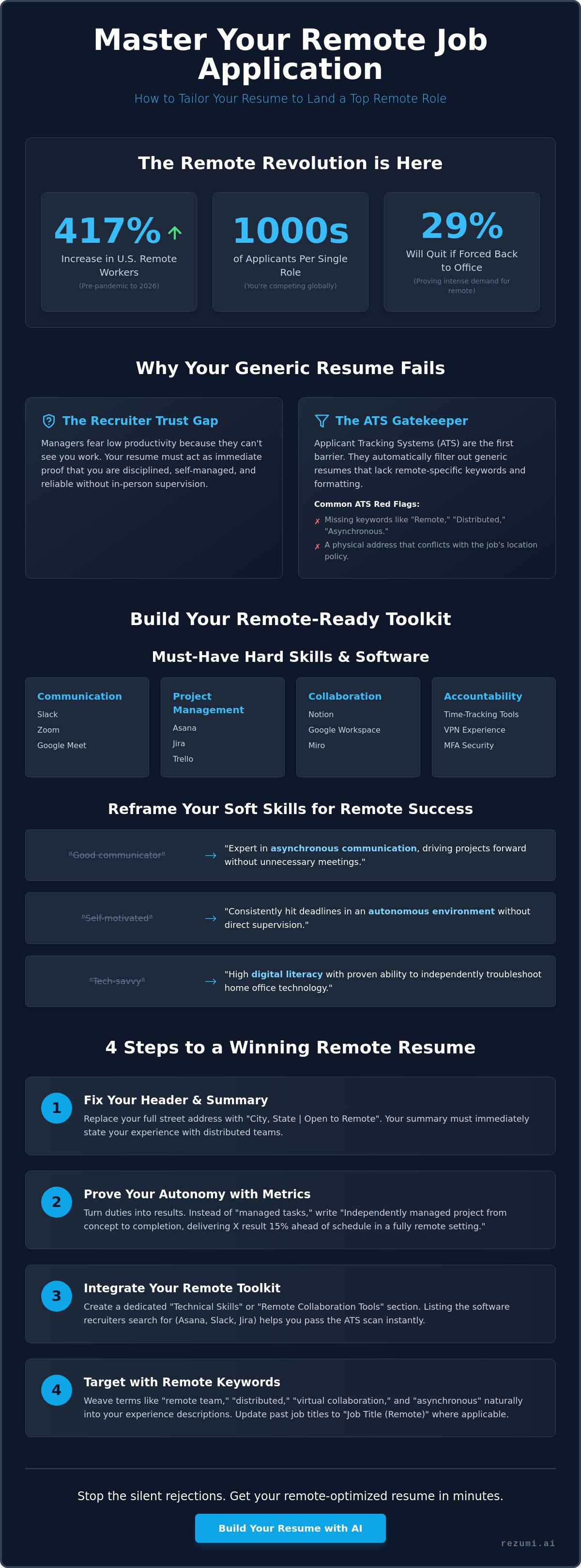
Twenty-nine percent of employees would rather quit their jobs than return to an office. This is the 2026 reality. You are competing against thousands of global applicants for every remote opening. You need to know how to tailor resume for remote job to stand out. Right now, you send applications and hear nothing. An automated wall is blocking your path. The system values data over experience.
You can stop the silent rejections today. We will show you the exact steps to score high on applicant tracking systems. You will learn the technical tools to list and the ways to prove productivity without an office. We are breaking down the resume maker features that land interviews with top US and Canadian employers. This guide moves you to the shortlist fast. You will get a clear roadmap to optimize your profile and win back control.
Key Takeaways
- Prove you can work without a boss watching. Learn how to highlight self-management to build immediate trust with remote hiring managers.
- Master the remote toolkit. We list the specific communication and project management software you must include to look like a remote pro.
- Discover how to tailor resume for remote job using real-time ATS scoring. This step ensures your application survives the initial automated scan.
- Fix your header and summary. Small changes to your location and bio can stop recruiters from rejecting you based on where you live.
- Use AI-powered suggestions to bridge the gap. See how to turn your old office tasks into evidence of remote success.
Why remote resume tailoring is a requirement in 2026
Your resume is no longer just a list of past duties; it's a proof of concept for your home office. In 2026, the U.S. is projected to have 36.2 million remote workers, a 417 percent increase from pre-pandemic levels according to Achievers.com. This growth means you are competing with thousands of applicants across North America for a single role. Learning how to tailor resume for remote job applications is the only way to bypass this massive competition and prove you can function without a manager looking over your shoulder.
Generic resumes fail because they assume an office provides the structure for your work. Remote hiring managers prioritize trust and self-management above all else. If your resume doesn't explicitly mention your ability to hit deadlines in a distributed environment, you represent a risk. Tailoring your resume proves you understand the digital-first culture where results matter more than hours spent at a desk.
The remote recruiter trust gap
Recruiters face a major challenge: they can't physically see if you are working. This creates a trust gap. Managers fear low productivity or poor communication in a work-from-home setting. A tailored resume acts as your first proof of professional autonomy. You must show, not just tell, that you are disciplined. According to a 2026 SurveyMonkey study, 29 percent of employees would leave their jobs if forced back to an office. This high demand for remote roles means recruiters use resume quality as a primary filter for maturity and reliability.
How ATS filters handle remote job applications
Automated systems are now the primary gatekeepers for remote-first companies. These Applicant Tracking Systems (ATS) scan for location-agnostic keywords that many candidates forget. If you don't include terms like "Remote," "Distributed," or "Asynchronous," the system may ignore your application. It's vital to update your job titles to reflect your work style. For example, writing "Senior Analyst (Remote)" instead of just "Senior Analyst" helps the software categorize you correctly.
Standard resume formats often get filtered out for location reasons. If the ATS sees a physical address in New York for a company based in Toronto, it might flag you as a relocation risk. You need to signal your remote availability clearly in your header. This tells the system you have the infrastructure and legal right to work from your current location without the company needing to rent office space for you. Using ATS resume optimization tools ensures these technical details are handled before you hit submit.
The remote toolkit: Essential skills for your resume
Your remote toolkit must show you are ready to work on day one without training on basic software. Remote hiring managers look for candidates who already know the digital stack. In 2026, 77 percent of remote workers report being as productive or more productive than when they were in the office according to Achievers.com. To join them, your resume must act as technical proof of your efficiency. Knowing how to tailor resume for remote job roles starts with your technical stack.
Technical proficiency in asynchronous communication tools is now non-negotiable. This means you can move projects forward using written messages without needing a live meeting. You should also highlight project management software experience. Listing tools like Jira, Asana, or Trello proves you have the organizational skills to manage tasks independently. If you are unsure which tools to prioritize, you can optimize your skill section using our data-backed templates.
Hard skills for a distributed workforce
You must list specific video conferencing and collaboration platforms to be taken seriously. Include Zoom and Google Meet, but also mention Miro for brainstorming or Slack for daily updates. Mastery of cloud-based documentation like Notion or Google Workspace is also mandatory. It shows you can collaborate in real time on shared files. Finally, mention experience with time-tracking or self-reporting software. This signals that you take full accountability for your output and hours.
Framing soft skills for remote success
Soft skills need a remote-first upgrade to catch a recruiter's eye. Replace "good communicator" with "expert in asynchronous communication." This tells the manager you won't clog their calendar with unnecessary calls. Use "self-motivated" to describe how you hit deadlines without direct supervision. You can also highlight "digital literacy." In a remote setting, this means you can troubleshoot your own home office tech. You don't have an IT desk down the hall, so showing you can fix your own connection is a major plus.
Cybersecurity awareness is a final, critical requirement for 2026. Remote companies are frequent targets for data breaches. Mention your experience with VPNs, multi-factor authentication (MFA), and secure data handling. Proving you are security-conscious makes you a much safer hire for a distributed team. These details turn a generic application into a professional remote profile.
Top resume maker features for remote job seekers
Applying to remote roles manually takes too much time. You need speed to beat other applicants. A modern resume maker does the heavy lifting by providing real-time ATS scoring for specific job descriptions. Instead of guessing if your resume is good, you get a data-backed score. This tells you exactly how to tailor resume for remote job postings before you hit the submit button. It replaces uncertainty with a clear plan of action.
AI-driven keyword optimization
Hidden remote requirements are often buried in long job descriptions. AI scans these postings to find the exact phrases recruiters use as filters. You get instant feedback on which skills are missing. This is why checking your resume score is a vital step. If your score is low, the AI suggests keywords to bridge the gap between your office history and your remote future. You can fix these gaps in seconds rather than hours.
Formatting also plays a huge role in global hiring. If you are applying to a US-based company from Canada or Europe, you must have the right page size. Understanding how to tailor resume for remote job requirements is easier when the software handles the formatting for you. Look for tools that offer both US Letter and A4 options. This prevents layout errors when a recruiter prints your file. Additionally, the best platforms include an AI Cover Letter Generator. Remote-first companies value culture fit. A tailored letter that addresses their specific remote values helps you stand out from the crowd of generic templates.
Centralized workspace and application tracking
Managing dozens of remote applications is a full-time job. You need a centralized workspace to keep your files organized. A high-quality resume maker allows you to save different versions for different roles. You can iterate on your resume quickly based on the feedback you receive from hiring managers. If one version gets more interviews, you can double down on that strategy. Keeping a consistent design across your resume and cover letter builds a professional brand. It shows you are a serious candidate who pays attention to detail.
By using these automated features, you move from a reactive search to a strategic one. You stop wasting time on applications that will never be seen. Instead, you focus on high-scoring resumes that land you on the shortlist. This efficiency is what separates successful remote workers from those still waiting for a callback.
Four steps to tailor your resume for a remote role
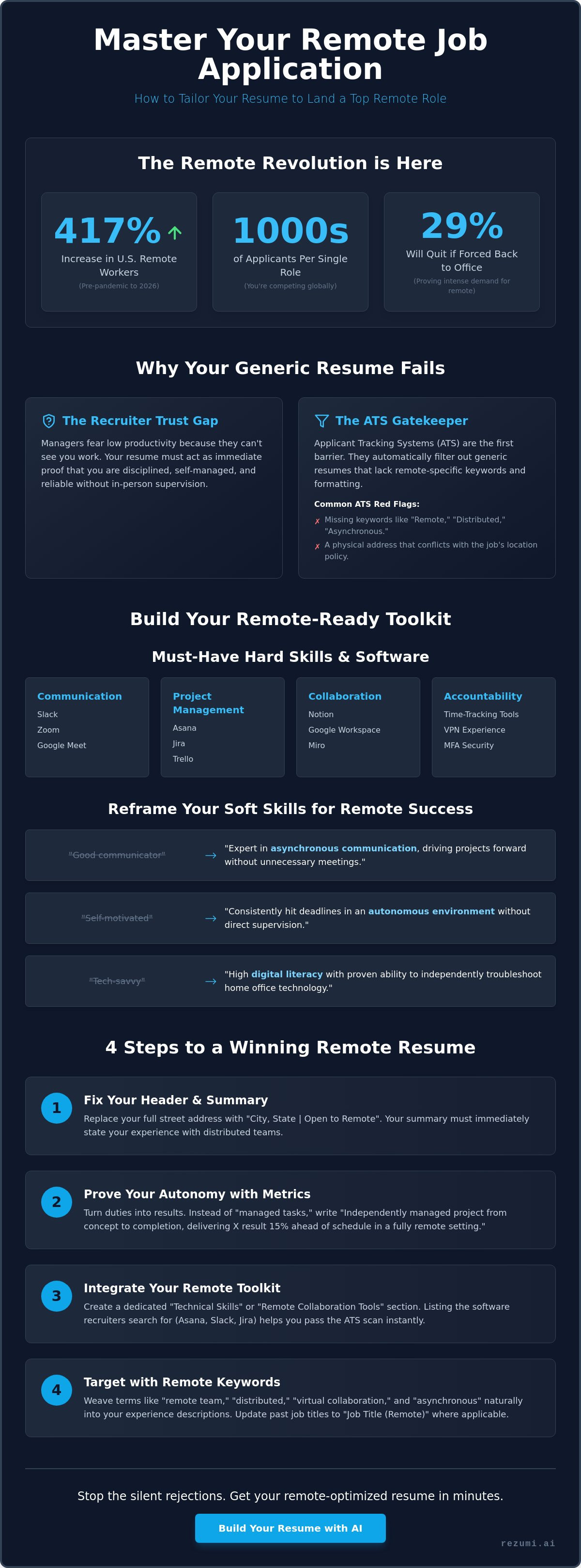
You need a systematic approach to beat the competition. Generic resumes get tossed because they don't answer the recruiter's biggest question: can you work alone? Knowing how to tailor resume for remote job applications means making four specific structural changes to your document. These steps move your resume from the "maybe" pile to the "must-interview" list.
Optimizing your header and summary
Start with your contact information. Signal your remote availability by using a format like "Remote / City, State" or "Work from Home / Country." This prevents the ATS from filtering you out based on a physical office location. Your professional summary is your elevator pitch. Write a summary that mentions your years of experience in distributed teams and your home office discipline. Use a clean, professional Harvard resume format to ensure your summary is the first thing a recruiter sees.
Reframing bullet points for remote impact
Standard bullet points describe tasks, but remote bullet points must describe output. Transform your past office-based duties into output-based achievements. For example, show how you "delivered 20% faster asynchronously" by using digital workflows instead of meetings. Show how you collaborated with team members across different time zones. This proves you can handle the logistical hurdles of a global company. You should also highlight your use of AI tools to increase your remote productivity.
Finally, audit your skills section. Prioritize digital collaboration tools over general skills. If you list "Communication," be specific and change it to "Expert in Slack and Microsoft Teams." This level of detail proves you don't need a week of training to get started. If you want to see these steps in action, you can access our ATS Resume Optimization to build a profile that hits every remote-first requirement.
By following these steps, you demonstrate that you are a low-risk, high-reward hire. You aren't just looking for a job; you are offering a proven remote workflow. This proactive approach is what gets you noticed by top-tier North American employers.
How Rezumi secures your remote career path
Rezumi is engineered for the 2026 job market. It removes the friction of manual editing and replaces it with a data-driven strategy. You get a system that understands the specific nuances of North American remote standards. Rezumi uses advanced AI to automate the process of how to tailor resume for remote job applications, ensuring your profile meets the strict expectations of recruiters from Toronto to New York. You stop guessing and start applying with confidence.
Our platform also includes an AI Cover Letter Generator that builds on your optimized resume. It targets remote-first values like trust, autonomy, and digital communication. This ensures your entire application package tells a consistent story of remote readiness. You can manage your entire job search from a single, high-performance workspace. This centralized approach keeps your different resume versions organized and ready for instant submission.
Beyond the resume: AI interview prep
Video calls are the new boardroom, but they come with unique challenges. You must master remote body language and technical setup to win the job. Our AI interview assistants help you practice in a simulated video environment. You will learn to maintain eye contact with the camera and manage your lighting for a professional look. This preparation is vital for the 2026 market where first impressions happen through a screen.
The system also helps you practice behavioral questions specifically for remote management. You will get real-time feedback on your tone and clarity. This coaching ensures you can explain your self-discipline and problem-solving skills without stumbling. It turns the anxiety of a high-stakes video call into a structured path toward a job offer.
Getting started with Rezumi
You can stop wasting hours on manual edits today. Our platform shows you exactly how to tailor resume for remote job descriptions by matching your skills to the specific software used by global teams. You can create a remote-optimized profile in minutes rather than days. This efficiency allows you to apply for more roles with higher quality than your competition. It is the fastest way to move from searching for work to signing a contract.
Sign up now to start your first remote-optimized workspace. You can check out our flexible pricing plans to find the right level of support for your career goals. Whether you are a new graduate or a senior professional, Rezumi provides the tools you need to win in a distributed workforce. Take control of your career and start seeing the interview invites you deserve.
Secure your remote future today
You now have the blueprint to bridge the trust gap with North American recruiters. You know that listing the right technical stack and proving your autonomy are the only ways to survive the 2026 job market. Learning how to tailor resume for remote job roles is no longer a suggestion; it's a survival skill. It doesn't matter if you're a new graduate or a senior lead; the right strategy gets you noticed.
Rezumi provides the edge you need to move from application to interview. Our system offers AI-powered ATS scoring that aligns your profile with strict North American remote standards. You can manage every version of your resume and track your applications in one high-performance workspace. This removes the guesswork and puts you in command of your professional journey.
Start optimizing your remote resume with Rezumi for free and see the difference a data-backed strategy makes. Your home office is ready. Your resume should be too. You have the skills to succeed in a distributed workforce, and we have the tools to help you prove it.
Frequently Asked Questions
Should I list my home address on a remote resume?
No, you shouldn't list your full street address on a remote resume. Most remote-first companies only need to know your city, state, or time zone for tax and legal compliance. Listing a full address can also create privacy risks. Simply use a header like "Remote / Seattle, WA" to signal your location while emphasizing your digital availability to North American employers.
How do I show remote work experience if I have never worked from home?
You can prove your remote readiness by highlighting times you worked without direct supervision. Mention projects where you collaborated with team members in different offices or used digital tools to hit deadlines. Even if you were in an office, using Slack, Zoom, or Trello shows you have the technical foundation needed for a distributed environment. Focus on results that you achieved through digital collaboration rather than physical presence.
What are the best keywords to use for a remote job resume?
The best keywords focus on output and digital tools. Use phrases like "asynchronous communication," "distributed team collaboration," and "self-managed workflows." Including specific software like Microsoft Teams, Asana, or Notion is also vital. Learning how to tailor resume for remote job filters depends on these technical terms. These keywords prove to the ATS that you have the specific vocabulary of a modern remote professional.
Can a resume maker really help me pass the ATS for remote roles?
A high-quality resume maker is essential because it provides instant ATS feedback. It scans your document against specific remote job descriptions to find missing keywords. This ensures your formatting is readable for automated systems. Tools that offer ATS resume optimization catch errors that a human eye might miss. This technology gives you a data-backed advantage over candidates using generic, unoptimized templates.
Do remote-first companies prefer a specific resume format?
Remote-first companies prefer clean, reverse-chronological formats that the ATS can easily parse. Avoid using tables, graphics, or complex columns that might scramble your data during the scan. A simple, one-column layout ensures your skills and experience are read correctly. This professional look also signals that you understand the efficient, digital-first culture common in remote tech and service sectors.
Is it necessary to write a cover letter for remote job applications?
Yes, a cover letter is a critical tool for remote roles because it acts as your first professional writing sample. It allows you to address the recruiter's concerns by explaining your home office setup and your history of discipline. Since remote work relies heavily on written communication, a well-crafted letter proves you can express complex ideas clearly. Use an AI generator to align your message with the company's specific remote values.
Disclaimer
This article is provided for general informational purposes only and does not constitute professional, legal, financial, or career advice. While Rezumi strives for accuracy, we make no warranties as to the completeness or reliability of this content. Hiring practices, ATS behavior, and job-market conditions vary by employer, industry, and region — always verify against your specific situation. Any action you take based on this article is at your own risk.