How to Tailor Your Resume to a Job Description for 2026
Learning how to tailor your resume to a job description makes you 6 times more likely to land an interview. Yet, most professionals spend hours manually editing only to face total silence from recruiters. You likely know the frustration of sending a resume into a digital black hole. It's a waste of your time and your talent. You need a faster way to stand out.
This guide teaches you a repeatable strategy to pass every automated filter with ease. You'll learn how to identify the keywords that actually matter and align your experience with what hiring managers need in 2026. We provide a clear framework to speed up your applications and increase your interview conversion rates. This approach replaces the anxiety of the job search with a structured, high-performance plan. Stop guessing and start using a data-backed method that puts you in control of your career path.
Key Takeaways
- Learn why generic resumes fail the six second scan and how to prove you can solve a company's specific problems immediately.
- Understand the mechanics of ATS scoring to ensure your application ranks at the top of the candidate database.
- Follow a clear, five step framework for how to tailor your resume to a job description by focusing on the top three requirements.
- Balance keyword optimization with natural language so your resume appeals to both algorithms and human hiring managers.
- Reduce application time from hours to minutes by using AI tools that automate the tailoring process while keeping you organized.
Why generic resumes fail the six second recruiter scan
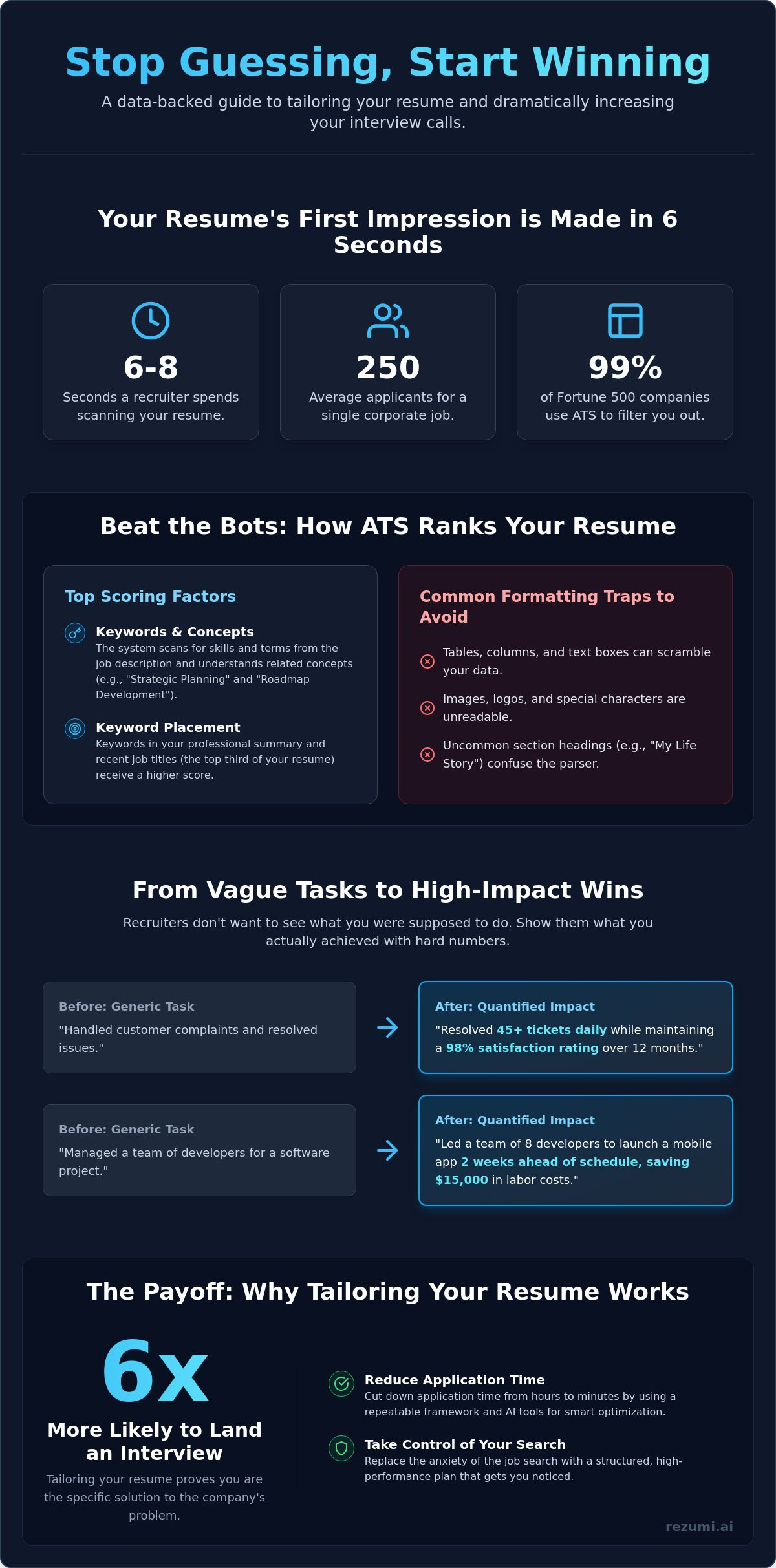
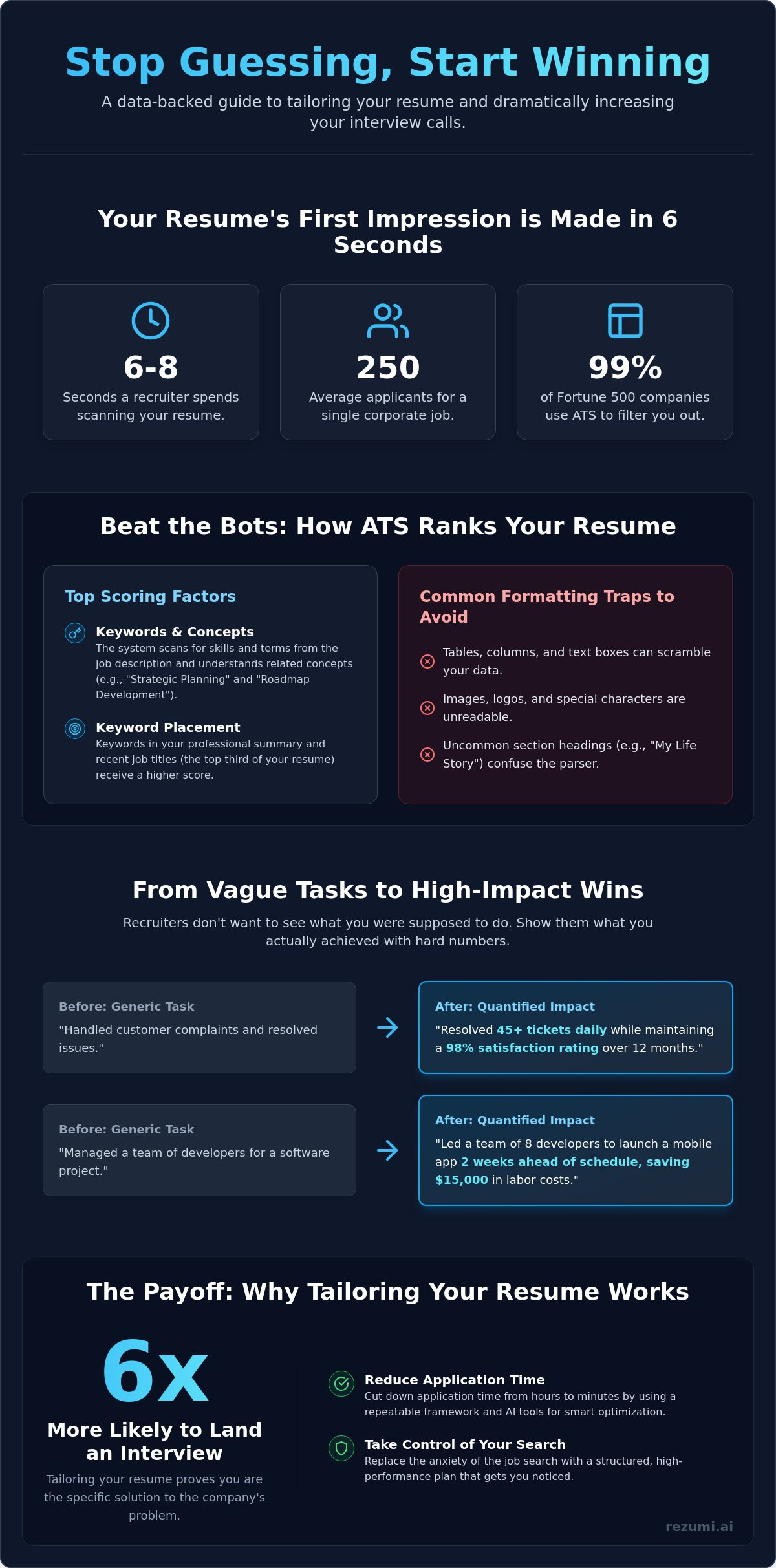
Recruiters don't read your resume. They scan it. Research shows they spend an average of 6 to 8 seconds deciding if you're a fit for the role. If they don't see an immediate match, they move on. They are looking for proof that you can handle the specific responsibilities of their open position right now. A generic resume fails because it forces the hiring manager to do the heavy lifting. They have to hunt through your history to find relevant skills. Most managers won't bother. They will simply move to the next candidate who made those connections obvious. You must understand how Applicant Tracking Systems work to ensure your most important data sits in the top third of the page. This prime real estate is where the human eye and the algorithm focus first.
The cost of the one-size-fits-all approach
Quantity is never a substitute for quality. Sending the same document to 100 different jobs usually results in a pile of rejections. In contrast, sending 10 highly focused applications can yield multiple interviews. Generic resumes lack the specific technical context required for senior North American roles. If you don't frame your experience correctly, you risk appearing overqualified or underqualified. An employer might see a broad list of skills and assume you're too expensive or lacking focus. Learning how to tailor your resume to a job description ensures your expertise matches the employer's expectations exactly. It shows you've done your homework and understand their unique pain points.
Moving from task lists to impact statements
Shift your focus from what you were supposed to do to what you actually achieved. Recruiters already know the basic duties of your job title. They want to see your impact. Replace vague task lists with statements that use hard numbers and percentages to provide scale. Use these examples to guide your edits:
- Before: Handled customer complaints and resolved issues.
- After: Resolved 45 tickets daily while maintaining a 98% satisfaction rating over 12 months.
- Before: Managed a team of developers for a software project.
- After: Led a team of 8 developers to launch a mobile app two weeks ahead of schedule, saving $15,000 in labor costs.
This provides the context managers need to trust your abilities. It proves you have solved the exact problems they are currently facing. When you learn how to tailor your resume to a job description, you choose the specific wins that mirror the requirements in the posting. This signals that you are a serious professional ready to deliver results from day one.
Understanding how ATS algorithms score your relevance
An Applicant Tracking System (ATS) isn't just a digital filing cabinet. It's a ranking engine. Nearly 99% of Fortune 500 companies use these platforms to screen the average of 250 resumes received per corporate job posting. The software scans your document and assigns a score based on how well your qualifications match the employer's criteria. To get noticed, you must tailor your resume to the position's requirements using precise language. Modern systems in 2026 use semantic analysis. This means they don't just look for exact words. They understand related professional concepts. If the job asks for "Strategic Planning," the ATS also looks for terms like "Roadmap Development" or "Forecasting."
How keyword frequency and placement affect your score
Placement matters as much as the words themselves. Algorithms often give higher weight to keywords found in the top third of your page. This includes your professional summary and your most recent work experience. Don't just list a skill once in a bulleted list. You need to mention it in your skills section and then prove it within your work history. This creates a logical connection for the system. Use a balanced mix of hard skills like software proficiency and soft skills like team leadership. Hiring managers are prioritizing collaboration more than ever. If you want to see how your current document ranks, you can check our ATS resume optimization plans for real-time feedback.
Common formatting traps that break ATS parsing
A resume that looks great to a human might be unreadable to a machine. Tables, text boxes, and images often confuse the parser. When the system can't read your data, it leaves fields blank or scrambles your history. This results in a low relevance score regardless of your talent. Stick to standard headings like "Professional Experience" and "Education." These are the labels the system recognizes to categorize your life. Learning how to tailor your resume to a job description starts with a clean structure. For more detail on this, read our guide on choosing the best resume format. Avoid using headers or footers for your contact information. Keep your most important details in the main body of the document to ensure the ATS captures every word correctly.
A five step framework for tailoring your resume
A systematic approach is the only way to beat the volume of competition in 2026. You don't need to rewrite your entire history for every application. Instead, you need a high-impact strategy to align your document with the employer's specific needs. Following a structured framework for how to tailor your resume to a job description saves you time and ensures your profile hits the right notes for both AI and human reviewers.
- Identify the top three requirements: Read the posting to find the non-negotiables. These are usually mentioned first or appear multiple times.
- Refine your professional summary: Update your first paragraph to include the exact job title and your most relevant achievement.
- Reorder your experience: Move the bullet points that match the job's daily tasks to the top of each work entry.
- Mirror technical language: If they ask for "Customer Relationship Management" instead of "CRM," use their exact phrasing.
- Verify the cultural tone: Ensure your language matches the company's vibe, whether it's a fast-moving startup or a traditional financial firm.
Analyzing the job description like a pro
Start by treating the job description as a cheat sheet. Look for keywords that repeat. If "Project Management" appears four times, it is a high-priority requirement. You should also distinguish between "must-have" qualifications and "nice-to-have" preferences. Focus 80% of your tailoring efforts on the must-haves. Finally, look for the pain points. Is the company struggling with growth, efficiency, or technical debt? Position yourself as the solution to that specific problem.
Mapping your skills to their requirements
Visualizing the match helps you write better content. Create a mental or physical table. Put their needs on the left and your matching wins on the right. This map tells you exactly which stories to tell in your work history. It also helps you decide if your current resume format is working for you. If you're changing industries, a functional layout might highlight your skills better than a chronological one. This level of detail is how to tailor your resume to a job description effectively without starting from scratch every time.
Optimizing for keywords without sacrificing readability
Your resume has two bosses. Algorithms first. Humans second. If you optimize only for the machine, your document becomes an unreadable list of terms. This is a common mistake that leads to instant rejection. If you write only for the human, you might never clear the initial digital gate. Learning how to tailor your resume to a job description requires a delicate balance between these two audiences. You must satisfy the software while remaining persuasive to a hiring manager.
Avoid keyword stuffing. It is a red flag. This is the practice of listing dozens of skills in a block of text without any context. Recruiters hate this. It looks unprofessional and suggests you are trying to game the system. Instead, weave your keywords into natural sentences that describe your career history. This proves you have the skills while keeping the document engaging for a person to read. Stick to North American standards for your layout. Use US Letter size (8.5 by 11 inches) and clean, modern typography. These fonts are easy for both humans and machines to process quickly.
Balancing hard and soft skills
Hard skills are technical abilities like Python, SQL, or Project Management. These are easy for an ats resume checker to identify and score. Soft skills are interpersonal traits like Team Building or Conflict Resolution. These are harder to quantify. Aim for a 70/30 split in your dedicated skills section. Put more weight on the technical requirements the job asks for. For your soft skills, don't just list them. Prove them by showing how they led to a specific result in your work history. This strategy is essential when you consider how to tailor your resume to a job description for competitive 2026 roles.
The importance of context in keyword usage
Context is what turns a keyword into a qualification. It proves you aren't just using buzzwords. Instead of just writing "Sales" as a bullet point, provide the full story. Write "Increased Sales by 20% through strategic territory management." This statement uses the keyword while proving your impact. Use high-impact verbs to start every sentence. Words like "Managed," "Developed," or "Executed" suggest movement and authority. They show you are a professional who takes action. If you want to ensure your keywords are perfectly placed for maximum impact, explore our resume optimization tools to get expert feedback on your draft. This data-driven approach removes the guesswork from your job search and helps you secure more interviews faster.
Automating the tailoring process with AI tools
Manual tailoring used to be a full-time job. You would spend three hours on a single application only to be rejected by an algorithm in seconds. In 2026, that approach is a liability. AI reduces the time spent on how to tailor your resume to a job description to under five minutes. This efficiency allows you to apply to more roles with higher accuracy than ever before. Rezumi provides a centralized workspace where you can track every version of your resume and see exactly how it matches specific requirements before you hit submit.
Hiring moves at a rapid pace. If you wait three days to perfect a document, the position might already be filled. AI tools act as a strategic partner by identifying the gaps in your experience that the human eye often misses. They ensure your document is perfectly aligned with the hidden mechanics of modern screening systems. By using technology to handle the repetitive work, you can focus your energy on preparing for the interviews you'll soon be securing.
Why AI is the strategic choice for 2026
Speed is a competitive advantage in the modern job market. Statistics show that more than 9 in 10 job seekers (92%) never complete their applications. This creates a massive opportunity for those who can move quickly. AI doesn't just match keywords. It analyzes the context of a job description to generate bullet points that prove you can solve an employer's specific problems. It ensures your resume stays ats-friendly regardless of the design choices you make. This removes the fear of your resume falling into a digital black hole.
Getting started with Rezumi
The process is simple and built for high performance. Start by uploading your base resume and the job description of the role you want. The system provides an instant analysis of your relevance score. You will see exactly which keywords you are missing and which achievements need more emphasis. Review the suggested edits to ensure they reflect your true professional experience. This keeps your document honest while making it highly persuasive to a recruiter. Once you are satisfied, you can export a polished, professional PDF. Check our pricing page for plans that fit your job search intensity. Taking control of your career path has never been more structured or rapid.
Command the 2026 job market
You now have a repeatable strategy to beat the algorithms and impress human recruiters. Success requires moving beyond generic templates to prove you can solve specific company problems. By mastering how to tailor your resume to a job description, you transform your application from a simple list of tasks into a high-impact business case. You have the tools to balance technical keywords with natural readability. Use automation to stay ahead of the competition.
Rezumi is built specifically for North American standards. Our platform provides real-time ATS scoring and feedback to ensure your document never hits a digital dead end. We even include AI-driven interview preparation to help you close the deal once you land the meeting. Stop wasting hours on manual edits and start seeing the callbacks you deserve. Your expertise is valuable. It's time to make sure hiring managers see it too.
Start tailoring your resume with Rezumi for free
Frequently Asked Questions
How much should I change my resume for each job?
Aim to adjust about 20% to 30% of your document for each application. Focus your energy on the professional summary, the skills list, and the top two bullet points of your most recent role. These are the areas recruiters and algorithms scan first. You don't need to rewrite your entire history. Just ensure the most visible parts of your resume speak directly to the specific requirements of the role.
Can I use the same resume for similar job titles?
You should avoid using the same document even for identical job titles at different companies. Every organization has unique goals and uses different keywords in their descriptions. One company might prioritize "Project Management" while another wants "Agile Delivery." Learning how to tailor your resume to a job description for every application ensures you match each employer's specific internal language and ranking criteria.
What happens if I do not have all the keywords in the job description?
Focus on your transferable skills and related professional concepts to bridge the gap. You don't need a 100% match to get an interview. If you lack a specific software skill, highlight a similar tool you've mastered to show you can learn quickly. Use semantic keywords like "CRM Management" if you haven't used the specific brand of software they list but have used a competitor's version.
Is it okay to use AI to write my resume bullet points?
Using AI is a smart way to save time as long as you verify every claim. AI tools help you rephrase your achievements to match the tone and keywords of a job posting. It acts as a sharp editor that ensures your language is impactful and data-driven. Always review the output to make sure it accurately reflects your actual experience. AI provides the draft, but your personal oversight provides the truth.
Should I include a skills section on my tailored resume?
A dedicated skills section is essential for passing modern ATS filters. It serves as a concentrated list of keywords that tells the system exactly what you can do. Group your skills into categories like "Technical Skills" and "Professional Competencies" to make them easy for a human recruiter to scan. Ensure at least 70% of these skills match the "must-have" requirements found in the job description.
How do I know if my resume is actually tailored enough?
Your resume is tailored enough when your professional summary and top experience entries mirror the job's primary goals. Look at the top three requirements in the posting. If a stranger can look at your resume and immediately guess which job you're applying for, you've done it right. You can also use an optimization tool to get a relevance score and aim for a high match rate before you submit.
Does tailoring my resume work for small companies without an ATS?
Tailoring is even more effective for small companies because a human will likely read every word. Smaller teams need people who can solve their specific problems immediately. Showing that you understand their unique challenges makes you stand out from a sea of generic applicants. It signals that you are genuinely interested in their mission and builds trust with the hiring manager before the first interview.
Should I tailor my resume for LinkedIn Easy Apply jobs?
You must tailor these applications because LinkedIn often uses its own internal filtering systems to rank candidates. If you use a generic profile, you may end up at the bottom of a very long list. Take the extra two minutes to upload a specific version of your resume. This simple step is a core part of how to tailor your resume to a job description and can significantly increase your response rate.
Disclaimer
This article is provided for general informational purposes only and does not constitute professional, legal, financial, or career advice. While Rezumi strives for accuracy, we make no warranties as to the completeness or reliability of this content. Hiring practices, ATS behavior, and job-market conditions vary by employer, industry, and region — always verify against your specific situation. Any action you take based on this article is at your own risk.