How to Tailor Your Resume to a Job Description for 2026
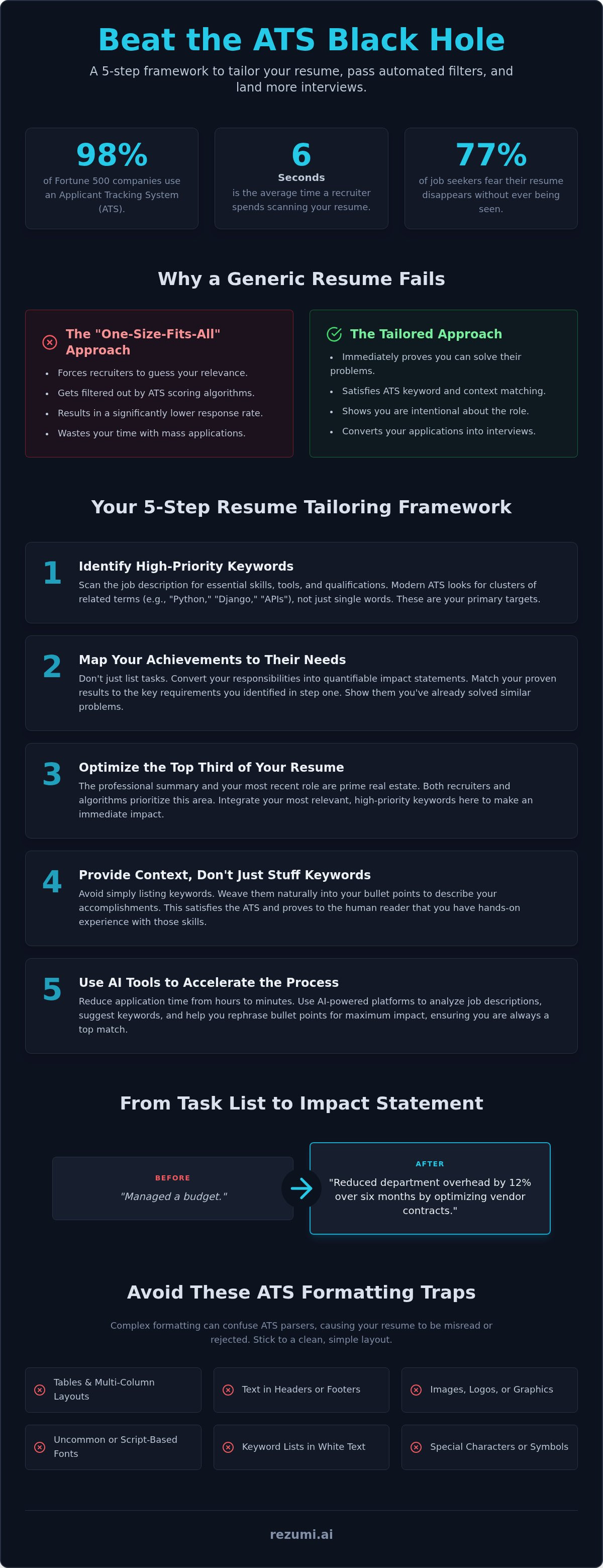
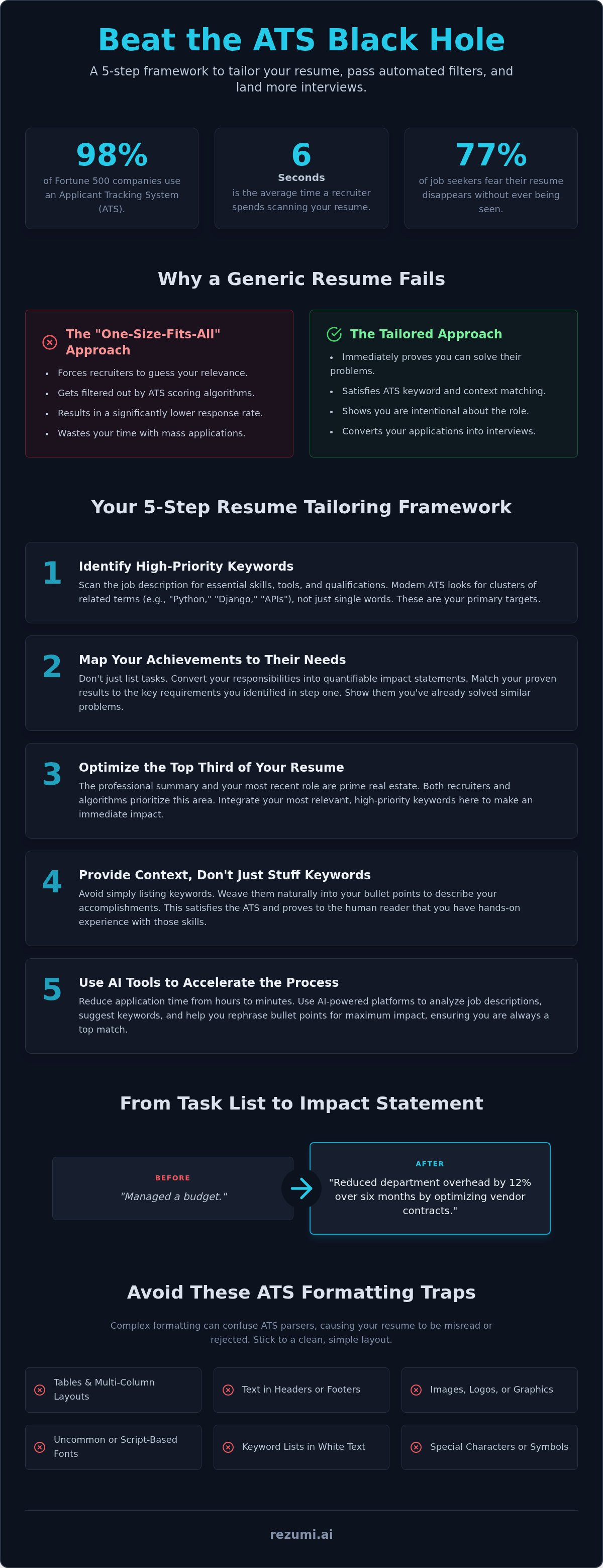
77 percent of job seekers fear their resume disappears into an ATS black hole. This concern is valid. In 2026, nearly 98 percent of Fortune 500 companies use an Applicant Tracking System like Greenhouse or Workday to filter candidates. If you don't know how to tailor your resume to a job description, your document may never reach a human recruiter. You likely feel the frustration of spending hours on manual edits only to receive zero callbacks. It's a waste of effort. High effort, low reward. The system is built to filter you out, not bring you in.
We agree that the traditional way of applying is broken. You shouldn't have to choose between quality and speed. You're about to learn a repeatable strategy to align your resume with job requirements so you pass automated filters and secure interviews. We'll break down how to identify high-priority keywords, map your achievements to structured hiring criteria, and use AI tools to speed up the process. This framework is designed to stop the guesswork. No more black holes. Just results.
Key Takeaways
- Recruiters spend only six seconds on your document, so you must prove you can solve their specific problems immediately to avoid being skipped.
- Master how to tailor your resume to a job description to satisfy ATS scoring algorithms while keeping your writing natural for human readers.
- Follow a five step framework to identify the top requirements of any job posting and align your professional summary for maximum impact.
- Avoid keyword stuffing by providing context for your skills, which ensures you pass automated filters and impress hiring managers.
- Reduce your application time from hours to minutes by using AI tools to automate the technical parts of resume optimization.
Why generic resumes fail the six second recruiter scan
Recruiters don't read your resume. They scan it. On average, a hiring manager spends exactly six seconds looking at your document before deciding to keep it or toss it. If you submit a generic file, you're forcing that recruiter to do the heavy lifting. You're asking them to guess how your past experiences solve their current problems. They won't. They'll just move to the next candidate who made the connection clear. High effort for them results in a quick rejection for you.
The top third of your page is prime real estate. This is where the decision happens. If key terms from the job posting aren't visible immediately, your application loses momentum. Learning how to tailor your resume to a job description ensures that your most relevant qualifications hit the recruiter right between the eyes. It signals that you aren't just looking for any job. You're looking for this job. That level of intentionality stands out in a sea of copy-paste applications.
Understanding how applicant tracking systems (ATS) work is only the first step. Even if you pass the computer, you still have to convince the human. A tailored document acts as a bridge between your history and the company's future. It replaces doubt with data. It replaces generic claims with specific proof.
The cost of the one size fits all approach
Efficiency is not about volume. It's about conversion. Sending the same resume to 100 different job postings is a strategy for failure. You'll likely see a much lower response rate than a candidate who sends 10 carefully optimized versions. In the North American market, specific context is everything. Without it, you risk appearing overqualified for mid-level roles or underqualified for senior positions. You must frame your experience to match the exact seniority and technical requirements listed. If you don't define your fit, the recruiter will define it for you, and they usually lean toward "no."
Moving from task lists to impact statements
Recruiters want to see what you achieved, not just what you were assigned. A task list is a set of instructions you followed. An impact statement is a record of the value you created. To master how to tailor your resume to a job description, you must translate your duties into wins. Use real numbers and percentages to provide a sense of scale. Instead of saying you "managed a budget," state that you "reduced department overhead by 12 percent over six months." This provides a concrete benchmark. It proves you can solve the specific problems mentioned in the new job description by showing how you solved them before.
Understanding how ATS algorithms score your relevance
An Applicant Tracking System (ATS) isn't just a digital filing cabinet. It's a sophisticated database that acts as a first-line judge. When you apply, the system scans your document and assigns a relevance score. This score determines whether a human recruiter ever sees your name. Scoring depends on how closely you tailor your resume to the position's requirements. If you don't know how to tailor your resume to a job description, the algorithm might miss the connection between your skills and the company's needs. It's a binary process. You either match the criteria or you don't.
Modern systems in 2026 are smarter than those from five years ago. Platforms like Greenhouse and Workday now use semantic search to find related professional concepts. They look for clusters of skills rather than just isolated words. If you're applying for a software role, the system expects to see specific languages alongside terms like "Agile" or "Version Control." Understanding how to tailor your resume to a job description requires you to speak both the language of the machine and the language of the industry. You need to provide the context that proves your expertise.
How keyword frequency and placement affect your score
Algorithms often prioritize keywords found in the top third of your page. This area includes your professional summary and your most recent role. Placement matters because the system assumes your most relevant skills are current. Don't just list a skill once in a sidebar. Mention your key competencies in your skills section and again within your work history. This repetition proves that you didn't just learn a tool; you applied it to achieve results. You can use our ATS resume optimization tool to see exactly how your keyword density stacks up against a specific job post. It provides the data you need to adjust your strategy before you hit submit.
Common formatting traps that break ATS parsing
The most common reason for a low score isn't a lack of talent. It's bad formatting. Many job seekers use tables, columns, or images to make their resume look modern. These elements often break the parsing process. When the system can't read your data, it leaves fields blank. This results in an automatic rejection. Stick to standard headings like "Professional Experience" and "Education." If you're unsure which layout to use, check our guide on choosing the best resume format to ensure your data remains readable. Standard fonts and clear hierarchies are your best friends when trying to beat the machine. Keep it simple so the technology can do its job.
A five step framework for tailoring your resume
You don't need to rewrite your entire career history for every application. You just need a system. A repeatable framework turns a two hour chore into a ten minute task. Research shows that 68 percent of job seekers spend less than 30 minutes tailoring their resume for each application. By following five logical steps, you can work faster and ensure your document hits the mark every time.
First, identify the top three requirements in the job description. These are usually mentioned in the first few bullets of the responsibilities section. If a company mentions "Project Management Professional (PMP)" and "Stakeholder Engagement," these are your priorities. Everything else is secondary. Focus your energy where it matters most.
Second, adjust your professional summary. This is your elevator pitch. If the job description asks for a "Senior Data Analyst," your summary should start with that exact title. Don't make the recruiter guess your level. Tell them exactly who you are and how you fit their specific goals from the very first sentence.
Third, reorder your bullet points. Most people list their duties chronologically. Instead, move the achievements that most closely match the job requirements to the top of each role. If the new job is 80 percent sales and 20 percent administration, your sales wins should come first in every section. This captures attention immediately.
Fourth, mirror the exact language used for technical skills and certifications. If the job description lists "SQL" and "Tableau," don't write "Database Management" and "Data Visualization." Use the specific terms they used. This is critical for how to tailor your resume to a job description so that ATS algorithms and structured hiring systems like Greenhouse recognize your expertise.
Finally, proofread to ensure your tone matches the company culture. A tech startup might value "hustle" and "innovation," while a financial institution prefers "compliance" and "accuracy." Ensure your verbs and adjectives match the company's energy. This signals that you aren't just a worker; you're a cultural fit who understands their business environment.
Analyzing the job description like a pro
Analyzing a job description is about finding patterns. Look for words that appear multiple times. High frequency usually indicates high priority. You must also separate "must-have" requirements from "nice-to-have" preferences. If you meet 70 percent of the "must-haves," you should apply. Focus your tailoring on solving the specific problems the company mentions, like "reducing customer churn" or "scaling operations." Identifying these pain points is the secret to how to tailor your resume to a job description effectively.
Mapping your skills to their requirements
Create a simple table to organize your thoughts before you start writing. Put their needs on the left side and your matching experience on the right. This visual map makes it easy to see where you need to strengthen your bullet points or add specific metrics. Use this data to write high-impact statements that prove your value. Ensure your resume format supports this high-impact information by keeping the layout clean and scannable. A clear map leads to a clear, persuasive document.
Optimizing for keywords without sacrificing readability
Your resume has a dual audience. You must satisfy the computer first to get through the door, but a human recruiter is the one who ultimately hires you. If you focus only on the machine, your document becomes a robotic list of terms that no person wants to read. Success comes from knowing how to tailor your resume to a job description while maintaining a natural, professional flow. You want to be seen as a person with a plan, not just a data point in a database.
Avoid the temptation of keyword stuffing. This is the practice of listing dozens of skills in a block of text without any context. Recruiters see this as a red flag. It suggests you are trying to game the system rather than proving your actual ability. Instead, weave your keywords into your achievement statements. Use clean typography and stick to North American standards like US Letter size (8.5 by 11 inches). This ensures your document looks as good on a screen as it does on a desk.
Balancing hard and soft skills
Hard skills are the technical tools of your trade, like Python, SQL, or Project Management. These are easy for an ats resume checker to identify and rank. Soft skills, such as leadership or team building, are more difficult to quantify. You must prove these through specific examples of results. Aim for a 70/30 split in your skills section. Devote 70 percent of the space to technical competencies and 30 percent to the interpersonal strengths that make you a great colleague.
The importance of context in keyword usage
Context turns a buzzword into a proof point. Instead of simply writing "Sales" as a skill, write "Increased Sales by 20 percent through strategic territory management." This shows the recruiter that you didn't just perform a task; you delivered a result. Use professional verbs like "Managed," "Developed," or "Executed" to start your sentences. This active language creates a sense of momentum. When you master how to tailor your resume to a job description with this level of detail, you move from being a candidate to being the solution to their problem.
Automating the tailoring process with AI tools
Manual tailoring is a relic of the past. In 2026, the volume of applications and the speed of hiring make manual editing a losing strategy. You can spend two hours on a single application or you can use technology to do the same work in two minutes. Knowing how to tailor your resume to a job description with AI gives you a massive competitive advantage. It allows you to apply to more roles without sacrificing the precision that recruiters demand. You gain speed without losing quality.
Rezumi provides a centralized workspace designed specifically for this high-stakes environment. You don't have to keep dozens of Word documents on your desktop. Instead, you manage every version of your application in one place. Our system generates specific bullet points that match the job description requirements perfectly. It analyzes the job description, identifies the core problems the employer wants to solve, and suggests achievement statements that prove you have the answer. You get real-time feedback on your resume score before you ever hit submit. This eliminates the anxiety of the black hole because you know exactly how the ATS will see you.
Why AI is the strategic choice for 2026
Hiring cycles are moving faster than ever. If you wait three days to perfect a manual resume, the position might already be in the interview phase. AI tools catch missing keywords that the human eye often overlooks during a late-night editing session. This ensures your resume remains ats-friendly regardless of the design you choose. It's about accuracy as much as speed. Research indicates that job seekers who tailor their document for each job get three times more interviews. You aren't just working faster; you're working smarter by using data to drive your strategy.
Getting started with Rezumi
Your journey begins with a single upload. Start by adding your base resume and the specific job description to the platform. The system provides an instant analysis of your current alignment. You'll see exactly where you match and where you fall short. Review the suggested edits to ensure they reflect your true experience. While the AI does the heavy lifting, your human oversight ensures the final product is authentic. Check our pricing page to find a plan that fits your job search intensity. Whether you're a new graduate or a senior professional, the right tools turn a daunting process into a streamlined path to your next role.
Command your career trajectory
You now have the framework to beat the machine. Mastering how to tailor your resume to a job description is no longer a guessing game. It's a precise, data-backed strategy. You understand that recruiters need immediate proof and that modern ATS platforms require semantic relevance. You're ready to move from uncertainty to total control.
Rezumi is built specifically for the North American market to give you a strategic advantage. You get real-time ATS scoring and feedback to ensure your document is ready for human eyes. We even include AI-driven interview preparation to help you close the deal once you secure the meeting. Speed and accuracy are now on your side.
Stop letting your potential get lost in a digital database. You have the tools and the knowledge to stand out in a crowded market. Take the first step toward your next interview today.
Frequently Asked Questions
How much should I change my resume for each job?
You don't need a total overhaul for every application. Aim to modify about 20 to 30 percent of your document. Focus your energy on the professional summary and the first few bullet points of your most recent role. These areas are the first things a recruiter sees during their six second scan. Adjusting these high impact sections ensures you meet the core requirements without wasting hours of your time.
Can I use the same resume for similar job titles?
No, because every company has different priorities and internal goals. Even if the titles are identical, one company might value "Revenue Growth" while another focuses on "Process Automation." Each job description uses unique keywords that the ATS uses to rank your relevance. If you use a generic document, you miss the chance to align with the specific language of that unique employer.
What happens if I do not have all the keywords in the job description?
You don't need a 100 percent match to secure an interview. Focus on the high priority keywords that appear multiple times in the posting. If you meet 70 to 80 percent of the requirements, you're a strong candidate. Don't lie about skills you lack. Instead, highlight transferable experience that proves you can learn new tools quickly. Recruiters value honesty and a proven track record of adaptability.
Is it okay to use AI to write my resume bullet points?
Yes, using AI is a strategic move to stay competitive in 2026. It helps you generate impactful statements that match North American hiring standards. However, you must review every suggestion to ensure it accurately reflects your real achievements. Always include specific numbers or percentages to prove your impact. AI provides the structure, but your personal experience provides the substance that wins the job.
Should I include a skills section on my tailored resume?
Yes, a dedicated skills section is essential for both ATS scanning and human readability. It provides a clear list of technical competencies for the system to index. When you learn how to tailor your resume to a job description, you should update this list to match the employer's specific software and certification needs. Use a mix of hard and soft skills to provide a complete picture of your professional profile.
How do I know if my resume is actually tailored enough?
Use an optimization tool to get an objective score before you apply. If your document contains the top three requirements and uses the same terminology as the job post, you're on the right track. A well tailored resume should look like it was written specifically for that one company. If your summary feels like it could apply to five other businesses, you need to add more specific details.
Does tailoring my resume work for small companies without an ATS?
Yes, it is often even more effective for human readers at smaller firms. Hiring managers at small businesses look for immediate proof that you understand their specific challenges. Tailoring signals that you've done your research and are genuinely interested in their mission. It builds rapport and trust before the interview even begins. A personal touch goes a long way when a human is doing the screening.
Should I tailor my resume for LinkedIn Easy Apply jobs?
Absolutely. Easy Apply often leads to a massive volume of applicants, which makes it harder to stand out. Submitting a generic resume makes you invisible in a sea of hundreds of other candidates. Taking two minutes to how to tailor your resume to a job description before clicking apply gives you a massive edge. It ensures your profile catches the recruiter's eye when they sort through the high volume of applications.
Disclaimer
This article is provided for general informational purposes only and does not constitute professional, legal, financial, or career advice. While Rezumi strives for accuracy, we make no warranties as to the completeness or reliability of this content. Hiring practices, ATS behavior, and job-market conditions vary by employer, industry, and region — always verify against your specific situation. Any action you take based on this article is at your own risk.