How to Use a Resume Grader to Beat the ATS in 2026
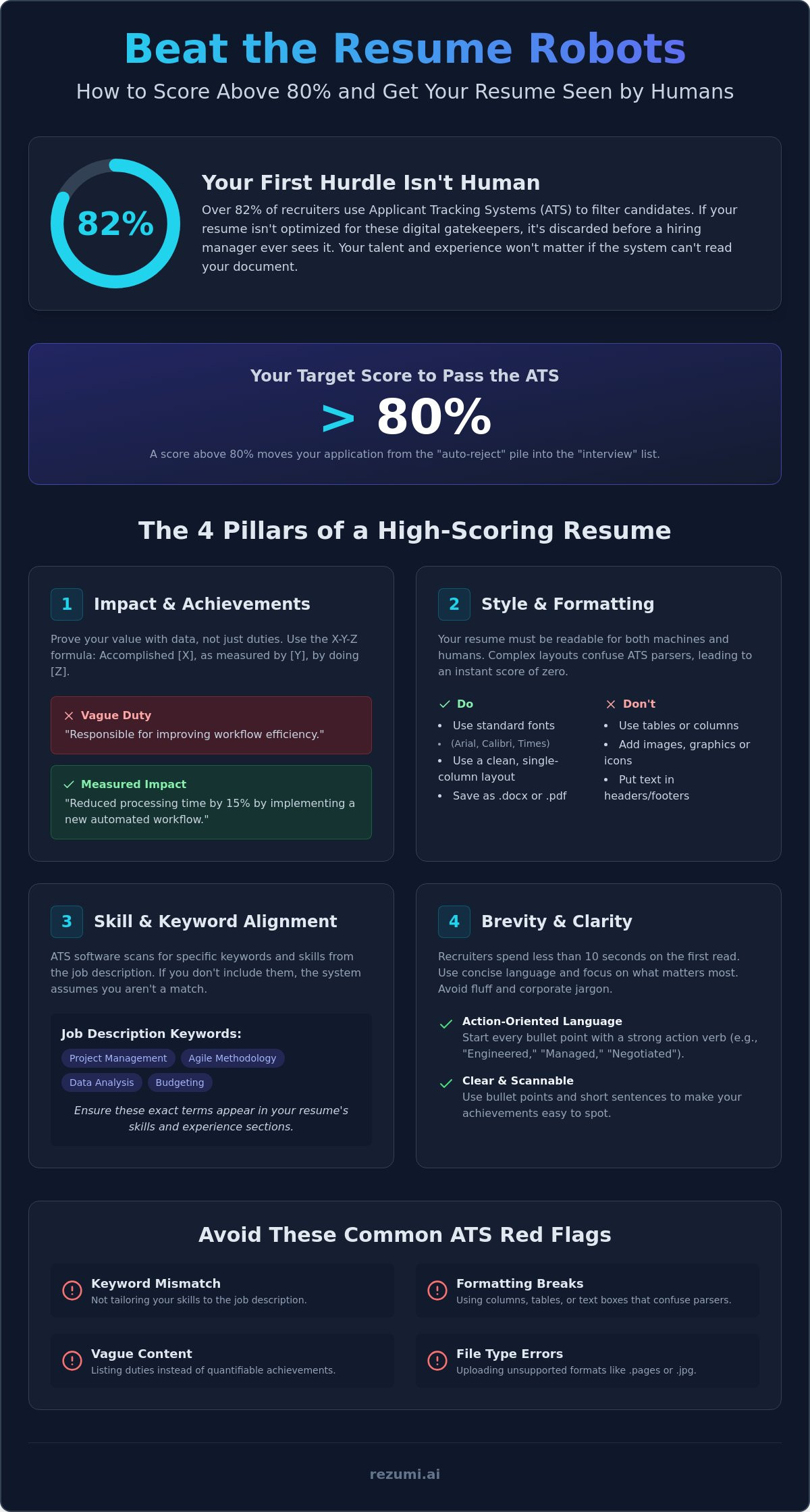
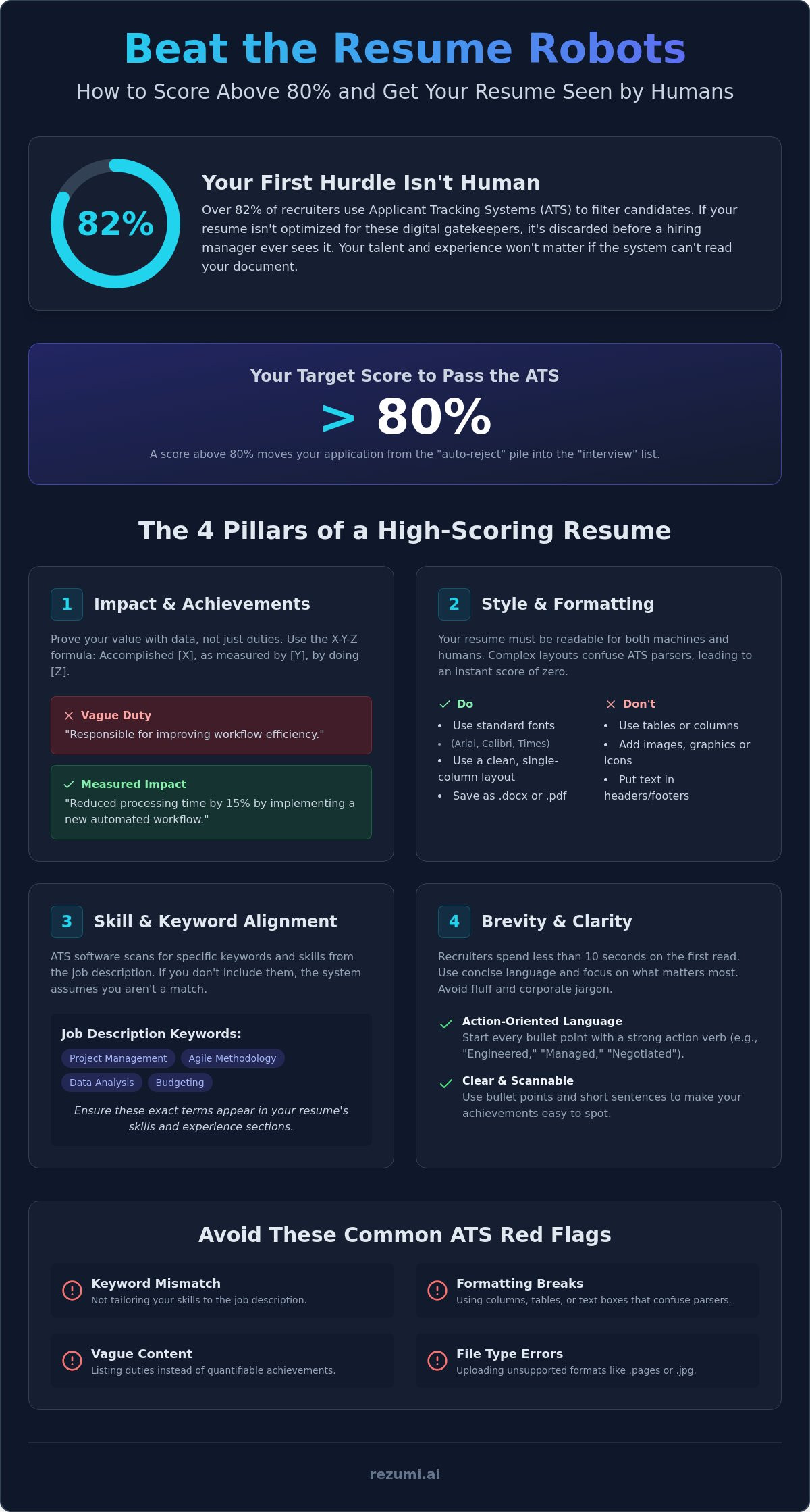
Over 82% of recruiters now use an Applicant Tracking System to screen candidates before a human ever sees a name. If your document isn't optimized for these digital gatekeepers, it's likely sitting in a digital trash can. Your talent doesn't matter if the system can't read it. Using a modern resume grader is the most effective way to see your profile through the eyes of an algorithm. You've likely felt the frustration of hitting apply dozens of times only to be met with silence. It is exhausting. You're left guessing what these technical systems want or why your experience isn't getting noticed.
You can take back control of your career path. This guide shows you how to use AI resume grading to identify exactly where your CV is failing for the North American market. We will walk through how to reach a score above 80. You'll learn to fix common formatting errors that break parsers. We'll ensure your experience aligns with what 2026 recruiters actually want. These steps will turn your current document into a high-performing asset that secures more callbacks.
Key Takeaways
- Learn how a resume grader mimics ATS software to identify the technical formatting errors that cause immediate rejection.
- Shift your focus from listing job duties to proving your impact with measurable data and concise language.
- Understand why generic free tools often provide misleading scores and how to use AI tuned for North American hiring norms.
- Follow a step-by-step process to compare your CV against specific job postings and close skills gaps instantly.
- Target a score above 80 to move your application past automated filters and into the hands of a hiring manager.
What Is a Resume Grader and Why Does Your Score Matter?
A resume grader is a diagnostic tool designed to audit your CV against the logic of automated hiring platforms. It functions as a simulation engine. It mimics how an Applicant Tracking System (ATS) processes your professional data. Instead of guessing if your layout works, you get a definitive score based on technical compatibility, keyword density, and formatting standards. It provides a clear view of how a machine sees your career history.
This score isn't just a vanity metric. It represents your visibility in a crowded market. In the North American job landscape, a high score acts as a green light. It tells the system to pass your application to a human recruiter. Low scores trigger automatic rejections before a person ever sees your name. Using a resume grader turns the hiring process from a game of luck into a data-backed strategy. You stop wondering why you aren't getting calls and start fixing the specific technical gaps that hold you back.
The Role of ATS in Modern Hiring
Most enterprise companies in the US and Canada utilize platforms like Workday or Taleo to manage high volumes of applicants. These systems act as the digital gatekeeper between you and the recruiter. They don't read your resume for "personality" or "style" in the traditional sense. Instead, they parse the text to find specific skills, job titles, and years of experience. If your document uses complex graphics, tables, or non-standard fonts, the system might see a blank page. You become invisible to the employer simply because of a software glitch. A grader identifies these parsing errors so you can fix them before you hit apply.
Why a Good Score Is Not Optional Anymore
Hiring is a high-speed environment. Recruiters often spend less than 10 seconds on their first manual review of a resume. However, they only see the resumes that the ATS ranks as high-quality matches. If your score is low, your application stays buried at the bottom of the pile. You must check resume for ats compatibility to ensure your credentials actually reach a real person. A professional grade helps you avoid common red flags such as:
- Keyword Mismatch: Missing the specific technical skills listed in the job description.
- Formatting Breaks: Using columns or headers that the software cannot read.
- Vague Content: Listing duties instead of measurable achievements.
- File Type Errors: Uploading formats that the system fails to process correctly.
Fixing these issues moves you from the "rejected" pile to the "interview" list. It shifts the power back into your hands. You gain the confidence that comes from knowing your resume is technically perfect and ready for the 2026 job market.
The 4 Pillars of a 2026 Resume Grade
A modern resume grader evaluates your document across four critical dimensions. It doesn't just look for keywords. It looks for structural logic and evidence of success. To pass advanced AI filters, your CV must excel in impact, brevity, style, and skill alignment. If you fail in even one of these areas, your application might never reach a human desk.
Quantifying Your Achievements for Impact
Impact is the most important metric for a high resume score. Vague descriptions like "hard worker" or "team player" carry zero weight with an AI. You must prove your value with hard data. Use the X-Y-Z formula to structure your bullet points. Accomplished [X] as measured by [Y] by doing [Z]. For example, instead of saying you "improved efficiency," state that you "reduced processing time by 15% through the implementation of a new automated workflow."
A sophisticated resume grader searches for percentages, dollar amounts, and specific timeframes. These numbers provide the context that machines and recruiters need to rank you above other candidates. Data from 2026 hiring reports shows that 79% of recruiters look at work experience first. They want to see what you achieved, not just what you were "responsible for." Avoid passive language. Start every bullet point with a high-impact action verb like "engineered," "coordinated," or "negotiated."
Mastering Style and Formatting
Your resume's visual design must be readable for both machines and humans. Modern filters are better at parsing text than previous versions, but complex layouts still cause failures. Stick to standard fonts such as Arial or Calibri. These fonts ensure that your text remains clear when the system converts your file into a plain-text string. If the software can't parse your font, your score drops to zero immediately.
Avoid using tables, columns, or images in your document. These elements often confuse the parsing engines used by many North American employers. If your contact information is trapped in a graphic, the system cannot contact you. You can review our detailed guide on resume format to ensure your layout meets current industry standards. A clean, single-column layout is the safest path to a high grade.
Brevity and skill alignment complete the pillars of a successful application. Keep your content focused on relevant experience from the last 10 years. Every sentence must serve a purpose. If a skill isn't mentioned in the job description, it likely doesn't belong on that specific version of your resume. Aligning your vocabulary with the employer's requirements is the fastest way to boost your score. If you want to see how these pillars affect your chances, you can explore our optimization plans to get detailed feedback on your current draft.
Why Free Resume Graders Often Give Misleading Scores
A high score on a basic resume grader often provides a false sense of security. Many free tools rely on legacy algorithms that simply count word frequency. This is not how modern hiring works. In 2026, an ATS does not just count words. It evaluates context, professional hierarchy, and semantic meaning. If your tool is only checking for keywords but missing the specific logic required for your industry, your score is effectively useless.
Some free services intentionally inflate scores to keep you feeling positive. You might receive an 85% on a generic scan, yet your application still disappears into a digital void. This happens because the tool is grading you against a generic template rather than the specific job you want. A score without a target job description is only half the picture. It tells you if your resume is readable, but it doesn't tell you if you are actually a match for the role.
The Problem with Generic Feedback
Context is the difference between a callback and a rejection. A resume optimized for a high-volume sales role requires different metrics than one for a senior software engineer. Free checkers often apply a "one size fits all" logic that ignores these industry nuances. They also frequently fail to detect complex formatting errors within PDF files. While you see a polished document, the legacy parser in a free tool might see a jumbled mess of text. You need a grader that understands North American hiring standards and modern file structures.
Intent-Based Matching vs. Keyword Stuffing
Modern Applicant Tracking Systems use Natural Language Processing (NLP) to understand the intent behind your writing. NLP is a type of AI that helps computers understand human language as it is naturally spoken or written. Simply repeating a keyword dozens of times will now hurt your ranking. These systems identify "keyword stuffing" and often flag those resumes as spam. You must focus on semantic relevance instead. This means using related terms and showing a logical progression of skills. Rezumi is specifically tuned to recognize these patterns. We ensure you pass advanced filters by focusing on the quality of your content rather than just the quantity of your keywords.
Step-by-Step: How to Improve Your Resume Grade for Specific Roles
To beat the ATS, you need a systematic approach. First, upload your current file to a professional resume grader to establish your baseline score. This initial number reveals exactly how much work is required to reach the top of the recruiter's pile. It identifies the technical blockers that are currently making you invisible to hiring managers in the US and Canada.
Once you have your baseline, paste the specific job description into the tool. This step is vital because it highlights the skill gap. A resume grader compares your text against the employer's requirements to find missing keywords and experience markers. You aren't just fixing a document; you are aligning your professional history with a specific business need.
Analyzing the Job Description Gap
Start by identifying the top five skills the employer mentions in the posting. If the job description asks for "Cross-Functional Leadership" and you only wrote "Led a team," the system will rank you lower. Check if these essential skills appear in your professional summary and your most recent work experience. You must use the exact terminology found in the posting. Modern systems look for these precise matches to verify your qualifications. If the employer uses a specific software name, ensure that exact name is on your list.
Fix your formatting errors before you worry about the wording of your bullet points. If the AI cannot read your contact information or employment dates, the rest of your content won't matter. Clear the style hurdles by removing columns, tables, or non-standard fonts that cause parsing failures. A clean layout ensures that every word you write is actually indexed by the system.
Iterative Optimization for Maximum Results
Optimization is an iterative process. This means you should make small, targeted changes and repeat the scan until you reach your goal. Do not try to rewrite your entire history in one sitting. Start with high-impact items like your job titles and the metrics in your most recent role. If your internal job title is "Client Happiness Lead," change it to "Account Manager" to match the industry standard used in the job posting. This simple change can significantly boost your relevance score.
Update your bullet points with the suggested keywords and metrics. Re-scan your document after every few changes to see how the score moves. You should aim for a grade of at least 80 to ensure you land in the top tier of candidates. To get the best results, you need a workspace that allows you to refine your CV as many times as necessary. You can find the right plan for your job search on our pricing page to start your optimization journey today.
Rezumi: The Next Generation of AI Resume Optimization
Rezumi is not just a standard resume grader. It is a centralized workspace built to handle the entire lifecycle of your job search. While other tools give you a score and leave you to fix the mess, we provide the technical infrastructure to build a winning application from scratch. Our AI is specifically tuned for the North American market. It understands the nuances of US and Canadian hiring norms that generic tools miss. You get the insider knowledge of a sharp career coach combined with the speed of advanced technology.
We adopt a solution-oriented approach to your career. You stop being a passive applicant and start becoming a strategic candidate. Our platform removes the anxiety of the unknown and replaces it with a clear, data-backed path to your next role. You are no longer fighting the system alone. You have a powerful ally that understands exactly what it takes to get noticed in 2026.
Beyond the Resume Score
A high score is the entry fee, but your strategy needs more than just a CV. We integrate your optimized resume with an AI Cover Letter Generator. This ensures your narrative remains consistent across all documents. If your resume highlights leadership, your cover letter will reinforce that theme automatically. This consistency builds trust with recruiters who look for red flags in mismatched profiles. You can manage every piece of your professional identity in one place.
You can also use our AI Interview Prep tool to practice for the specific role you just targeted. The system analyzes the job description to predict the questions you will face. Practice your responses until you feel as confident as a seasoned professional. You can even track your application status to see which versions of your resume perform best in the real world. This data helps you refine your approach for future opportunities.
- Generate tailored cover letters that match your optimized resume.
- Practice with an AI interview coach for real-world scenarios.
- Track your application progress in a centralized workspace.
Your Strategic Partner in the Job Search
We prioritize substance and accuracy. We don't rely on hype or empty promises. Our platform is built by professionals who have seen the flaws in traditional hiring methods. We designed a more sophisticated way forward. You aren't just using software. You are partnering with a visionary guide that understands the hidden mechanics of the ATS. We focus on the quality of your writing and the impact of your bullet points to ensure you impress human recruiters too.
Stop guessing if your resume looks professional. Join thousands of job seekers who have replaced anxiety with a data-backed strategy. You deserve a tool that respects your time and delivers tangible outcomes. You can explore our professional plans to access the full suite of optimization tools. Take control of your career path today. We are here to ensure your talent actually gets noticed.
Secure Your Next Interview with Data-Backed Confidence
Success in the 2026 job market requires technical precision. You now understand the mechanics of automated filters and how to align your professional history with employer intent. Moving from a generic document to a high-impact profile is the most direct path to a recruiter callback. Focus on measurable achievements and clean formatting to satisfy both the machine and the human reviewer.
Using a professional resume grader provides the strategic advantage you need to bypass digital gatekeepers. Establish your baseline score, fix formatting errors, and iterate until your document meets North American standards. This data-driven approach removes the anxiety of the job search and puts you back in control of your career path.
Rezumi serves as your strategic partner with real-time ATS feedback and a centralized workspace to manage your progress. Get your free resume score on Rezumi today and start applying with a document built for results. You have the skills. We provide the visibility you deserve.
Frequently Asked Questions
Is a resume grader really necessary for every application?
Yes, optimization is essential if you are applying to any medium or large company in North America. Most of these organizations use automated filters to rank candidates before a human recruiter ever sees a name. A resume grader ensures your document is technically compatible with these systems. It prevents your application from being discarded due to simple formatting errors or missing keywords.
Can a resume grader help me if I have a gap in my employment history?
A grader helps you identify how a gap affects your technical ranking. It suggests ways to emphasize your skills and projects to keep the algorithm focused on your value. You can use the tool to see if your timeline structure is causing parsing errors. This allows you to fix the layout so your experience remains the primary focus for the recruiter.
How much does it cost to get a professional resume score?
Most tools in the industry offer a basic score for free to help you establish a baseline. Professional plans usually require a subscription if you need detailed, line-by-line feedback and unlimited scans. These paid options are designed for serious job seekers who need to tailor their documents for multiple different roles. You should check individual platforms to see which features fit your current budget and search intensity.
What is a good resume score to aim for in 2026?
You should aim for a score of 80 or higher for every application. Reaching this threshold typically places you in the top tier of candidates for that specific job description. A score below 70 often indicates significant gaps in keyword alignment or formatting. Use a resume grader to iterate on your content until you reach the recommended range for your industry.
Will using an AI resume grader get me banned by recruiters?
No, recruiters do not ban candidates for optimizing their resumes. In fact, they prefer documents that are clear, well-structured, and relevant to the job. Optimization is about making your true qualifications visible to the system. It is a standard professional practice in the 2026 job market. It shows you understand how to communicate your value effectively in a digital environment.
How often should I update my resume through a grader?
You must update and scan your resume for every single job you apply for. Every job posting has a unique set of requirements and priority keywords. A document that scores 90 for one role might only score 60 for another. Constant tailoring ensures that your resume grader reflects your actual fit for each specific employer.
Does a resume grader work for creative or non-technical roles?
Creative roles still pass through an ATS when you apply to large corporations or agencies. A grader ensures your "creative" layout doesn't break the software's ability to read your text. It helps you balance a professional aesthetic with the technical requirements of the scanner. This ensures your portfolio link and experience are actually seen by the hiring team.
What happens if my resume score is high but I still do not get interviews?
A high score means your resume is technically perfect, but it might still lack human appeal. Check your bullet points to ensure they focus on measurable results rather than just job duties. If the machine likes you but humans don't, you need to improve the impact of your storytelling. Also, verify that your LinkedIn profile matches the data on your CV to avoid red flags.
Disclaimer
This article is provided for general informational purposes only and does not constitute professional, legal, financial, or career advice. While Rezumi strives for accuracy, we make no warranties as to the completeness or reliability of this content. Hiring practices, ATS behavior, and job-market conditions vary by employer, industry, and region — always verify against your specific situation. Any action you take based on this article is at your own risk.