How to Write a Resume Summary That Passes the 2026 ATS Test
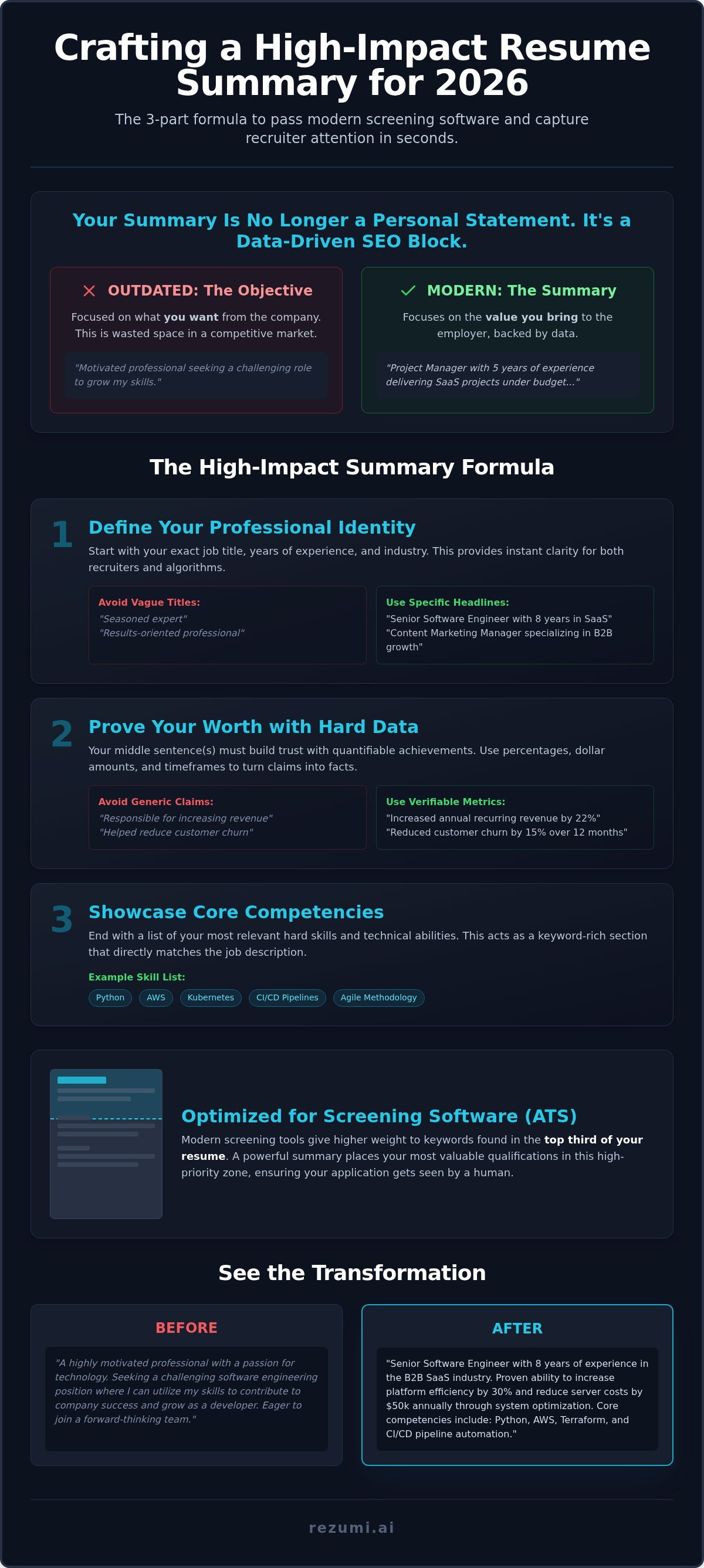
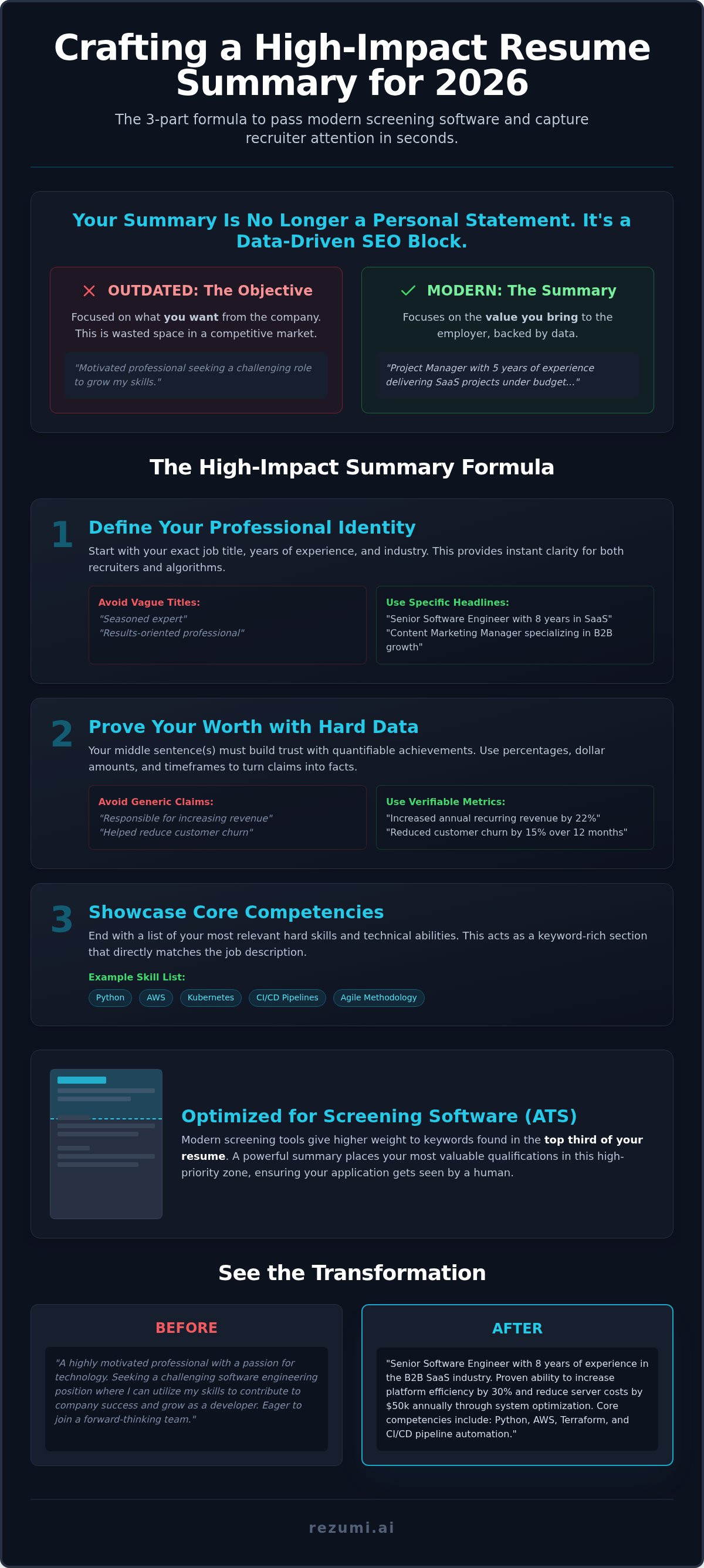
Your resume summary is no longer a personal statement. It's a data-driven search engine optimization (SEO) block for your career. Learning how to write a resume summary that aligns with 2026 technology is the difference between an interview and a silent rejection.
You've likely felt the frustration of condensing years of work into three short sentences. It's difficult to know which keywords to include or how to satisfy a computer algorithm without sounding like a robot. We understand that the modern job search feels like a system built to filter you out rather than bring you in. You need a way to prove your value to both machines and humans simultaneously.
This guide changes your strategy. You'll learn a specific three-part formula to create a summary that grabs recruiter attention and clears modern screening filters. We provide the exact steps to turn your professional history into a high-performance data block. By the end of this article, you'll have a finished summary that increases your ATS score and secures more interview invites. We'll start by breaking down what 2026 screening tools look for and then build your new summary together.
Key Takeaways
- Master a three-part formula that uses your professional title and hard numbers to prove your value to recruiters immediately.
- Learn how to write a resume summary that places high-priority keywords in the top third of the page where ATS software looks first.
- Transition from a vague personal statement to a data-backed career hook that satisfies both automated filters and human hiring managers.
- Use real-world examples and standard job titles to ensure your resume remains scannable and relevant in the 2026 hiring market.
- Tailor your summary for every job application in seconds to significantly increase your chances of securing an interview.
What is a resume summary and why is it mandatory in 2026?
A resume summary is your 30-second elevator pitch in written form. It is a three to five sentence paragraph positioned at the top of your document that highlights your most impressive achievements and technical skills. In 2026, this section is mandatory because it serves as the primary hook for both human recruiters and Applicant Tracking Systems (ATS). It acts as the executive summary of your professional value, giving readers a reason to keep looking at your application.
Modern screening software gives higher weight to terms found in the top third of your page. If you skip the summary, you miss the best opportunity to feed the algorithm the exact keywords it wants to see. It is effectively the meta description of your career. To make this section as effective as possible, you should always write it last. You cannot summarize a story you have not finished telling. Once your work history and skills sections are complete, you will have the data-backed proof points ready to pull into this high-impact paragraph.
The difference between a summary and a professional profile
Many job seekers confuse these two terms. A resume summary is built on past wins and quantifiable proof. It tells the employer exactly what you have done and what you are prepared to do for them on day one. This format is the standard for North American corporate and tech roles because it provides the structured data that modern hiring tools require to rank you against other candidates.
Professional profiles are generally broader and more descriptive. They are often used in creative fields like graphic design or high-level executive roles where leadership style matters as much as data. However, if you are applying for a role that uses automated screening, learning how to write a resume summary is the more strategic choice. It ensures your most relevant qualifications are impossible to miss.
Why Objectives are dead in the modern job market
The traditional Objective statement focused on what you wanted from the company. In a competitive market, this is wasted space. Recruiters already know your objective is to get the job. Understanding What is a Resume? helps clarify its purpose as a marketing tool, not a wish list. Every inch of real estate must be dedicated to the employer's needs.
By learning how to write a resume summary instead of an objective, you shift the focus from your personal goals to the specific value you bring to the organization. Algorithms do not care about your desire for growth or your passion for learning. They look for specific competencies and historical success. Replacing an objective with a summary ensures your resume starts with a punchy, results-oriented statement that justifies your candidacy immediately.
The three-part formula for a high-impact resume summary
Generic adjectives are the fastest way to get your resume ignored. Words like "motivated" or "hardworking" don't provide value to a recruiter. They are filler that takes up space without proving your worth. In 2026, you need a data-backed formula for a high-impact resume summary that anchors your candidacy in facts. This three-step process keeps your summary under 100 words. It ensures you fit the most important information on a single page while satisfying both human eyes and machine algorithms.
Step 1: The professional identity statement
Your first sentence is your brand headline. It must be specific. Do not call yourself a "seasoned expert" or an "experienced professional." That tells the recruiter nothing about your actual role. Instead, use your exact job title and niche. Write "Senior Software Engineer with 8 years in SaaS" or "Content Marketing Manager specializing in B2B growth." This provides instant clarity. It tells the reader exactly what box you fit into. By naming your industry immediately, you show you understand the specific challenges of that market. This sets the stage for the proof that follows.
Step 2: Proving your worth with hard data
The middle of your summary is where you build trust. You do this with numbers. AI screening tools are programmed to extract metrics. They look for percentages, dollar amounts, and timeframes. Human recruiters do the same. Use metrics like "Increased annual recurring revenue by 22 percent" or "Reduced customer churn by 15 percent over 12 months." If you managed a team, state the size. If you handled a budget, name the amount. Data is the universal language of high performance. It turns a vague claim into a verifiable fact. Numbers stand out and break up blocks of text, catching the eye during a quick scan.
Step 3: The keyword alignment sentence
The final sentence is for optimization. You must align your skills with the specific job description. Read the posting carefully. Identify the three most mentioned technical skills or requirements. Weave these into your final sentence. This ensures your resume format is tailored to the specific role. It shows the employer you aren't just sending a generic document. You are presenting yourself as the exact solution to their current problem. This is where you bridge the gap between your past success and their future needs.
Learning how to write a resume summary is about more than just listing facts. It is about strategic placement. If you need help identifying which keywords to prioritize for a specific application, you can optimize your resume summary with real-time feedback. This ensures you never miss a critical term that could trigger an ATS rejection. By following this formula, you turn the top of your resume into a high-performance data block that demands attention.
How to optimize your summary for ATS algorithms
Applicant Tracking Systems (ATS) don't read your resume like a human. They scan for data density. Modern algorithms prioritize the top third of your document. This is where your summary lives. If your summary lacks the right data points, the system may discard your application before a recruiter ever sees it. You must treat this section as an SEO field for your career.
Start by mirroring the job title exactly. If the posting asks for a "Senior Project Manager," use that specific string of words. Do not use creative titles that only make sense at your current company. Internal jargon like "Level 4 Growth Ninja" confuses the algorithm. Stick to industry standards. Use a clean, sans-serif font like Arial or Calibri. These fonts ensure the software parses every character correctly without errors.
Identifying the right keywords for your industry
You cannot guess which keywords matter. You need evidence. Analyze three similar job postings in your target industry. Look for recurring technical terms. If "Python" or "Project Management" appear in every ad, they belong in your summary. Focus heavily on these hard skills. While soft skills are valuable, algorithms prioritize measurable competencies. Learning how to write a resume summary means knowing which words carry the most weight.
Don't leave your success to chance. You can use an ats resume checker to verify your keyword density. This tool compares your summary against the job description in real time. It identifies missing terms that are critical for a high score. Aim for a natural integration of these words. Overstuffing can lead to a penalty, but omission leads to invisibility.
Avoiding the fluff trap that triggers filters
AI filters in 2026 are more sophisticated than ever. They are trained to ignore generic buzzwords. Phrases like "team player," "passionate professional," and "go-getter" are now recognized as fluff. They take up valuable space without providing a single data point. When you are figuring out how to write a resume summary, you must delete these empty qualifiers.
Replace fluff with high-impact action verbs. Instead of saying you are a "hard worker," say you "executed" a project. Instead of calling yourself "passionate about sales," say you "negotiated" contracts. Action verbs suggest movement and results. They turn a passive description into a list of achievements. This shift makes your resume more readable for humans and more searchable for machines. It ensures you pass the initial filter and reach a real person.
Resume summary examples for 2026 (Before and After)
Seeing the contrast between a generic statement and a data-backed summary helps you understand how to write a resume summary that actually converts. Most applicants use the summary to talk about what they want. You will use it to show what you have already achieved. These examples follow the three-part formula to meet specific North American hiring standards.
The Entry-Level Transformation
Before: Recent grad looking for a marketing role. Hard worker and fast learner.
After: Marketing Graduate with a 3.9 GPA and 6 months of internship experience managing social media for a 50,000 follower brand. Skilled in SEO and content strategy.
The "before" version is a classic objective. It focuses on your needs rather than the employer's problems. The "after" version provides concrete credentials and proof of reach. North American recruiters value specific internship outcomes over vague promises of being a fast learner. This version gives the ATS specific keywords like "SEO" and "content strategy" to index immediately. It proves you can handle real responsibility from day one.
The Mid-Career Shift
Before: Project manager with many years of experience in construction and tech.
After: PMP-certified Project Manager with 7 years of experience delivering 2 million dollar tech infrastructure projects 15 percent under budget. Expert in Agile and Scrum methodologies.
This "after" version uses high-impact verbs and fiscal data. It highlights a globally recognized certification and specific methodologies. This satisfies ATS filters looking for "PMP" and "Agile" while proving financial responsibility to human hiring managers. It tells a story of efficiency and reliability that a generic description cannot match. It shows you understand the technical and financial stakes of your role.
The Senior Executive in Finance
Before: Strategic leader in finance with experience in global markets and team management.
After: Senior Finance Director with 15 years of experience managing 400 million dollar portfolios for North American retail firms. Led three successful M&A integrations resulting in 12 million dollars in annual cost savings.
At the executive level, scale is the most important metric. This version uses specific portfolio sizes and quantifiable cost savings. It moves beyond "leading teams" to show the strategic impact of those leadership efforts. By mentioning "North American retail firms," the candidate establishes local market expertise that is critical for senior roles. Learning how to write a resume summary at this level requires a focus on high-level business outcomes and specific fiscal wins.
Using Rezumi AI to tailor your summary in seconds
Tailoring your summary for every job is the most effective way to get hired. A generic summary tells recruiters you are mass-applying. It signals a lack of intent. In 2026, you cannot afford to send the same document twice. Every job description has a unique set of prioritized keywords that the ATS is programmed to find. If your summary doesn't align with those specific terms, your application will stall.
Rezumi AI analyzes the job description and suggests the perfect keywords for your specific target role. Our platform ensures your summary follows all North American ATS rules, from character counts to keyword density. This isn't just about passing a filter. It's about presenting yourself as the exact solution to the employer's problem. By using technology to align your experience with their needs, you remove the guesswork from your application strategy.
Our platform provides a suite of tools to help you stay organized during a high-stakes job search:
- Real-time keyword analysis based on specific job descriptions.
- Compliance checks for US and Canadian ATS standards.
- A centralized workspace to track which summary versions get the most responses.
Automating the tailoring process
Stop spending hours rewriting your summary for every application. It's a manual task that drains your energy. You should focus on interview prep, not word processing. Technology has evolved to handle the technical SEO of your career. By automating this phase, you ensure consistency and accuracy across every submission you make.
Upload your base resume and let the ai resume builder do the heavy lifting. The system identifies the gap between your current summary and the job requirements. It then suggests specific edits to bridge that gap. You should always review and edit the AI suggestions to keep your personal voice intact. The AI provides the data-backed structure, but your unique professional perspective provides the final polish.
Ready to command the job market?
Your resume summary is the first step toward your next big role. It's the hook that keeps the reader on the page. Now that you know how to write a resume summary, you have a strategic advantage over candidates using outdated methods. You've moved from guessing to calculating. This transition from uncertainty to control is where your job search becomes successful.
Get a professional, data-backed summary that beats the bots and grabs human attention. A well-optimized summary is an investment in your future earnings. It's the difference between a resume that sits in a database and one that results in a phone call. View our pricing plans and start optimizing your resume today. You have the tools and the formula. It's time to put them to work.
Command Your Career in 2026
You now have the blueprint for a resume that demands attention. Mastering how to write a resume summary is the fastest way to turn a static document into a high-performance career tool. Use the three-part formula to move beyond generic adjectives. Provide the hard data that modern recruiters require. You aren't just listing duties. You are proving your worth.
Technology should work for you, not against you. Rezumi provides AI-driven keyword optimization and real-time resume scoring to ensure you never send a blind application. Our platform is specifically tailored for US and Canadian markets. It matches your skills to local hiring standards with precision. You've identified the flaws in traditional methods. Now it's time to use a more sophisticated way forward.
Your next interview invite is waiting. Take control of your professional narrative and let your results speak for themselves. You're ready to lead.
Frequently Asked Questions
How long should a resume summary be in 2026?
A resume summary should be three to five sentences or about 50 to 100 words. Recruiter scan times remain low, often under seven seconds, so your message must be immediate. This length provides enough space for the ATS to find keywords without overwhelming a human reader. Keep it punchy and focused on your most recent high-level wins.
Can I use bullet points in my resume summary?
Keep your summary as a short paragraph rather than using bullet points. Bullet points are better suited for your work history and skills sections where you list individual tasks. A paragraph allows you to create a cohesive narrative about your professional brand. It makes the top of your resume look distinct and professional before the reader gets into the technical lists below.
Do I need a resume summary if I have no experience?
You should still use a summary even without professional experience. Focus on your GPA, relevant certifications, and major academic projects. This shows the employer that you have the technical foundation required for the role. Mentioning your degree and specific skills helps you rank for keywords that would otherwise be missing from a blank work history section.
Is a resume summary the same as a cover letter intro?
A summary is a data-driven snapshot, while a cover letter intro is more personal. Your summary proves you are qualified through hard numbers and titles. The cover letter explains your motivation for joining a specific company. While both are hooks, the summary is designed for the ATS and quick scanning, whereas the cover letter is for the human hiring manager.
Should I use the first person (I, me) in my summary?
Avoid using "I" or "me" in your summary. Use the implied first person by starting with your job title or a strong action verb. Instead of writing "I managed a team," write "Managed a team of 10." This is the standard North American resume style. It sounds more professional and leaves more room for the data that actually gets you hired.
What are the best keywords to use in a resume summary?
The most effective keywords come directly from the job posting. Focus on hard skills like "Python," "Budget Management," or "Agile." When learning how to write a resume summary, you must identify the technical requirements the employer mentions most often. These specific terms are what the ATS uses to score your profile against other candidates in the pool.
How do I update my summary for a career change?
Highlight your transferable skills that bridge the gap between your old and new roles. If you are moving from retail management to corporate HR, emphasize your experience with conflict resolution and scheduling. Use numbers to prove your success in these areas. This tells the recruiter that your skills are valuable regardless of the industry or job title.
Does the ATS read the summary differently than the work history?
Many ATS algorithms give extra weight to keywords found in the summary section. The software assumes the most important information is at the top of the page. By including your core skills here, you ensure the system indexes your top qualifications immediately. This is a key part of how to write a resume summary that actually passes modern screening filters.
Disclaimer
This article is provided for general informational purposes only and does not constitute professional, legal, financial, or career advice. While Rezumi strives for accuracy, we make no warranties as to the completeness or reliability of this content. Hiring practices, ATS behavior, and job-market conditions vary by employer, industry, and region — always verify against your specific situation. Any action you take based on this article is at your own risk.