Journalism Resume Development: The 2026 Digital Strategy Guide
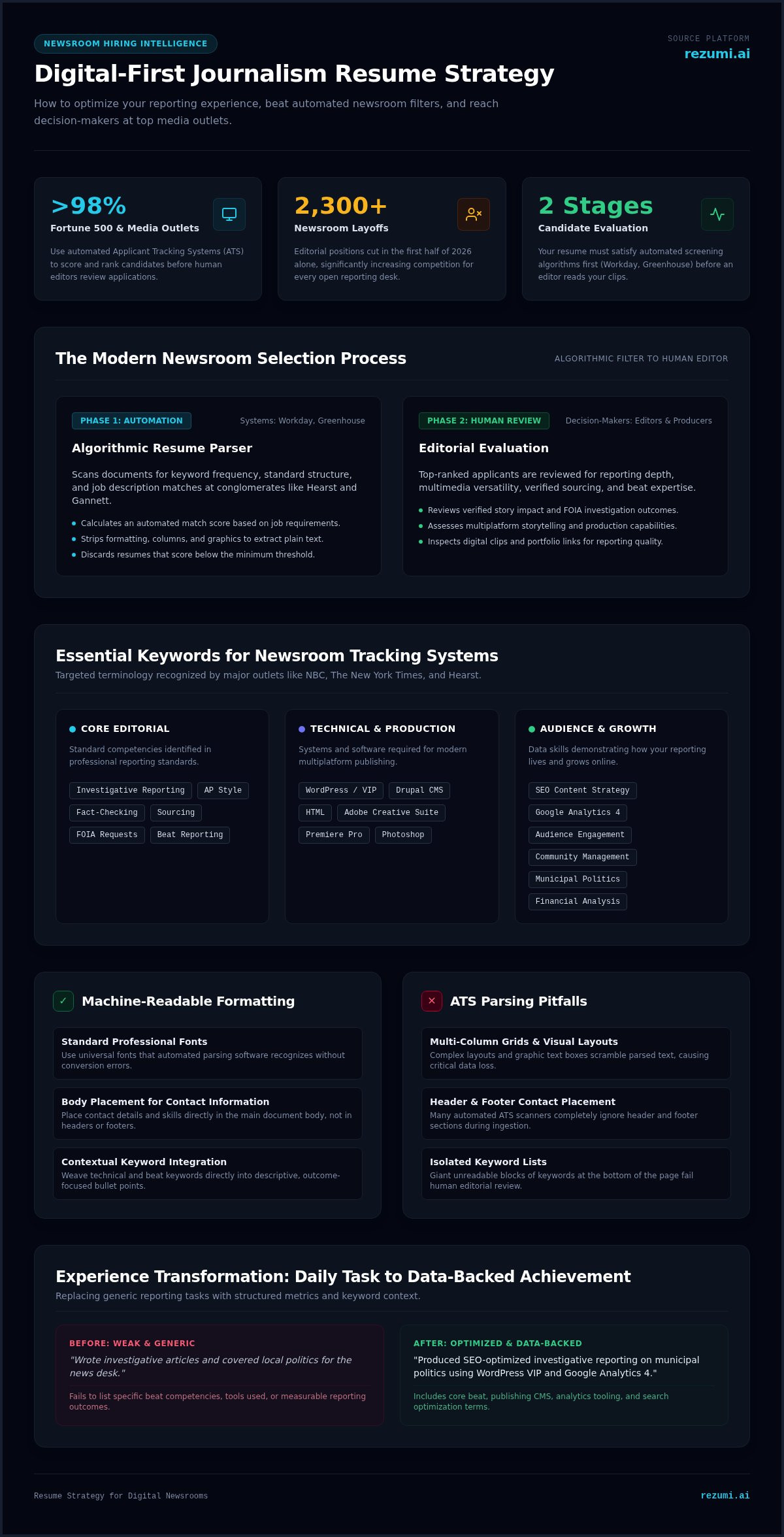
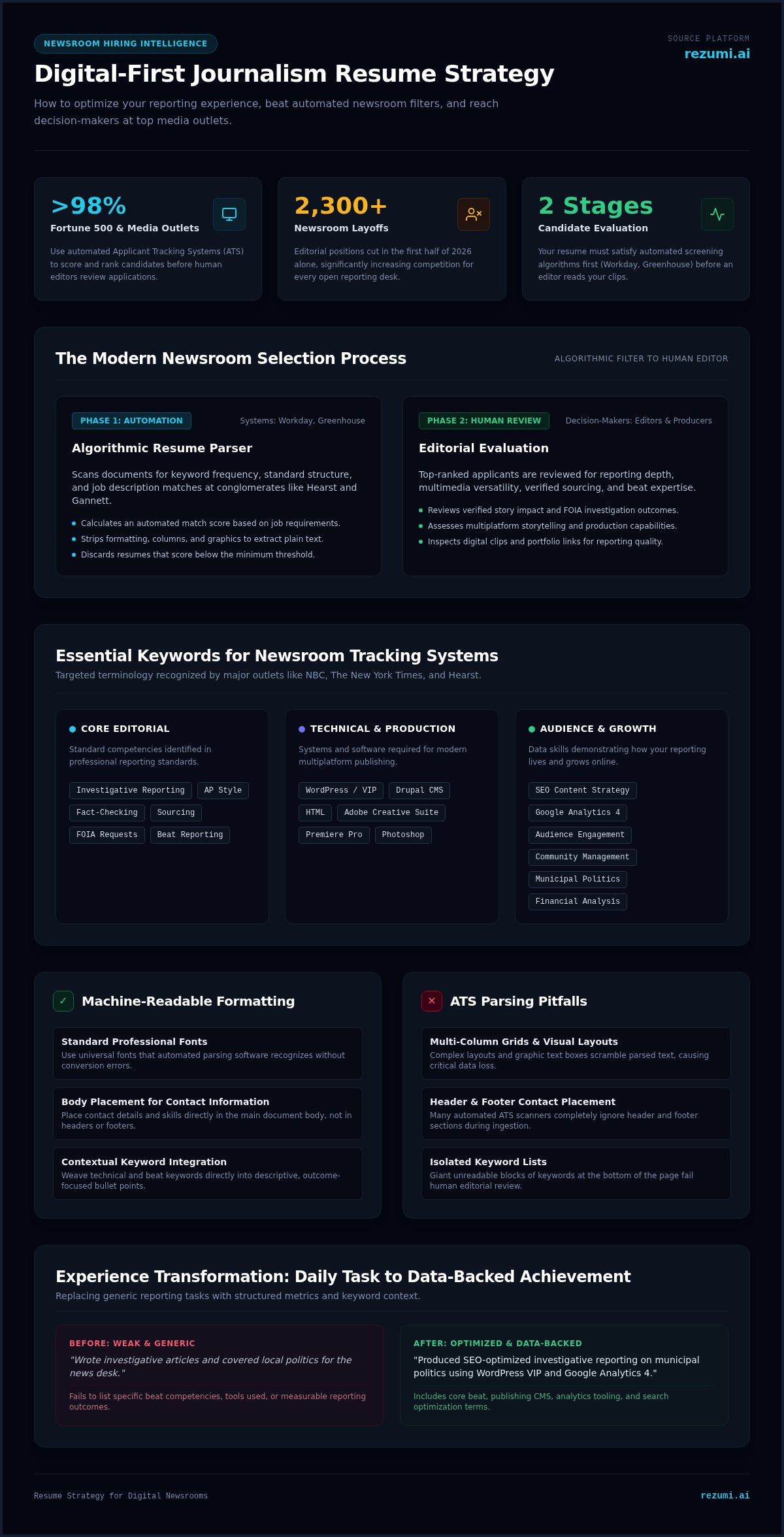
More than 98 percent of Fortune 500 companies and major media conglomerates use automated tracking systems to rank candidates before a human editor ever sees a name. You have spent years building a portfolio of hard hitting stories and investigative wins. It is exhausting to feel like those clips are being ignored by a machine. You know your value. Generic resume templates simply don't account for beat reporting, FOIA requests, or multimedia production.
You can stop the cycle of silence. This guide teaches you a modern strategy for journalism resume development that satisfies digital filters while keeping your professional voice intact. You will learn to place high impact keywords where they matter most and format your digital portfolio links so scanners don't scramble them. We will show you how to transform your daily assignments into data backed achievements that prove your impact to the world's top newsrooms.
Key Takeaways
- Understand how modern newsrooms use automated filters to rank candidates and how to ensure your resume survives the initial scan.
- Improve your journalism resume development by identifying and placing high-impact keywords that align with specific newsroom job descriptions.
- Replace vague descriptions with concrete data and measurable outcomes to prove the real-world impact of your investigative reporting.
- Format your digital portfolio and multimedia links correctly so they remain clickable and readable for automated parsers.
- Use AI tools to tailor your application for specific beats in minutes, helping you stand out as a specialist rather than a generalist.
Why Your Journalism Resume Needs a Digital Strategy
The 2026 media market is unforgiving. Editorial and newsroom layoffs hit over 2,300 positions in the first half of 2026 alone. Competition isn't just high; it is automated. You are no longer just competing with other reporters. You are competing with algorithms. Traditional journalism resume development used to focus entirely on the quality of your clips. Now, your writing skills mean nothing if your file is discarded before an editor even sees your name. You need a strategy that prioritizes digital visibility.
The Reality of Automated Newsroom Hiring
Major media conglomerates like Hearst and Gannett don't have time to manually sort every application. They use Applicant Tracking Systems (ATS) like Greenhouse or Workday to filter thousands of candidates. These systems assign a resume score based on how well your document matches the job description. If your score is too low, you are out. This makes understanding The High-Stakes Guide to ATS Resume Optimization essential for your survival in the hiring pool. You must treat your resume like a piece of SEO content. It needs to be searchable, scannable, and optimized for the technical requirements of the role.
Transitioning from Traditional to Digital-First CVs
The old school approach was simple: send a PDF with a beautiful layout and a list of links. That method is now a liability. Creative layouts with multi-column grids or embedded graphics often scramble the data for ATS parsers. As the evolution of digital journalism accelerates, newsrooms prioritize candidates who understand technical distribution. You need a machine-readable format that highlights your multimedia skills without breaking the software. Modern journalism resume development requires a shift from aesthetic design to strategic data placement.
- Use standard, professional fonts that machines can recognize easily.
- Avoid placing contact information or skills in headers or footers, as many systems ignore these areas.
- Prioritize plain text descriptions over complex charts or progress bars.
Your resume is the bridge to your portfolio. If the bridge is broken, your best work remains hidden. You must build a document that speaks to both the algorithm and the human editor. A digital-first strategy ensures your experience reaches the desk of a decision-maker instead of disappearing into a database.
Identifying High-Impact Journalism Keywords for ATS
Keywords are the currency of the modern job search. They act as the primary data points that Applicant Tracking Systems (ATS) use to rank your application. For successful journalism resume development, you must mirror the exact language used by hiring managers at outlets like NBC, the New York Times, or Hearst. If the job description asks for a "multiplatform storyteller," your resume should not just say "reporter." You need to use their specific terminology to prove you are the right fit.
Core Editorial and Reporting Keywords
Your resume must signal that you understand the fundamentals of the craft. Use terms like investigative reporting, AP Style, fact-checking, and sourcing. These are not just tasks; they are essential competencies according to the Bureau of Labor Statistics occupational guide for journalists. If you specialize in a specific beat, include terms like municipal politics, financial analysis, or court reporting. An algorithm doesn't feel your passion for a story. It only sees that you have used the term "investigative series" in your work history. Use these terms to demonstrate your expertise clearly and directly.
Technical and Multimedia Keywords
Modern digital newsrooms look for more than just a good writer. They want a producer who understands the technical side of the industry. You must include technical terms like CMS (WordPress or Drupal), SEO content strategy, and HTML. If you have experience with the Adobe Creative Suite, list specific programs like Premiere Pro or Photoshop. Don't forget audience metrics. Use terms like audience engagement, Google Analytics 4, and community management. These terms show you understand how a story lives and grows online. You can optimize your technical skill list to ensure these specific terms rank highly in recruiter searches.
Avoid listing these keywords in a giant, unreadable block at the bottom of the page. Instead, weave them into your bullet points. For example, instead of just saying you "wrote articles," say you "produced SEO-optimized investigative reporting using WordPress VIP." This demonstrates your expertise in context. It proves you can apply your technical skills to real-world reporting challenges. This approach satisfies both the machine and the human editor who eventually reads your file. By placing these terms naturally, you increase your visibility without sacrificing your professional voice.
Structuring Your Journalism Experience for Maximum Impact
Your resume structure is just as important as the stories you write. For effective journalism resume development, you should use the reverse-chronological resume format. This layout is the industry standard because it puts your most recent and relevant work at the top where recruiters and scanners look first. It provides a clear timeline of your career progression and prevents your most important achievements from being buried under older roles.
Quantifying Your Journalistic Success
Editors don't just want to know your beat. They want to know your impact. Instead of listing daily duties like "attended city council meetings," focus on the results of your reporting. You might say you "increased page views by 40% through SEO optimization" or "broke 5 local news stories that led to city council policy audits." Use real numbers to show the scale of your audience and the tangible reach of your work. An ATS-friendly journalism resume is a document that balances human readability with algorithmic optimization. This approach aligns with the Harvard Career Services resume writing guide, which emphasizes using strong action verbs and measurable results to prove your worth to a potential employer.
The Professional Summary vs. The Objective
Objectives are outdated in the 2026 job market. They tell the employer what you want, but the employer only cares about what you can do for them. Replace the objective with a high-impact professional summary. This three to four sentence paragraph acts as the lead for your professional story. Strategic journalism resume development requires you to highlight your unique value proposition immediately. Mention your primary beats, your technical proficiencies, and your most significant career win. This section should prove you are a specialist who understands the modern newsroom workflow.
Keep your contact information professional and accessible. Include a link to your LinkedIn profile and your professional digital portfolio. Ensure your email address is a simple variation of your name. If a recruiter can't find your contact details or your clips in five seconds, they will move on to the next candidate. Your resume is a tool for conversion. Every line must serve the goal of getting you an interview.
Integrating Multimedia Clips and Digital Portfolios
Your resume acts as the digital gateway to your body of work. In the 2026 market, editors expect to see your multimedia capabilities immediately. However, many applicant tracking systems fail to parse complex hyperlinks or embedded media. This means your best investigative clips might remain invisible if you don't format them correctly. Strategic journalism resume development ensures that your digital presence is both machine-readable and editor-ready.
How to Link Portfolios for ATS Compatibility
Digital scanners often struggle with "click here" buttons or hyperlinked text that hides a long URL. To ensure your portfolio is accessible, use a clean and direct format. Write out the URL in plain text using a standard font like Arial or Calibri. The best format is a simple label followed by the address, such as [Portfolio: yourname.com/clips]. This allows the software to recognize the link as data rather than an error. If a scanner cannot read the destination of a link, it may flag the document as incomplete or suspicious.
Avoid using QR codes or complex graphics in your contact section. While they look modern, most ATS software treats these as blank spaces or unreadable images. Stick to text-based links that are easy to copy and paste. If you use a portfolio hosting service like Muck Rack or Clippings.me, provide the direct shortened URL. This keeps your layout clean while guaranteeing that your work is only one click away for a human recruiter. This simple adjustment prevents your application from being trapped in the "black hole" of automated rejection.
Describing Multimedia Projects on Paper
You must describe your multimedia projects using high-impact, technical language. Don't just say you "made a video." Instead, focus on the production process and the tools you used. Use active verbs like produced, edited, or scripted. Mentioning specific software like Adobe Premiere Pro, Audition, or Final Cut Pro captures essential technical keywords. This proves you have the hands-on skills required for modern newsrooms. Editors want to see that you can manage a project from the initial pitch to the final digital export.
Cross-platform storytelling is now a standard requirement for digital roles. Show how you adapted a single story for multiple formats, such as a long-form print piece, a social video, and a podcast segment. This demonstrates versatility and an understanding of audience distribution. By integrating these skills into your work history, you show that you are more than just a writer. You are a complete digital producer. Mention specific audience metrics, such as video completion rates or podcast downloads, to prove that your multimedia work actually reached people.
Tailoring Your Resume for Specific Beats Using AI
Generic resumes are a fast track to rejection in a specialized media market. If you are applying for a financial beat, your resume shouldn't look like your application for a sports desk role. Strategic journalism resume development requires you to adapt your experience to the specific needs of each newsroom. AI tools allow you to perform this tailoring in minutes rather than hours, ensuring your professional summary aligns perfectly with the news organization’s mission. You can check your pricing options to access professional-grade optimization tools that handle this process for you.
Adapting to Different Newsroom Cultures
A legacy newspaper expects a tone of authority and deep institutional knowledge. A digital-first startup often values speed, audience interaction, and experimental storytelling. You must adjust your vocabulary to match these distinct cultures. Use an ai resume builder to scan a specific job post and identify the exact terms that matter to that editor. This technology highlights missing keywords and suggests adjustments to your tone, making your application feel like a natural fit for the team.
The Final Polish: Accuracy and Ethics
Accuracy is your most important trait as a journalist. A single typo or an incorrect date on your resume can ruin your credibility instantly. Editors view your resume as your first writing assignment. If you cannot fact-check your own career, they won't trust you to fact-check a news story. Double-check every claim, every metric, and every link before you hit send. If you claim a specific percentage increase in audience engagement, be ready to back it up with data during the interview.
Use this final checklist to ensure your resume is ready for the North American market:
- Verify all employment dates and job titles for absolute accuracy.
- Test every portfolio link on multiple devices to ensure they are clickable.
- Compare your skills list against the top five requirements in the job description.
- Ensure your contact information is current and professional.
- Confirm that your document is saved as a machine-readable PDF.
Your resume is a reflection of your professional standards. By combining AI-driven strategy with traditional journalistic rigor, you position yourself as a high-value candidate. This balanced approach proves you have the technical skills to pass the filters and the editorial integrity to lead a modern newsroom. Take the time to refine every detail, as the most polished applications are the ones that secure the interview.
Command the Modern Newsroom Search
You've spent your career telling stories that matter. Now, it's time to tell your own story in a way that modern newsroom technology understands. Your clips prove your talent, but your digital strategy determines if anyone ever sees them. Effective journalism resume development in 2026 requires a shift from simple assignment lists to data-driven outcomes and machine-readable formatting. You must prioritize algorithmic visibility to reach the desks of top editors at major media outlets.
Rezumi offers AI-powered ATS optimization specifically tailored for North American newsrooms. You can use our real-time resume scoring to see exactly how your experience ranks against the world's most competitive job descriptions. This data-backed approach replaces the anxiety of the application "black hole" with the confidence of a strategic partner. Stop wondering why your callbacks have stalled. Start using a high-performance tool built for serious results.
You have the skills to report the news. We have the tools to ensure you are the one making it. Your next big beat is waiting.
Frequently Asked Questions
How long should a journalism resume be in 2026?
Keep your resume to one page if you have less than 10 years of experience. Senior journalists with extensive investigative portfolios can extend to two pages. The priority is density of information. Every bullet point must justify its space by showing a result or a technical skill. If you aren't sure if a role fits, cut it to keep the document scannable for both humans and machines.
Should I include my social media handles on my resume?
Include your professional social media handles if they showcase your reporting or audience engagement. LinkedIn and X are standard for North American journalists. Ensure the handles are text-based rather than icons so ATS software can read them correctly. If your personal accounts aren't related to your beat, leave them off. High-quality social metrics can be a strong proof point for your digital distribution skills.
Do journalism resumes need a photo?
You should never include a photo on a resume for the North American market. It takes up valuable space and can trigger unconscious bias during the hiring process. Some Applicant Tracking Systems also struggle to parse documents with large image files. Stick to a clean, text-based layout that focuses on your skills and achievements. Let your professional portfolio or LinkedIn profile provide the visual representation of your work.
What is the best way to list freelance work on a journalism resume?
Group your freelance work under a single heading titled Freelance Journalist or Independent Contributor. List the most prestigious outlets you've written for and highlight your most impactful stories. Use the same metric-focused bullet points as a staff role. This approach shows a consistent career trajectory in journalism resume development rather than a series of disconnected gigs. It also makes it easier for recruiters to see your range across different publications.
How many clips should I reference in my resume?
Highlight three to five of your strongest clips that are most relevant to the beat you want. Don't try to list every story you've ever written. Your resume is a teaser for your full body of work. Include a clean, plain-text link to your digital portfolio where editors can explore your broader archive. Focus on stories that show your investigative depth or your ability to handle complex multimedia projects.
Can I use an AI tool to write my journalism resume?
You can use AI tools like Rezumi to optimize your resume for ATS and tailor it to specific job descriptions. These tools help you identify missing keywords and improve your resume score. However, you must verify every claim for accuracy. Journalism is built on truth, so ensure your AI-generated text accurately reflects your actual experience. Use the tool to refine your strategy while keeping your unique professional voice.
What are the most important technical skills for journalists today?
Modern newsrooms look for proficiency in SEO content strategy and Content Management Systems like WordPress. Data analysis skills, including Excel or SQL, are highly valued for investigative roles. You should also list multimedia tools like Adobe Premiere Pro for video or Audition for audio production. Understanding audience metrics through Google Analytics 4 is another essential skill. These technical proficiencies prove you can handle the full lifecycle of a digital story.
How do I handle a gap in my reporting history?
Address a reporting gap by focusing on what you did during that time. If you freelanced, took a certification course, or worked on a personal newsletter, list those as active professional projects. North American editors value transparency and continuous learning. You don't need to explain personal reasons in detail. Instead, show how you kept your skills sharp or how your experiences during the gap added to your perspective as a reporter.
Disclaimer
This article is provided for general informational purposes only and does not constitute professional, legal, financial, or career advice. While Rezumi strives for accuracy, we make no warranties as to the completeness or reliability of this content. Hiring practices, ATS behavior, and job-market conditions vary by employer, industry, and region — always verify against your specific situation. Any action you take based on this article is at your own risk.