Mastering the Harvard Resume Layout for the 2026 Job Market
In 2026, the most effective tool for your career growth is a plain, single-column text document. Many applicants believe a complex design makes them stand out. The reality is the opposite. With 88% of organizations now using AI automation in their hiring process, your professional resume layout must be clean to survive. You feel the sting of rejection when an automated system discards your application without a human review. It's a common frustration. It's also one you can solve today.
You need a framework that works as hard as you do. By adopting the Harvard resume layout, you will use a data-backed structure built to beat modern ATS algorithms and land high-stakes interviews. This layout is the industry gold standard because it values clarity over visual fluff. We will show you how to organize your achievements, select safe fonts like Georgia or Calibri, and use the single-column format to keep your data intact. You will gain the confidence to apply for competitive roles knowing your resume is ready for the 2026 market.
Key Takeaways
- Adopt a professional resume layout that uses a single-column, minimalist design to pass 2026 automated screening systems with ease.
- Discover why the Harvard framework remains the gold standard for high-stakes roles by prioritizing readability and a clear information hierarchy.
- Protect your application from parsing errors by keeping critical contact information out of document headers and avoiding complex tables or graphics.
- Identify the specific formatting adjustments needed to showcase your career progression, whether you are a new graduate or a mid-career professional.
- Optimize your writing with data-backed action verbs and automated formatting tools to ensure your resume meets North American hiring standards.
Why the Harvard Resume Layout Remains the Gold Standard
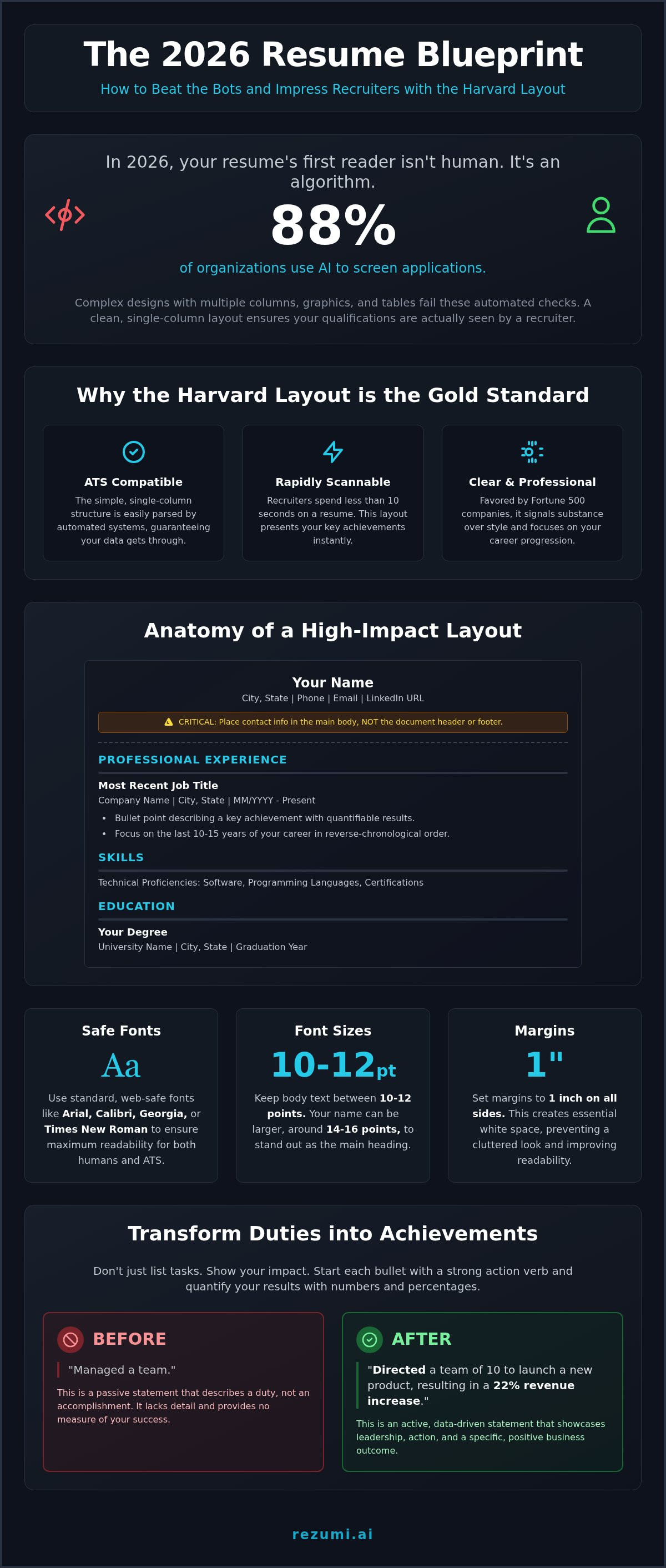
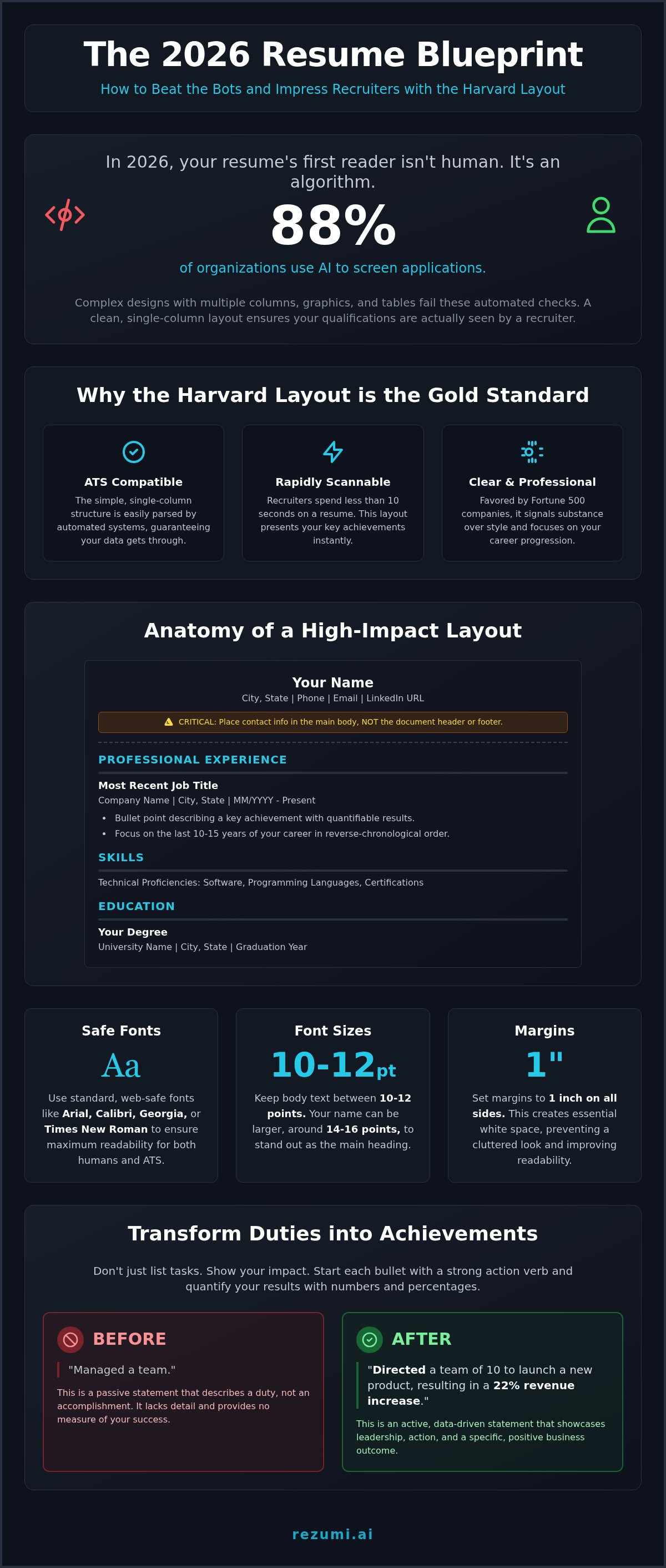
The Harvard resume layout isn't just a tradition for Ivy League students. It's a high-performance framework. Elite recruiters at Fortune 500 companies favor this style because it respects their time. When you use this professional resume layout, you provide a clear map of your career progression that a human can scan in under ten seconds. It relies on a reverse-chronological structure. This means your most recent wins come first. Understanding the history and evolution of the modern resume shows that while technology changes, the need for clarity remains constant. Executives use this framework because it signals authority and focuses on substance over style.
The Core Principles of the Harvard Style
Consistency is your foundation. You must use uniform margins, typically between 0.5 and 1 inch, and standard font sizes like 10 to 12 points for body text. This isn't about looking pretty. It's about engineering a document that guides the eye. You should focus on your results instead of just listing your daily duties. Use white space strategically to prevent reader fatigue. If your page is a wall of text, the hiring manager will skip over your best work. A balanced layout keeps them engaged with your accomplishments by creating a logical flow from your contact info to your education. This approach ensures that every line of text serves a specific purpose.
Why Simplicity Beats Flashy Design in 2026
Flashy designs are often a career trap. In 2026, 88% of organizations use AI automation in at least one business function, including recruitment. Complex graphics, icons, and multi-column layouts often scramble these systems. If the AI can't read your data, a human never will. A clean Harvard-style resume uses a single-column layout. This is the safest way to ensure your information parses correctly every time. Research shows that 64% of recruiters report seeing more look-alike applications because candidates use generic AI tools. You don't stand out with a neon border. You stand out with a professional resume layout that delivers clear, quantifiable data. North American hiring managers equate professionalism with directness. They don't want to hunt for your skills behind a colorful sidebar. They want to see your value immediately.
The Anatomy of a High-Impact Harvard Layout
A professional resume layout is more than a list of jobs. It is a strategic hierarchy. You must lead with your strongest assets to capture a recruiter's attention in those first six seconds. Every section must serve a purpose. If a line of text doesn't prove you can do the job, it doesn't belong on the page. You're building a document that balances human readability with machine precision.
Start with your contact information at the very top. Include your full name, a professional phone number, and a clean email address. You should also add your LinkedIn URL to show you're active in your industry. Avoid placing these details in the document header. Many ATS systems in 2026 still struggle to read text inside headers or footers, which could lead to your application being discarded.
Your professional experience is the core of your resume. Organize this section backward from your most recent role. For each position, include your job title, the company name, and your dates of employment. Focus on the last 10 to 15 years of your career. This chronological order demonstrates your growth and stability to hiring managers. Use a brief skills section to highlight technical proficiencies like software or certifications. You can also include a short interests section if it suggests high-performance traits, such as community leadership or competitive sports.
Formatting Rules You Must Follow
Precision is the difference between an interview and a rejection. Use a 10 to 12 point font for your body text. Your name should be larger, between 14 and 16 points, to ensure it stands out. Stick to standard, web-safe fonts like Arial, Calibri, or Times New Roman. These fonts are the safest choice for a professional resume layout because they're easy for AI to parse. Set your margins to 1 inch on all sides. This creates a balanced look that prevents your page from feeling cluttered or overwhelming to the reader.
Writing Effective Bullet Points
Your bullets are where you prove your value. Don't just list your daily tasks. Instead, tell the story of your wins. Start every bullet point with a strong action verb like Directed, Developed, or Generated. Use the STAR method (Situation, Task, Action, Result) to provide context. For example, instead of saying you "managed a team," say you "Directed a team of 10 to launch a new product, resulting in a 22% revenue increase." Include real numbers and percentages whenever possible. Quantifiable data is the only language every recruiter speaks. If you want to ensure your wording hits the mark, you can use ATS resume optimization tools to refine your bullets based on the job description.
Technical Optimization for 2026 ATS Systems
Technical compliance is the only way to reach a human recruiter. In 2026, 88% of organizations use AI to screen applicants. If your file is poorly structured, the system will reject you before a person even sees your name. You must treat your professional resume layout as a data source that needs to be perfectly indexed. This is not about aesthetics. It is about survival in a digital-first hiring market.
Stick to standard section titles. AI algorithms are trained on billions of documents, and they expect to see headers like Work Experience or Education. Using creative titles like My Career Journey or Where I've Been confuses the parser. This confusion leads to missing data in your candidate profile. You should also keep all critical information, like your phone number and email, out of the header and footer. Many systems still ignore these areas entirely, which can leave a recruiter with no way to contact you.
Your choice of file format determines your success. Save your resume as a .docx or PDF file. While .docx is the safest option for older tracking systems, a PDF preserves your professional resume layout across all devices. If a job posting specifically asks for one format, follow those instructions exactly. Precision here prevents your text from becoming a jumbled mess during the upload process.
Keyword Integration Without the Clutter
Context matters more than frequency in 2026. Modern ATS technology analyzes how you use keywords, not just how many times you repeat them. You should identify the top three technical skills in the job description and weave them into your bullet points naturally. Don't just list Project Management in a skills bank. Instead, describe how you managed a specific project to achieve a measurable result. You can check your progress by using Rezumi to get real-time feedback on your resume quality. This tool identifies missing industry terms so you can fix them before you hit submit.
The Role of AI in Resume Tailoring
A generic resume is a failed resume. Employers want to see that you understand their specific needs. You can use AI to analyze job descriptions and suggest phrasing that aligns with their requirements. This isn't about cheating. It's about translating your experience into the language the employer uses. You can learn more about ATS resume optimization to see how these systems rank candidates. By tailoring your Harvard template for every application, you prove you are the right fit for the role. This strategic approach turns your resume from a static list into a high-performance tool.
Tailoring the Harvard Template for Every Career Stage
Your resume must evolve as your career grows. A student needs a different professional resume layout than a Vice President. If you use a student template for a senior role, you signal a lack of executive presence. Conversely, a graduate who omits campus leadership misses the chance to prove potential. You must align your document with the expectations of your specific career stage to pass both AI and human filters.
Recent graduates should place the Education section at the top. This is your strongest asset. Include your GPA if it is 3.5 or higher, and list relevant coursework to show technical readiness. Mid-career professionals must flip this hierarchy. Move your education to the bottom and lead with your professional experience. Focus on your progression and specific projects that led to business growth. If you are a career changer, emphasize transferable skills and relevant certifications. You need to prove that your past wins are relevant to your new industry.
The Executive Harvard Resume
Conciseness is a sign of leadership. Limit your experience to the last 10 to 15 years to keep the document tight. Recruiters for senior roles don't need to see your entry-level history from two decades ago. Focus on high-level strategy and team management rather than daily tasks. You are being hired for your vision and ability to drive results. Choosing the best resume format depends on how clearly you can summarize years of leadership into a few high-impact pages.
Adapting for the North American Market
Cultural norms in the US and Canada are strict regarding personal data. Never include a photo, age, or marital status on your resume. These details can trigger legal bias concerns for employers and may lead to your application being discarded immediately. Ensure your professional resume layout uses US Letter paper size, which is 8.5 by 11 inches. If you submit an A4 document to a North American firm, it will not print or display correctly in their systems. Focus on achievements with real numbers rather than just listing your responsibilities. North American hiring managers want to see the value you added to your previous teams.
Building Your Professional Layout with Rezumi AI
Manual formatting is a risk you don't need to take. While static Word templates are common, they are often difficult to adjust without breaking the underlying structure. Rezumi automates the rigid requirements of the Harvard framework. This ensures your professional resume layout remains technically perfect every time you make a change. You can focus on your career narrative while the platform handles the technical precision required for 2026 hiring systems.
The platform does more than just align your text. It analyzes your work history and suggests the strongest action verbs for your bullets. You will receive a real-time resume score that measures your alignment with specific job descriptions. This data-backed feedback allows you to fix weaknesses before a recruiter sees them. When your document is ready, you can export a perfectly formatted, ATS-ready PDF with a single click. This eliminates the anxiety of wondering if a human will ever see your hard work.
Tailoring Your Content in Seconds
Generic applications are ignored. To win in a competitive market, you must speak the employer's language. You can paste any job description into Rezumi to see exactly which keywords you are missing. The AI then suggests tailored bullet points that highlight your most relevant wins. This process turns a standard template into a bespoke marketing tool. You can review our pricing plans to start optimizing your application today. Speed and accuracy are your primary advantages when a high-demand role receives hundreds of submissions.
Beyond the Resume: The Full Application Suite
A great resume is the first step, but it shouldn't be the last. You can use our AI Cover Letter Generator to create a matching document in the same professional resume layout. This creates a consistent brand for your application. Consistency signals attention to detail to hiring managers. Once you secure the interview, use our AI-driven coaching to practice your responses. This preparation is tailored to the specific achievements listed on your new resume. You can master the North American job market by using a complete suite of tools designed for serious professionals. Moving from uncertainty to control is easier when you have a strategic partner in your corner.
Take Command of Your 2026 Career Search
The path to a high-stakes interview is no longer a mystery. You now understand that a professional resume layout is your most powerful marketing tool. It bridges the gap between complex AI algorithms and the human recruiters who make final hiring decisions. By mastering the Harvard framework, you replace guesswork with a data-backed strategy. You've learned how to structure your wins, select safe fonts, and avoid the technical traps that sink most applications.
Thousands of professionals have already used these standards to land roles across the US and Canada. You don't have to fight the system alone. Rezumi provides the AI-powered keyword matching and clean designs that recruiters love. It's time to stop sending resumes into a black hole and start securing the interviews you deserve.
Your next career move is within reach. Take these tools and apply with absolute confidence.
Frequently Asked Questions
Is the Harvard resume format ATS-friendly?
Yes, it is one of the most ATS-friendly layouts available. Its single-column design and lack of complex graphics ensure that automated parsers can read your data without errors. In 2026, 88% of organizations use AI screening, making this minimalist approach essential. It avoids the parsing glitches common in multi-column designs. By using this professional resume layout, you ensure your data remains intact throughout the digital application process.
Should I use a one-page or two-page resume for the Harvard format?
Use one page if you have less than 10 years of experience. Professionals with extensive leadership history or specialized technical backgrounds can move to a second page. The Harvard style focuses on brevity and impact. If you can't fit your wins on one page, ensure the most critical data is on the first half of the first page. This captures attention immediately before a recruiter moves to the next candidate.
Can I use the Harvard resume template if I did not go to Harvard?
Absolutely, this professional resume layout is a universal standard used by executives and recruiters globally. It is not restricted to university students or alumni. The name refers to the specific minimalist framework popularized by the institution. Hiring managers at Fortune 500 companies recognize this style as a sign of professional maturity and clarity. Using it signals that you understand North American hiring norms and value the reader's time over visual fluff.
What is the best font for a Harvard style resume?
Stick to standard, web-safe fonts like Arial, Calibri, or Georgia. For a more traditional look, Times New Roman is the classic choice. These fonts are highly legible for both human eyes and AI parsers. In 2026, avoid decorative or custom fonts that might not be installed on a recruiter's system. Stick to a 10 to 12 point size for the body text to maintain a clean and professional appearance.
How do I list my GPA on a Harvard resume?
Only include your GPA if it is 3.5 or higher and you graduated within the last three years. List it next to your degree in the Education section. If you're a mid-career professional, your GPA is no longer relevant to employers. They care more about your recent business results and leadership wins. Focus your space on quantifiable achievements that prove your current value. This keeps your layout focused on your most marketable skills.
Should I include a professional summary in the Harvard format?
Include a summary only if you're a senior professional or changing careers. A brief three-line summary helps frame your expertise for a recruiter. Recent graduates should skip the summary and lead with their education and internships. If you use one, focus on your years of experience and top two achievements. Avoid generic fluff like saying you're a "hard worker." Instead, use data-backed statements that prove your readiness for a high-stakes role.
What are the best action verbs to use on a professional resume?
Use high-impact verbs that suggest movement and success, such as Directed, Generated, or Refined. These words show that you took initiative and achieved a result. Avoid passive phrases like "Responsible for" or "Duties included." Active verbs help you quantify your impact, which is critical for passing the 2026 ATS screen. They make your document feel energetic and results-oriented. Choosing the right verbs is essential for a high-performance professional resume layout.
How do I handle a gap in my employment using this format?
Use the reverse-chronological format and list your years of employment clearly. Don't try to hide a gap with a functional layout, as recruiters often find those suspicious. If the gap is recent, you can add a brief line about professional development or certifications you earned during that time. Focus the reader's attention on the strength of your wins in your previous roles. This approach keeps the focus on your career progression and value.
Disclaimer
This article is provided for general informational purposes only and does not constitute professional, legal, financial, or career advice. While Rezumi strives for accuracy, we make no warranties as to the completeness or reliability of this content. Hiring practices, ATS behavior, and job-market conditions vary by employer, industry, and region — always verify against your specific situation. Any action you take based on this article is at your own risk.