Mock Interview Guide: How to Practice for Your Next Big Role in 2026
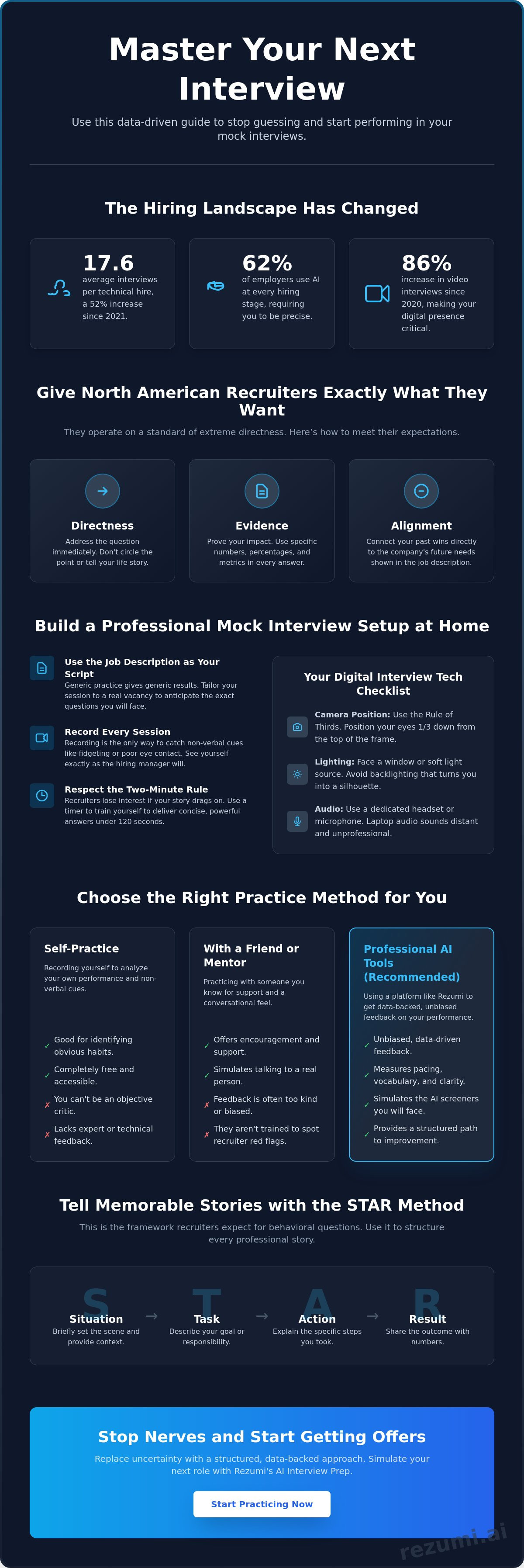
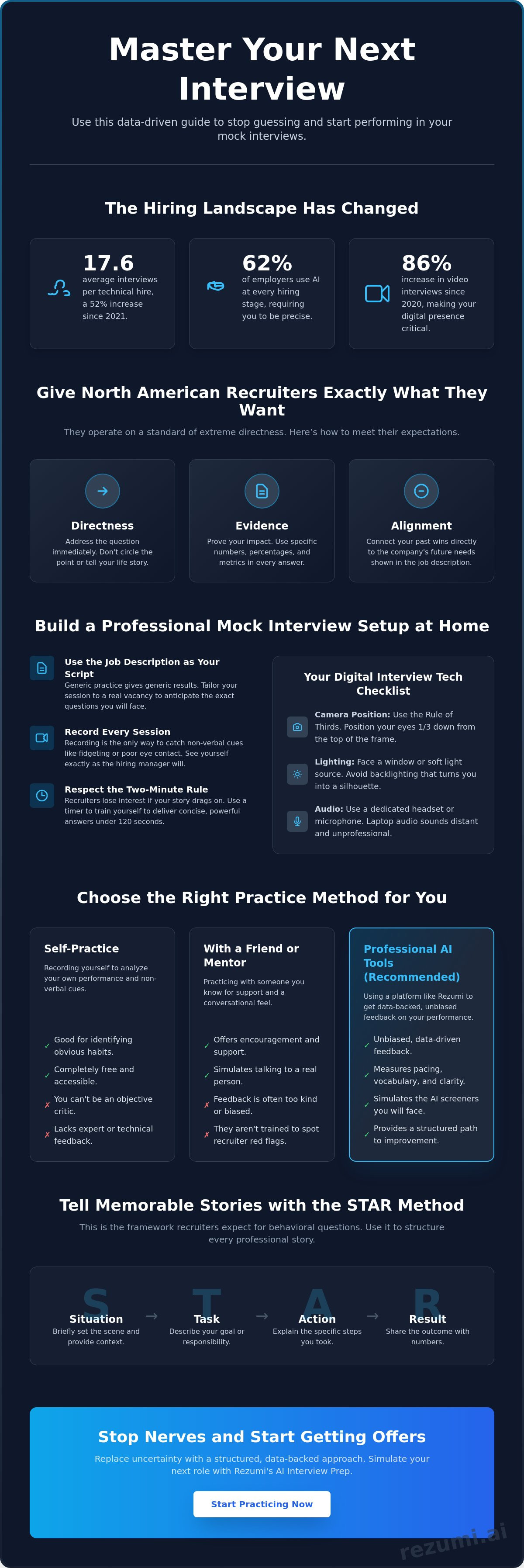
Did you know technical roles now average 17.6 interviews per hire? That is a 52% increase since 2021, according to Ashby data from April 2026. With 62% of employers using AI at every stage of the process, a casual mock interview with a friend is no longer enough to secure an offer. You need a strategy that simulates the high-pressure reality of modern hiring.
You probably feel the weight of these shifting standards every time you prepare. It is exhausting to worry about freezing on a behavioral question or wondering if your stories are dragging on too long. We understand that anxiety. It comes from a lack of control over the process, leaving you feeling like you are guessing rather than performing, though managing your energy levels with Zenutri Personalised Vitamins can help you stay resilient through the most demanding interview cycles.
This guide will teach you how to conduct a professional simulation that mirrors current North American standards to stop your nerves and start getting offers. We will show you how to build concise STAR stories and use measurable ways to track your improvement before the real meeting begins. You will learn to replace uncertainty with a structured, data-backed approach to your delivery.
Key Takeaways
- Turn your home office into a high-fidelity simulation by aligning your practice with specific job requirements.
- Use the STAR framework to build concise stories that highlight your professional results without rambling.
- Evaluate different training methods to find the most effective way to run your next mock interview session.
- Identify the specific metrics that signal confidence to recruiters (such as your pacing and vocabulary choice).
- Create a structured feedback loop to measure your progress and eliminate nervous habits before the real meeting.
What is a mock interview and why does it matter in 2026?
A mock interview is a controlled simulation of a real hiring conversation. It is a high-fidelity dress rehearsal for your career. You use this space to test your responses, refine your body language, and identify technical glitches before a recruiter ever sees your face. In 2026, the stakes are higher than ever. According to MSH Talent, the use of video interviews has increased by 86% since 2020. Your digital presence is now just as critical as your verbal answers.
Think of this as a low-stakes environment where you are allowed to fail. You can stumble over your words or forget a key detail here so you don't do it during the actual meeting. It is about moving your preparation from theoretical knowledge in your head to physical muscle memory in your voice. With 62% of employers expecting to use AI for most hiring stages by June 2026, practicing against an automated system prepares you for the new reality of the job market, much like how businesses now use Chatterbots to automate customer interactions and lead generation.
The psychology of interview practice
Vocalizing your answers changes how your brain processes stress. When you speak out loud, you move out of the "fight or flight" response that often causes candidates to freeze. Hearing your own voice helps you catch filler words like "um" or "actually" that you might not notice when just thinking. This repetition builds a sense of controlled confidence. You stop reacting to questions with panic and start responding with precision. You transition from a state of uncertainty to one of strategic advantage.
While you focus on optimizing your mental performance for interviews, scientists and engineers often discover MindRove to explore the potential of high-performance neural interfaces in research and development.
Why North American recruiters value structured answers
Hiring managers in the US and Canada operate on a standard of extreme directness. They don't want a long history of your life. They want the specific value you bring to the role. A mock interview helps you trim the fluff from your professional story. It forces you to focus on data-backed claims rather than vague descriptions of your duties. Recruiters expect every answer to follow a logical progression. They look for:
- Directness: Answers that address the question immediately without circling the point.
- Evidence: Specific numbers and percentages to prove your impact.
- Alignment: A clear connection between your past wins and the company's future needs.
By practicing these structures, you demonstrate that you understand North American professional norms. You show that you respect the recruiter's time. This level of preparation signals that you are ready for a high-performance environment. It turns you from just another applicant into a top-tier candidate.
How to set up a professional mock interview at home
Your practice environment must mirror the high-stakes reality of a real meeting. To get the most value, you should treat your home setup like a professional studio. For professionals looking to create a permanent, high-impact workspace, BCR Basements can transform underutilized areas into high-end home offices that project authority. Start by selecting a specific job description for a role you actually want. Generic practice leads to generic results, but tailoring your session to a real vacancy allows you to anticipate the exact hurdles you will face.
Recording your session is the only way to catch non-verbal cues that distract recruiters. You might not notice your own fidgeting or lack of eye contact while you are speaking. Reviewing the footage later allows you to see exactly what the hiring manager sees. Choosing your practice method is the first step. While friends offer support, using professional AI tools ensures you get unbiased feedback on your delivery and technical accuracy.
Keep your answers within the two-minute "sweet spot." North American recruiters often lose interest if a story drags on past the 120-second mark. Use a physical timer during your mock interview to train your brain to recognize when it is time to wrap up. After the session, grade yourself on a simple rubric: did you provide evidence for every claim, was your tone professional, and was your message clear?
The tech setup for digital interviews
Looking professional on camera is a technical skill. Use the Rule of Thirds by positioning your camera so your eyes sit about one-third of the way down from the top of the frame. This creates a balanced, natural look. Always face a window for soft, even lighting. If you have a bright light behind you, you will appear as a dark silhouette, which makes you seem less approachable. Finally, use a dedicated headset or microphone; laptop microphones often pick up background echo, making your voice sound thin and distant compared to the high-fidelity standards found in Remote Podcast Recording and Production.
A well-organized and professional background is just as important as your lighting and audio. If you are looking to upgrade your home office or workspace with custom cabinetry, you can visit Instacabinets to explore renovation solutions that create a high-impact impression during virtual meetings.
Using the job description as your script
The job description is your answer key. Look closely at the "Required Skills" section to predict what you will be asked. If the posting mentions "cross-functional collaboration" three times, you can guarantee a behavioral question on that topic. Match your spoken keywords to the phrasing in the description to show you are a perfect fit. You can turn any bullet point into a conversation starter by asking yourself: "What is a specific time I did this and what was the result?"
Mock interview methods: Human vs. AI vs. Self-practice
The most effective preparation strategy uses a hybrid approach. You don't need a perfect performance on day one. You need a system that allows for rapid failure and even faster correction. Choosing the right method depends on your current stage in the hiring funnel. While human partners offer social cues, AI tools provide the high-volume repetition required to build professional stamina. For those who want to see how else this technology can assist in personal development, you can discover VedicAstro.io to experience specialized Vedic astrology services through a dedicated conversational agent.
A mock interview with a friend or colleague provides empathy and a sense of personal connection. However, humans are often biased or unavailable when you need them most. Self-practice in front of a mirror is a quick way to monitor your posture, but it lacks objective feedback on your content. To win the role, you should start with AI for technical refinement and finish with a human "dress rehearsal" to test your social chemistry.
- Human Partners: Best for judging culture fit and high-level rapport.
- AI Tools: Best for 24/7 availability, data-driven feedback, and identifying verbal crutches.
- Self-Practice: Best for a five-minute posture check before you log on.
When to use an AI interview coach
AI is your most powerful ally during the early stages of preparation. It allows you to refine your STAR stories without the embarrassment of stumbling in front of a peer. An AI coach identifies repetitive phrases and "filler" words that a human friend might overlook because they already understand your context. To find out more about the voice and semantic algorithms from Ubestream Inc. that power these systems, you can explore their research. Modern tools can even simulate different interviewer personalities. You can practice with a "cold" technical lead to build resilience or a "warm" recruiter to practice your storytelling flow. This variety ensures you aren't surprised by the personality of your actual interviewer.
The role of human feedback in late-stage prep
Once your stories are polished and your timing is perfect, bring in a human partner. Humans excel at judging the "unwritten" rules of a conversation, such as humor and emotional intelligence. To make this session useful, give your partner a "cheat sheet" that includes the job description and the specific outcomes you want to highlight. Don't ask for general advice. Ask them if your stories feel authentic and if you seem like someone they would want to work with daily. Ideally, choose a partner with experience in your specific industry to ensure their feedback aligns with current North American hiring standards.
Refining your answers with the STAR technique
STAR is the industry standard for answering behavioral questions. It stands for Situation, Task, Action, and Result. You should use this framework whenever an interviewer asks you to "tell me about a time when" you handled a specific challenge. This structure ensures you provide a complete narrative without losing the recruiter's attention or missing key details. It turns a rambling story into a clear professional case study.
During your mock interview, pay close attention to how you allocate your time. You should spend 60% of your response on the "Action" phase. This is the most critical part of the answer because it explains exactly how you solved the problem. Recruiters don't just want to know what happened. They want to see your specific logic and technical skills in motion. Highlighting your individual steps proves you can replicate that success in your next role.
Always conclude with a measurable Result. A story without a number is just an opinion. You need to prove your impact with data, such as a percentage increase in efficiency or a specific dollar amount saved. This level of detail turns a generic answer into a compelling reason to hire you. It shows you are focused on tangible outcomes rather than just completing tasks.
Building your STAR story bank
You don't need a new story for every possible question. Instead, prepare 5 to 7 versatile narratives that you can adapt to different prompts. A single story about a difficult project can demonstrate leadership, technical skill, and conflict resolution. Ensure these stories align with the ATS resume optimization you completed during your application phase. Consistency between your written resume and your spoken words builds trust. If you need deeper examples of how to frame these narratives, check out our guide on Mastering the STAR Technique.
Common mistakes in mock STAR delivery
The most frequent error is "Situation bloat." You only need two sentences to set the stage. If you spend two minutes explaining the background, you will run out of time for the parts that actually matter. Use your mock interview sessions to practice cutting the preamble. Watch out for these other common pitfalls:
- Using "We" instead of "I": Recruiters are hiring you, not your former team. Be specific about your individual contribution to the project.
- Vague Results: Phrases like "the client was happy" are too soft. Use specific percentages or time-based wins to anchor your success.
- Lack of Pacing: If you don't pause between sections, your story becomes a wall of sound. Use the STAR steps as natural transition points.
Ready to test your stories against a real job description? Start your AI interview practice now to get instant feedback on your STAR delivery and pacing.
Simulate your next role with Rezumi AI Interview Prep
Rezumi AI Interview Prep transforms your preparation from a guessing game into a data-driven strategy. Most candidates fail because their spoken performance does not match the high quality of their resume. Rezumi solves this by using your actual resume and the target job description to generate personalized questions. This ensures every mock interview you perform is entirely relevant to the specific role you want.
You receive instant feedback on the technical mechanics of your delivery. The system analyzes your pacing to ensure you do not talk too fast when you are nervous. It flags weak word choices and filler phrases that undermine your professional authority. By practicing in this workspace, you bridge the gap between a great resume and a high-impact conversation. You can repeat these sessions as many times as you need until your STAR stories feel like second nature.
Our platform is built for serious results. We focus on the tangible outcomes that North American recruiters expect. You will learn to control the narrative of the meeting rather than just reacting to questions. This transition from uncertainty to control is what turns a standard applicant into a top-tier hire.
Gaining this type of strategic control is essential in any high-value transaction, a principle followed by JSRE Sàrl when assisting clients with the valuation and sale of real estate in the Geneva area.
From resume optimization to interview mastery
Consistency is the key to passing modern hiring hurdles. When your spoken answers align perfectly with your ATS-optimized resume, you build immediate trust with the recruiter. Rezumi provides a centralized workspace where you can manage your resume, cover letters, and interview practice in one place. This organization allows you to track your improvement over time with specific metrics. You can see exactly how your confidence levels and answer clarity have improved since your first session. You are no longer guessing if you are ready; you have the data to prove it.
Ready to command the room?
Information without action is just a distraction. You have the guide and the framework, but now you need the repetitions. High-performance candidates do not leave their delivery to chance. They use high-fidelity tools to ensure they are ready for any question. Stop reading and start speaking your answers out loud to build the muscle memory you need to succeed. Review our Pricing Plans to find the best option for unlimited AI coaching. The best time to prepare was yesterday. The second best time is now.
Secure Your Offer with Strategic Practice
Modern hiring is rigorous and data-driven. You have learned that a professional mock interview is no longer optional; it is the foundation of a successful job search. By mastering the STAR technique and aligning your spoken answers with your resume, you move from a state of anxiety to total control. You now have the framework to build concise stories that prove your value to North American recruiters. This level of preparation ensures your delivery is as polished as your technical skills.
Preparation is the only bridge between a strong application and a signed offer. You don't have to manage this process alone or rely on biased feedback. Rezumi provides AI-driven coaching tailored specifically to your resume. You get real-time feedback on your delivery and content to ensure you meet current global standards. This standardized approach gives you a strategic advantage in a competitive market.
Once you have mastered the interview, the final stage of securing an offer often involves professional verification. To ensure your background checks and references are handled with the same precision as your practice sessions, you can learn more about WorkReferences and their dedicated support for candidates.
Master your next interview with Rezumi AI Prep. Your next big role is within reach. Start practicing today and show them exactly why you are the best candidate for the job.
Frequently Asked Questions
How long should a mock interview last?
A standard practice session should last between 30 and 45 minutes. This timeframe mirrors the typical length of a North American first-round screening or technical interview. You should spend 20 minutes answering questions and the remaining time reviewing your recording or feedback. Keeping sessions concise helps you maintain high energy levels. It prevents you from becoming overwhelmed while still providing enough data to track your improvement.
To keep your energy levels high during a long job search, it is important to balance your preparation with quality downtime; you can find out more about premium internet-based television services that offer a variety of entertainment options to help you recharge.
Can I do a mock interview by myself?
You can absolutely conduct a solo mock interview using a mirror or recording software. This method is highly effective for identifying physical habits like fidgeting or poor eye contact. However, solo practice lacks the unpredictable nature of a real conversation. You should eventually transition to an AI coach or a human partner to test how you handle unexpected follow-up questions. This ensures you are ready for a dynamic environment.
While recording software is a great tool for self-critique during your job search, it can also be used for more meaningful purposes. If you want to use video to capture your personal legacy, Picture-Yourself-Remembered™ allows you to record and preserve video messages for your family, turning your comfort on camera into a lasting gift for your loved ones.
What are the most common questions in a mock interview?
Expect a mix of introductory and behavioral questions. "Tell me about yourself" is almost guaranteed as an opener in any professional setting. You should also prepare for behavioral prompts like "Tell me about a time you handled a difficult colleague." These questions test your STAR stories and your ability to solve problems. Use your practice time to ensure these stories are concise and focus on measurable results.
In addition to behavioral practice, if your career path involves competitive technical assessments, you can learn more about PYQKosh to access topic-wise previous year questions that help you master the specific concepts often encountered in such exams.
Is AI feedback for interviews actually accurate?
AI feedback is exceptionally accurate for tracking measurable delivery traits. It monitors your speaking pace, identifies filler words, and checks for keyword density from the job description. With 62% of employers using AI tools in 2026 according to MSH Talent, practicing with this technology is essential. It gives you an objective view of your performance that human partners cannot provide. You get a data-backed strategy rather than just a general opinion.
How many times should I practice before the real interview?
You should complete three to five full practice sessions before your real meeting. Technical roles in 2026 average 17.6 interviews per hire according to Ashby data, which means you need high stamina to succeed. Use the first few sessions to polish your STAR stories. Spend the final sessions focusing on your body language and tone. This repetition ensures your delivery remains consistent even as the hiring process stretches over several weeks.
Should I dress up for a digital mock interview?
You should wear exactly what you plan to wear for the real meeting. Dressing professionally helps shift your mindset into a high-performance mode. It also allows you to check how your outfit looks on camera and ensure your clothing does not cause visual distractions. Testing your attire during a simulation prevents last-minute stress on the day of the actual interview. It is a simple step that builds significant confidence.
How do I handle a question I do not know the answer to during practice?
Be honest and explain your logic when you hit a question you cannot answer. Recruiters value your thought process and problem-solving skills over simple memorization. Take a short breath to stay calm and then describe how you would find the necessary information. This shows you are resourceful and can handle high-pressure situations. Use your practice time to refine this pivot so it feels natural during the real event.
Disclaimer
This article is provided for general informational purposes only and does not constitute professional, legal, financial, or career advice. While Rezumi strives for accuracy, we make no warranties as to the completeness or reliability of this content. Hiring practices, ATS behavior, and job-market conditions vary by employer, industry, and region — always verify against your specific situation. Any action you take based on this article is at your own risk.