STAR Method Interview Questions: How to Use AI for a Winning Performance in 2026
Your past work experiences are not just memories. They are high-value data points that determine your future salary. Most candidates treat the STAR method as a rigid script. This leads to robotic answers and missed details. You likely feel the pressure to sound perfect while worrying that you will ramble or forget a crucial metric. You want to sound prepared without sounding rehearsed. It is a common frustration. It is also a fixable one.
The secret to a high-impact performance is treating your background like a data structure. You can use STAR method interview questions AI to transform your messy project notes into a structured story library. This guide teaches you how to use technology to refine your career wins into narratives that sound human and professional. We will show you how to organize your background, sharpen your delivery, and walk into your next final round with total control over your story. By the end, you will have a clear framework for building a library of stories that secure job offers.
Key Takeaways
- Learn how to treat the STAR method as a data structure that predicts your future success to hiring managers.
- Use STAR method interview questions AI to scan your resume and identify high-impact stories you might have forgotten.
- Prompt AI to act as a specific interviewer so you can practice your delivery and refine your narrative structure.
- Adjust your story results to match the top soft skills in the job posting for better alignment with the role.
- Transition from interview anxiety to confidence by using real-time coaching tools to perfect your performance.
What is the STAR Method and Why Do You Need It?
Hiring managers don't want to hear your life story. They want proof of your future performance. Behavioral questions are the standard tool for this in the North American market. When an interviewer asks you to "describe a time you failed," they are looking for a specific data structure. This is where the STAR method becomes your most valuable asset. It organizes your messy experiences into a logical flow that proves you can solve problems.
In 2026, the stakes are even higher. Many first-round video interviews now use AI to analyze your speech patterns. These systems look for the presence of specific components like "Action" and "Result." If you ramble without a clear structure, the algorithm might flag your response as low-impact. Mastering STAR method interview questions AI techniques is the only way to stay competitive in a tech-driven hiring market. Using STAR method interview questions AI tools ensures you hit every requirement the recruiter and the software expect.
This shift toward algorithmic evaluation isn't unique to hiring; in the business world, companies are increasingly turning to an AI SEO agency Singapore to ensure their brand messaging is optimized for the conversational platforms that now dominate search.
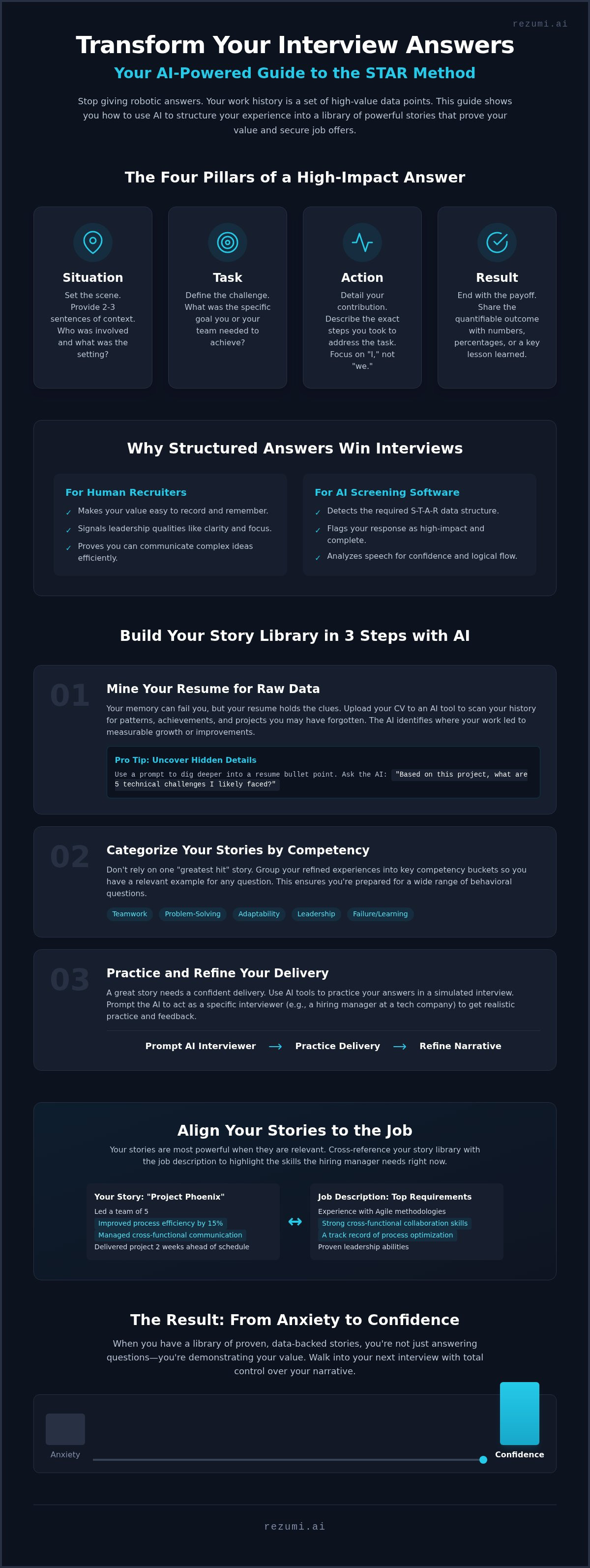
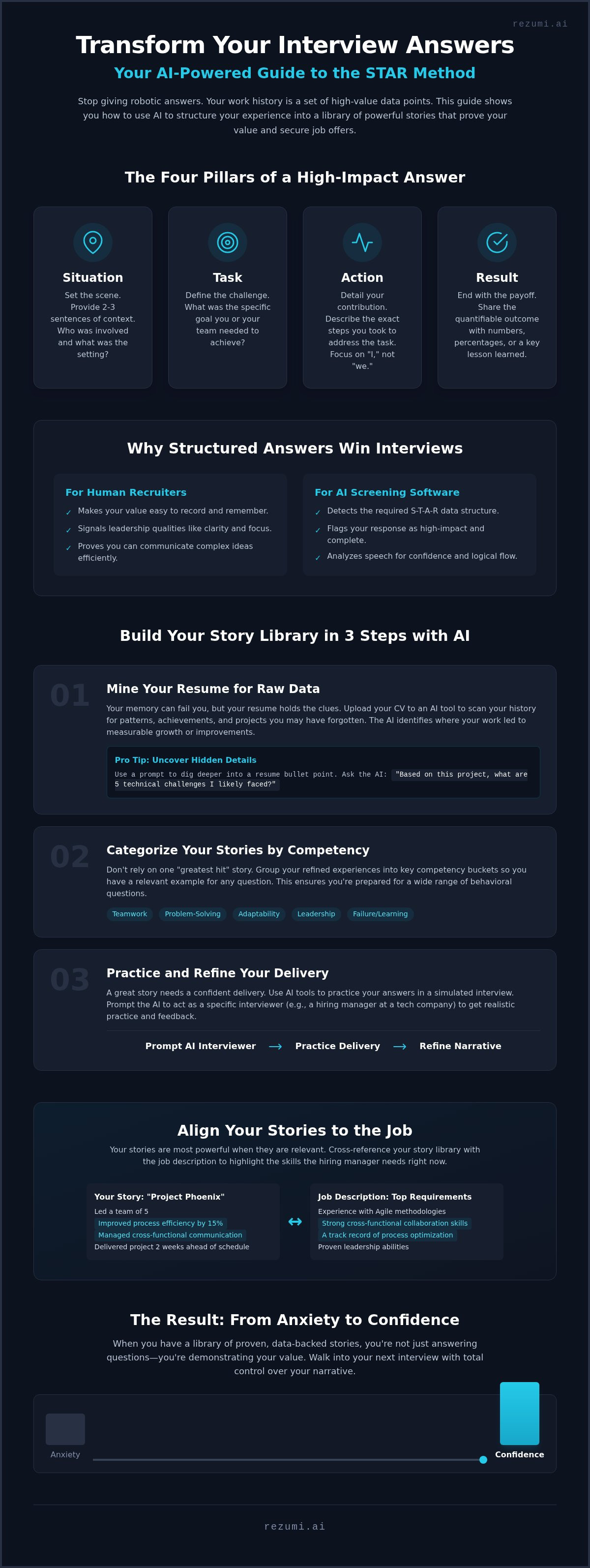
The Four Pillars of a STAR Response
A successful answer follows a strict architecture. Break your story into these four segments to keep your audience engaged and provide the data they need.
- Situation: Provide 2 to 3 sentences of context. Who was involved and what was the setting? Don't get bogged down in technical jargon here.
- Task: Define the specific challenge. What was the goal you needed to reach? This sets the stakes for your story.
- Action: This is the core of your response. Detail the exact steps you took to address the task. Focus on your individual contribution rather than the team's effort.
- Result: End with a quantifiable outcome. Use numbers, percentages, or a specific lesson learned to prove success. This is the payoff that recruiters remember.
Why Recruiters in 2026 Demand Structured Answers
Recruiters in the US and Canada value efficiency and directness. They often conduct back-to-back interviews and need to take clear notes. A structured answer makes their job easier. It also signals that you possess leadership qualities. Leaders communicate with clarity and focus on results. If you give "yes or no" answers, you miss the chance to show your value. A simple "yes" is a dead end. It kills the momentum of the conversation and leaves the recruiter with nothing to write down. Every question is an opening to provide a data-backed example of your skills. A structured narrative turns a simple question into a powerful demonstration of your expertise.
This level of clarity is especially prized in high-stakes industries like cybersecurity. Firms such as CyberOne look for professionals who can articulate complex technical situations and outcomes with the same precision they apply to managing security threats.
How to Build Your Story Library Using AI
Memory is a poor storage system for career wins. You likely remember the stress of a major project, but you might forget the specific 15% efficiency gain you achieved. Building a story library ensures you have a database of success ready at a moment's notice. By using STAR method interview questions AI, you can systematically extract these details from your past roles without the mental fatigue of manual reflection. You aren't just remembering. You are auditing your history for high-value data.
Mining Your Resume for Raw Data
Start by uploading your CV to an AI resume builder. The software scans your history for patterns that human eyes often miss, such as a consistent trend of beating deadlines or saving costs. It identifies projects where your contribution led to measurable growth or structural improvement. Once you have a list of raw data points, use a prompt to uncover hidden details. Ask the AI: "Based on this bullet point, what are five technical challenges I likely faced?" This forces you to recall the specific hurdles you cleared. It turns a generic resume line into a rich, believable narrative.
Look for keywords that appear frequently in your target job descriptions. If "cross-functional collaboration" appears five times in the posting, your story library needs a project that highlights that specific skill. AI can help you cross-reference your resume against the job description to find the best matches. This ensures your stories aren't just impressive. They are relevant to what the hiring manager needs right now.
Categorizing Stories by Competency
You need stories that cover different professional competencies. Don't rely on one "greatest hit" for every question. Instead, group your stories into buckets such as Teamwork, Adaptability, and Problem Solving. Following established STAR method interview advice will help you verify that each story concludes with a strong result. Use STAR method interview questions AI to check if your stories have a clear "Result" phase with real numbers. If you don't have a specific percentage, describe the qualitative change. Did a process become easier for your team? Did a client give positive feedback? These are valid results if you frame them correctly.
- Conflict: A time you disagreed with a peer but reached a professional solution.
- Leadership: A moment you took initiative, even if you weren't the manager.
- Failure: A project that went wrong and the specific steps you took to fix it.
- Technical: A complex problem that required your specific expertise to solve.
Write a single sentence defining your "Hero Story" for each major role. This sentence acts as your mental North Star. It keeps your answer grounded when the interview gets intense. For instance, if you are a senior manager, your hero story might focus on a time you led a team through a merger. If you are a new grad, it might be about a complex capstone project. You can optimize your story library today to ensure your most impressive wins are never left out of the conversation. Having these categories ready allows you to pivot quickly when an interviewer asks an unexpected question.
The AI Practice Loop: Refining Your Delivery
Speaking your answer is different than writing it. In 2026, many first-round interviews are conducted by AI avatars that analyze your pace, clarity, and keyword density. You can master STAR method interview questions AI strategies by treating every practice session as a data-gathering exercise. Don't just memorize a script. Use an iterative loop to move from a rough draft to a high-impact performance that feels natural and authoritative.
Step 1: The AI Prompt Setup
Give the AI the exact context it needs to be an effective coach. Paste the job description and your raw story into the prompt. Ask the AI to critique your response based on North American hiring standards and the STAR framework. Instruct the AI specifically to flag "we" language. Recruiters are not hiring your former team; they are hiring you. If your "Action" section relies on what "we" did, you hide your personal impact. Ask the AI to suggest three active verbs to replace generic words like "assisted" or "worked on." Replacing these with words like "orchestrated" or "executed" changes how a recruiter perceives your seniority.
Step 2: Iterative Refinement
Read your restructured story out loud. Your eyes might miss a clunky sentence, but your ears will catch it immediately. Aim for a total response time between 90 and 120 seconds. This is the ideal window for behavioral answers in the US and Canadian markets. It provides enough detail to be credible without losing the interviewer's attention. If your story is too long, ask the AI to identify 20% of the "Situation" context that you can cut. Most candidates spend too much time setting the scene. You should spend 60% of your time on the "Action" phase because that is where you prove your skills.
Focus on cutting filler words like "um," "basically," and "actually." These words dilute your confidence. Use the AI to scan your transcript for these verbal crutches. Once you have a clean version, record yourself and listen for a natural rhythm. You want to sound like a professional having a conversation, not a robot reading a list. You can access advanced coaching tools to get real-time feedback on your delivery. This process turns your past experiences into a library of stories that you can deliver with total control. By the time you reach the final round, your delivery will be sharp, concise, and backed by data.
Tailoring STAR Answers to Specific Job Descriptions
Hiring managers want to see a direct link between your past and their future. You shouldn't just tell a good story. You must tell the specific story they are looking for. Using STAR method interview questions AI tools allows you to perform a data-match between your experience and the job description. This ensures your answers hit the exact keywords the recruiter is listening for during the conversation.
Start by identifying the top three soft skills requested in the job posting. If the role emphasizes "cross-functional leadership," your story must highlight how you managed different departments. Ask the AI to "keyword-optimize" your STAR responses for the target role. This isn't about lying. It is about using the specific vocabulary the company uses. When you mirror their language, you prove that you already speak their professional dialect.
Matching Stories to Company Values
Every company has a unique culture that dictates how they measure success. You can use AI to summarize a company's latest quarterly report or mission statement. This gives you insight into their current goals, such as growth, efficiency, or innovation. Adjust the "Result" of your story to align with these priorities. If a company is focused on cost-cutting, a story about saving money is more powerful than one about gaining new users. You can find more advice on this in our strategic interview tips guide to ensure you fit the corporate mold perfectly.
Before and After: The Power of Tailoring
Tailoring helps you pass the "human ATS" check. Recruiters scan your verbal answers for specific markers just like a computer scans a resume. If you miss those markers, you lose their interest. A generic answer might sound professional, but a tailored answer sounds like a solution to their specific problems. Look at the difference in impact below.
| Section | Generic STAR Answer | Tailored STAR Answer |
|---|---|---|
| Task | I needed to improve our team's monthly reporting process. | I was tasked with reducing reporting errors by 20% to meet new compliance standards. |
| Action | I created a new template and shared it with everyone on the team. | I engineered an automated Python script to audit data entries before the final submission. |
| Result | The reports were better and the team liked the new system. | We achieved a 25% increase in data accuracy, saving the department 10 hours of manual work per week. |
Specific metrics make the tailored version more believable. They provide the "proof of work" that North American recruiters demand in 2026. By focusing on quantifiable outcomes, you move from being a candidate who "can do the job" to one who "has already done it."
Command the Room with Rezumi AI Interview Prep
Confidence comes from knowing your data is accurate. You have already organized your stories and matched them to the job description. Now you must perform. Rezumi acts as your strategic partner by providing an all-in-one workspace for your entire job search. Our AI Interview Prep tool takes the guesswork out of your delivery by using your actual resume data to simulate high-stakes conversations.
This integration is vital for your success. It ensures your spoken STAR method interview questions AI responses perfectly match your optimized ATS resume. Recruiters look for consistency across every touchpoint. If your spoken results differ from your written metrics, you create doubt. Rezumi eliminates this risk by keeping your narrative unified from the first application to the final negotiation. You are not just reciting facts. You are presenting a cohesive professional identity.
Real-Time Coaching for Real-World Results
Practice is only effective if it includes feedback. Rezumi provides real-time coaching on your tone, clarity, and narrative structure. The tool analyzes your speech to ensure you aren't rambling or skipping the "Result" phase of your story. You can practice in a low-pressure environment that mimics the AI-led first rounds common in the US and Canadian markets. This environment allows you to fail, refine, and try again until your delivery is flawless. You will learn to cut verbal fillers and speak with the technological confidence that modern employers demand.
Next Steps: From Practice to Hired
Preparation is the only real cure for interview anxiety. When you know your stories are backed by data and refined by AI, the fear of the unknown disappears. You move from a state of uncertainty to a position of total control. Start building your story library today to secure your place in the final round. You can explore our pricing plans to find the premium access level that fits your current career goals.
Your career is too important to leave to chance. Use these data-backed strategies to turn your past experiences into high-impact stories. Sign up now and start transforming your interview performance into a series of job offers. The North American market is competitive, but with the right tools, you can command any room you walk into.
Master Your Narrative and Secure the Offer
You now have the blueprint to transform your career history into a series of high-impact wins. By treating the STAR method as a data structure rather than a script, you ensure every answer provides the proof recruiters demand. You've learned how to mine your resume for metrics and use an iterative loop to perfect your delivery. Mastering STAR method interview questions AI techniques is the final step in moving from a qualified candidate to the top choice. To learn more about how self-improvement leads to professional market dominance, click here.
Rezumi is used by professionals landing roles at top North American firms. It provides real-time feedback on your answer structure and impact. Our system is fully integrated with our industry-leading ATS resume optimizer to keep your story consistent.
Stop guessing what interviewers want to hear. Take control of the conversation and walk into your next interview with total confidence. You've got the experience. Now you have the tools to prove it.
Frequently Asked Questions
What are the 5 STAR questions in an interview?
There are no five specific questions, but recruiters usually focus on five core categories: conflict, leadership, failure, teamwork, and problem solving. You will recognize these by openings like "Tell me about a time you..." or "Give me an example of..." These behavioral prompts are designed to see how you handled real world challenges in the past.
How do you pass the STAR method interview without sounding rehearsed?
Internalize your story structure instead of memorizing a script. Focus on the key data points of your "Action" and "Result" phases so you can speak naturally. Using STAR method interview questions AI tools helps you practice the framework until it becomes second nature. This allows you to adjust your tone and pace during the actual conversation without losing your place.
Can I use the STAR method for phone or video interviews?
The STAR method is the expected standard for all interview formats in the North American market. It is especially important for video interviews where AI screening tools may analyze your response for specific structural patterns. Keep brief bullet points for your "Task" and "Result" near your camera to stay on track while maintaining eye contact with the interviewer.
What are common STAR mistakes that cost people the job?
Most candidates fail by rambling during the "Situation" phase or forgetting to provide a quantifiable "Result." Spending too much time on background details leaves little room for your actual contributions. If you don't share a specific number or a clear lesson learned, the recruiter lacks the data needed to justify hiring you over another candidate.
How long should a STAR method answer be?
Your response should last between 90 and 120 seconds. This timeframe is the sweet spot for keeping a recruiter's attention while providing enough detail to be credible. Spend the majority of this time on the "Action" section. This is where you prove your technical skills and decision making abilities to the hiring manager.
Is it okay to use the same story for different interview questions?
You should avoid repeating the same story because it makes your experience look thin. It is better to build a library of six to eight distinct stories that cover different competencies. If you must use the same project twice, ensure you highlight a completely different challenge and a different set of actions to show versatility.
How do I answer a STAR question if I do not have a relevant experience?
Draw from transferable skills found in volunteer work, academic projects, or personal leadership roles. Focus on the logic you used to solve the problem rather than the specific job title you held. Recruiters value your thought process and ability to take initiative even if the example comes from outside a traditional office setting.
Does AI really help with interview preparation?
AI provides objective data on your delivery that a human coach might miss. It identifies verbal fillers, analyzes your speaking pace, and checks if your answers align with your resume. Using STAR method interview questions AI software lets you refine your stories in a low-pressure environment. This ensures you are fully prepared for the high-stakes reality of a final round interview.
Disclaimer
This article is provided for general informational purposes only and does not constitute professional, legal, financial, or career advice. While Rezumi strives for accuracy, we make no warranties as to the completeness or reliability of this content. Hiring practices, ATS behavior, and job-market conditions vary by employer, industry, and region — always verify against your specific situation. Any action you take based on this article is at your own risk.