Tailor Your Resume to Job Descriptions for ATS Success
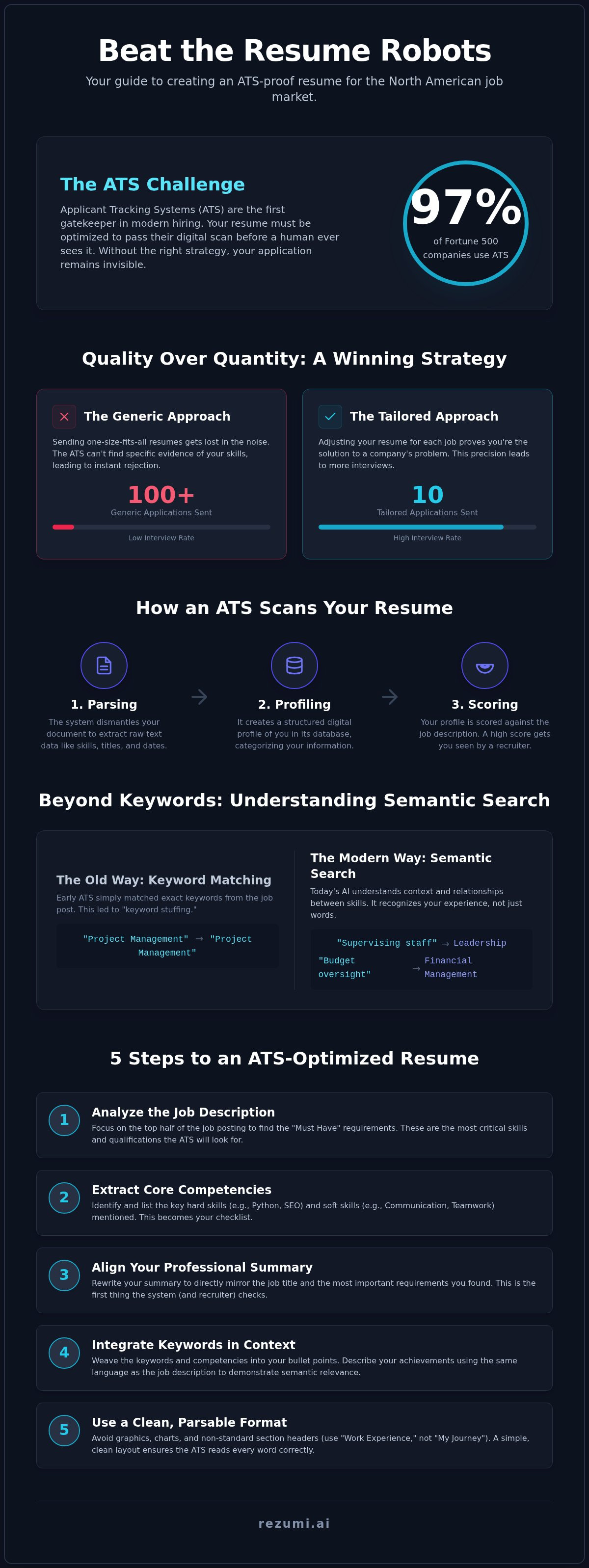
Over 97 percent of Fortune 500 companies use an Applicant Tracking System (ATS) to filter candidates before a human recruiter ever sees a name. This makes learning how to tailor resume to job description a critical survival skill for your career. If your document does not speak the same language as the software, your experience remains invisible. You need a data-driven strategy to stay in the game.
It is frustrating to feel like your applications disappear into a digital black hole. You spend hours on a single resume only to receive an instant rejection from a machine. You are likely confused about which keywords actually matter and tired of the guessing game. You deserve a process that replaces this anxiety with the reassurance of a proven strategy.
This guide teaches you the exact steps to align your professional profile with job requirements so you pass the digital screen. We will cover how to identify high-impact keywords and structure your experience for maximum readability. You will learn a faster way to apply that maintains the high quality top-tier companies demand, moving you from uncertainty to total control of your job search.
Key Takeaways
- Learn how modern systems use semantic search to understand the context of your work beyond simple word matching.
- Discover how to tailor resume to job description by identifying the most important requirements in the top half of a job posting.
- Follow a five-step system to extract core competencies and align your professional summary with the specific job title.
- Use automation to manage multiple versions of your resume in a centralized workspace without losing quality.
Why Your Resume Needs a Custom Fit for Every Application
Tailoring is the strategic process of adjusting your professional history to match the requirements of a single job posting. It's more than just changing a few words. It's about proving you're the exact solution to a company's specific problem. Most large employers use an Applicant Tracking System (ATS) to manage the flood of applications they receive. In fact, research from August 2026 shows that 97.4 percent of Fortune 500 companies use these systems. If your resume is generic, it lacks the specific data points these programs look for during the initial scan. This often leads to an instant rejection before a human ever sees your name. Learning how to tailor resume to job description is the only way to ensure your profile reaches a recruiter's desk.
The Cost of Sending Generic Applications
Sending out hundreds of identical resumes is a losing strategy. Modern software treats generic documents as background noise. When you use a one-size-fits-all approach, your most relevant skills often end up buried under irrelevant details. You might look overqualified for some roles and underqualified for others because the software can't find the specific evidence it needs. Recruiters in 2026 spend an average of 11.2 seconds on their initial scan of a resume. If they can't see your value immediately, they move on. Quality beats quantity every time. Sending 10 carefully tailored applications will yield more interview invitations than blasting out 100 generic ones.
Meeting the North American Standard
Hiring managers in the US and Canada expect a high level of relevance. They want to see exactly how your past wins apply to their current goals. A tailored resume shows you've done your homework. It proves you understand the specific challenges the team faces. To set yourself up for success, start with a clean design. You can refer to our guide on Choosing the Best Resume Format to ensure your layout is professional and easy for software to read. Learning how to tailor resume to job description turns your application from a simple list into a high-performance marketing tool. This precision makes you stand out as a top-tier candidate who's ready to deliver results on day one.
The Technical Mechanics of ATS Tailoring
Modern hiring begins with a parser. This software dismantles your PDF to create a structured digital profile. It extracts your skills, job titles, and dates of employment into a searchable database. The system then calculates a match score. This score determines if a recruiter ever sees your application. If your formatting is messy, the software misses critical data. Understanding these mechanics is vital when learning how to tailor resume to job description for the 2026 market. Your resume is data. The ATS is the processor. Alignment is the only goal.
You can verify your document's readability with ATS resume optimization tools that simulate these scans. This step identifies gaps before you hit submit.
Keywords vs Semantic Context
Keywords are the specific terms found in a job ad, such as 'Project Management' or 'Python'. In the past, you could simply list these words to pass. Today, systems use semantic search. Semantic search is the ability of AI to understand the meaning behind professional phrases. It recognizes that 'supervising staff' is a form of 'leadership'. It knows that 'budget oversight' relates to 'financial management'. This shift means you must focus on context, not just word counts. Use industry-standard terms, but describe your achievements in a way that shows the software you understand the role's scope. This ensures the AI ranks you high for both specific skills and general expertise.
Parsing Errors That Kill Your Score
Design flourishes often backfire in an ATS. Images, logos, and complex charts are usually invisible to the software. If your core skills are trapped inside a graphic, the system records a blank space. This leads to an automatic low score. Non-standard headers also create confusion. If you label your work history as 'My Professional Path' instead of 'Work Experience', the parser might fail to recognize your career history. Stick to a simple, clean layout. Use standard headings and bulleted lists. This ensures every word is indexed correctly. A clean document allows the software to accurately map your skills to the job requirements. When the technical scan is successful, you earn the 11.2 seconds of human attention needed to secure an interview.
How to Identify the Right Keywords and Skills
Finding the right keywords is a pattern recognition exercise. You must treat the job description as a blueprint for your application. Start by reading the top half of the posting to find 'Must Have' requirements.
These are the non-negotiables that determine your initial match score. Learning how to tailor resume to job description starts with this critical analysis phase. If you ignore these core needs, your application will fail the scan.
Look for recurring nouns and verbs throughout the ad. If a term like 'Project Lifecycle' appears multiple times, it is a high-priority keyword. Pay close attention to software and technical tools mentioned in the requirements.
These are often the binary filters used to narrow the field. Mirror the company's tone to show you fit their professional culture. This alignment proves you are a strategic match for the team.
Hard Skills vs Soft Skills
Hard skills are measurable abilities like 'Data Analysis' or 'Bilingualism'. Soft skills are interpersonal traits like 'Communication' or 'Problem Solving'. You must prioritize hard skills in your bullet points to satisfy technical ATS filters.
Software verifies a specific tool usage more easily than a personality trait. Use your experience section to provide concrete evidence of these technical abilities first. This ensures the system recognizes your baseline competency immediately.
Prioritizing Requirements
The first three bullet points in a job description are usually the most important. They represent the primary problems the company needs to solve. Reflect these top requirements in your professional summary and recent work history.
You can use Rezumi pricing plans to access tools that identify these keywords for you automatically. This saves time and ensures you never miss a critical skill. This focus increases your visibility during the 11.2 second recruiter scan.
A 5 Step System to Tailor Your Resume
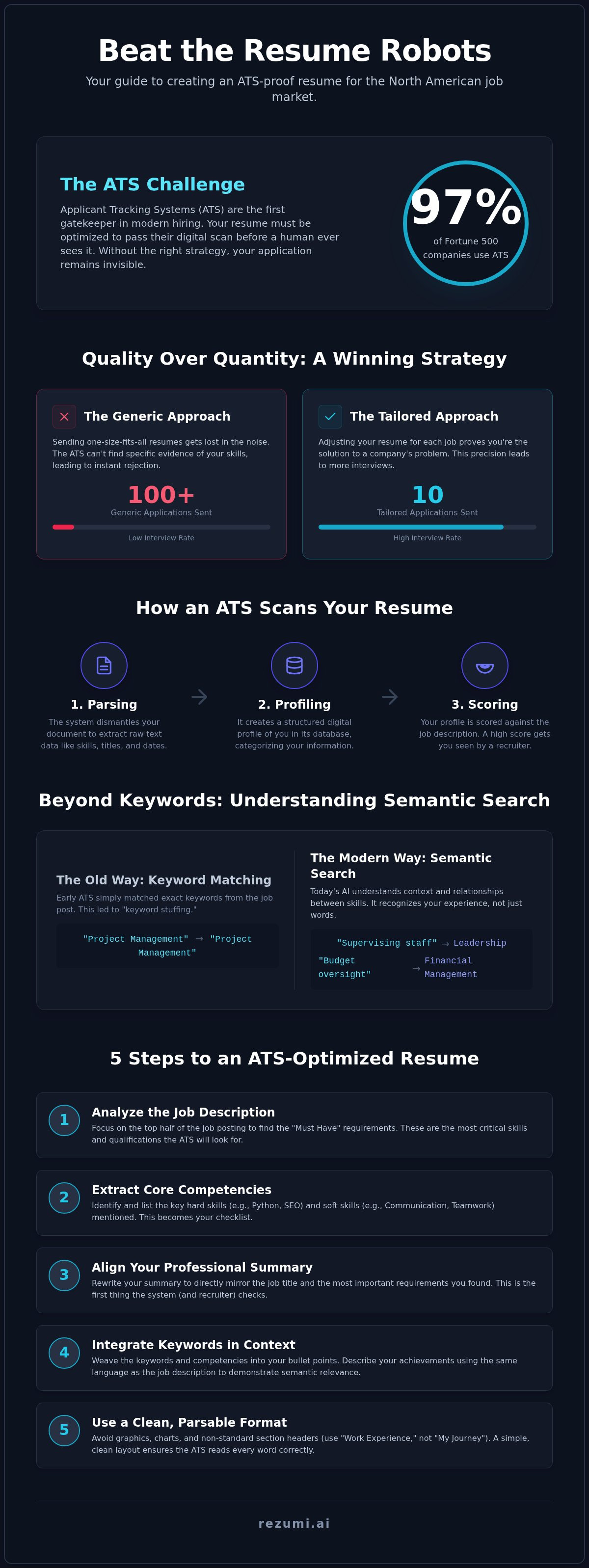
Success requires a methodical approach to data alignment. You can't guess what the software wants. You must follow a technical checklist to ensure your profile ranks high. Learning how to tailor resume to job description effectively means moving through five specific phases of optimization.
Start by analyzing the job posting to extract the top five core competencies. These are the primary skills or experiences mentioned most frequently in the text. Next, rewrite your professional summary to include the exact job title from the posting. If the company is looking for a Senior Project Manager, your summary should use that specific phrase. Then, modify your bullet points to lead with achievements that directly relate to the role's requirements. Follow this by adding a dedicated skills section that mirrors the company's technical stack. Finally, run a comprehensive check to ensure your formatting is clean, professional, and free of complex graphics that block parsing.
Aligning Experience with Requirements
Precision in your vocabulary is mandatory. Use the exact terminology the employer uses in their advertisement. If they list Customer Success as a requirement, don't use Client Support in your work history. The ATS looks for these specific matches to calculate your score. Place your most relevant experience at the top of your history section to catch the recruiter's eye during their 11.2 second scan. Ensure your dates and locations follow a standard format like (Month Year). This consistency helps the software index your career progression accurately without errors.
Quantifying Your Results
Numbers provide the evidence that AI and humans both value. Use real percentages and dollar amounts to show the impact of your work. Instead of saying you improved sales, write that you increased revenue by 20 percent over 6 months. This level of detail builds immediate trust. It transforms a vague claim into a verifiable achievement. Data-backed bullets prove you don't just have the skills, but you also understand how to deliver measurable results in a North American business environment. This strategy is essential when mastering how to tailor resume to job description for top-tier roles.
Command the North American Market with Rezumi
Rezumi acts as your technical ally in a competitive market. We provide the tools to ensure your data is always ready for the next opportunity. Our platform offers a centralized workspace to track and manage every tailored version of your resume. This organization is vital when you apply to multiple roles simultaneously. You can easily see which version of your experience you sent to which company without searching through messy folders.
We also provide an AI Cover Letter Generator. This tool ensures your cover letter matches the specific keywords used in your resume. A consistent professional image across all documents signals high-level attention to detail. This is how you move from a simple applicant to a top candidate. Understanding how to tailor resume to job description is easier when you have a system that automates the tedious parts of the work. You save time while maintaining the high quality that elite firms expect.
Strategic Advantage for US and Canada
North American firms have specific expectations for resume length and content. Rezumi understands these norms and helps you meet them. We help you avoid common mistakes that global professionals often make. For example, including a photo or personal details like age is a major error in the US and Canadian markets that can lead to an automatic rejection. We focus on the nuances of these regions, including specific formatting rules and the emphasis on quantifiable achievements. You can review our AI Resume Builder to see how we automate the tailoring process. This ensures your profile meets the exact standards of top-tier companies every time.
Beyond the Resume: Interview Preparation
Successful tailoring is the first step, but it is not the last. Once you pass the ATS, you must prove your value in person. Our AI Interview Prep allows you to practice answering questions based on the specific data in your optimized profile. This creates a seamless transition from your application to your interview performance. Practicing with our AI tool helps you internalize the keywords you used. You will not just list skills; you will be able to explain them with the same precision found on your resume. This builds a strong narrative of success that hiring managers find hard to ignore. Visit our pricing page to start your journey toward a better career today.
Take Control of Your Career Strategy
You now have the technical framework to beat the 11.2 second recruiter scan. Understanding how to tailor resume to job description is the difference between an instant rejection and a phone call from a hiring manager. You can move from guessing to knowing by using real-time AI feedback built for North American market standards. This strategy ensures your professional summary and skills section align perfectly with what the software and the hiring team require. Modern systems look for semantic context, so your wording must be precise and intentional. By following a structured system, you eliminate the friction that keeps qualified candidates from being seen by human eyes.
Stop letting your applications disappear into a digital black hole. You have the professional experience and the technology to command the attention you deserve. It's time to show top-tier companies exactly why you're the right fit for the role.
Frequently Asked Questions
How much should I change my resume for each job?
You should aim to modify 20 to 30 percent of your resume for every application. Focus on the professional summary, the skills section, and the first few bullet points of your most recent role. This ensures you address the specific core competencies the employer prioritized in the top half of their posting. Adjusting your job titles to match the ad can also boost your match score if the roles are functionally the same.
Can the ATS read my resume if I use a PDF format?
Yes, modern systems can easily parse a standard PDF as long as it is text-based rather than an image. You should avoid using "Print to PDF" from a graphic design tool, as this can turn your text into a flat image that is invisible to the software. Stick to a clean layout exported directly from a word processor or a tool like Rezumi to ensure the parser extracts your data accurately.
Is it okay to copy and paste words from the job description?
You should use the exact keywords found in the ad, but you must weave them into your own unique sentences. Copying entire phrases verbatim can look suspicious to human recruiters and might trigger plagiarism flags in some systems. When learning how to tailor resume to job description, focus on mirroring the specific terminology while describing your personal achievements and quantifiable results. This shows you understand the industry language.
What is the best way to handle gaps in my work history?
You should address gaps by focusing on your skills and any professional development you completed during that time. Use a standard chronological format but include a brief, one-line explanation for gaps longer than six months if necessary. You can also list relevant freelance work, certifications, or volunteer roles to show you remained active. The ATS primarily scans for skill matches, so ensuring your technical competencies are current is the most important factor.
Do I need to tailor my cover letter as well as my resume?
Yes, your cover letter must match the specific tone and requirements of the role to create a consistent professional image. A tailored cover letter reinforces the keywords used in your resume and provides context for how you solve the company's specific problems. Using a tool like our AI Cover Letter Generator helps you maintain this alignment quickly. This dual approach proves to the hiring team that you are a serious, high-quality candidate.
How do I know if the ATS has correctly parsed my data?
You can verify your data extraction by using a professional optimization tool that provides real-time feedback on your document. These tools simulate the parsing process used by systems like Workday or Greenhouse to show you exactly what the software sees. If your names, dates, or titles appear scrambled in the preview, you need to simplify your formatting. Clean headers and standard fonts are the best ways to prevent these technical errors.
Should I use a skills section or integrate skills into my experience?
You should do both to maximize your visibility for both the AI and the human recruiter. A dedicated skills section provides a quick list of keywords for the ATS to index immediately. Integrating those same skills into your work history proves you have actually applied them to achieve real-world results. This combination shows the software you have the right tools and shows the recruiter you know how to use them effectively.
What are the most common ATS friendly fonts to use?
You should stick to standard, sans-serif fonts like Arial, Calibri, or Helvetica for maximum readability. These fonts are easily recognized by almost every parser in the North American market. Avoid decorative or handwritten fonts that can confuse the software and lead to parsing errors. When you understand how to tailor resume to job description, you realize that simple, clean typography is a strategic choice. It ensures your data remains accessible and professional during every digital scan.
Disclaimer
This article is provided for general informational purposes only and does not constitute professional, legal, financial, or career advice. While Rezumi strives for accuracy, we make no warranties as to the completeness or reliability of this content. Hiring practices, ATS behavior, and job-market conditions vary by employer, industry, and region — always verify against your specific situation. Any action you take based on this article is at your own risk.