The 2026 Chronological Resume Template Guide for North American Jobs
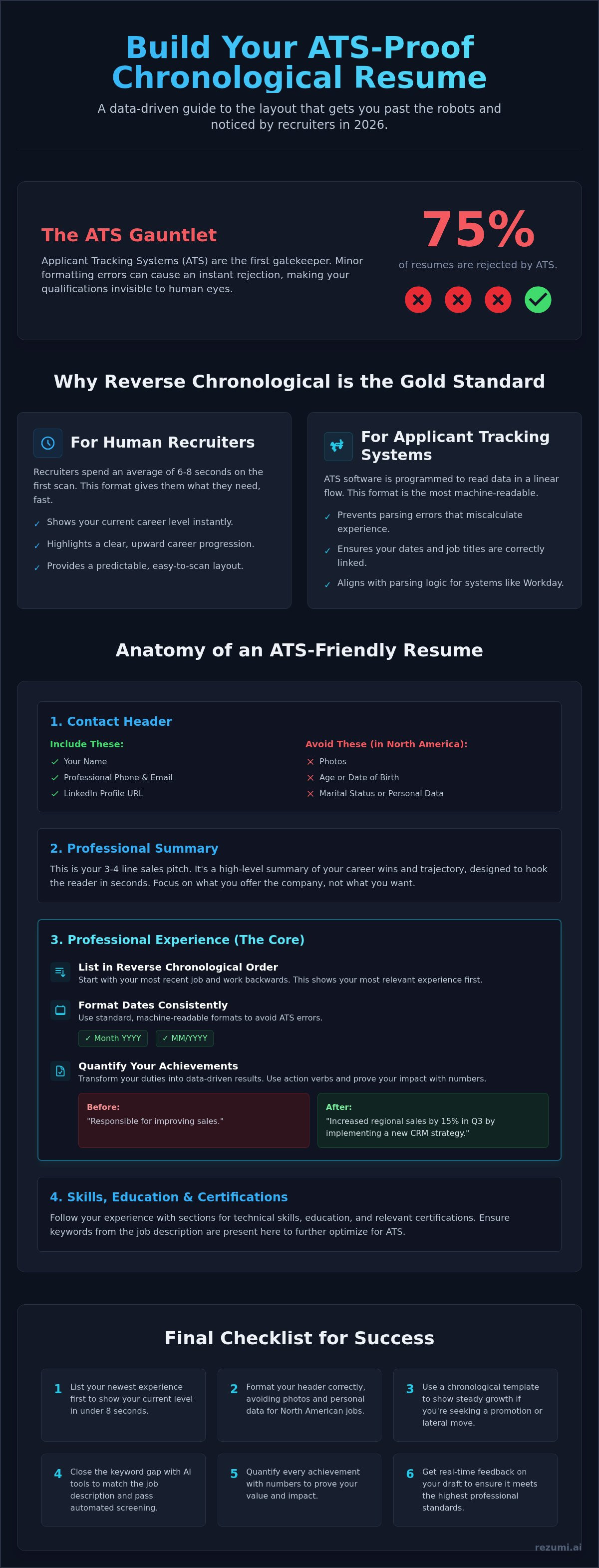
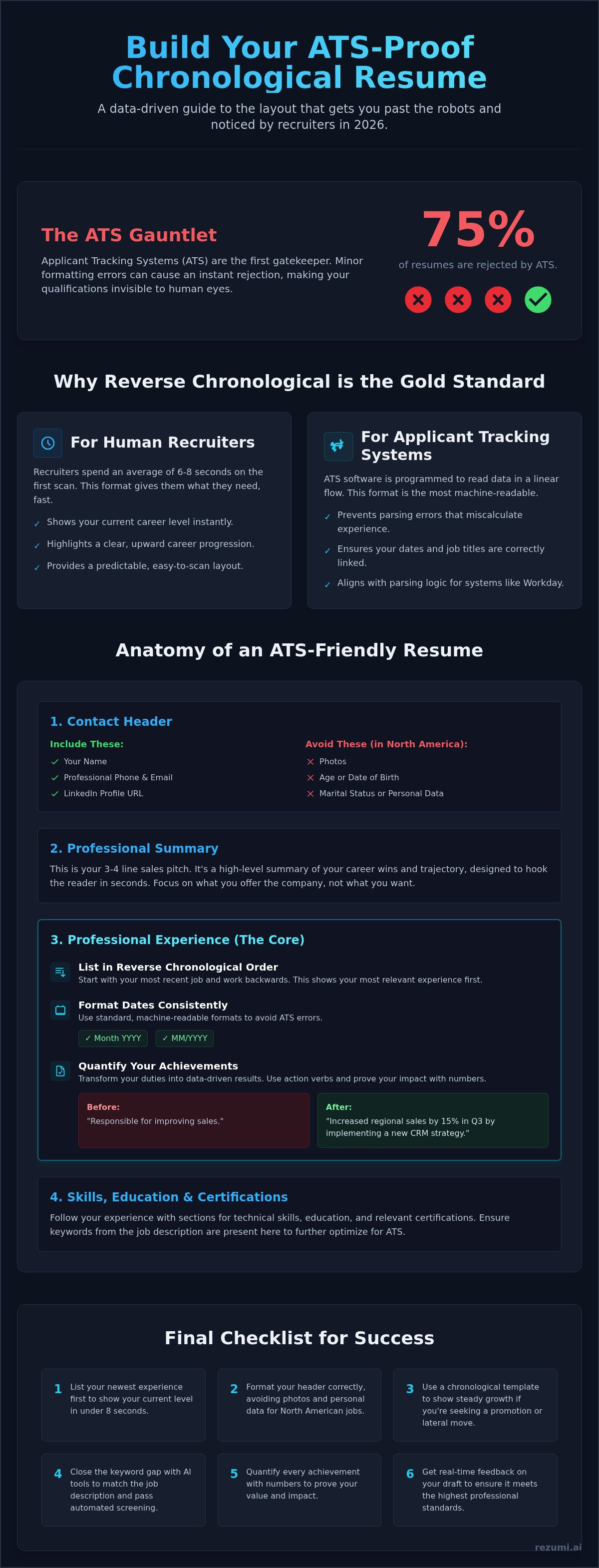
75% of resumes are rejected by Applicant Tracking Systems (ATS) before a human recruiter sees them. This is the reality of the 2026 job market. You have the skills and the drive. Yet, a single formatting error on your chronological resume template can trigger an automated rejection. It's frustrating to watch your career history disappear into a digital void. You might feel confused by conflicting advice on reverse chronological order or struggle to show clear career progression. You deserve a strategy that turns your work history into a competitive advantage. You have the experience. You need the visibility.
A professional layout is the solution. It provides the clear, data-driven map that North American hiring managers demand. This guide shows you how to build a high-performance resume that clears ATS filters and proves your value. We'll move you from uncertainty to control by replacing guesswork with a data-backed strategy. We'll break down the exact layout requirements for 2026, explain how to quantify your professional wins, and ensure your career growth is impossible to ignore.
Key Takeaways
- List your newest experience first. This format helps recruiters see your current career level in under eight seconds.
- Format your header and summary correctly. Avoiding photos and personal data keeps your application compliant with North American hiring laws.
- Choose a chronological resume template to show steady growth. This layout is the best choice if you're seeking a promotion or a lateral move.
- Close the keyword gap with AI. Modern tools help you identify the exact terms you need to pass through automated screening systems.
- Get a live score on your draft. Real-time feedback ensures your resume meets the high standards of the 2026 job market.
What is a chronological resume and why is it the gold standard?
Understanding What is a chronological resume is the first step to surviving the modern hiring process. This format lists your work experience in reverse order. Your most recent job sits at the very top. It's a strategic data map of your career. Recruiters prefer this layout because it shows your current career level immediately. They don't have to hunt for your most relevant skills. This structure highlights your professional growth. It proves you've taken on more responsibility over time. Using a professional chronological resume template ensures your history is organized exactly how hiring managers expect it.
Efficiency is the primary reason this format remains the gold standard. It's the most readable structure for Applicant Tracking Systems (ATS). These systems, such as Workday, are programmed to parse dates and titles in a linear flow. When you use a chronological resume template, you make it easy for the AI to categorize your experience. If the system can't map your timeline, it can't rank you. A clear, chronological flow ensures your data lands in the right category. It prevents the system from miscalculating your years of experience or missing your latest promotion.
The reverse chronological logic
Logic starts with the present. You place your current or most recent role at the top of the experience section. From there, you work backward through your history. Most North American experts recommend covering the last 10 to 15 years. This timeline builds trust. It shows a continuous record of employment without hidden gaps. Hiring managers can see your trajectory without confusion. It proves you're ready for the next level. If you have older experience, you can summarize it or leave it off to keep the focus on your recent wins.
Why North American recruiters demand this format
Speed drives the job market in the US and Canada. Recruiters spend an average of 6 to 8 seconds on their initial scan. They need to find your job titles and dates instantly. Predictable layouts reduce friction. This is the standard resume format for 2026. If you use a different style, you risk confusing the reader. Confusion leads to rejection. A standard chronological layout keeps you in the running. It aligns your history with the mental shortcuts recruiters use to filter talent. You want them focused on your achievements, not struggling to find your start dates.
The anatomy of an ATS-friendly chronological resume
A high-performance application starts with a rigid, logical structure. Your chronological resume template must prioritize readability for both algorithms and human recruiters. Start with a header that contains only your essential contact information. This includes your name, a professional phone number, email address, and your LinkedIn profile URL. Never include a photo, age, or marital status. In the US and Canada, these details are considered a liability for employers and can lead to your resume being discarded to avoid discrimination claims.
The professional summary follows the header as your primary sales pitch. Write three to four lines that summarize your career trajectory and your biggest wins. Don't use a generic objective statement. Focus on what you can do for the company. Mention your years of experience and specific technical proficiencies that match the job description. This section acts as a hook to keep the recruiter reading beyond the first six seconds.
Formatting dates for ATS success
Technical accuracy is non-negotiable. Use standard formats like MM/YYYY or Month YYYY to prevent parsing errors in systems like Workday. Consistent date formatting helps the ats resume checker calculate your total years of experience without errors. Avoid using text boxes or complex columns to house your dates. Many ATS programs read text from left to right. If you place dates in a separate graphic box, the software may fail to link the date to the correct job. This results in a "zero years of experience" error that kills your chances.
The professional experience section
Treat this section as the core of your document. Use clear, bold headings for your Job Title, Company Name, and Location. Each job entry should feature three to six bullet points that lead with high-impact action verbs. Words like "Directed," "Engineered," or "Optimized" carry more weight than passive phrases like "Responsible for."
Quantify every achievement possible. Use percentages, dollar amounts, or time saved to provide context. Instead of saying you "improved sales," write that you "increased regional sales by 22% within six months." These numbers provide the concrete evidence recruiters need to trust your claims. Finish your resume with concise education and skills sections. Group your skills logically so a recruiter can find your software proficiencies in a single glance. If you need help aligning your experience with specific job requirements, you can check out professional optimization tools to refine your final draft.
When to use (and avoid) the chronological format
Choosing the right layout is a matter of strategic alignment. You should use this format if you have a steady work history within a single industry. It's the strongest choice when your next career move is a promotion or a lateral step. Recruiters in the US and Canada want to see that your trajectory makes sense for the role you're targeting. If your background shows a logical progression of skills, this layout reinforces your readiness for more responsibility. It provides the proof that you've already mastered the fundamentals of your field.
You should avoid this format if you're making a radical career change. A chronological resume template highlights your most recent experience. If those roles aren't relevant to your new target field, you'll likely be filtered out by the ATS. In these cases, a functional or hybrid layout works better. You also want to consider a hybrid format if you have employment gaps longer than one year. This allows you to lead with your skills while still providing the timeline recruiters expect. Using a chronological resume template when your history is fragmented can draw unnecessary attention to your time away from the workforce.
The best fit for experienced professionals
This structure is ideal for professionals with 5 to 20 years of continuous experience. It creates a clear visual of your climb up the corporate ladder. By listing your roles in reverse order, you demonstrate authority in your specific niche. Senior managers and executives often favor this style because it proves they've successfully managed increasing levels of complexity over several years. It shows you've stayed current with industry shifts and have a track record of stability that companies value in 2026.
Handling employment gaps in a timeline
Gaps happen, and you can handle them without breaking the flow of your document. If you have a gap shorter than six months, you can list only the years of employment rather than specific months. This subtle shift keeps the focus on your achievements. For gaps longer than six months, include a brief, one-line explanation. Mentioning things like parental leave, full-time education, or personal health shows transparency. This ensures your resume still follows the resume format standards while answering the recruiter's questions before they even ask. Always stick to a standard US Letter page size and avoid adding a photo to keep your application professional and compliant with North American hiring norms.
How to tailor your chronological content with AI
AI is the bridge between your experience and the job description. You can't rely on a generic draft in 2026. You need to analyze the specific keywords the employer wants. Start by identifying the hard skills mentioned in the requirements section. Look for technical terms like Python or Project Management. These are the primary anchors for the ATS. If these words are missing, your application will likely be ignored.
Next, identify soft skills. Values like Leadership or Communication are often hidden in the company culture descriptions. You must place these keywords naturally within your chronological resume template. Don't just list them in a separate section. Weave them into your work history bullets. This proves you didn't just read the job posting. It proves you've actually applied these skills in a professional setting. This integration shows you understand the nuances of the role.
Gap analysis is your secret weapon. Use an AI tool to compare your draft against the job requirements. It will show you exactly what's missing. If the job asks for "Strategic Planning" and your resume says "Organized meetings," the AI will flag the mismatch. You can then rewrite your bullet points to mirror the employer's specific vocabulary. This isn't about lying. It's about translating your wins into the language the hiring manager understands. This process ensures your chronological resume template is optimized for the specific algorithm used by that company.
Finding the right keywords
Employers categorize skills into two groups. Hard skills are your technical tools. If the role requires Python, that word must appear in your experience section. Soft skills describe how you work. Leadership and Communication are essential for management roles. You should find these in the "Requirements" or "Preferred Qualifications" sections of the posting. Once you find them, integrate them into your work history. Use them to describe your daily tasks and major projects. This creates a cohesive narrative that matches the employer's ideal candidate profile.
Using AI to generate impact sentences
Generic job descriptions don't win interviews. You need sentences that show impact. Input your basic duties into an ai resume builder to generate achievement-based bullets. The AI will help you focus on the "Result" part of the sentence. This is the "so what?" factor. For example, don't just say you "managed a team." Say you "managed a team of 10 to reduce project turnaround time by 15%." This specific number provides the proof recruiters need. The AI will suggest metrics based on your industry standards, helping you recall wins you might have overlooked.
Refine every AI suggestion. It must sound like your own voice. The AI provides the data-driven structure, but you provide the nuance. Once you have your new bullets, check your final draft against an ATS scanner. You want a high match score before you hit submit. This final check ensures your resume is ready for the North American market.
Ready to build? Use the Rezumi strategy for 2026
Rezumi provides the technical precision you need to dominate the North American job market. You don't have to guess if your chronological resume template will pass an automated scan. Our platform builds documents specifically for systems like Workday and Taleo. Our AI analyzes your draft against real job descriptions to give you a live score. You'll see exactly where you stand before you hit the submit button. This takes the anxiety out of the process and puts you back in control of your career path. You've earned your experience. Now you need a system that ensures recruiters actually see it.
Why a template is only half the battle
Visual appeal won't save a resume that lacks the right data. A clean design is necessary, but it's only the foundation. Structure and substance must work together to get you past the initial bot filters. If your keywords don't match the employer's requirements, the prettiest layout in the world will still result in a rejection. Rezumi provides the data-backed strategy you need to win. We ensure your experience is mapped correctly so the software sees your value immediately. This turns your work history into a high-performance tool for your job search.
Your next steps to a new role
Winning the interview starts with a commitment to quality. You need to follow a proven process to stand out in a sea of applicants. Start with a clean chronological structure that highlights your most recent wins. Optimize every single line of your work history for the specific role you want. Don't settle for a generic application when a tailored one gets results. You can check our pricing page to start your optimization today.
Getting past the ATS is just the beginning of your journey. Once you secure the callback, you'll need to prove your skills in person. We offer AI-powered interview prep tools to help you practice your pitch. You've done the hard work of building a career. Now it's time to use a tool that works as hard as you do. You'll move from being a name in a database to a top-tier candidate. The right strategy makes all the difference.
Take Control of Your Career Path
The reverse chronological format is your most powerful tool for 2026. It provides the clear, data-driven map that North American hiring managers demand. You now have the blueprint to organize your history and the technical insights to bypass automated filters. A professional chronological resume template ensures your structure is sound. AI-driven optimization ensures your substance is undeniable. You've learned how to quantify your wins and align your vocabulary with employer expectations.
Rezumi was built by global professionals specifically for the North American market. Our platform offers real-time ATS feedback and AI-powered tailoring to give you a strategic advantage. You don't have to guess if your application is ready. You'll know it's optimized before you hit submit. This transition from uncertainty to control is the key to securing more interviews and faster callbacks.
Your experience is valuable. Don't let a formatting error or a missing keyword hide your potential. You have the skills and the drive to succeed in the US and Canada. Now you have the technology to prove it. Take the next step with confidence.
Frequently Asked Questions
What is the best resume format for 2026?
The reverse-chronological format remains the best resume format for 2026. Using a professional chronological resume template ensures your structure is sound and readable for both humans and bots. It's the standard for North American hiring because it highlights your most recent and relevant wins first. This format provides the transparency and logic that US and Canadian employers expect from serious candidates.
Is a chronological resume better than a functional one?
A chronological resume is superior to a functional one for most job seekers. Functional resumes often raise suspicions because they hide the timeline of your work history. Recruiters in North America prefer to see exactly when and where you gained your experience. Choosing a chronological layout builds trust and proves you have a consistent track record of professional growth.
How far back should a chronological resume go?
Your resume should generally cover the last 10 to 15 years of your career history. Focus your bullet points on your most recent roles since these carry the most weight with hiring managers. If you've got older experience that's highly relevant, you can list the titles and companies in a simplified section. This keeps your document concise while still proving your long-term expertise.
Can I use a chronological resume if I am changing careers?
You can use a chronological resume for a career change, but a hybrid layout is usually more effective. A hybrid style leads with a dedicated skills section to highlight your transferable experience. You then follow this with your work history in reverse order. This approach satisfies the recruiter's need for a timeline while emphasizing why your past skills fit a new industry.
Should I include my graduation date on a chronological resume?
Include your graduation date only if you're a recent graduate with less than three years of experience. For established professionals, listing the date can lead to unconscious age bias. You should still list your degree and the name of the institution. This proves you have the required credentials without distracting the recruiter from your more recent professional achievements.
How do I handle a promotion in the chronological format?
Stack your job titles under a single company heading to show a promotion clearly. List the company name once, then place your most recent title at the top with its specific dates. Place your previous title directly below it. This visual structure highlights your upward mobility and career growth within one organization. It's proof to recruiters that you're a high-performing employee.
What is the most common mistake in chronological resumes?
The most common mistake is failing to customize your chronological resume template for each application. Many job seekers use the same document for every role, which ignores the specific keywords that ATS software scans for. You must align your professional wins with the unique requirements of the job description. If you don't tailor your content, your resume won't rank high enough to reach a human recruiter.
Disclaimer
This article is provided for general informational purposes only and does not constitute professional, legal, financial, or career advice. While Rezumi strives for accuracy, we make no warranties as to the completeness or reliability of this content. Hiring practices, ATS behavior, and job-market conditions vary by employer, industry, and region — always verify against your specific situation. Any action you take based on this article is at your own risk.