What Does ATS-Friendly Actually Mean in 2026?
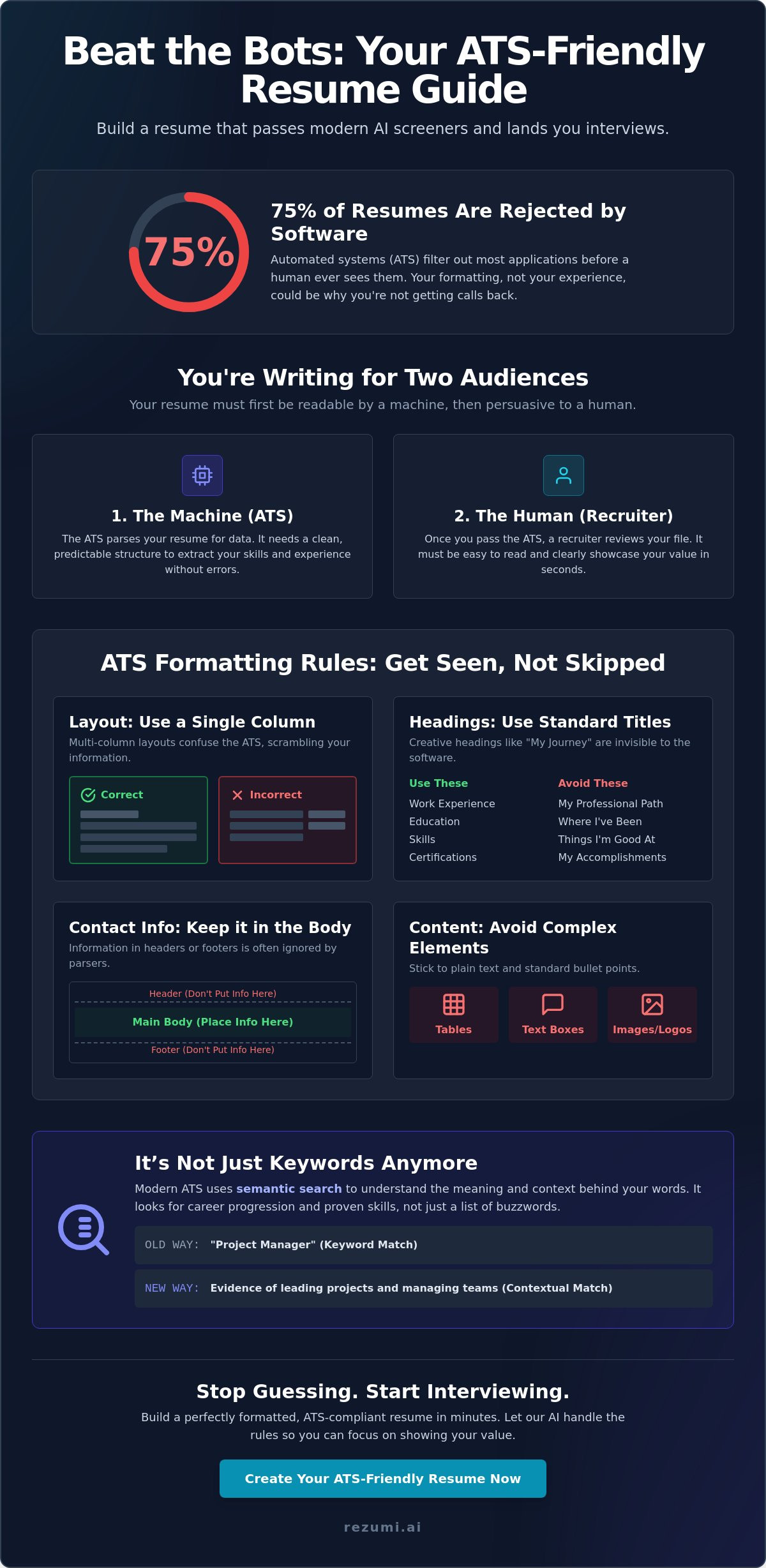
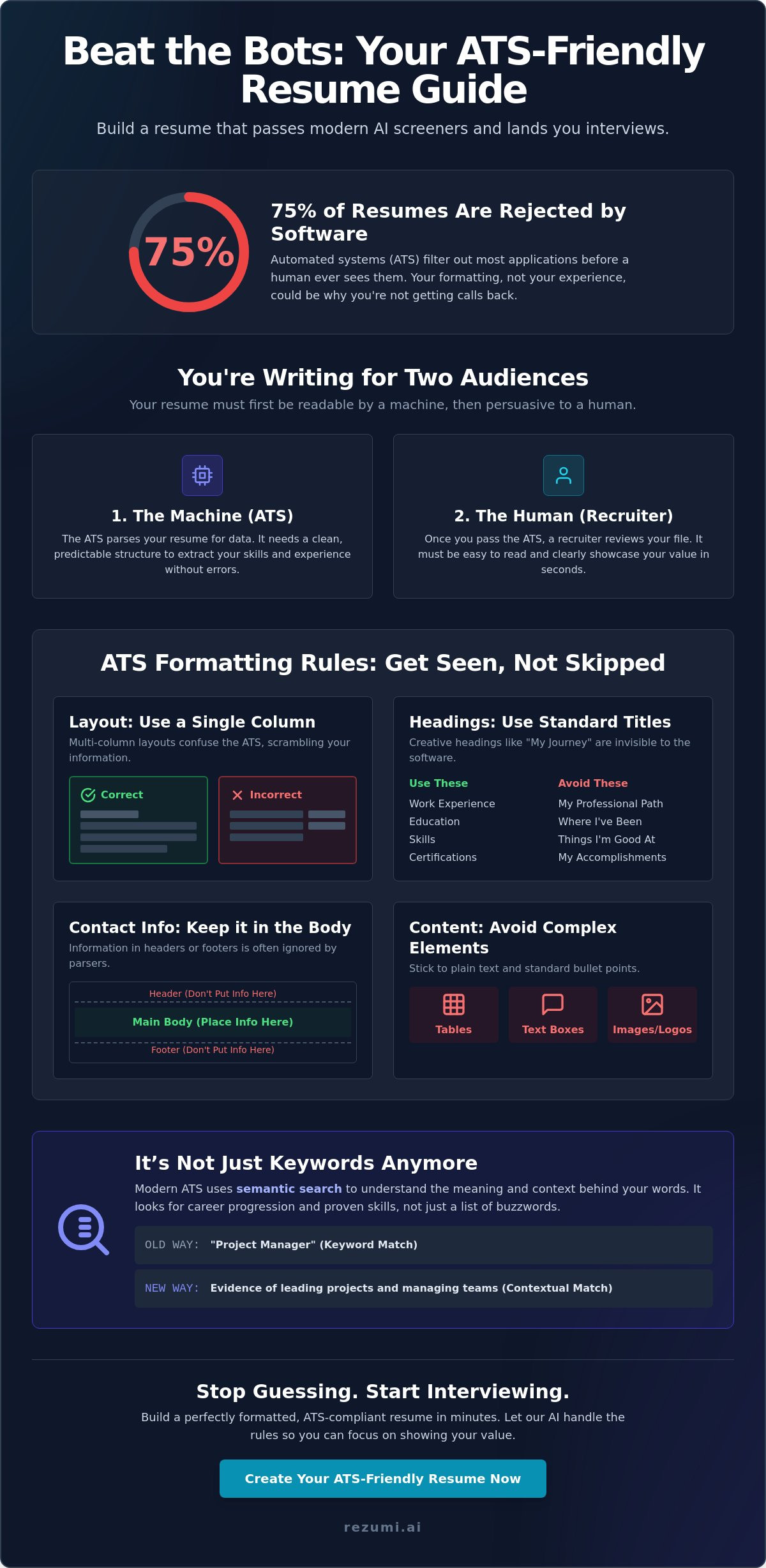
Approximately 75% of resumes are filtered out by automated systems before a human ever sees them. You might spend hours tailoring your experience only to receive a rejection email seconds after clicking submit. It feels like your hard work disappeared into a black hole. You know you have the skills for the role, but your current approach to an ats-friendly document might be the only thing standing in your way.
It is frustrating to feel like a machine is judging your entire career. You deserve a fair shot at the roles you are qualified for. We are going to show you exactly how to build a resume that passes modern AI screeners and secures interviews in the North American market. You will stop guessing about layout and start using a strategy that works for systems like Workday and Taleo every time.
This article provides a clear look at the technical requirements of 2026 hiring. We will cover why single-column layouts are mandatory and which file formats 53% of hiring managers now prefer. You are about to learn how to align your experience with what recruiters actually want to see without the stress of manual formatting.
Key Takeaways
- Learn why a single-column layout is essential for letting AI parsers (software that reads and sorts text) read your work history correctly from top to bottom.
- Avoid common formatting traps like creative section titles that cause an ats-friendly resume to be rejected automatically by modern systems.
- See how semantic search (technology that understands the meaning behind words) now evaluates your professional intent instead of just counting keywords.
- Ensure your contact information is visible by placing it in the main body of your document instead of the header or footer sections.
- Prepare for the North American market by using data-backed strategies that satisfy both automated screeners and human hiring managers.
What is an ATS-friendly resume in the 2026 job market?
An ats-friendly resume is the bridge between your experience and a recruiter's digital database. It is no longer just a document; it is a data source designed for machine consumption. Modern systems use AI to extract your work history, skills, and contact details into a digital profile. If your resume is not built for this extraction, you don't exist in the recruiter's system. In 2026, being ats-friendly means your resume must be technically readable and contextually relevant. You are writing for two audiences at once. First, the machine. Second, the human hiring manager who eventually reads the parsed data.
Technical readability is the foundation of your success. It ensures the parser (the software that reads your text) converts your file into a clean profile without errors. If you use complex layouts or non-standard fonts, the data breaks. Contextual relevance is the second layer. This means your experience aligns with the job's intent. The AI doesn't just look for words; it looks for meaning. It determines if your past roles actually prepared you for the one you want today. It is a sophisticated process that requires a strategic approach to every bullet point.
The role of the invisible gatekeeper
Recruiters at major North American companies use an Applicant Tracking System (ATS) like Workday or Greenhouse to manage thousands of applications. This software acts as a filter. It ranks you based on how well your profile matches the specific job description. If the software cannot read your file, a human may never see your experience. You are effectively invisible. This is why many qualified candidates receive instant rejections. The system didn't reject your skills; it rejected your formatting. Success requires a document that satisfies the software's logic while maintaining high professional standards.
Why simple keyword stuffing no longer works
Older systems were simple. They looked for exact word matches like "Project Manager" or "Sales Representative." If you missed one specific word, you were out. That era is over. 2026 systems understand synonyms and related concepts through semantic search. Your resume needs to show a logical career progression, not just a list of buzzwords. AI now analyzes the context of your achievements. It looks for how your skills have grown over time. For example, if you list "leadership" as a skill, the AI looks for evidence in your work history to back it up. It rewards clarity and evidence over repetitive keywords. You must prove your value with facts, not just list nouns.
This evolution means you can't trick the system anymore. You have to be honest and clear. Use standard job titles that the AI recognizes. Describe your results with numbers and percentages. When you show a clear path of growth, the AI ranks you higher. It sees you as a low-risk, high-reward candidate. This alignment is what gets you through the gate and into the interview room. It is about being smarter than the software by giving it exactly what it is programmed to find.
The technical rules for ATS-friendly formatting
A clean, single-column layout is the only way to guarantee the parser reads your history in the correct order. Building an ats-friendly layout requires you to prioritize function over fashion. Multi-column resumes might look modern, but they often confuse the software. The AI reads from left to right, across the entire page. If you have two columns, it might mix your skills from the left with your job titles on the right. This creates a broken profile that gets rejected immediately.
Use standard headings to guide the software. Labels like "Work Experience," "Education," and "Skills" are universal markers. Creative titles like "My Professional Path" or "Where I've Been" might sound unique, but they are invisible to an ats-friendly parser. When the system can't find a standard header, it often fails to categorize your experience correctly. If you want to ensure your document meets every technical requirement, you can check out our professional resume design and export tools.
Avoid using tables, text boxes, or images. These elements are often treated as "dead zones" by the computer. While you see a neat table of skills, the AI sees a blank space or a string of garbled characters. Stick to plain text and simple bullet points to keep your data accessible. Choose professional, web-safe fonts like Arial, Calibri, or Georgia. These are safe bets because they are easy for both machines and humans to read. Keep your body text between 10 and 12 points to ensure your resume looks polished on any screen.
Choosing the right file type
PDF is the gold standard for 2026. Research shows that 53% of hiring managers prefer text-based PDFs because they preserve your formatting perfectly. While 43% still favor Word documents (.docx), modern AI handles both formats with high accuracy. Always name your file professionally, such as "Firstname-Lastname-Resume.pdf." This makes it easy for recruiters to find your application in their database and prevents your file from getting lost in a sea of generic downloads.
North American design standards
You must set your document to US Letter size (8.5 x 11 inches) for applications in the US and Canada. International A4 sizes can cause layout shifts when printed or viewed on standard North American software. Keep margins at exactly one inch on all sides to maintain a professional balance. Finally, never include a photo, your age, or your marital status. North American labor laws discourage these details to prevent bias during the hiring process. Including them can actually trigger an automatic rejection to protect the company from legal risks.
Semantic search: How AI reads your resume today
Modern AI looks for the intent behind your bullet points. It doesn't just scan for specific words like a basic search engine. It tries to understand what you actually did in your previous roles. In 2026, an ats-friendly document must be written for semantic search. This is a technology that focuses on the meaning of phrases rather than just matching characters. For example, a modern system interprets "led a team" as exactly the same as "managed a department." You don't have to stress over finding every possible synonym for your job title anymore.
The software now groups your skills into categories like "Leadership" or "Technical Proficiency" automatically. If you list several programming languages, the AI understands you are a developer even if you never use that specific noun. Context matters much more than frequency. Mentioning a skill once in a high-impact sentence is better than repeating it five times in a list. The machine is looking for evidence of your expertise. It wants to see how you applied your knowledge to solve a problem.
Keyword matching vs. semantic intent
Keyword matching is about finding the word. Semantic intent is about proving the skill. To succeed in the North American market, you should use strong action verbs to describe your results. Don't just list your daily duties. Instead of saying you were "responsible for sales," say you "generated $1.2 million in new business." This gives the AI concrete metrics to verify your claims. These numbers act as data points that increase your credibility with the system. They prove you didn't just show up to work; you delivered value.
Focus on the outcome of your actions. If you improved a process, state by what percentage it became faster. If you saved money, list the dollar amount. This level of detail satisfies the ats-friendly requirement for semantic depth. It shows the AI that you have the specific experience the employer needs. It turns your resume from a simple list into a high-performance data profile.
The importance of the resume score
Many hiring platforms now give you a score based on your alignment with a specific job description. This score acts as a filter for recruiters who have too many applications to read. A high score does not guarantee a job offer, but it moves you to the top of the recruiter's list for a human review. It is a tool for prioritization. You can learn what is a good resume score for your industry to see where you stand. Aim for a score that reflects both technical accuracy and deep semantic alignment.
Common mistakes that trigger automatic rejections
Your qualifications don't matter if the system can't see them. Many candidates lose out on interviews because of simple technical errors that make their data unreadable. Placing your contact information in the header or footer is a common trap. While it looks clean to you, many parsers skip these sections entirely. This leaves the recruiter with no way to contact you, even if you are a perfect match. Always place your email and phone number in the main body of your document to keep it ats-friendly.
Creative section titles also cause confusion. Using "My Journey" or "Professional Story" instead of "Work Experience" breaks the logic of the software. It doesn't know where your history starts or ends. You should also avoid applying with a generic resume. If the job title in your document doesn't match the one in the posting, the AI assumes you aren't a fit. Finally, never submit a scanned image of your resume. A PDF must be text-based so the computer can copy and paste your details into its database. When you scan a physical paper, the computer sees an image, not text, resulting in a blank profile.
The danger of 'hidden' text
Do not use white text to hide keywords in the background. This was an old trick to boost rankings, but it is now a major red flag for any ats-friendly document. Modern systems are programmed to detect "keyword stuffing" and will flag your profile as spam. You want to focus on checking your resume for ATS using tools that respect the software's rules. If you are ready to build a document that follows these standards perfectly, you can start with our ATS resume optimization services.
Inconsistent dates and formatting
Use a consistent date format like MM/YYYY throughout your entire document. If you use "May 2024" in one section and "05/2024" in another, the AI may calculate your total years of experience incorrectly. Address gaps in employment clearly. If you took time off for personal growth or education, list it as a brief entry so the timeline remains unbroken. This prevents the system from flagging you for unexplained periods of unemployment.
Ensure your contact information and job titles match your LinkedIn profile exactly. Inconsistencies between your resume and your online presence can trigger manual flags during the background check phase. Recruiters often use tools that cross-reference your application with your public profiles. If your dates don't align, it creates doubt about your accuracy. Keep your data synchronized across all platforms to build trust with both the machine and the human hiring manager.
How Rezumi optimizes your application for 2026
Rezumi gives you a strategic advantage by automating the complex technical rules of 2026 hiring. Our platform uses AI to tailor your resume specifically for the North American market, ensuring your experience aligns with the expectations of top recruiters. You don't have to worry about whether your layout is technically readable or if your bullet points have enough semantic depth. We check for both simultaneously. This means your resume will pass through systems like Greenhouse or Workday while also proving your value to the human manager who reads it next. Every document you create is designed to be ats-friendly from the first pixel to the final period.
You can manage your entire job search from a single, high-performance workspace. Our platform includes a Profile Editor that allows you to refine your details and store different versions of your experience for various industries. You can also generate professional cover letters that match your resume's style and tone perfectly. This consistency builds a stronger personal brand and shows employers that you are a polished, high-quality candidate. When you are ready, use our Resume Design and PDF Export features to create a document that looks as good to a human as it does to a machine.
Real-time feedback and scoring
You get instant feedback on your document quality before you ever hit the submit button. Our scoring system analyzes your resume against the specific requirements of your target role. It identifies missing skills and keywords that are critical for passing the initial screening. You can see how your current score compares to the standards of top-tier companies, giving you the confidence to apply only when your document is fully optimized. This real-time analysis ensures your ats-friendly strategy is backed by data, not guesswork. You will know exactly which bullet points need more metrics and which sections require better formatting.
Take control of your job search
Stop wondering why you are receiving rejection emails and start using a strategy that works. Rezumi replaces the anxiety of the job hunt with a clear, instructional path to success. Once your resume is ready, you can prepare for the next step with our AI-driven interview coaching tools. These tools help you practice your responses to common questions and refine your delivery so you feel ready for any high-stakes conversation. Success in 2026 requires more than just a good document; it requires a complete preparation strategy. You can check out our flexible pricing plans to start optimizing your career path today.
Secure Your Seat at the Interview Table
You now have the technical blueprint to satisfy the machines. Modern hiring is no longer a guessing game; it's a data challenge you can win. By shifting from basic keyword lists to semantic intent and keeping your formatting strictly text-based, you've removed every barrier between your skills and a recruiter. Your ats-friendly document is now a high-performance tool ready for the most advanced parsers in the industry.
Thousands of successful professionals already use our AI-powered semantic matching to stay ahead of the curve. Our platform is specifically tailored for the North American market to ensure your document meets every local standard. Stop waiting for a response that never comes and start using a strategy that forces the system to take notice. Optimize your resume for the 2026 market with Rezumi and take control of your professional future. You've got the experience. We've got the technology to make sure it gets seen. Your next big opportunity is waiting.
Frequently Asked Questions
Can ATS read resumes with two columns?
No, you should avoid two-column layouts because they often confuse the parsing software. The system reads from left to right across the entire page. If you have two columns, the AI might merge unrelated text from both sides into a single line. This results in a garbled profile that human recruiters will never see. Stick to a single-column format to ensure your data remains organized and readable.
Is it better to use a PDF or a Word document for ATS?
PDF is generally the superior choice for 2026 as long as it is a text-based file. Research shows that 53% of hiring managers prefer PDFs because they preserve your layout across different devices. Word documents (.docx) are also acceptable and favored by 43% of recruiters. Unless the job application specifically asks for a Word file, a text-based PDF is your safest bet for maintaining professional formatting.
Does every company use an Applicant Tracking System?
Almost every large company and over 95% of Fortune 500 businesses use an Applicant Tracking System to manage candidate data. While some small businesses still review resumes manually, it is safer to assume your document will be screened by software first. Preparing an ats-friendly resume ensures you are ready for any hiring environment; it protects your application from technical errors regardless of the company size.
How do I know if my resume is ATS-friendly?
You can test your document by copying the text and pasting it into a plain text editor like Notepad. If the text appears in a logical order without scrambled characters or missing sections, the parser can likely read it. You should also check that your contact information is in the main body rather than the header. For a more detailed analysis, use a professional optimization tool to verify your semantic alignment and technical readability.
Can I use color and bold text on an ATS-friendly resume?
Yes, you can use bold text and standard colors as long as the underlying text remains readable. Bold headings help both the AI and human recruiters identify key sections of your career history. However, avoid using light colors or background shading that might make the text difficult to parse. Your primary goal is clarity. Stick to dark text on a white background to ensure the software extracts your information without any errors.
What are the best keywords to use on my resume?
The best keywords are the specific skills, job titles, and tools mentioned in the job description you are targeting. Modern AI looks for semantic intent, so use verbs that prove your expertise rather than just listing nouns. If a job post emphasizes budget management, ensure that exact phrase appears in your work history. Include real numbers and metrics to give the AI data points that verify your proficiency in those areas.
Should I include a summary or an objective on my resume?
Use a professional summary instead of an objective to show immediate value to the employer. Objectives focus on what you want, but summaries highlight what you can do for the company. A well-written summary provides a high-level view of your career that the AI can quickly categorize. It is an excellent place to include primary keywords and set the stage for your specific achievements listed later in the document.
How long should an ATS-friendly resume be?
Your resume should be one page if you have less than ten years of experience and no more than two pages for senior roles. Keeping your document concise ensures that the AI and the recruiter can find the most relevant information quickly. An ats-friendly document doesn't need to be long; it needs to be dense with relevant facts and metrics. Focus on your most recent and impactful work to keep the focus on your current value.
Disclaimer
This article is provided for general informational purposes only and does not constitute professional, legal, financial, or career advice. While Rezumi strives for accuracy, we make no warranties as to the completeness or reliability of this content. Hiring practices, ATS behavior, and job-market conditions vary by employer, industry, and region — always verify against your specific situation. Any action you take based on this article is at your own risk.