AI Resume Scanner: How to Command the 2026 North American Market
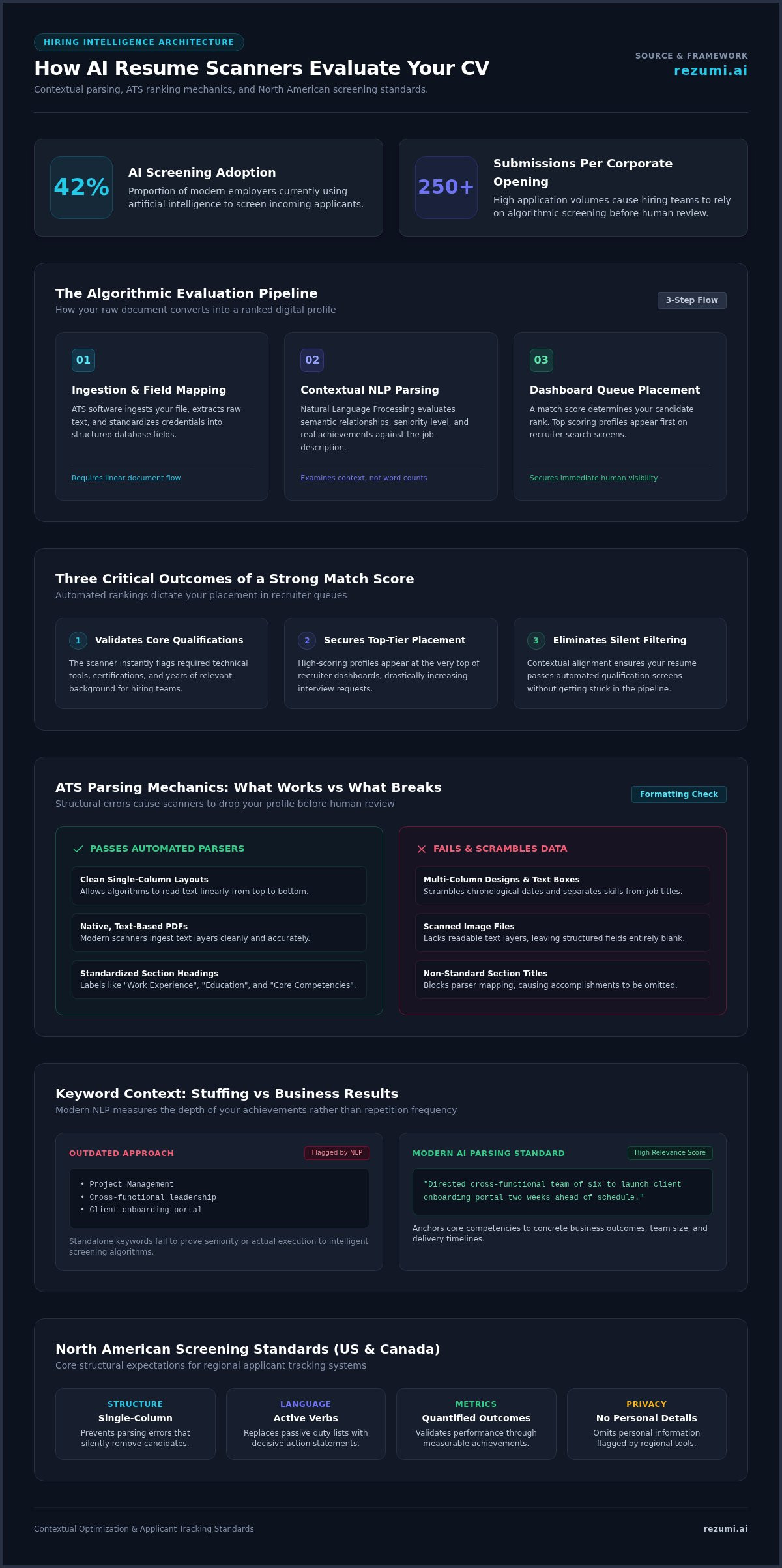
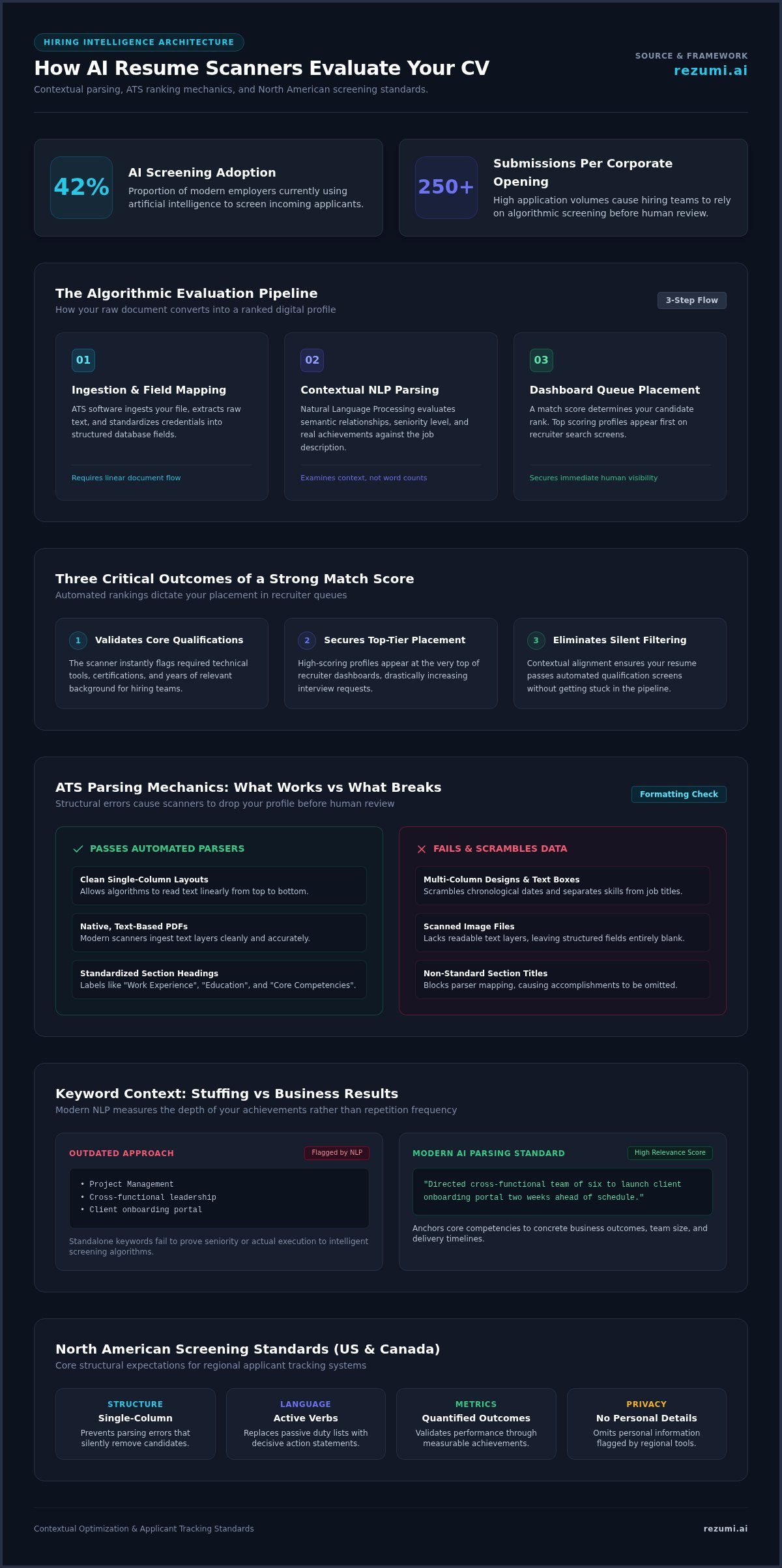
With 42% of employers using artificial intelligence to screen applicants, an ai resume scanner evaluates context and real achievements rather than simple keyword matches. If you feel exhausted from spending hours tailoring bullet points only to receive instant rejections, you're not alone. It's frustrating to know you're fully qualified for a role while an automated system decides whether a human ever sees your name.
Hiring systems aren't mysterious black boxes built to shut you out. They're structured screening tools, and once you understand their mechanics, you take back control. You'll discover exactly how modern scanners score your experience, what top employers across the US and Canada see behind the scenes, and how to format your resume to consistently pass ATS filters.
Here, we break down the latest shifts in semantic parsing, the layout mistakes that trigger technical errors, and the exact steps to turn automated screening into your greatest career advantage.
Key Takeaways
- An ai resume scanner ranks your experience through contextual parsing, meaning relevant achievements matter far more than simple keyword stuffing.
- Clean, single-column formatting prevents parsing errors that silently remove qualified candidates from recruiter pipelines.
- US and Canadian employers prioritize quantified outcomes and active verbs over personal details and generic duty lists.
- Benchmarking your CV against specific job descriptions exposes clear competency gaps before you submit an application.
- Managing your tailored drafts within a centralized workspace keeps your search structured and aligned with current hiring expectations.
What is an AI Resume Scanner and Why Does it Matter?
An ai resume scanner is specialized software that reads your resume, extracts your professional details, and scores your candidacy against a specific job posting. Corporate openings routinely receive 250 or more submissions. To process this volume, hiring teams rely on algorithmic screening to decide which applications warrant a deeper look.
The technology driving these evaluations has evolved quickly. Modern platforms use Natural Language Processing (NLP) to understand the real context of your career history. Instead of blindly counting keywords, an intelligent scanner examines how your accomplishments, technical proficiencies, and past responsibilities demonstrate capability for the target role.
The Role of Applicant Tracking Systems
Before any hiring manager opens your file, your application enters an Applicant Tracking System (ATS). This software serves as the central administrative hub for recruitment. It ingests your file, converts the text into structured fields, and builds a standardized digital candidate profile.
Recruiters interact with this database using precise search parameters. They filter candidates by core competencies, specific job titles, and location. If your resume uses non-standard section titles or multi-column layouts, the parser can scramble dates and omit key accomplishments. When the database fails to capture your credentials accurately, recruiters simply won't see your profile in their search results.
Why a High Match Score is Critical
Your match score directly dictates your placement in the recruiter's queue. Recruiters face tight hiring deadlines and rarely review applicants who fall outside the top tier of automated rankings. A strong score ensures your application commands immediate attention.
Maintaining a competitive score achieves three vital outcomes:
- Validates core qualifications: The scanner instantly flags required technical tools, certifications, and years of relevant background.
- Secures top-tier placement: High-scoring profiles are displayed first on recruiter dashboards, drastically increasing the likelihood of an interview request.
- Eliminates silent filtering: Contextual alignment ensures your resume passes basic qualification screens without getting stuck in the pipeline.
How AI Resume Scanners Evaluate Your CV in 2026
Modern recruitment technology doesn't just scan for isolated words. It evaluates your career progression. An advanced ai resume scanner examines semantic relationships across your work history, checking whether your past responsibilities match the seniority level required for the target job.
Parsing Text and Formatting Layers
Outdated career guides often claim that automated systems cannot read PDF files. In reality, modern scanners handle native, text-based PDFs without difficulty. The actual problem comes from scanned image files, complex columns, and visual elements that scramble your text order.
When software analyzes your document, it looks for predictable structural markers:
- Standard headings such as "Work Experience," "Education," and "Core Competencies"
- Linear formatting that flows naturally from top to bottom without text boxes
- Clear employment timelines that tie job titles directly to specific employers
If an algorithm cannot map your text to standard database fields, it leaves those entries blank. That technical breakdown drops your ranking before a hiring manager ever sees your name.
The Importance of Keyword Context
Keyword stuffing no longer works. Modern systems evaluate how you used a skill rather than how many times you repeated it. Simply adding a long list of technical terms at the bottom of your page won't fool modern algorithms.
To satisfy an ai resume scanner, anchor your key proficiencies to concrete business results. Instead of writing "Project Management" as a standalone bullet, write: "Directed cross-functional team of six to launch client onboarding portal two weeks ahead of schedule." This phrasing shows the system the depth of your expertise while proving your value to human recruiters.
To see how automated systems interpret your current layout and credentials, review Rezumi's ATS resume optimization features to benchmark your profile before submitting your next application.
North American Standards: Optimizing for US and Canada
Targeting employers in the United States and Canada requires a specific structural approach. Many international applicants submit multi-page documents filled with personal details, unaware that North American screening tools flag these entries. A regional ai resume scanner checks for strict structural conformity, expecting a concise summary tailored to local employment practices.
Page setup matters before the system reads a single word. US and Canadian platforms expect standard US Letter sizing (8.5 x 11 inches) rather than international A4 dimensions. Submitting an A4 document can trigger unexpected margins and broken line breaks during parsing. Format your contact header cleanly: include your city, state or province, phone number, and LinkedIn URL without listing a complete street address.
Standard Resume Layouts for North America
Hiring algorithms in North America strongly favor reverse-chronological layouts. This format organizes your career history starting with your most recent role, allowing the parser to trace your growth cleanly. Check our guide on Choosing the Best Resume Format for the 2026 North American Job Market to align your background with recruiter expectations.
Never include photos, birth dates, marital status, or nationality. Anti-discrimination laws in both the US and Canada discourage employers from collecting this personal data. When a parser spots headshots or demographic markers, the system may purge the file to protect the employer from compliance liabilities.
Measurable Impact and Action Verbs
North American recruiters demand hard metrics over routine duty descriptions. An ai resume scanner scans your experience for high-impact action verbs connected to measurable business results. Passive descriptions consistently lower your competitive ranking.
Upgrade passive statements into quantified accomplishments:
- Routine task: Handled customer support tickets and trained new team members.
- Optimized result: Resolved 45+ daily technical tickets and coached 8 incoming representatives, cutting team onboarding time by 20%.
Open every bullet point with strong verbs such as "spearheaded," "engineered," or "directed." Follow with percentages, dollar amounts, or time savings. This structure satisfies the parsing engine while showing human hiring managers that you produce tangible results.
How to Use an AI Scanner to Tailor Your Application
Tailoring your resume takes minutes instead of hours when you use a diagnostic feedback loop. Upload your baseline resume alongside the target job description to run an initial match audit. An ai resume scanner instantly benchmarks your qualifications, revealing the specific hard skills, certifications, and contextual gaps that separate you from top candidates.
For a detailed breakdown of how automated checkers evaluate these data points, consult The High-Stakes Guide to ATS Resume Optimization: Mastering the Checker in 2026. Follow a clear four-step cycle for every submission:
- Audit: Upload your current draft to establish a baseline compatibility score.
- Compare: Paste the target job posting to identify missing skills and terminology.
- Refine: Revise bullet points to weave identified proficiencies into real accomplishments.
- Verify: Run a second scan to confirm your score increased without breaking layout rules.
Identifying and Closing Keyword Gaps
Focus on high-frequency competencies that appear across the employer's requirements. If an opening emphasizes "budget forecasting" four times and your resume only mentions "accounting," update your language. Integrate those exact terms directly into your historical bullet points rather than dumping them into a detached list.
Scanners also cross-reference your job titles against standard occupational categories. If your past internal title was creative but vague, such as "Client Happiness Specialist," add the standard industry equivalent in parentheses, like "(Customer Success Specialist)." This simple adjustment helps the system categorize your seniority correctly.
Final Review for Human Readability
Never sacrifice clean visual presentation just to satisfy an algorithm. An ai resume scanner might reward a document packed with dense jargon, but a human recruiter must review the file next. If your text looks cluttered or unnatural, the reviewer will reject it within seconds.
Pair your optimized resume with a tailored cover letter that explains your career trajectory. Running your materials through structured checks ensures you satisfy technical filters while delivering a polished document that impresses the hiring team.
Commanding Your Career with Rezumi Technology
Passing an automated screen is only your opening move. To secure high-value offers, you need a disciplined system that manages every stage of your hiring pipeline. Rezumi provides a centralized workspace built specifically around US and Canadian hiring benchmarks, turning raw data into an actionable application strategy.
An ai resume scanner offers the diagnostic baseline, but Rezumi equips you to act on those insights instantly. You receive real-time feedback that evaluates both technical alignment and professional clarity, ensuring every draft meets recruiter expectations.
Tailoring at Scale Without Losing Quality
Targeting different roles usually leads to messy folders filled with conflicting document versions. Rezumi eliminates that confusion. Through our Profile Editor and centralized workspace, you can manage targeted variations of your resume for distinct industries without rebuilding your work history each time.
Speed matters when top positions open. Our AI Cover Letter Generator pairs directly with your optimized resume, creating coordinated materials that reinforce your core qualifications. You save hours of tedious manual drafting while maintaining the exact standards required by competitive employers.
Preparing for the Interview
Once an ai resume scanner advances your profile past the initial filter, human decision-makers take over. Clearing the automated barrier earns you an audience, but your live performance seals the offer.
Rezumi's AI Interview Prep coaches you through targeted questions tailored to your target industry, giving you immediate feedback to refine your delivery. Review our companion guide on Strategic Interview Tips to Command the North American Job Market in 2026 to structure your answers, present your accomplishments with poise, and turn interview invitations into signed contracts.
Command Your Next Career Move
Automated recruitment tools don't have to stand between you and your career goals. When you treat an ai resume scanner as a strategic audit partner, you stop guessing what hiring algorithms want and start submitting verified, high-impact applications. Clean single-column layouts, strict adherence to North American standards, and quantified achievements ensure your profile clears filters and commands attention from real decision-makers.
Rezumi provides the edge you need to turn screening passes into signed offers. Built specifically for US and Canadian hiring benchmarks, our platform combines ATS resume optimization, centralized application tracking, and targeted AI interview coaching inside one focused workspace. You can manage multiple tailored drafts with ease, knowing every detail aligns with what employers expect.
Take the uncertainty out of your job search. With the right data and a structured plan, you can enter the hiring process with clarity, control, and complete confidence in your qualifications.
Frequently Asked Questions
Is a free AI resume scanner accurate enough for professional jobs?
Free tools often rely on basic keyword matching rather than semantic parsing. These simple platforms check whether specific words appear on the page, missing the nuance of your accomplishments. A dedicated ai resume scanner built for North American standards evaluates your phrasing, seniority level, and layout hierarchy, giving you the detailed feedback needed to compete for selective corporate roles.
Can an ATS read my resume if I use a PDF format?
Yes, modern recruitment platforms easily read native, text-based PDF files. Applicant tracking systems extract data cleanly from PDFs generated directly by text editors or modern career software. The real risk comes from scanned image PDFs, text boxes, and complex multi-column templates that scramble reading order. Sticking to a clean, single-column document keeps your text parseable.
How many keywords should I include to pass the scanner?
You should include the core hard skills and tools mentioned in the job post without repeating them artificially. Keyword density matters far less than contextual relevance. Aim to integrate required technical proficiencies and industry terms into your bullet points two or three times across your career history. Stuffing keywords into detached lists will trip spam filters.
Do I need to change my resume for every single job application?
Yes, you should tailor your resume for every serious opening you pursue. Submitting one generic resume lowers your match score against candidates who tailored their experience to the posting. You don't need to rebuild your work history from scratch. Adjust your summary statement, reorder your bullet points, and highlight the specific tools requested in the job description.
What is a good resume score to aim for in 2026?
Aim for a match score of 80% or higher before submitting your application. Reaching a perfect 100% score is rarely possible because job descriptions often contain contradictory or secondary requirements. An 80% score proves you meet the core requirements and formatting guidelines, placing your file high in the recruiter's search results for manual review.
Will using an AI resume builder get me banned by recruiters?
No, recruiters won't ban you for using AI tools to format and optimize your application. Hiring teams only reject submissions that feel generic, robotic, or disconnected from the actual work. Using an ai resume scanner to spot formatting errors and keyword gaps is standard practice. Keep your accomplishments authentic, accurate, and tailored in your own voice.
How does a scanner handle gaps in my employment history?
Scanners extract dates chronologically, but they don't automatically discard your application because of a gap. Screening software measures your cumulative years of relevant experience against role requirements. To prevent parsing errors, list both months and years for every position. If you took time off for consulting, caregiving, or continuing education, include that time as a clear entry.
Does the scanner check my LinkedIn profile too?
Standard scanners don't automatically inspect external links, but modern corporate systems pull public profile data once you apply. Recruiters use ATS enrichment features to cross-check your resume dates, previous employers, and certifications against your LinkedIn profile. Ensure your online employment timeline matches your resume so human reviewers don't spot conflicting career details.
Disclaimer
This article is provided for general informational purposes only and does not constitute professional, legal, financial, or career advice. While Rezumi strives for accuracy, we make no warranties as to the completeness or reliability of this content. Hiring practices, ATS behavior, and job-market conditions vary by employer, industry, and region — always verify against your specific situation. Any action you take based on this article is at your own risk.