Behavioral Interview Questions: The 2026 Guide to Winning Your Next Role
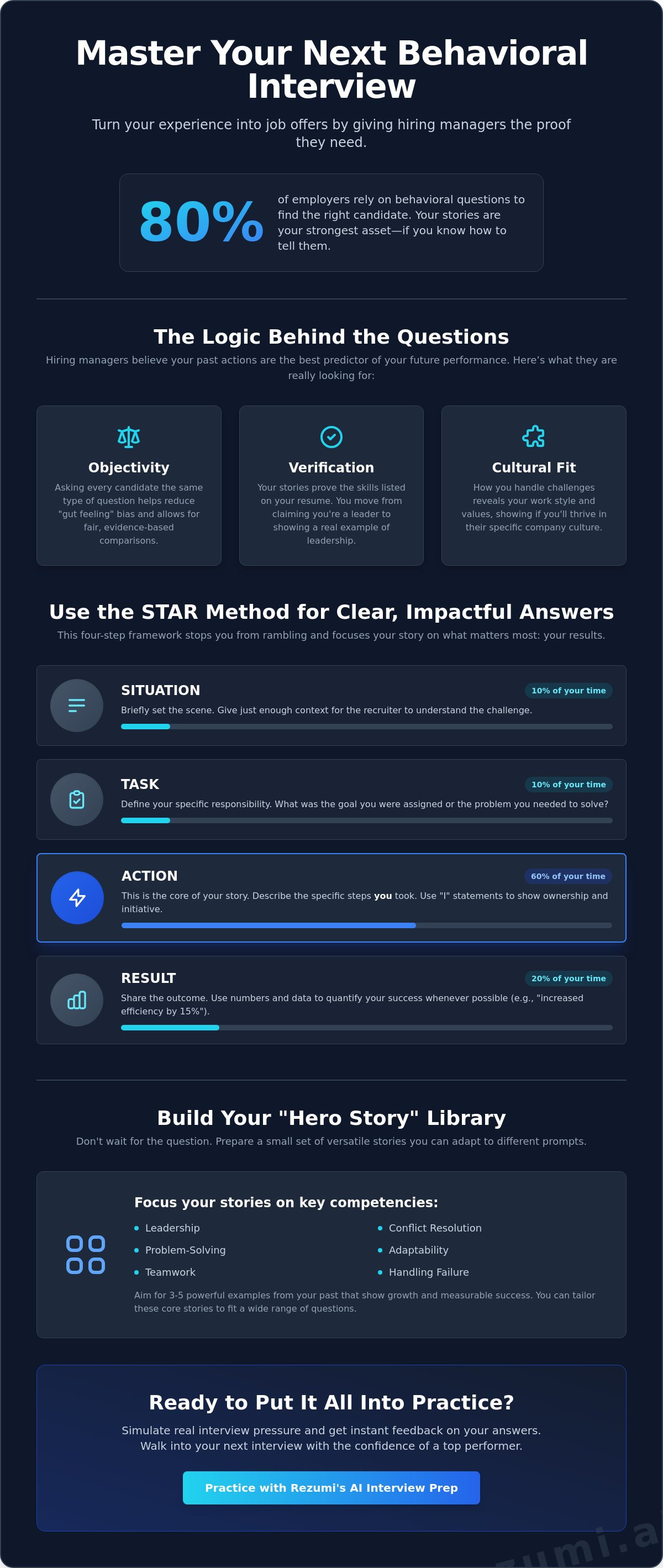
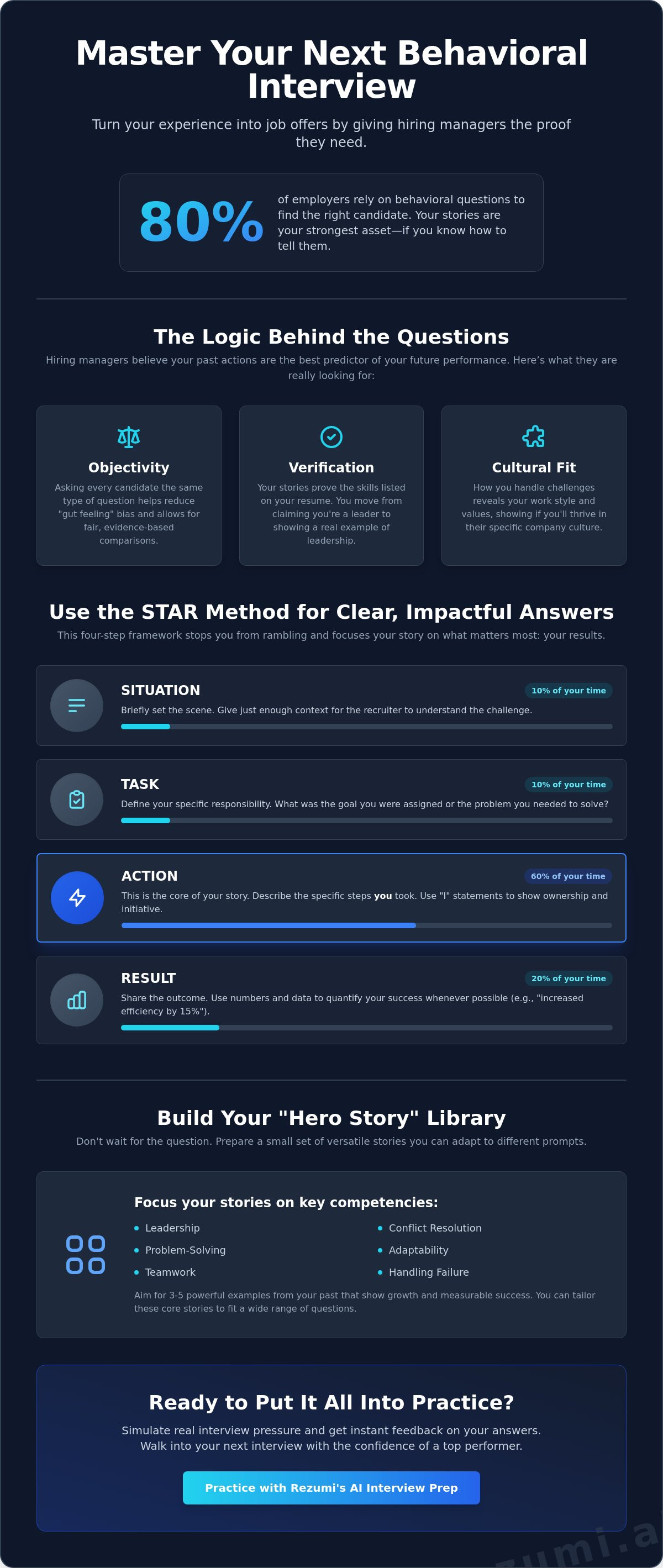
80% of employers now rely on behavioral interview questions to decide if you are the right fit for their team. It is a high-stakes moment where a single "Tell me about a time" prompt can make or break your candidacy. Most candidates feel a spike of anxiety when preparing for a behavioral questions interview. You might worry about rambling, forgetting your best achievements, or failing to explain a past mistake without sounding like a liability.
You deserve to walk into the room feeling like a strategic partner rather than a nervous applicant. This guide will help you turn your work history into a library of high-impact stories. You will learn how to deliver the structured, data-backed answers that hiring managers and AI screening tools look for in 2026. By following this strategy, you can replace uncertainty with a proven system for success.
We are going to move past generic advice and look at the exact mechanics of winning responses. You will discover a clear framework for handling unexpected questions, identifying your most relevant wins, and proving your future value to any employer. Let's start building the confidence you need to secure your next role and land the offer you want.
Key Takeaways
- Identify the hidden logic recruiters use to evaluate your soft skills and prove your future value to the team.
- Master the STAR framework to keep your behavioral questions interview responses structured, concise, and impactful.
- Transform difficult questions about conflict or failure into high-impact stories that demonstrate your professional growth and resilience.
- Build a small library of versatile hero stories that you can adapt for almost any leadership or problem-solving prompt.
- Use AI Interview Prep to simulate real interview pressure and refine your delivery before you meet the hiring manager.
Understanding Behavioral Interview Questions and the Logic Behind Them
Hiring managers use behavioral questions to strip away the polish of a prepared pitch. Instead of asking what you would do in a hypothetical situation, they ask what you actually did in a real one. This shift from the theoretical to the historical is intentional. It provides concrete evidence of your soft skills, such as leadership, conflict resolution, and adaptability. The fundamental philosophy is simple. Your past actions are the most accurate predictor of your future performance.
You can identify these prompts by their distinctive openers. Phrases like "Tell me about a time you faced a tight deadline" or "Give me an example of a conflict with a coworker" are classic examples. These are not invitations to speak in generalities. They are direct requests for a specific story with a measurable outcome. In a behavioral questions interview, your goal is to provide a narrative that proves you have already solved the types of problems the company is currently facing.
Why North American Hiring Managers Prefer This Style
Objectivity is the primary driver for this interview format in North America. By asking every candidate the same set of behavioral questions, companies can compare responses based on specific evidence rather than "gut feelings." This helps reduce unconscious bias and creates a more equitable hiring process. It also serves as a critical verification tool. While a resume can claim you are a "proactive leader," a behavioral response requires you to prove it with a real-world scenario. Managers use these stories to cross-reference the claims made on your profile with your actual professional history.
Cultural fit and situational judgment are also at the forefront. Managers want to see how you react when things go wrong. They are looking for alignment between your decision-making process and the company's internal values. If a firm prizes speed over perfection, they will listen for stories where you prioritized rapid deployment. If they value consensus, they will look for examples of collaborative problem solving.
The Hidden Competencies Behind the Questions
Every behavioral question has a hidden intent. When a recruiter asks about a time you disagreed with a supervisor, they aren't looking for drama or gossip. They are measuring your emotional intelligence and professional maturity. They want to see if you can handle friction without damaging professional relationships. Interpreting what the recruiter is actually asking is the first step toward a successful answer.
Successful candidates focus on ownership and accountability. Even when discussing a team failure, you must highlight your specific role and the actions you took to rectify the situation. Using the STAR method helps you organize these thoughts so the recruiter can easily spot your individual contributions. Always align your stories with the specific competencies listed in the job description. If the role requires high adaptability, ensure your story bank includes moments where you pivoted successfully under pressure.
Using the STAR Method to Build High Impact Responses
The STAR method is your strategic roadmap for every behavioral questions interview. It provides a logical flow that prevents rambling and ensures you hit every key point. By following this structure, you transform a vague memory into a compelling case study of your professional value. The framework consists of four distinct phases: Situation, Task, Action, and Result.
- Situation (10%): Briefly set the scene. Provide just enough context for the listener to understand the environment.
- Task (10%): Define the specific challenge or goal. What was the problem that needed a solution?
- Action (60%): This is the core of your answer. Detail the exact steps you took to address the task.
- Result (20%): Share the final outcome. This is the payoff that proves your effectiveness.
Efficiency is key here. You want to spend most of your time on the "Action" phase because that is where you demonstrate your skills. However, the "Result" is what ultimately sells you to the recruiter. If you find it difficult to organize your thoughts in real-time, you can explore structured preparation tools to help refine your delivery.
Mastering the Action Phase
The Action phase is your opportunity to show, not just tell. You must use "I" instead of "we" throughout this section. Recruiters are hiring you, not your former team. Even if the project was a group effort, focus on your specific contributions and decision-making process. Break your process down into three or four logical steps. Mentioning specific tools like Python, Salesforce, or specialized project management software adds a layer of technical credibility to your story. It shows you have the practical knowledge to execute high-level tasks.
Quantifying Your Results for Maximum Impact
North American recruiters prioritize results over activities. A story without a measurable outcome is just a list of tasks. You should always include concrete data points like percentages, dollar amounts, or time saved. For example, instead of saying you "improved efficiency," state that you "reduced processing time by 15% over six months." This provides the "so what" that businesses need to see your ROI. For more detailed examples of how to frame these wins, check out our guide on Mastering the STAR Technique to ensure your stories stand out.
Common Behavioral Questions and Strategic Answer Frameworks
Preparing for a behavioral questions interview requires more than just memorizing stories. You need to understand the strategic intent behind the most common prompts. Recruiters use specific categories to test your resilience and professional maturity. They want to see how you handle the friction and volatility of a modern workplace. By using a structured framework, you can turn these high-pressure moments into proof of your future ROI.
Most behavioral prompts fall into four main categories: conflict, failure, initiative, and adaptability. Each one requires a different strategic focus to be successful. You aren't just recounting the past. You are demonstrating that you possess the specific soft skills the company needs to hit its 2026 targets. Let's break down how to handle the two most difficult categories.
Answering the Conflict Question
Focus on the resolution and the preservation of the professional relationship. Conflict is inevitable in any high-performance environment, and recruiters ask this to see if you are a collaborator or a liability. Your answer must never blame a colleague or speak poorly of a former supervisor. This is a common trap that reveals more about your character than the actual situation. It makes you look difficult to manage.
Instead, demonstrate active listening and emotional intelligence. Choose a situation where the final outcome was productive for the business. Explain how you sought to understand the other person's perspective before proposing a data-backed compromise. Successful answers show you can prioritize team goals over personal ego. This proves you can maintain a professional edge even when tensions are high.
Turning Failure into a Strength
Show self-awareness by picking a real mistake that did not result in a catastrophe. The "tell me about a failure" question is often the most feared part of the process. You might feel the urge to pivot to a fake weakness, but recruiters see through that immediately. Authenticity is your best strategy. Lead with the immediate corrective action you took the moment you realized things went wrong. This shows you have the composure to handle stress and own your outcomes.
Explain the specific changes you made to your workflow afterward. Did you implement a new double-check system? Did you adopt a specific project management tool to track deadlines? This turns a negative event into proof of your capacity for rapid improvement. You are showing the recruiter that you learn faster than your peers. This type of growth mindset is a primary indicator of long-term success in senior roles.
Finally, be ready to discuss initiative and adaptability. Initiative is about identifying a gap and filling it without being told. It proves you think like an owner rather than just an employee. Adaptability is equally critical as companies pivot faster than ever. Your stories should highlight times you remained productive even when project scopes changed overnight. These responses show you are ready for the speed of today's hiring market.
Building Your Story Bank for Any Interview Scenario
Efficiency is your greatest advantage. You don't need to memorize dozens of different anecdotes to succeed in a behavioral questions interview. Instead, focus on developing 5 to 7 "hero stories" that demonstrate your core competencies. These are versatile narratives that you can adapt to fit various prompts. By refining a small set of high-impact examples, you reduce the risk of forgetting details under pressure and ensure your delivery remains polished.
Before you step into the interview, document each hero story using the STAR framework. This forces you to identify the specific metrics and actions that prove your value. Writing them down clarifies the narrative arc and helps you spot gaps in your logic. Once written, practice your stories out loud. This isn't about memorization; it's about internalizing the rhythm of the story so you sound confident and natural. For more tips on refining your performance, see our Mock Interview Guide.
Reverse Engineering the Job Description
Predicting the questions is easier than it looks. You must treat the job description as a cheat sheet for the interview. Scan the posting for repeated keywords like "cross-functional collaboration" or "data-driven decisions." If a skill appears multiple times, the recruiter will almost certainly ask for a behavioral example of it. Highlight these key skills and match them to your past achievements. This ensures your story bank is perfectly aligned with what the company actually needs to solve its current problems.
The Versatility Audit
A single story should serve multiple purposes. For example, a story about meeting a tight deadline might also demonstrate problem solving and technical proficiency. Run a "versatility audit" on your stories to ensure they cover both individual wins and team-based successes. If a story only answers one specific question, it isn't strong enough for your bank. You want examples that can pivot based on the recruiter's focus. Once your bank is ready, you can start practicing with AI-driven feedback to perfect your delivery and build real-time confidence.
Ensure your bank includes a mix of scenarios. You need examples of when things went well and when you had to manage a difficult situation. This variety proves you have a well-rounded professional toolkit. By auditing your stories for versatility, you ensure that no matter what the recruiter asks, you have a high-impact response ready to go. Often, professional success is linked to personal well-being; to explore health transformations that improve your quality of life, check out ד"ר אסנת רזיאל.
Optimizing Your Interview Skills with Rezumi AI Coaching
Preparation is only half the battle. You can have the most impressive hero stories in the world, but they won't matter if your delivery is shaky. Performance requires real-time feedback to ensure you stay on track. This is where many candidates stumble during a behavioral questions interview. They have the right experience, but they lose the recruiter's interest through poor pacing or a lack of structure.
Rezumi AI Interview Prep is designed to solve this problem by simulating real-world pressure. It isn't just a recording tool; it's a sophisticated coaching system that analyzes your responses as you give them. You receive instant data on your tone, pacing, and the logical flow of your STAR responses. This allows you to identify exactly where your story loses momentum before you ever meet a hiring manager.
How AI Coaching Polishes Your Delivery
Rambling is the most common reason candidates fail their interviews. AI coaching helps you identify filler words and long-winded explanations that weaken your impact. Instead of guessing if you're being concise, you get objective measurements of your answer length. The system suggests stronger action verbs and reminds you to include the quantified results we discussed earlier. This ensures your answers remain focused on your individual contributions and measurable success.
The goal is to move past memorization. You want your STAR responses to feel like a natural conversation rather than a rehearsed script. By practicing in a simulated environment, you build the muscle memory needed to stay calm when faced with unexpected prompts. You can refine your delivery until every story in your bank sounds confident and professional. This transition from uncertainty to control is what separates top candidates from the rest of the pool.
The Final Step to Job Search Mastery
Consistency is the hallmark of a senior professional. Your interview performance must align perfectly with the ATS-optimized resume you used to land the meeting. If your resume claims you're a data-driven leader, your behavioral responses must prove it with the same level of precision. This creates a cohesive personal brand that recruiters can trust. It shows you're exactly who you claimed to be on paper.
When your application and your interview tell the same story, you become the obvious choice for the role. You're no longer just another applicant; you're a proven solution to the company's problems. To get full access to these coaching tools and start refining your performance, check out Rezumi Pricing. Taking this final step ensures you're ready to turn your next interview into a firm job offer.
Secure Your Next Offer with Strategic Storytelling
You now have the framework to turn your past experiences into high-impact job offers. Success in a behavioral questions interview isn't about having a perfect work history. It's about how you structure your wins and failures using the STAR method. By building a bank of 5 to 7 versatile hero stories, you ensure you're never caught off guard by a recruiter's prompt. This approach replaces the anxiety of the unknown with the confidence of a data-backed strategy.
Preparation is the first step, but your performance is what closes the deal. You can master your next interview with Rezumi AI Prep to get immediate, AI-driven feedback on your STAR answers. Our platform is specifically tailored for North American hiring standards and has been used by thousands of successful professionals in 2026 to refine their delivery. Stop worrying about what might go wrong and start practicing with a tool that builds your real-time confidence.
You have the skills and the professional experience to succeed. Now you have the structural strategy to prove your future value to any employer. Step into your next meeting ready to lead the conversation and secure the role you deserve.
Frequently Asked Questions
How many stories should I have ready for a behavioral interview?
You should prepare 5 to 7 versatile hero stories for your behavioral questions interview. These stories should be broad enough to cover multiple themes like leadership, problem solving, and adaptability. Having a small set of well rehearsed examples prevents you from feeling overwhelmed while ensuring you have proof for any competency the recruiter tests. It is better to have a few high-quality stories than dozens of weak ones.
What if I cannot think of a specific example for a question?
Ask for a moment to reflect if you cannot immediately recall a relevant scenario. You can say, "That is a great question. May I have a moment to think of the best example?" If nothing comes to mind after a few seconds, ask to return to the question at the end of the interview. This shows composure and ensures you don't provide a weak or fabricated response under pressure.
Is it okay to use the same story for two different questions?
You should avoid using the exact same story twice during a single interview. Repeating yourself makes it seem like your experience is limited or one dimensional. If you must use the same situation, focus on a completely different action and result than you mentioned the first time. It is always better to have a diverse story bank that showcases the full range of your professional capabilities.
How long should a behavioral interview answer be?
Aim for a response that lasts between 2 and 3 minutes. This timeframe is long enough to include the necessary STAR details without losing the recruiter's attention. Spend the majority of this time on the Action portion of your story to show exactly how you solved the problem. If you go over 3 minutes, you risk rambling and diluting the impact of your achievement.
Should I talk about a personal failure or a professional one?
Always choose a professional failure rather than a personal one. Recruiters are looking for your ability to handle workplace challenges and improve your professional workflow. A personal failure might feel too intimate or irrelevant to the role you are seeking. Focus on a time you missed a deadline or made a technical error, then explain the corrective systems you built to prevent it from happening again.
How do I handle a question about a conflict with a manager?
Focus on the productive resolution and what you learned from the disagreement. Never badmouth your former manager or frame yourself as a victim of their decisions. Instead, explain how you used active listening to understand their perspective and worked toward a compromise that benefited the company. This demonstrates high emotional intelligence and proves you can maintain a professional relationship during high stakes disagreements.
Can I use examples from school if I am a recent graduate?
You can use academic examples if you are a recent graduate with limited work history. Focus on major group projects, leadership roles in student organizations, or challenging internships. Treat these scenarios with the same professional rigor as a full time job by highlighting your specific actions and measurable results. This shows recruiters you have the foundational soft skills needed to succeed in a professional environment.
What is the most common mistake people make in behavioral interviews?
The most common mistake is failing to provide a clear, measurable result. Many candidates spend too much time on the situation and forget to explain the payoff of their actions. Without a specific outcome like "saved 10 hours per week" or "increased revenue by 5 percent," your story lacks the proof recruiters need to see your ROI. Use a structured framework to ensure every answer ends with a strong win.
Disclaimer
This article is provided for general informational purposes only and does not constitute professional, legal, financial, or career advice. While Rezumi strives for accuracy, we make no warranties as to the completeness or reliability of this content. Hiring practices, ATS behavior, and job-market conditions vary by employer, industry, and region — always verify against your specific situation. Any action you take based on this article is at your own risk.