Cover Letter Templates: Your Strategic Guide for the 2026 Job Market
83% of companies use AI to screen your application before a human ever sees it. It's the reality of the 2026 job market. You need a strategy that turns these automated filters into your biggest advantage. Choosing the right cover letter templates is the first step in moving from a generic applicant to a top-tier candidate.
You likely feel the pressure to stand out while fearing your document looks unprofessional. You want a polished result that matches your resume perfectly. You need to save time without losing your voice. I understand the struggle to stay authentic while meeting strict corporate standards.
This guide provides the technical roadmap to choose and customize templates that command recruiter attention across North America. You will learn how to satisfy Applicant Tracking Systems (ATS), the software tools used to rank your profile, while still sounding like a human.
I'll show you how to use the 70-30 rule, which blends AI structure with your own voice, to prove your value. We are going to turn your application into a high-performance tool that secures the interviews you deserve.
Key Takeaways
- Pick cover letter templates that satisfy both automated filters and human recruiters so your application actually gets seen.
- Match your layout to your experience level, focusing on education for new grads or specific results for mid-career professionals.
- Update your header with your LinkedIn profile and use a direct, personalized greeting to avoid looking like a generic applicant.
- Use AI to align your past achievements with the job description by finding the specific keywords that matter most to the employer.
- Keep your design consistent across all documents to show hiring managers that you care about professional presentation.
What makes a cover letter template strategic in 2026?
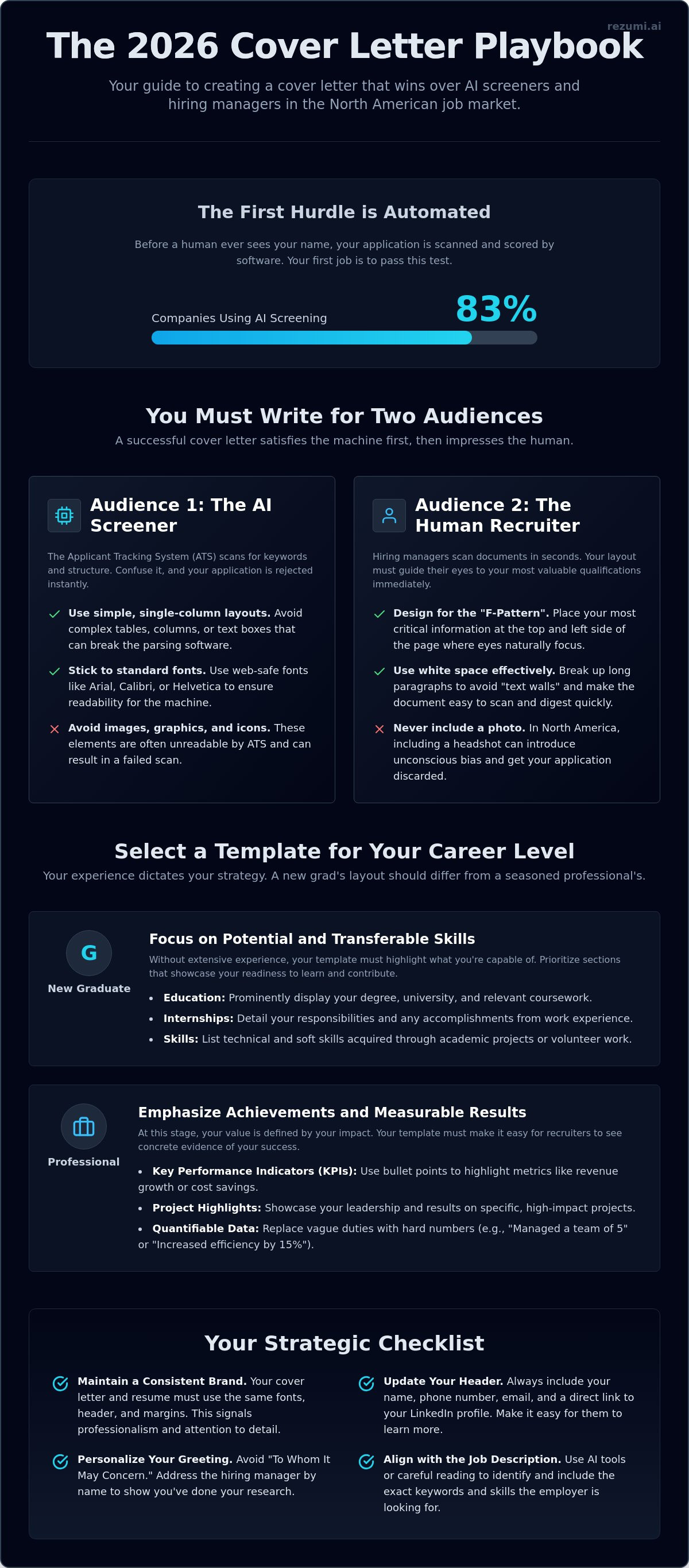
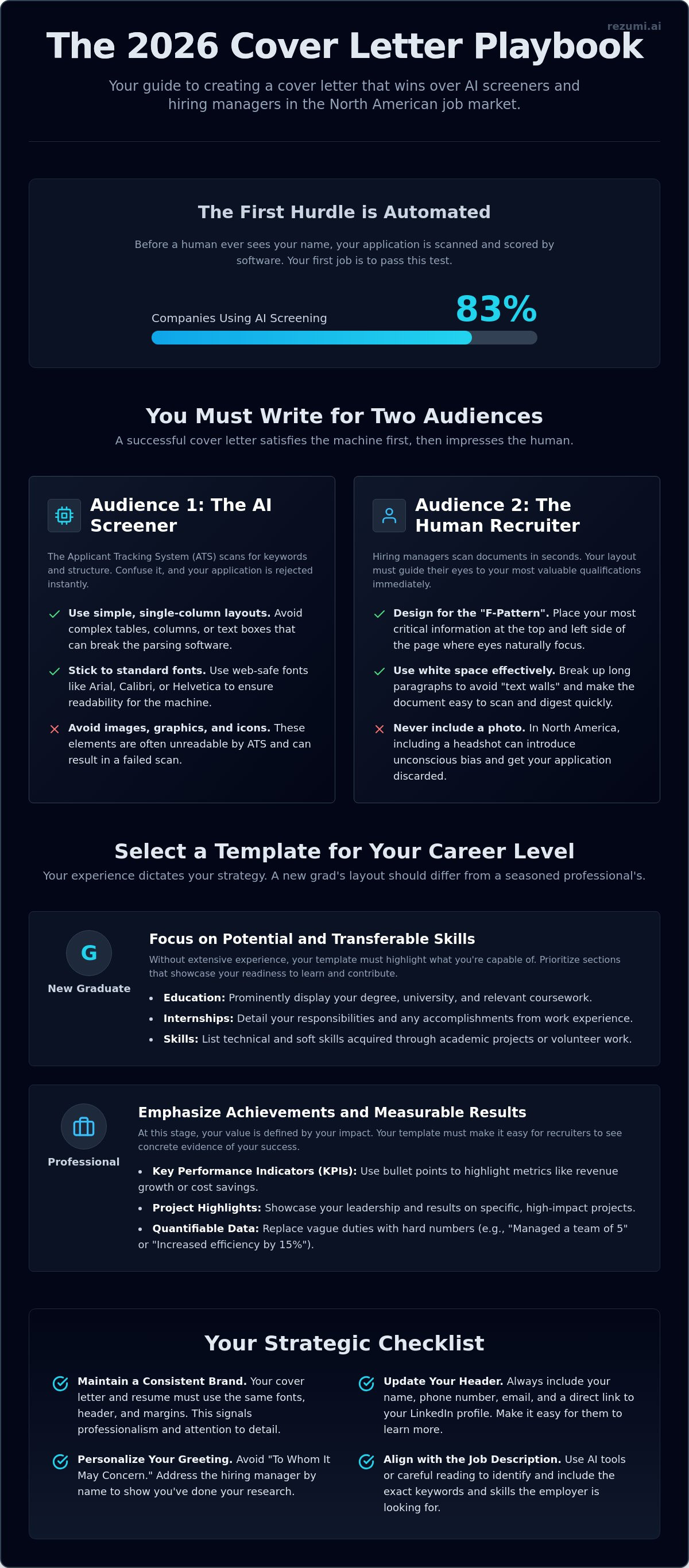
A strategic cover letter template is a bridge between two distinct audiences. First, it must satisfy the algorithms that decide if you are worth a human's time. Second, it must respect the limited attention of a recruiter who views dozens of applications every hour. To understand the basics of this document, you can review What is a Cover Letter? before you start building your own strategy. In 2026, the best cover letter templates prioritize data over decoration. They organize your career story so that your most valuable achievements are impossible to miss.
Consistency is your silent advocate. Your cover letter and resume should look like they belong to the same professional brand. Using the same fonts, margins, and header styles signals a high level of attention to detail. This visual alignment builds trust before a single word is read. It shows you are organized and prepared for a high-stakes role. Hiring moves fast. A uniform look reduces mental friction. It lets the recruiter focus on your value instead of trying to figure out your formatting.
The role of ATS in cover letter screening
Recent data shows that 83% of companies use AI to screen applications. These Applicant Tracking Systems (ATS) are software tools that scan your text for specific keywords and skills. If your template uses complex graphics, images, or multi-column layouts, the software might fail to read your content correctly. Stick to standard fonts like Arial or Calibri. These are "web-safe" and easy for machines to parse. A strategic layout ensures that your keywords are placed where the software expects to find them. This maximizes your chances of passing the initial automated filter.
Visual design vs. professional clarity
Humans read differently than machines. Busy recruiters often follow an "F-pattern" when looking at a page. They scan the top header, the first few lines of each paragraph, and the left side of the document. You should place your most impressive results in these high-visibility areas. Prioritize white space to prevent "text walls" that cause reader fatigue. In North American markets, you must avoid including photos or excessive icons. These additions can trigger unconscious bias and might lead to your application being discarded for compliance reasons. Focus on a clean, high-impact layout that highlights your professional readiness.
The goal is to shift from listing duties to proving impact. Don't just say what you did. Use your cover letter templates to show the value you created. A strategic choice helps you move from the "maybe" pile to the "interview" list by making your success metrics the center of the conversation. You are not just filling a role. You are solving a problem for the company.
Selecting the best cover letter template for your career level
Your choice of cover letter templates should change as your career evolves. A design that works for a college graduate will often fail for a senior executive. You need a layout that mirrors your current professional authority. Leading with the right visual structure tells a recruiter you understand your industry's standards before they read a single sentence.
New graduates should focus on templates that prioritize education and transferable skills. Since you may lack years of direct experience, your template needs to highlight your potential. Use a layout that gives space to internships, volunteer work, and relevant coursework. You can find excellent examples of how to structure these sections in the University of Arizona's cover letter guide. This approach shifts the focus from what you haven't done to what you are capable of achieving for a new employer.
Mid-career professionals need a different strategy. At this stage, your template must emphasize specific industry achievements and measurable results. Choose a format that allows for bulleted lists within the body of the letter. This makes it easy for hiring managers to spot key performance indicators (KPIs) like revenue growth or project completion rates. If you are applying for creative roles, you can afford more color and unique fonts. However, you must keep the overall look professional to ensure you are taken seriously as a candidate. You can compare professional plans to find templates that offer this specific balance of style and data.
Executive templates require a sophisticated, minimalist aesthetic. At the leadership level, less is more. Your document should focus on high-level strategy and team management achievements. Avoid flashy graphics that distract from your career narrative. A clean, balanced layout signals confidence and maturity. It shows you don't need gimmicks to prove your worth.
Simple and minimalist templates
These formats are the safest bet for conservative industries like finance, law, or engineering. They focus on clear text hierarchy and readability. Because they lack complex design elements, they are highly effective at passing any ATS. If you want to ensure your application is processed without errors, a minimalist approach is your best tool. These cover letter templates prioritize the logic of your career story over visual flourishes.
Modern and bold templates
Tech, marketing, and startup environments often prefer a bit of personality. Modern templates use subtle color accents to draw the eye to your most important skills. This helps your application stand out in a sea of black and white documents. For a quick and effective setup, you can follow this Google Docs cover letter guide to build a modern layout that stays professional. This balance of style and substance is key for innovative industries where culture fit is a priority.
The must-have sections for North American job applications
Every centimeter of your cover letter must earn its place. In North America, hiring managers often spend less than ten seconds on an initial scan. If your cover letter templates don't present the right information immediately, you risk being overlooked. You need a structure that builds momentum from the header to the final signature. This ensures that both the software filters and the human recruiters find exactly what they are looking for.
The contact header and salutation
Start with a professional header that matches your resume design exactly. Include your name, phone number, professional email, and your LinkedIn profile URL. In the US and Canada, adding your city and state is still the standard practice. It helps recruiters confirm you are in the right region or are open to relocation. If you are applying for creative roles, add a link to your digital portfolio in this section. This gives the recruiter a direct path to see your best work without searching for it.
Never use "To Whom It May Concern" in your greeting. It's outdated and suggests a lack of effort. Take five minutes to find the hiring manager's name on LinkedIn or the company website. If you can't find a specific name, use "Dear [Department Name] Hiring Team" or "Dear [Job Title] Search Committee." This shows initiative and respect for the specific team you want to join. It sets a professional tone from the very first line.
The body paragraphs: evidence of impact
Stop repeating your resume word for word. Your cover letter is the place to explain the "how" and "why" behind your achievements. Use real numbers and percentages to prove your value. For example, instead of saying you "managed a team," say you "led a team of 12 to complete a project 15% under budget." This concrete data provides the proof recruiters need to trust your claims. It moves you from making promises to showing results.
This data-driven approach is a core part of the example of a cover letter strategy. It turns a generic document into a persuasive argument for your candidacy. You are telling a story that connects your past success to the company's future goals. Ensure your opening hook mentions a specific company mission or a recent achievement you admire. This shows you aren't just looking for any job, but for a role at their specific organization.
Finish with a call to action that makes the next step easy for the recruiter. Tell them you are eager to discuss how your background aligns with their current needs. Suggest your availability for a brief conversation or interview. This proactive approach shows confidence and respects the recruiter's time by clearly defining the next phase of the process.
Step-by-step guide to tailoring your template with AI
AI is your co-pilot, not the driver. Using it to fill your cover letter templates saves hours of staring at a blank screen. It ensures your message aligns with what the recruiter is actually searching for. Follow this workflow to build a document that passes the machine and impresses the human.
First, upload your current resume. This establishes your professional baseline. It gives the AI the facts, dates, and achievements it needs to work with. Without this step, the output will be generic and unconvincing. You want a letter that is grounded in your real-world experience. It must be a true reflection of your career path.
Next, paste the target job description into the tool. This is where the strategy happens. The AI analyzes the text to identify the essential keywords and skills the employer prioritizes. It looks for the specific problems the company is trying to solve. By providing this context, you ensure the draft bridges the gap between your past roles and their current needs.
Once you have a draft, don't just hit send. Review and edit the AI output to ensure it sounds like you. AI can sometimes be too formal or repetitive. Add your personal touch by mentioning a specific project or a shared value. Finally, check your work against an ATS resume checker. This final step confirms your document is optimized for the software used by 83% of companies.
Keyword matching without the fluff
Identify the top three skills mentioned in the job post. These are usually found in the first few bullet points of the "Requirements" section. Use the AI to rephrase your achievements using the employer’s specific language. If they ask for "stakeholder management," don't just say "client relations." Use their words. Avoid "keyword stuffing," which is the practice of listing words without context. This can confuse the ATS and will definitely annoy a human recruiter. Focus on natural integration within your success stories. You want to prove your skills, not just list them.
Ensuring a natural human rhythm
Recruiters can spot purely AI-generated text. It often has a robotic, uniform rhythm. To fix this, vary your sentence lengths. Mix short, punchy statements with longer, explanatory ones. Use contractions like "I've" or "you'll" to make the tone feel professional yet warm. Remove common AI-clichés like "thinking outside the box" or "highly motivated individual." These phrases add no value and make you look like every other applicant. You can access our AI cover letter generator to start building a tailored document that avoids these common traps.
Beyond templates: Command your application with Rezumi
A great template is only the beginning. While high-quality cover letter templates give you a visual edge, a centralized workspace gives you a strategic one. Rezumi moves you beyond static documents into a dynamic career management system. You need more than a file; you need a workflow that tracks every interaction and optimizes every word. This shift from manual drafting to automated strategy is what secures interviews in 2026.
Managing multiple applications is a full-time job. Rezumi's Profile Editor and tracking tools help you stay organized and responsive. You can see exactly which versions of your resume and cover letter are performing best. Real-time feedback on your application quality ensures you never send a weak file. This data-driven approach removes the guesswork from your search, replacing anxiety with a clear plan of action. You are always ready for the next opportunity.
The journey doesn't end when you hit submit. Our AI Interview Prep tool prepares you for the high-stakes conversations that follow a successful application. It uses the same job description keywords you used in your cover letter to simulate realistic interview scenarios. You'll enter the room with the same technological confidence that got you through the ATS. This end-to-end support is what separates a serious candidate from a casual applicant. You aren't just applying for jobs; you are winning them.
Tailoring at scale with AI
Manual tailoring is the biggest bottleneck in the 2026 job market. You can't afford to spend three hours on a single document when you need to apply to ten relevant roles. Rezumi’s AI Cover Letter Generator solves this problem by automating the alignment process. It maintains a high "resume score" across every document you send, ensuring you meet the 62.18% average ATS pass rate reported by top-tier platforms. You save hours of work while maintaining the personalization that North American recruiters demand. This is how you scale your search without sacrificing quality.
Ready to command your career?
It's time to move from uncertainty to total control. The North American job market is competitive, but you have the tools to win. You don't have to handle this process alone. A professional edge is within your reach. Take the next step in your professional journey and check out Rezumi pricing to access the premium features that will secure your next role. Your career deserves a high-performance strategy built for serious results. Stop guessing and start leading.
Take Command of Your Career Narrative
Winning the 2026 job market requires a blend of technological precision and authentic storytelling. You've seen how strategic cover letter templates do more than just hold text. They organize your career results for both automated systems and busy hiring managers. By focusing on impact data and maintaining visual consistency with your resume, you signal a level of professional readiness that commands attention.
Rezumi provides the high-performance tools you need to move from an applicant to a top-tier candidate. Our platform features AI-powered tailoring built by global professionals to meet strict North American hiring norms. You get access to ATS-optimized templates and real-time feedback that ensures you never submit a weak file. It's time to replace the anxiety of the search with a data-backed strategy that delivers tangible results.
Start your strategic application with Rezumi today and secure the interview you deserve. You have the skills. Now you have the system to prove it.
Frequently Asked Questions
Are cover letter templates still necessary in 2026?
Yes, 94% of hiring managers still read cover letters and say they influence their final interview decisions. While your resume lists your history, a cover letter explains your future value. Using cover letter templates ensures you have a professional structure that includes a hook, evidence of impact, and a clear call to action.
How do I make sure my cover letter template is ATS-friendly?
Stick to a single column layout and avoid using tables, images, or complex graphics. Since 83% of companies use AI to screen applications, these visual elements can confuse the software and cause your data to be skipped. Use standard headings and keep your contact information at the top of the page in plain text.
Should I use a PDF or a Word document for my cover letter?
You should always use a PDF unless the job description specifically asks for a Word file. A PDF ensures your formatting looks exactly the same on the recruiter's screen as it does on yours. Modern screening systems can read PDF text easily as long as you don't save the document as an unsearchable image file.
How long should a professional cover letter be?
The ideal length for a modern cover letter is between 250 and 400 words. Data shows that 49% of hiring managers prefer a half page document, while only 26% prefer a full page. You should aim for three to four short paragraphs that focus on your most impressive, measurable achievements rather than a long life story.
Can I use the same template for every job application?
You can keep the same visual design, but you must tailor the words for every single role you apply for. Applications with tailored content are 1.9 times more likely to receive an interview invitation. Use your cover letter templates as a starting point and swap out keywords to match the specific job description you are targeting.
What is the best font to use in a cover letter template?
Use clean, sans-serif fonts like Arial, Calibri, or Helvetica at a size of 10 to 12 points. These fonts are easy for Applicant Tracking Systems to parse and look professional to human readers. Avoid decorative or script fonts that are difficult to read, as they can lead to your application being discarded during the initial automated scan.
Is it okay to use AI to write my cover letter?
It is acceptable to use AI as a tool, but you must add your own voice to the final draft. Follow the 70-30 rule, where AI handles 70% of the structure and you provide 30% of the personal details and tone. Since 88% of hiring managers can tell when AI wrote a letter, your personal edits are what make the document feel authentic.
How do I find the name of the hiring manager for my salutation?
Start by searching LinkedIn for the company's department head or the person who posted the job. You can also look at the "Team" or "About Us" page on the company website to identify the likely manager. If you cannot find a specific name after a thorough search, use a professional greeting like "Dear [Job Title] Hiring Team."
Disclaimer
This article is provided for general informational purposes only and does not constitute professional, legal, financial, or career advice. While Rezumi strives for accuracy, we make no warranties as to the completeness or reliability of this content. Hiring practices, ATS behavior, and job-market conditions vary by employer, industry, and region — always verify against your specific situation. Any action you take based on this article is at your own risk.