Harvard Resume Format: 2026 Strategic Guide for Job Seekers
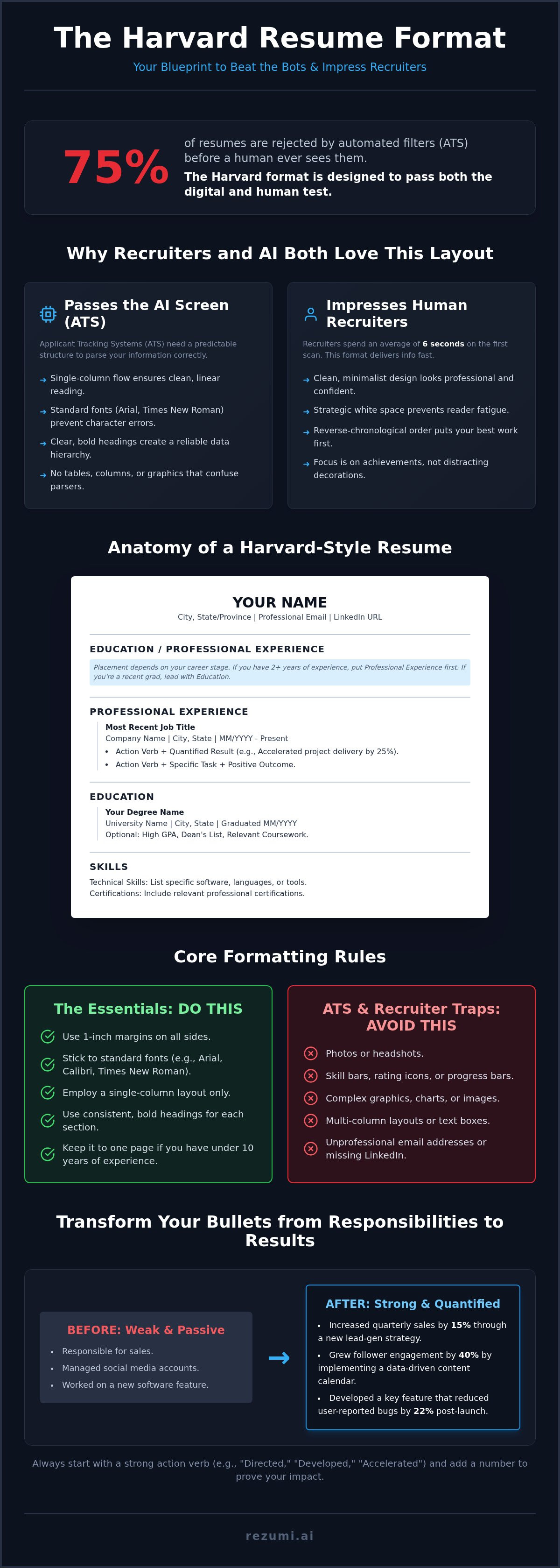
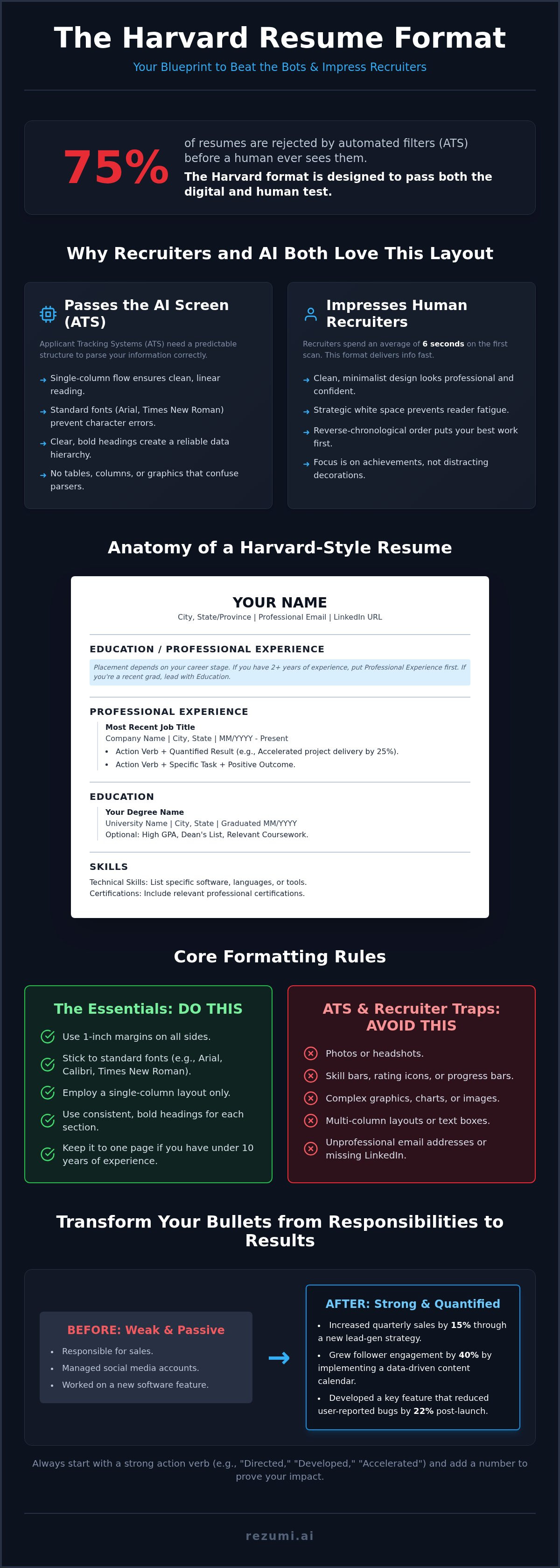
75% of resumes are rejected by automated filters before a human recruiter ever sees them. It's a harsh reality that makes the job search feel like a losing game. You want a clean, professional look that recruiters trust, but you're likely worried about passing the digital screen. The harvard resume format is the solution to this technical hurdle. It's the gold standard of design because it's simple enough for an AI scanner to read and polished enough for a human to respect. This layout isn't just a template. It's a strategic tool built for the modern market.
You're about to learn how to master this format to secure more interviews. We'll show you how to move from uncertainty to total control using data-backed strategies. This guide provides a clear structure to follow, including how to quantify your wins with real numbers that prove your value. You'll get the exact blueprint you need to turn your work history into a high-performance document that gets results. Stop guessing and start optimizing your application for the 2026 hiring environment.
Key Takeaways
- Understand why a clean, reverse-chronological layout is the preferred standard for both human recruiters and AI scanners.
- Learn the specific rules for section placement, including where to put your education based on your current experience level.
- Master the harvard resume format to ensure your application passes modern parsing systems like Workday without technical errors.
- Follow a clear, step-by-step process to build your document using standard margins and a single-column structure.
- Discover how to use AI optimization to tailor your professional draft for specific job descriptions in real time.
What Is the Harvard Resume Format?
The harvard resume format is a clean, minimalist, and reverse-chronological layout that puts your most recent work history at the top. It's the gold standard for high-stakes industries like finance, consulting, and tech because it removes every distraction from your professional results. Instead of flashy colors or complex graphics, this style uses:
- Standard fonts like Arial or Times New Roman
- Clear, bold headings
- Consistent bullet points
- One-inch margins on all sides
This layout isn't just about looking traditional. It's a strategic choice. By using a single-column structure, you ensure that every line of text is easy to read. You don't need a graphic designer to stand out. You need a document that proves you can do the job. The harvard resume format provides the structure to make that proof undeniable. It turns your career history into a logical progression that any hiring manager can understand in seconds.
The Core Philosophy of Simple Design
Simplicity isn't a lack of effort; it's a signal of professional confidence. The harvard resume format uses white space strategically to prevent reader fatigue and guide the eye to your best data points. You won't find photos, skill bars, or multi-column layouts here. Those elements confuse human readers and can break automated scanners. By stripping away the fluff, you force a focus on your achievements. It's a high-performance design that puts substance ahead of style. This approach ensures that your most relevant qualifications aren't buried under unnecessary decorations.
Why Recruiters and AI Both Love This Layout
Modern hiring is a two-step process. First, you pass a digital screen. Then, you impress a human. This layout succeeds at both. The single-column flow is the most reliable structure for automated parsing tools used by major North American employers. In 2026, these systems use AI to map your skills to the job description. Standardized sections allow recruiters to find what they need immediately. It eliminates the friction that leads to rejection and satisfies the technical requirements of the ATS by using a predictable hierarchy:
- Contact Information and LinkedIn profile
- Education (placement depends on experience)
- Professional Experience with quantified wins
- Skills and Certifications
The Essential Sections of a Harvard-Style Resume
Your contact information must be professional and easy to find. Include your full name, a professional email address, and your LinkedIn profile URL. North American hiring norms in 2026 suggest listing your city and state or province, rather than your full street address. This protects your privacy while confirming your location for recruiters. Ensure your email address is a simple combination of your name and doesn't include unprofessional nicknames or numbers.
The harvard resume format relies on a logical hierarchy that changes based on your career stage. If you're a student or a recent graduate, your education belongs at the top of the page. For seasoned professionals with more than two years of experience, move the education section below your professional experience. This shift ensures that your most relevant accomplishments are the first thing a human recruiter sees during their initial scan. Your professional experience must follow a strict reverse-chronological order with clear dates and job titles to show your career progression.
Structuring Your Education for Impact
List your degree, institution, and graduation date clearly at the top of this section. If you earned a high GPA or received honors like the Dean's List, include those details to show academic excellence. Only list specific coursework if it directly supports your current job goal or fills a technical gap in your experience. Once you've completed a university degree, remove your high school information entirely. It's no longer relevant and takes up valuable space that you should use for professional wins.
Writing Experience with Action-Oriented Bullet Points
Every bullet point in your experience section must start with a strong action verb. Use words like "Directed," "Developed," or "Accelerated" to show movement and success. Don't just list your daily responsibilities. Instead, focus on the result of your actions. For example, instead of saying "responsible for sales," write "Increased quarterly sales by 15% through a new lead-generation strategy." This quantification is what builds trust with hiring managers and proves you can deliver results.
The skills section should be a brief, high-impact list of technical competencies and certifications. This is where you include the specific software or industry tools that help you pass automated filters. If you're struggling to organize these sections, you can access professional resume design tools to ensure your layout is perfect. Keep your interests section short and only include items that demonstrate leadership or unique skills relevant to the role. This keeps the focus on your professional readiness while showing a hint of your personality.
Harvard Format vs. ATS: Passing the 2026 Digital Screen
Many job seekers fear that a plain resume looks lazy or unprofessional. They choose "creative" templates with charts, logos, and colorful sidebars to stand out. This is a strategic mistake. While these designs might catch a human eye, they often fail the digital screen. Modern Applicant Tracking Systems (ATS) in 2026 are sophisticated, but they still rely on structured data. The harvard resume format is the antidote to digital friction. Its simple, single-column design ensures your data is never lost or scrambled during the upload process.
According to current research, 75% of resumes are rejected by automated filters before a human recruiter ever sees them. This usually happens because the software can't map the candidate's skills to the job description correctly. The Harvard style uses standard headings like "Experience" or "Education" that systems like Workday recognize immediately. By avoiding tables, text boxes, and images, you guarantee a clean scan. This technical reliability is why high-stakes professionals stick to the harvard resume format. It moves you from the "rejected" pile to the recruiter's desk with 100 percent parsing accuracy.
Why Classic Layouts Outperform Fancy Templates
Fancy templates often use non-standard fonts that ATS software can't interpret correctly. Even worse, multi-column designs can cause the software to read your resume out of order. Instead of reading top to bottom, the system might read left to right across columns. This turns your work history into a jumbled, incoherent mess. A classic Harvard layout follows a linear path that every major recruitment platform understands. It focuses on substance over style, which is the primary requirement for North American roles. Don't let a "pretty" template hide your actual achievements from the people who hire.
Modern Tweaks for Tech-Friendly Applications
To keep your document compatible with 2026 systems, you must use standard file formats. Stick to PDF or .docx files to maintain your layout across different platforms. Ensure your font size stays between 10 and 12 points for body text. This keeps it legible for both the automated scanner and the human recruiter who eventually reads it. You should also align your text to the left rather than using "justified" alignment, which can create awkward spacing that confuses some parsers. For a deeper look at layout strategy, read our guide on Choosing the Best Resume Format for the 2026 North American Job Market. These small technical adjustments turn a traditional document into a high-performance career tool.
How to Build Your Harvard Resume (Step-by-Step)
Building a high-performance document requires more than just copying a template. You need to engineer your professional story to meet the technical demands of 2026. Generic resumes get ignored. Strategic layouts win interviews. Follow these steps to assemble a professional harvard resume format that commands attention.
Step 1: Download a clean, single-column template. Set your margins to exactly one inch on all sides. This creates the white space necessary for readability. Step 2: Input your contact details. Use a professional email address and a direct link to your LinkedIn profile. Step 3: Draft your experience using the Action-Context-Result (ACR) framework for every bullet point. This method ensures you focus on outcomes rather than just listing daily tasks.
Step 4: Audit your skills section. Compare your draft against the job posting and include the specific technical keywords found in the description. Step 5: Review your document for consistent formatting. Check that your font choices, date formats, and use of periods remain uniform across the entire page. Small errors in consistency signal a lack of attention to detail to a recruiter.
Quantifying Your Achievements
Numbers provide the context recruiters need to understand the scale of your work. They turn vague claims into verifiable facts. Instead of saying you "Managed a team," say you "Managed a team of 12 to increase output by 20 percent." If you handled a budget, state the exact dollar amount. For example, "Directed a 50,000 dollar project that reduced operational costs by 15 percent." Use these real-world numbers to prove you can deliver the specific outcomes the employer wants.
The Final Formatting Polish
Visual consistency is the final step in mastering the harvard resume format. Check that all your dates are right-aligned. This creates a clean visual line down the right side of the page and makes your timeline easy to scan. Ensure you use the same bullet style for every entry. A mix of circles and squares looks disorganized. Finally, read your resume backward. This technique forces your brain to focus on individual words, helping you catch spelling errors that your eyes would normally skip during a standard review.
Strategic Optimization with Rezumi
Building a harvard resume format is only half the battle. You have the structure, but now you need the right data to win. Most applications fail because they aren't tailored to the specific job description. To move from a generic applicant to a top-tier candidate, you must optimize your content for every role.
Rezumi uses AI to analyze your draft against specific job descriptions in real time. The platform identifies missing keywords and suggests immediate improvements to your bullet points. This technical audit ensures you meet the specific requirements of North American ATS filters. You'll gain a high resume score that proves your readiness to hiring managers.
Using AI to Tailor Your Content
Adjusting your professional summary and experience to match recruiter expectations is critical. Rezumi removes the guesswork by showing you exactly which skills to prioritize. You can find deeper tactics in The High-Stakes Guide to ATS Resume Optimization. This ensures your tailored content is ready for the technical hurdles of 2026.
Command the Room with a Polished Profile
An optimized resume is your ticket to the interview stage. Once your document passes the digital screen, you can focus on winning the actual offer. Combine your high-performance resume with Strategic Interview Tips to handle the final conversation with confidence. This complete approach ensures you're prepared for every step of the hiring process.
Secure Your Next Interview Today
You've moved from uncertainty to total control by mastering the harvard resume format. This classic layout remains the gold standard because it respects the time of busy recruiters and the technical requirements of AI scanners. By using the Action-Context-Result framework and keeping your design minimalist, you ensure your achievements are never lost in a jumbled template. The transition from a generic applicant to a top-tier candidate starts with this strategic foundation.
Rezumi is built by global professionals who understand the hidden mechanics of the North American market. Our AI-powered ATS scoring and feedback help you tailor your document for top employers in the US and Canada. You've already done the hard work of building your career. Now, let technology ensure that hiring managers see your true value. You're ready to command the room and win the offer.
Frequently Asked Questions
Is the Harvard resume format too plain for creative roles?
No, because it ensures your work portfolio remains the primary focus. Even in creative fields, recruiters value clarity and ATS compatibility above flashy design. You can show your creativity through your portfolio link while using this format to guarantee your application is actually read. It provides a sophisticated backdrop that makes your actual achievements stand out without distracting visual clutter.
Should I use a one-page or two-page resume in 2026?
Use the length that best showcases your relevant experience. While 40.6% of workers kept their resume to one page in early 2026, 49% of job seekers now use documents longer than one page. If you have over ten years of experience, a second page is often necessary to list your quantified wins. Focus on quality over a strict page count to ensure you cover your career's most important milestones.
Can I include a professional summary in the Harvard format?
Yes, you can add a brief summary at the top to highlight your unique value proposition. Keep it to three or four lines of text. Focus on your years of experience and your most significant achievement to hook the reader during their initial six-second scan. This section helps you frame your career story before the recruiter moves into your specific work history and education.
What are the best fonts to use for a Harvard-style resume?
Stick to standard fonts like Arial, Calibri, or Times New Roman. These are the best choices because they're highly legible for both humans and AI scanners. Using a standard font ensures that your harvard resume format remains professional and easy to parse across all recruitment platforms. Avoid custom fonts that may fail to load correctly on a recruiter's screen or confuse automated parsing software.
Does the Harvard format work for senior-level executives?
It's actually the preferred choice for executive leadership. Senior roles require a focus on high-level strategy and fiscal results. This minimalist layout provides the perfect backdrop for demonstrating how you led large teams or managed significant budgets. The harvard resume format signals professional maturity and a focus on substance, which is exactly what boards and hiring committees look for in top-tier candidates.
How do I handle a gap in my work history using this format?
Address the gap directly by listing it chronologically or focusing on the skills you gained during that time. You can include a brief line about professional development, certifications, or consulting work. The reverse-chronological structure makes it easy to show a clear return to the workforce. Honesty and clarity are always better than trying to hide a gap with a confusing functional layout.
Is it okay to use color in a Harvard resume?
It's best to stick to black text on a white background for maximum professional impact. Some candidates use subtle blue for headings, but high-contrast black is the safest bet for ATS readability. Consistency in your design signals a level of sophistication that colorful templates often lack. Black and white remains the industry standard for high-stakes applications in finance, law, and technology.
How often should I update my Harvard-style resume?
Update your draft every time you achieve a major milestone or complete a significant project. Regular updates ensure you don't forget the specific numbers and data points that prove your impact. Keeping your document ready means you can apply for a new opportunity the moment it appears. It's much easier to add a single bullet point now than to reconstruct your entire history later.
Disclaimer
This article is provided for general informational purposes only and does not constitute professional, legal, financial, or career advice. While Rezumi strives for accuracy, we make no warranties as to the completeness or reliability of this content. Hiring practices, ATS behavior, and job-market conditions vary by employer, industry, and region — always verify against your specific situation. Any action you take based on this article is at your own risk.