How Long Should a Resume Be in 2026? The High-Stakes Guide to Page Count
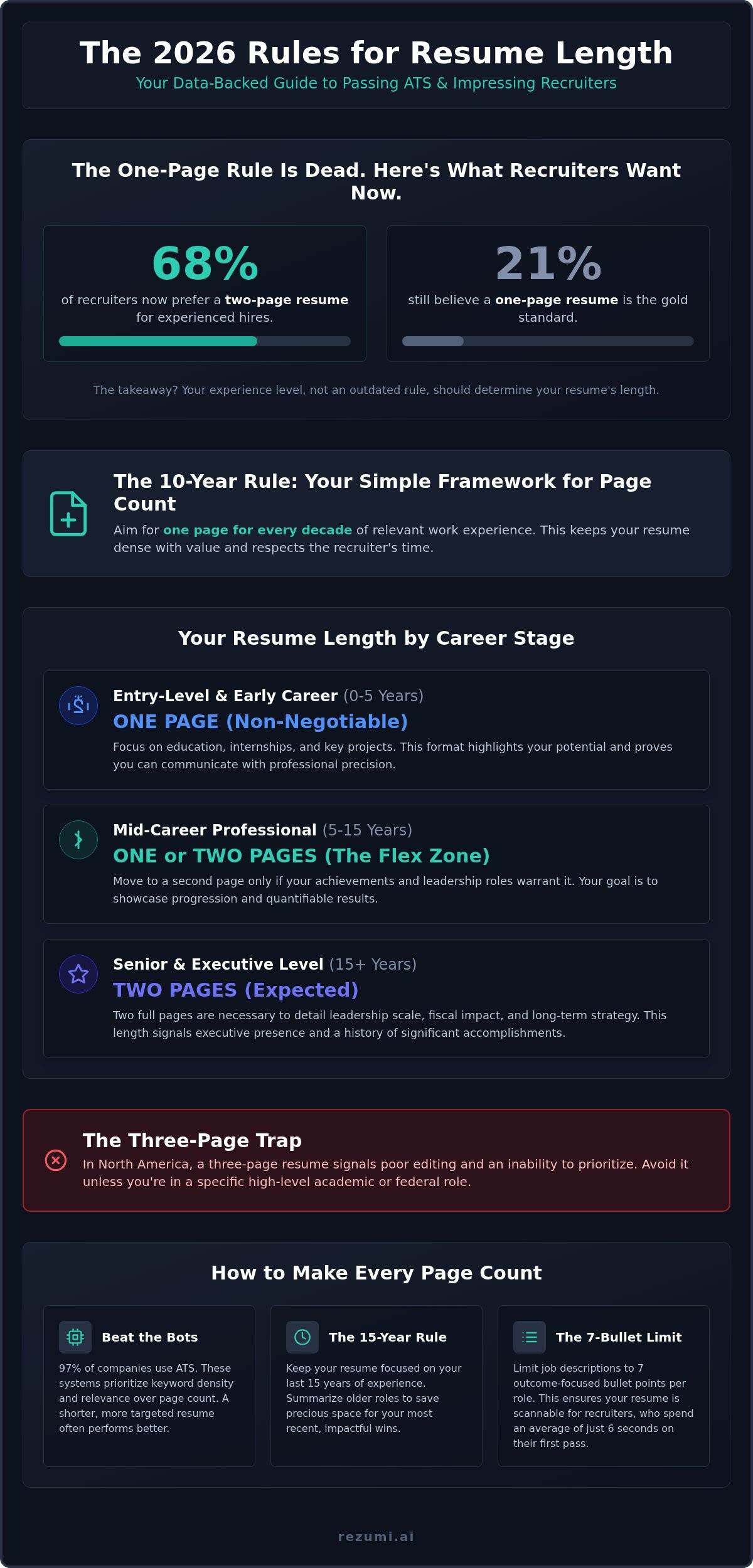
Over 68 percent of recruiters now prefer a two-page resume, while only 21 percent still believe a single page is the gold standard. For years, you were told that anything over one page would end up in the trash. That outdated rule is officially dead. If you are asking how long should a resume be in 2026, the answer depends on your career density rather than a rigid page count.
It is stressful to decide which career wins to keep and which to cut. You worry that a shorter resume misses your best work, but a longer one might get buried by an automated system. Nearly 97 percent of companies now use AI-powered systems to filter candidates, so your length must work for the software too. We are here to replace that anxiety with a data-backed strategy.
You will learn exactly how many pages you need to stay competitive and how to optimize your length for modern Applicant Tracking Systems. This guide breaks down the ideal length for every experience level, from new graduates to senior executives. We will show you how to trim the fat without losing your impact, ensuring your resume captures human attention in seconds.
Key Takeaways
- Aim for one page for every decade of work experience to keep your most impressive wins at the top of the document.
- Get the definitive answer on how long should a resume be to satisfy modern ATS algorithms that prioritize keyword density over simple page counts.
- Apply the 15-year rule to move older experience into a summary, ensuring your most recent roles get the attention they deserve.
- Limit your descriptions to seven outcome-focused bullet points per role to keep your document scannable and results-driven for human recruiters.
- Use real-time AI density analysis to tailor your content for specific job descriptions so you don't fall into the trap of being too brief.
The Definitive Rules for Resume Length in 2026
The rule of thumb for 2026 is simple. You should aim for one page for every ten years of relevant work experience. This isn't just a suggestion. It's a strategic framework designed to respect a recruiter's time while maximizing your professional impact. If you're wondering how long should a resume be to land an interview, remember that density beats volume every single time. You don't have time to guess. The stakes are too high to leave your career to chance.
Recruiters often spend less than six seconds on their first pass. They are looking for reasons to move to the next candidate. A bloated document is the easiest reason to hit delete. By following standard resume guidelines, you signal that you understand professional norms and can communicate your value with precision. Your resume is a marketing tool, not a complete biography.
The One-Page Standard
One page is the non-negotiable standard for new graduates, career changers, and professionals with less than a decade of experience. If you fall into these categories, a single page forces you to be ruthless with your editing. You must cut the filler and highlight only the wins that prove you can do the job. This format is perfect for the initial human review. It presents your value immediately without making the reader hunt for it. It keeps the focus on your trajectory and potential rather than a list of duties.
The Two-Page Exception
A two-page resume is a strategic advantage when you have over 10 years of high-level experience. This extra space allows you to detail complex projects or technical certifications that wouldn't fit on a single sheet. Executives, senior managers, and technical specialists with deep expertise need this room to show a history of leadership and measurable results. If your career includes multiple long-term roles with distinct achievements, two pages give you the breathing room to tell a complete story. It allows for a dedicated skills section that helps you stand out in competitive fields.
Avoid the three-page trap at all costs. In North America, a three-page resume is almost always a sign of poor editing. It signals to recruiters that you can't prioritize information or understand what matters to the business. Unless you are applying for a high-level academic or scientific role, keep it to two pages maximum. If your resume is pushing into a third page, it's time to cut the roles from 15 years ago. Most hiring managers only care about what you've done lately. Focus on your recent wins to keep the reader engaged. If you are struggling to fit your experience onto the right number of pages, you can check out our tools and plans at Rezumi pricing to see how AI can help you optimize your content density.
Length Requirements by Career Stage
Your career stage determines your document's footprint. While the question of how long should a resume be has a standard answer, the nuance lies in your specific experience level. If you're a global professional moving to North America, be careful. Many countries prefer long, multi-page CVs. In the US and Canada, brevity is a sign of executive presence and professional maturity. You must adapt your length to match local expectations if you want to secure an interview.
Hiring managers in North America look for a specific density of information. They want to see that you can filter your own history to show only what matters to their business. A resume that is too long suggests you cannot prioritize. A resume that is too short might suggest you lack the necessary experience. Finding the middle ground is the key to passing both human and automated checks.
Entry-Level and Early Career
If you have zero to five years of experience, you must stay on one page. Your focus should be on education, internships, and technical projects. Don't use "filler" sections like hobbies or high school honors just to reach the bottom of the page. It looks amateur and wastes the reader's time. Instead, use the Harvard Resume Format to organize your data. This structure ensures your academic wins and transferable skills are the stars of the show. It creates a clean, professional look that signals you are ready for the corporate world.
Management and Executive Levels
Mid-career professionals with 5 to 15 years of experience live in the "flex zone." You can move to a second page if your achievements warrant it, but don't feel forced to expand if your story fits on one. However, senior executives are expected to use two full pages. You need that space to demonstrate leadership scale, fiscal impact, and long-term strategy. Understanding a recruiter's perspective on resume length is vital here. They want to see your most recent 10 years of success on the first page. This is where you detail your biggest wins and team leadership. Anything older than 15 years should be a brief summary on page two to maintain a high impact-to-space ratio.
There are rare cases where these rules don't apply. Federal resumes and academic CVs often run five to ten pages because they require every publication, grant, and government-specific detail. For any other role, stick to the standard. If you're unsure if your content is dense enough to justify a second page, you can explore Rezumi plans to get an AI-driven audit of how long should a resume be for your specific target role.
Does the ATS Care About Resume Length?
The short answer is no. Applicant Tracking Systems (ATS) do not have a mechanical page counter that automatically rejects you for hitting page two. However, the software is deeply concerned with the data living on those pages. If you are wondering how long should a resume be for a bot, you must focus on content density rather than physical dimensions. The system is looking for a match, not a specific number of inches.
Modern ATS platforms like Greenhouse or Workday parse your document to extract specific skills and titles. If your resume is too short, you likely lack the necessary keywords to rank well against the job description. On the other hand, a document that is too long can actually dilute your score. Including irrelevant roles from two decades ago introduces noise into the system. The software sees a high volume of words that don't match the target role, which can lower your overall relevance percentage.
Technical limits are a real factor that most guides ignore. Some older enterprise systems struggle with files larger than 5MB. If you use heavy graphics or unoptimized images to fill space, you might crash the parser before it even reads your name. Extremely long text strings or massive, uninterrupted blocks of content can also cause indexing errors. Keep your file size small. Keep your text focused. Ensure the bot can digest your data without a technical glitch.
Keyword Density vs. Page Count
Tailoring your content is more important than hitting a specific page goal. You want to match the language of the job description without falling into the keyword stuffing trap. Adding a list of 50 skills at the bottom of a four-page document won't help you. Bots now use semantic analysis to look for context. They want to see those keywords used within your bullet points to prove you have the experience. Using an ats resume checker can help you find the right balance. It identifies where your content is thin and where you are over-optimizing.
Formatting for Bot Readability
Bot readability is a matter of predictable layout. Stick to standard margins between 0.5 and 1 inch. This keeps your text blocks in a linear path that the parser can follow. Avoid multi-column layouts at all costs. While they might look sharp to a human, many systems still read across the page from left to right. This can scramble your work history and make your document unreadable to the bot. Use a clean resume template to ensure every word is indexed correctly. A simple design is the safest way to ensure your length doesn't interfere with your ranking success.
How to Trim Your Resume Without Losing Impact
Cutting content is not just about making things shorter. It is about increasing the density of your success stories. When you ask how long should a resume be, you are really asking how much high-value data you can fit into a scannable format. You must be ruthless with your editing to ensure every word serves a purpose. High-impact resumes are built through subtraction as much as addition.
Start by eliminating outdated phrases that waste vertical space. "References available upon request" is the most common offender. Recruiters know you have references, and they will ask for them when the time is right. Removing this line alone can often save you two lines of valuable real estate. You should also audit your white space strategically. Keep your font size at a minimum of 10pt and use line spacing between 1.0 and 1.15 to keep the layout tight but readable. If you find your content spilling onto a third page by just a few lines, adjust your margins to 0.5 inches on all sides. This often pulls those stray lines back without sacrificing readability.
The 15-Year Rule
Hiring managers focus almost entirely on your most recent decade of work. Apply the 15-year rule to your history. Move roles older than 15 years into a "Previous Experience" summary section or remove them entirely if they don't add value. This keeps the focus on modern technologies and current industry standards. If a role from 2008 doesn't prove you can solve 2026 problems, it doesn't belong on your primary list. You want to show a trajectory of growth, not a complete archive of every job you've ever held.
Editing for Achievement Density
Your bullet points are the core of your document. Limit yourself to 3-7 bullets per role. If you have more than seven, you are likely listing daily tasks rather than measurable wins. Focus on outcomes. Use specific numbers and percentages to prove your impact. This is how you show quality without needing excessive quantity. To decide how long should a resume be for your specific situation, look at your bullet points and ask if each one justifies its own existence.
- Replace passive phrases like "responsible for" with high-impact verbs like "engineered," "orchestrated," or "negotiated."
- Consolidate two-line bullets into a single, punchy statement by removing unnecessary adjectives and filler words.
- Audit your skills list to remove generic soft skills like "team player" or "hard worker." These should be demonstrated through your achievement bullets instead.
Optimizing Your Resume Length with Rezumi
Rezumi replaces manual guesswork with data-driven precision. Stop wondering how long should a resume be for every single application. Our AI-powered platform analyzes your document's density in real-time. It ensures your most relevant wins are front and center while trimming the fat that slows down recruiters. This is not just a template. It is a strategic partner that helps you stay in control of your professional narrative.
Manual editing is slow and prone to errors. You might cut a vital keyword or keep a bullet that adds no value. Rezumi uses machine learning to compare your resume against millions of successful data points. It provides a definitive answer on how long should a resume be for your specific target industry. You get instant feedback that tells you exactly where to trim and where to expand. This moves you from uncertainty to total control in seconds.
Smart Tailoring with AI
Rezumi's ATS Resume Optimization engine reads job descriptions like a recruiter. It identifies exactly which bullets to keep and which to cut based on the specific role. This creates the perfect balance of keywords for high-ranking results. You no longer have to spend hours debating which project to include. Check our pricing to start optimizing your application today.
Design and Export
Managing margins and font sizes manually is a waste of your time. Rezumi offers ATS-tested designs that manage vertical space with surgical accuracy. You can export your document to PDF with perfect formatting every single time. The technical layout is handled automatically so you can focus on your career wins. This ensures your document looks professional on every screen and passes every parser. You get a bespoke experience without the manual labor.
Use the Profile Editor to build a comprehensive Master Resume containing every win from your career. When you apply for a specific role, Rezumi helps you export a tailored version at the ideal length. Automated feedback is significantly faster than manual editing. It gives you the confidence that your document meets modern standards in seconds. Rezumi handles the hidden mechanics of the hiring system so you can focus on the interview and the outcomes that matter.
Take Control of Your Career Narrative
You now have the definitive answer to how long should a resume be in 2026. It is a question of career density rather than physical pages. Precision is your greatest competitive advantage. Use one page to highlight your early trajectory or two pages to demonstrate executive scale. This strategic choice respects a recruiter's time while proving you can prioritize high-value data.
Trimming your history to the last 15 years keeps your document modern. It ensures that human recruiters and automated systems focus on your current impact. Rezumi was built specifically for the North American market to handle these technical nuances. Our real-time ATS density feedback and AI-powered bullet point trimming remove the uncertainty from your job search. You no longer have to guess if your document is too long or too thin.
You are ready to move from a generic application to a high-performance career tool. Secure your next interview with a resume that respects the reader's time and proves your value. The transition from uncertainty to total control starts with your next edit. Take the lead and let your achievements speak for themselves.
Frequently Asked Questions
Is a 2-page resume okay for someone with 5 years of experience?
One page is the ideal standard for professionals with five years of experience. A two-page document at this stage often contains filler content that can distract a recruiter from your core wins. Stick to a single page unless you have a high volume of technical projects, publications, or certifications that directly prove your value. Keeping it tight demonstrates that you can prioritize information effectively.
Can a resume be 1.5 pages?
A 1.5-page resume is acceptable, but you must ensure the second page is at least half-full to look intentional. A document that spills over by only two or three lines looks like a formatting error rather than a choice. If you are struggling with how long should a resume be, adjust your margins or font size to either fit everything on one page or fill more of the second.
Should I include my earliest jobs if they are not relevant?
You should prioritize relevance over a complete chronological history by removing jobs that do not add value to your current target. If your first role was 20 years ago in an unrelated industry, it likely won't help you land a modern position. Use the 15-year rule as your guide. This keeps your document focused on the skills and technologies that hiring managers actually care about today.
Does a 2-page resume hurt my ATS score?
A two-page resume does not hurt your ATS score because the software focuses on text content rather than page counts. However, when considering how long should a resume be for bot readability, you must avoid including too many irrelevant terms. This noise dilutes your keyword density, which is the frequency of specific skills in your text, making it harder for the system to identify you as a top match.
What is the best font size for a one-page resume?
Use 10 to 12 points for your body text to maintain a professional balance between readability and space. Going smaller than 10 points makes your resume difficult for humans to read, while going larger than 12 points can look amateur. Set your section headings between 14 and 16 points. This creates a clear visual hierarchy that helps recruiters scan your achievements in seconds.
Should I use a double-sided resume for in-person interviews?
You should always print your resume on separate sheets of paper for in-person interviews. Double-sided printing is risky because a recruiter might miss the back page or encounter errors when scanning the hard copy into their system. Using single-sided sheets ensures a polished, professional look. It also makes it easier for multiple interviewers to review your history at the same time.
Disclaimer
This article is provided for general informational purposes only and does not constitute professional, legal, financial, or career advice. While Rezumi strives for accuracy, we make no warranties as to the completeness or reliability of this content. Hiring practices, ATS behavior, and job-market conditions vary by employer, industry, and region — always verify against your specific situation. Any action you take based on this article is at your own risk.