How to Become a Machine Operator and Land Your Next Role in 2026
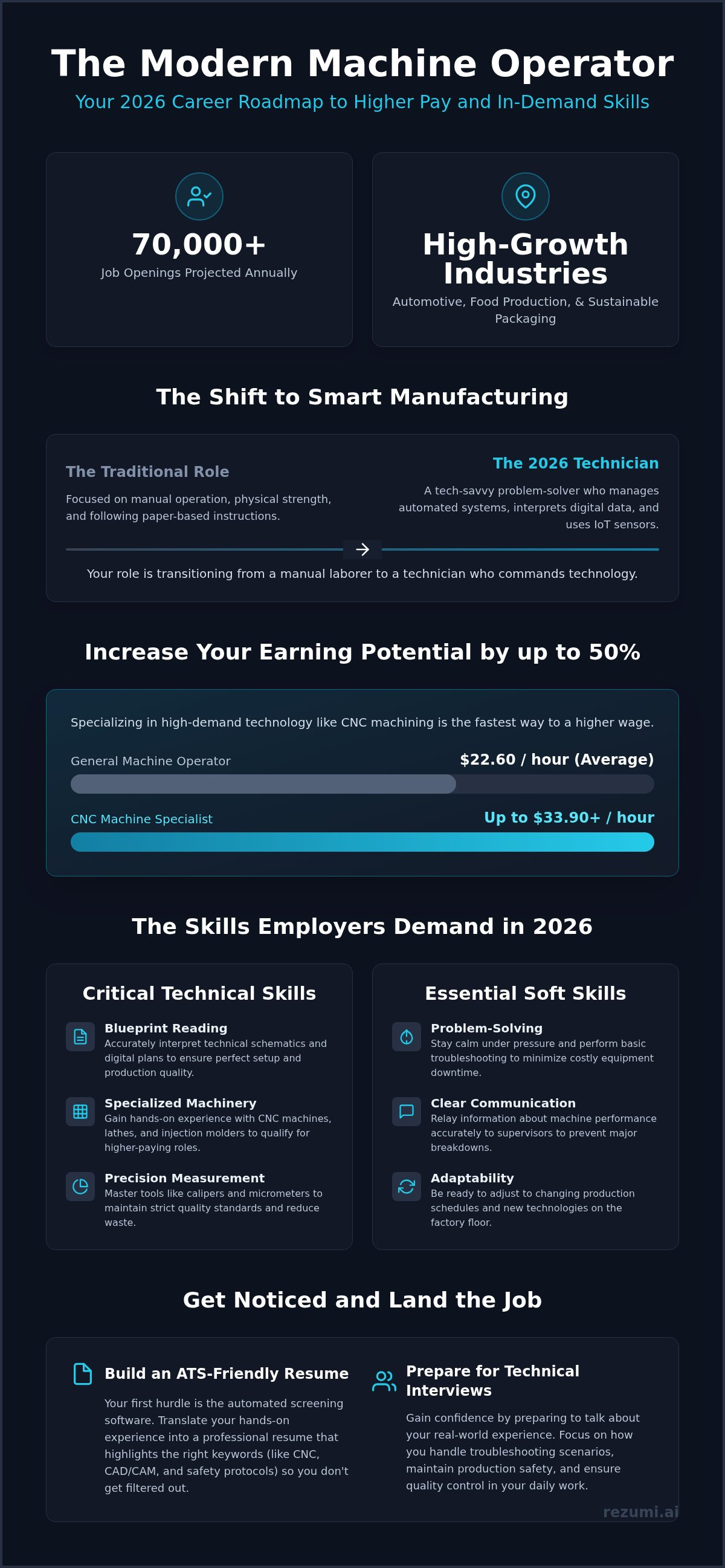
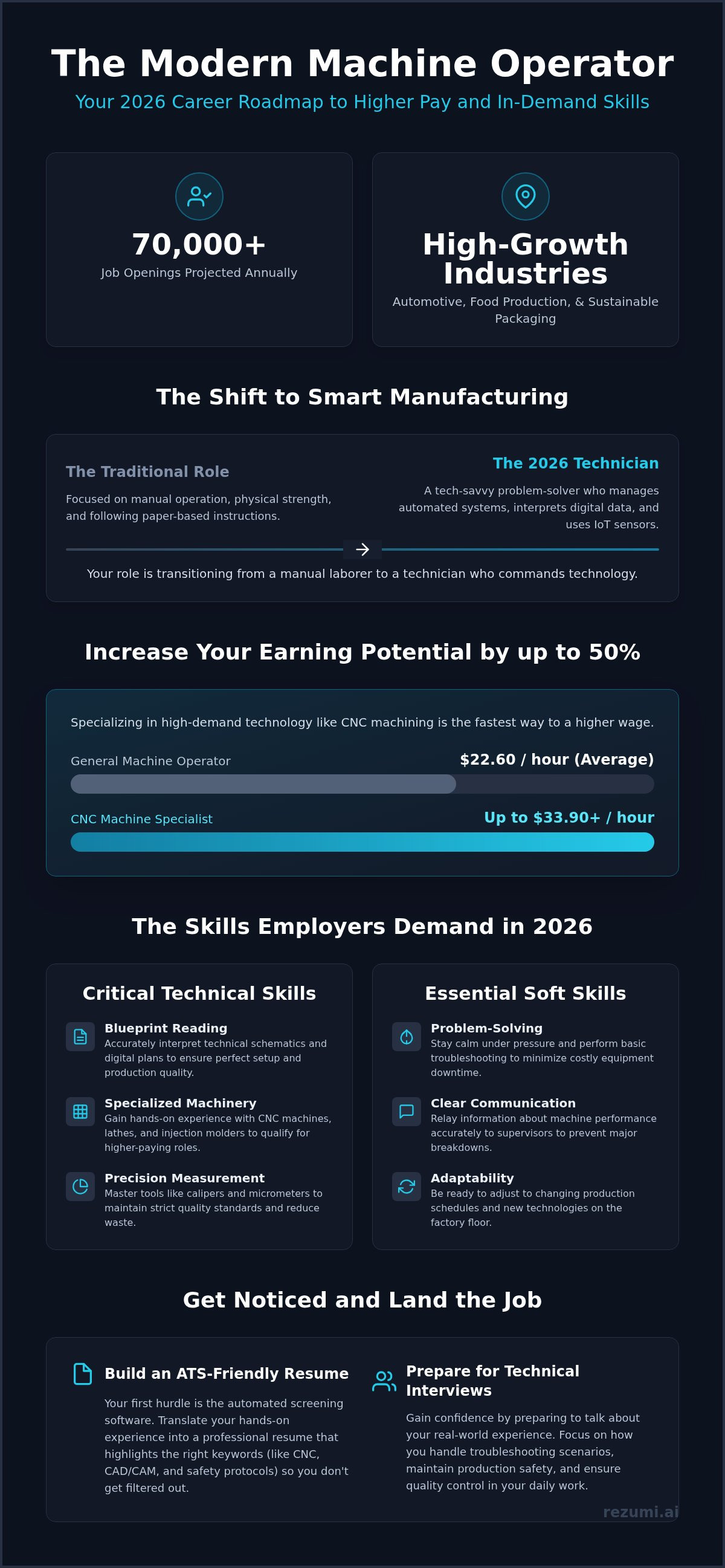
Over 70,000 job openings for a machine operator will appear every year through 2035. While the industry is changing, the demand for skilled workers to replace a retiring workforce is higher than ever. You have the manual skills. You have the work ethic. Yet, your applications often get stuck in a digital gatekeeper before a hiring manager even sees your name. It's a common hurdle. Modern software often makes the first cut, leaving qualified professionals behind.
You deserve a clear path to your next role. This guide gives you the exact steps to build your skills and get noticed. We'll show you how to translate your hands-on experience into a professional resume that passes the Applicant Tracking System (ATS) every time. You'll learn which technical skills, like CNC programming and digital monitoring, are fetching the highest wages in 2026. We also provide a roadmap to help you prepare for technical interviews. You will learn to speak about your expertise with confidence. By the end of this article, you will have a data-backed strategy to move from uncertainty to a signed job offer.
Key Takeaways
- Learn why the 2026 machine operator market favors technicians who can manage automated systems and CNC technology.
- Identify the specific hard skills, such as CAD/CAM and precision measurement, that make your profile stand out to recruiters.
- Find out how specializing in CNC machining can increase your earning potential by up to 50 percent.
- Build an ATS-friendly resume so you don't get filtered out by automated hiring software before a human sees your work.
- Gain the confidence to handle technical interview questions by focusing on troubleshooting and production safety.
Understanding the Machine Operator Role in the 2026 Job Market
A machine operator is the heartbeat of the modern factory floor. You don't just push buttons. You manage, monitor, and maintain complex industrial equipment to keep production moving. You act as the first line of defense against equipment failure and costly production delays. If a machine goes down, the entire company loses money. This Overview of a Machinist's Role shows how these titles often overlap in technical environments. In 2026, the role requires a sharp eye for detail and a solid understanding of how hardware and software work together.
Demand is surging in North America. Growth is especially high in food production, automotive manufacturing, and sustainable packaging. Companies are hiring rapidly to replace a retiring workforce. About 70,700 openings are projected each year through 2035. The average hourly wage currently sits at $22.60, but specialized roles pay significantly more. While the field is changing, the opportunities for steady work remain high for those who can adapt to new technology.
Core Responsibilities and Daily Tasks
Your day starts with equipment setup. You calibrate machines based on specific blueprints or digital orders. Monitoring output quality is a constant task. You catch defects before they become expensive waste. Routine maintenance keeps the line running, and you often perform basic troubleshooting on the fly. Safety protocols are the most critical part of your routine. You follow strict rules to protect yourself and the facility from accidents. Reliability is your greatest asset in this role.
The Shift Toward Smart Manufacturing
The industry is moving toward smart manufacturing. Basic computer literacy is now as important as physical strength. You'll likely interact with IoT (Internet of Things) sensors that assist you by sending real-time alerts to your workstation. These sensors tell you when a part is wearing out before it actually breaks. Data entry and digital reporting have replaced paper logs in most modern plants. You'll use these digital tools to report production numbers and machine health. This shift means you are transitioning from a manual laborer to a tech-savvy technician who understands data.
Mastering the Technical and Soft Skills Employers Demand
Landing a role as a machine operator requires more than just showing up. Employers in 2026 look for a precise blend of technical expertise and personal reliability. You must prove that you can handle expensive machinery while working effectively within a team. This balance is what separates a general laborer from a high-paid technician. It is the difference between a stagnant career and one that moves forward quickly.
According to the BLS Job Outlook for Machine Operators, entry-level requirements are changing as technology advances. While foundational manual skills are still vital, the ability to interpret data and follow digital schematics is now a standard expectation. You need to demonstrate a commitment to precision. A single measurement error can halt an entire production line, costing thousands of dollars in wasted material and time. Accuracy is your primary metric for success.
Critical Technical Skills for Machine Operators
Technical skills are the specific tools you use to perform your job. You should focus on mastering these areas to increase your value on the production floor:
- Blueprint Reading: You must understand technical schematics and manuals to set up machines correctly. This ensures every part meets the exact design specs.
- Specialized Machinery: Experience with CNC machines, lathes, or injection molders is highly sought after. CNC specialization is especially lucrative. Entry-level CNC operators can earn 35 percent to 50 percent more than those in other entry-level trades.
- Precision Measurement: You need to be proficient with tools like calipers, micrometers, and gauges. Accuracy to within a fraction of a millimeter is often required to maintain quality standards.
Essential Soft Skills for the Production Floor
Soft skills are the traits that make you a reliable team member. Technical knowledge gets you the interview, but soft skills help you keep the job. Focus on these three areas:
- Problem Solving: Machines will eventually fail. You need to stay calm under pressure and troubleshoot basic issues to minimize downtime.
- Clear Communication: You must relay information accurately to supervisors and maintenance teams. If you notice a strange sound or a slight change in output quality, speaking up early prevents major breakdowns.
- Adaptability: Production schedules change often. You might need to switch between different machines or adjust to different shift times on short notice.
Your resume should reflect this balance of technical ability and personal reliability. If you aren't sure how to describe your manual experience in a way that catches a recruiter's eye, you can use professional resume optimization tools designed for the manufacturing sector. Highlighting these skills clearly is the first step toward a higher salary and a more stable career path.
Choosing Your Specialization within Manufacturing and Production
Specialization is your most direct path to a higher salary and better job security. While a general machine operator handles basic tasks, a specialist masters complex systems that few others can run. This expertise makes you an essential part of the facility. It gives you more bargaining power during salary negotiations because the cost of replacing you is much higher than the cost of keeping you. You should research which industries are growing in your specific North American region to find the best fit.
For example, the Midwest remains a hub for automotive parts. If you live in this area, focusing on metal stamping or robotic assembly machines is a smart move. In contrast, the Pacific Northwest and parts of the South see high demand in aerospace. In these regions, high-precision milling and turning are the skills that pay the most. Aligning your training with local demand ensures you'll always have multiple job offers to choose from.
High-Demand Specializations
Every niche has its own set of rules and rewards. Choosing the right one depends on your interests and the local job market. Here are three areas with strong demand in 2026:
- CNC Machining: This involves high-precision work for the aerospace or medical device industries. You'll work with tolerances so small they require specialized measuring tools. This is one of the highest-paying paths in the trade due to the technical knowledge required.
- Packaging and Logistics: These are high-speed roles focused on consumer goods and e-commerce. You'll manage machines that must run at peak efficiency to meet shipping deadlines. Reliability and quick troubleshooting are the most valued traits here.
- Food and Beverage: This sector focuses heavily on sanitation and strict regulatory compliance. You must follow detailed cleaning protocols to ensure consumer safety and meet FDA or CFIA standards.
How to Transition into a New Niche
You don't need to start from scratch to change your focus. Many of the skills you already have will transfer directly to a new environment. Start by identifying your transferable skills. If you've worked in a high-pressure automotive plant, your ability to maintain speed while following safety rules will appeal to packaging facilities. These companies value your experience with high-volume production cycles.
Seeking out short-term certifications for specific machine types can also bridge the gap. Many community colleges offer six-week courses on specific CNC controllers or PLC (Programmable Logic Controller) systems. Use your resume to highlight relevant safety or quality control experience from your past roles. This proves you understand the high stakes of a production environment, regardless of what you're making. If you want to see how your current skills as a machine operator look to an employer, you can optimize your profile to match these new specializations.
How to Build an ATS Friendly Resume for Machine Operator Jobs
Most large manufacturing companies use an Applicant Tracking System (ATS) to scan applications. If your resume isn't optimized for this software, it will likely be rejected before a person ever looks at it. If you are a machine operator looking for a new role, you must bridge the gap between your manual skills and the automated hiring process. This requires a strategic approach to keywords and formatting to ensure your experience gets noticed by human recruiters.
Step 1: Identify Keywords in the Job Description
The ATS acts like a search engine for recruiters. It looks for specific terms that match the job post. You should carefully read the requirements and look for machine names, software, or safety certifications. If the post mentions a specific brand of CNC controller or a type of lathe, those exact words must appear on your resume. You should also include standard industry terms like OSHA, quality control, and preventive maintenance. These words act as triggers that tell the system you are qualified for the role. You can use Rezumi to scan the job post and identify missing keywords automatically. This tool helps you see your resume through the eyes of the software so you don't leave your career to chance.
Step 2: Use the Right Resume Format
Fancy designs and creative layouts often confuse the scanner. You should stick to a clean, single-column layout that the software can read without errors. Avoid using images, charts, or complex graphics, as these can cause the ATS to scramble your text or skip entire sections. A simple, professional look is always the better choice for the manufacturing sector. Stick to standard fonts like Arial or Calibri and save your file as a PDF unless the job post asks for a Word document. You can read our guide on choosing the best resume format for more detail on how to structure your work history for maximum impact.
Step 3: Write Impactful Bullet Points
Listing your duties is not enough to stand out in 2026. You need to prove your value with concrete numbers. Instead of saying you "operated machine," you should say you "managed a CNC lathe with a 99% accuracy rate." This specific data shows the employer that you are a high-performance machine operator who cares about quality. You should also highlight your safety record. Mentioning that you "maintained a zero-accident record over 24 months" proves you are a reliable professional who follows protocols. Efficiency gains are also important to production managers. If you "reduced setup time by 15% through better organization," you are showing that you understand how to save the company money. These details prove you aren't just a worker, but a strategic asset to the production team.
Landing the Job through Strategic Interview Preparation
The interview is the final stage where you prove your technical knowledge and reliability. You've already shown the hiring software that you have the right keywords. Now, you must show a human manager that you are a safe, dependable professional who values quality. In 2026, manufacturing leaders aren't just looking for someone who can run a machine. They want a problem solver who understands the high stakes of a production floor. Preparation is the only difference between receiving a job offer and getting another rejection letter.
Common Machine Operator Interview Questions
Expect a mix of behavioral questions and technical troubleshooting scenarios. You should prepare specific examples from your past work to answer these common prompts:
- Handling Faulty Parts: How do you react when a machine produces parts that don't meet specs? A good answer focuses on immediate stoppage, reporting, and root-cause analysis.
- Safety Hazards: Tell me about a time you identified a safety risk. This is your chance to prove you follow OSHA standards and care about your coworkers.
- Routine Maintenance: What steps do you take during a machine changeover? Detail your process for calibration and cleaning to show you don't cut corners.
Using AI to Refine Your Performance
Practicing your answers out loud is the best way to reduce nerves. You can use an AI interview coach to get real-time feedback on your tone and clarity. This technology helps you refine your stories so they sound professional and concise. You should also check out our strategic interview tips to master the STAR method. This method helps you structure your answers by explaining the Situation, Task, Action, and Result. Don't forget to prepare your own questions for the manager. Ask about their facility's safety culture or any planned equipment upgrades. This shows you are thinking about a long-term future with the company.
Take Control of Your Career Today
Stop sending generic resumes into the void and start using a strategy that works. The 2026 job market is competitive, but it is full of opportunity for those who are prepared. You have the manual skills to be an excellent machine operator. Now, you need the digital tools to prove it. Optimize your application with a platform built specifically for the North American market. You can view our pricing plans to start your journey toward a better job today. Taking control of your career starts with choosing the right partner to help you succeed in the hiring process.
Build Your Future in Manufacturing
Success as a machine operator in 2026 depends on your ability to combine manual skill with a clear digital strategy. You've learned that specializing in high-precision areas like CNC machining can significantly increase your earnings. You also know that a clean, keyword-heavy resume is the only way to get past automated filters and reach a human recruiter. Landing your next role isn't about luck. It's about using the right tools to prove your reliability and technical knowledge to hiring managers across North America.
Rezumi provides the technology you need to stay competitive. Our platform offers AI-powered ATS optimization built specifically for North American hiring standards. You can also use our AI Interview Prep modules to build the confidence you need for technical troubleshooting questions. These tools help you bridge the gap between your physical experience on the floor and the digital requirements of modern human resources departments.
You have the expertise to keep production lines moving safely and efficiently. Now, it's time to show the industry what you can do. Take the first step toward a more stable and rewarding career path right now.
Frequently Asked Questions
Do I need a college degree to be a machine operator?
No, you don't need a four-year degree. Most employers require a high school diploma or a GED. Technical certificates from community colleges can help you get hired faster. These programs focus on specific tools like CNC machines. On-the-job training remains the most common way to learn the trade. Demonstrating mechanical aptitude and a willingness to learn is often more important than a formal degree in this field.
How much does a machine operator make per hour in 2026?
The average hourly wage for a machine operator in the United States is $22.60. This rate annualizes to approximately $46,946 per year. Your actual pay depends heavily on your specialization and region. For instance, entry-level CNC operators often earn 35 percent to 50 percent more than general operators. High-demand sectors like aerospace or medical device manufacturing also offer higher hourly rates for skilled technicians.
What is the most important skill for a machine operator?
Attention to detail is the most critical skill for success. You must catch small defects before they become expensive errors. Safety awareness is equally important to protect yourself and your team. Technical skills like blueprint reading and using precision measurement tools are also vital. You need to be reliable and capable of following strict protocols without skipping steps. This combination ensures high-quality production and minimal downtime.
How do I make my resume pass the ATS for manufacturing jobs?
You must include specific keywords that match the job description. Look for machine names, safety standards like OSHA, and technical tasks like preventive maintenance. Use a clean, single-column layout with no charts or images. These graphics often confuse the software and lead to automatic rejection. Focus on using standard fonts and clear headers. This ensures the system can read your experience and move you to the next round.
What certifications should a machine operator have?
OSHA 10 or OSHA 30 safety certifications are highly valued by North American employers. NIMS certifications are also respected because they prove your technical competency in metalworking. If you work with specific brands, getting certified by manufacturers like Haas or Fanuc can make you a top candidate. These credentials show that you are a dedicated professional. They provide proof of your expertise before you even step onto the production floor.
Can I become a machine operator with no prior experience?
You can certainly enter the field without prior experience. Many companies hire for entry-level positions and provide extensive on-the-job training. You should focus your resume on transferable skills like manual dexterity and mechanical aptitude. Highlighting a strong attendance record and a commitment to safety will appeal to hiring managers. Apprenticeship programs are another great way to earn a paycheck while you learn the technical side of the trade.
What are the physical requirements for a machine operator role?
You must be prepared for a physically demanding environment. Most roles require you to stand for 8 to 12 hours at a time. You will likely need to lift materials weighing up to 50 pounds regularly. Good hand-eye coordination is essential for operating controls and using precision tools like calipers. You should also be comfortable working in noisy environments while wearing personal protective equipment like earplugs and steel-toed boots.
How can AI help me find a job as a machine operator?
AI helps you navigate the automated hiring systems used by most large employers. Tools like Rezumi optimize your resume for ATS standards to ensure you get noticed. AI can also generate professional cover letters tailored to specific manufacturing roles. Using an AI interview coach allows you to practice your answers for technical troubleshooting questions. This technology gives you the data-backed strategy needed to move from a manual worker to a hired professional.
Disclaimer
This article is provided for general informational purposes only and does not constitute professional, legal, financial, or career advice. While Rezumi strives for accuracy, we make no warranties as to the completeness or reliability of this content. Hiring practices, ATS behavior, and job-market conditions vary by employer, industry, and region — always verify against your specific situation. Any action you take based on this article is at your own risk.