How to Write a Cover Letter: 2026 North American Guide
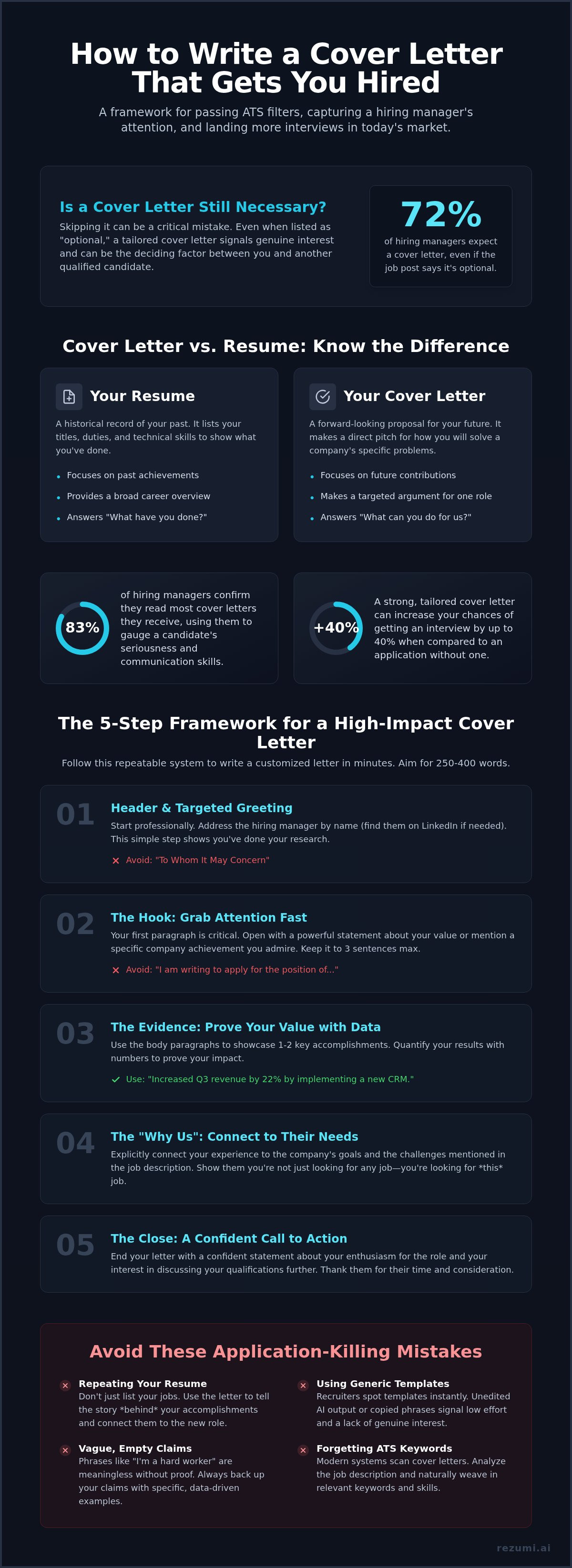
72% of hiring managers expect a cover letter even when the job posting says it is optional. Skipping this step often means your application is dead on arrival. You likely feel the frustration of writing the same generic letter for every role. You worry about sounding too arrogant or too passive. Worst of all, you fear your hard work will disappear into an ATS black hole. This guide teaches you how to write a cover letter for a job using a framework that passes filters and captures attention.
We understand the pressure of the 2026 hiring market. New laws in states like Illinois and Maryland now require transparency about AI in hiring, but the core challenge remains the same. You need a document that speaks to both robots and people. You must prove your value without the anxiety of guesswork. Our strategy replaces uncertainty with a data-backed approach that works for the modern North American professional.
You will learn a repeatable system to customize your pitch for every application in minutes. We will show you how to match keywords naturally and highlight your results. This article provides a clear path to higher callback rates and total confidence in your application strategy.
Key Takeaways
- Understand why your letter must act as a strategic bridge that connects your past results to a company's future needs.
- Master a repeatable 5-step framework on how to write a cover letter for a job that captures attention within the first paragraph.
- Use specific formatting rules and standard professional fonts to ensure your document passes through modern ATS filters.
- Identify and remove generic mistakes like repeating your resume or using outdated greetings that signal a lack of effort.
- Learn how to use AI tools to analyze job descriptions and find the exact keywords you need to stand out.
What is the Strategic Purpose of a Cover Letter in 2026?
Your cover letter is not a summary of your resume. It is a strategic bridge between your past results and a company's future needs. While your resume lists your history, your cover letter explains the "why" behind the "what." It acts as a direct pitch to the hiring manager. It shows exactly how you will solve the specific problems their team faces today. In the North American market, this document serves as a vital cultural fit check and a test of your professional communication skills.
Modern standards require your letter to be concise and data-driven. You cannot rely on vague claims of being a "hard worker." You must provide evidence that aligns with the job description. Understanding What is a Cover Letter? helps you realize its true value. It is your opportunity to control the narrative of your career before you even step into an interview room. When you learn how to write a cover letter for a job, you shift from being just another applicant to being a targeted solution.
Cover Letter vs. Resume: Knowing the Difference
Your resume is a historical record of what you have already done. It is a list of titles, dates, and duties. In contrast, your cover letter is a forward-looking proposal of what you will do for your next employer. The two documents work together in different ways:
- Resume: Focuses on past achievements and technical skills.
- Cover Letter: Focuses on future contributions and cultural alignment.
- Resume: Provides a broad overview of your career path.
- Cover Letter: Provides a targeted argument for one specific role.
The cover letter is the strategic bridge that connects your previous wins to the company's future goals. One looks backward to prove your experience; the other looks forward to prove your potential value.
Do Recruiters Still Read Cover Letters?
The short answer is yes. Research shows that 83% of hiring managers read most cover letters, even when they are not required. Additionally, 72% of employers expect to see one even if the job posting lists it as optional. Skipping this step sends a clear signal that you are "spraying and praying" applications rather than targeting their specific role. A well-written letter proves you are serious about the company.
Recruiters also use these documents to choose between two equally qualified candidates. Beyond the human element, modern ATS software often scans cover letters for keywords that your resume might have missed. Understanding how to write a cover letter for a job helps you pass these automated checks while proving your value to human recruiters. A strong letter can increase your interview chances by 40%, ensuring you pass filters and convince a manager you are the right fit.
The 5-Step Framework for a High-Impact Cover Letter
Stop sending the same generic document to every company. Recruiters can spot a template in seconds, and 25% of them view unedited AI output as a sign of low effort. To stand out, you need a structured framework that prioritizes customization. This five-step system ensures you provide the exact information hiring managers want while keeping your writing concise. Aim for a total length of 250 to 400 words to respect the reader's time.
Start with a professional header that matches your resume design. Address the hiring manager by name whenever possible. If the name is not in the job posting, a quick search on LinkedIn often reveals the head of the department. Avoid "To Whom It May Concern" at all costs. Using a direct greeting shows you have done your homework and are genuinely interested in this specific team.
The Hook: How to Start Strong
The first paragraph must grab attention immediately. Do not waste space with "I am writing to apply for the position of..." because the recruiter already knows why you sent the email. Instead, start with a statement of value or a specific company achievement. Mention a recent product launch, a news item, or a referral from a current employee. Keep this opening to three sentences maximum to maintain high impact and momentum. If you find yourself struggling to find the right words, you can check out our AI tools to help draft a custom opening based on the job description.
The Evidence: Proving Your Value with Data
The middle of your letter is where you prove you can do the job. Use the STAR method (Situation, Task, Action, Result) to describe one or two key wins from your past roles. In the North American market, hard numbers are your best friend. Don't just say you "improved sales." Say you "increased quarterly revenue by 22% through a new lead-scoring system."
Link every result back to a requirement found in the job posting. If they need a problem-solver, show them a specific problem you solved. This data-driven approach is consistent with Federal Government Cover Letter Advice, which emphasizes providing evidence of your qualifications. Research shows that 49% of hiring managers believe a strong cover letter like this can secure an interview for a candidate who might otherwise be overlooked.
The Close: Ending with Professional Confidence
Close your letter by reiterating your excitement for the company's specific mission. Avoid being passive. Instead of saying "I hope to hear from you," state your availability for a conversation. A confident call to action shows you are ready to contribute from day one. Finish with a professional sign-off like "Sincerely" or "Best regards" followed by your full name. When you master how to write a cover letter for a job using this framework, you transform your application into a high-performance sales pitch.
Optimizing Your Cover Letter for ATS and Recruiters
A staggering 70% of cover letters fail Applicant Tracking System (ATS) keyword matching. Another 75% are rejected simply because of formatting issues. When you learn how to write a cover letter for a job, you must treat it as a technical document as much as a personal one. The software scans your file for specific skills and experience before a human ever sees it. If the machine cannot read your text, your application will never reach a recruiter's desk.
Stick to standard professional fonts like Arial, Calibri, or Helvetica. These sans-serif options are the easiest for software to parse correctly. Always save your final version as a PDF unless the job description specifically asks for a Word document. This preserves your layout and ensures the text remains searchable. Avoid using images, charts, or complex graphics. These elements often confuse scanners and result in a "parsing error" that can disqualify you instantly.
Keyword Matching Without the Fluff
Effective keyword optimization is about alignment, not "stuffing." Identify the top three skills or requirements mentioned in the job post. Ensure these exact phrases appear naturally in your body paragraphs. For example, if the post asks for "cross-functional project management," use that specific term rather than a vague alternative. You can find excellent advice on structuring these components at the University of Wisconsin-Madison's Writing Center.
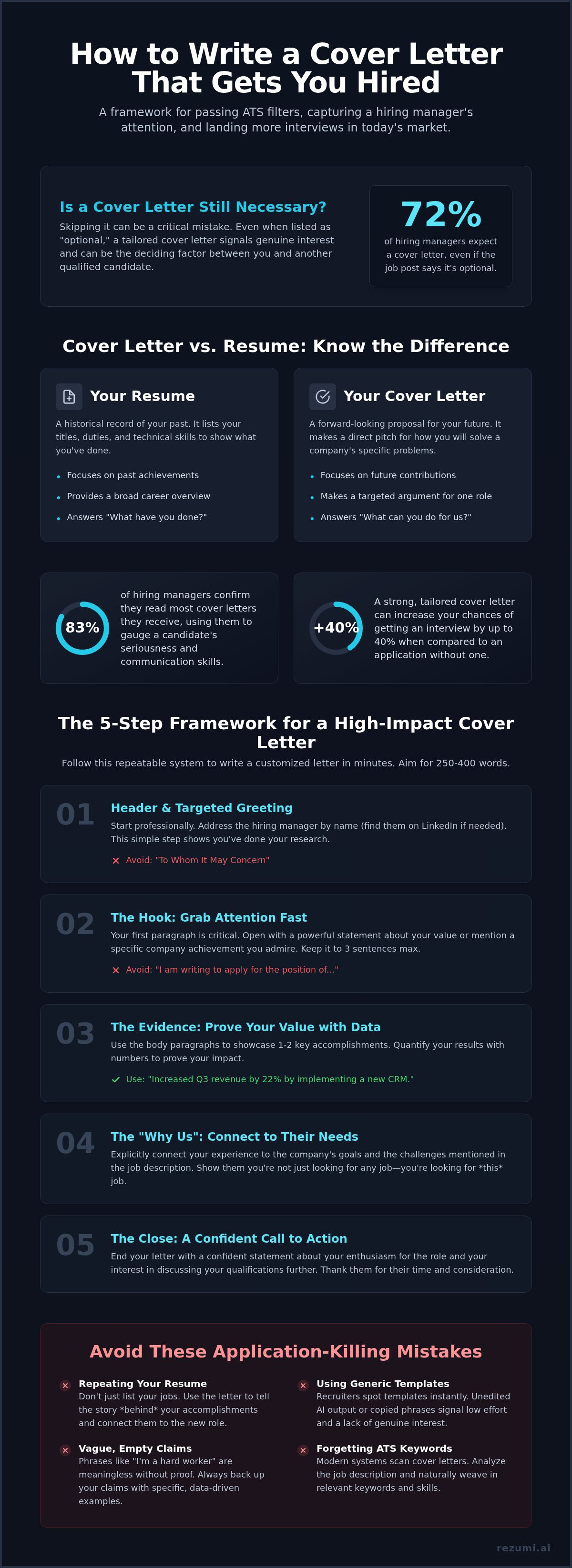
Back up every keyword with concrete evidence. An ATS might flag the word "leadership," but a human recruiter will look for the result. Don't just list a skill; prove it with a number or a specific outcome. This balance prevents your letter from sounding like an AI-generated list and shows you possess the actual expertise needed for the role.
Formatting Rules for Digital Success
Keep your margins at a standard one inch on all sides. This creates a balanced look that is easy to read on screens and in print. If you use a non-traditional layout, make sure your headings are clear and distinct. Your design should complement your resume without distracting from the content. You can read more about choosing the best resume format to ensure your entire application package looks professional and cohesive.
Focusing on these technical details ensures your hard work doesn't go to waste. When you understand how to write a cover letter for a job that satisfies both robots and humans, you gain a massive competitive advantage. You transition from a candidate who is just "applying" to one who is strategically positioned for success.
Avoiding the Generic Mistakes That Kill Applications
A single mistake can end your application before it truly begins. 18% of hiring managers state that a weak letter will disqualify a strong candidate. When you learn how to write a cover letter for a job, you must avoid the "To Whom It May Concern" trap. It signals a lack of effort and a failure to research the team. Find a specific name or use "Hiring Manager" to show you are paying attention to the details.
Stop repeating your resume word-for-word. Your cover letter should add context and personality that your bullet points cannot. If your resume says you managed a team, your letter should explain how you motivated them during a specific crisis. Provide the narrative that your resume lacks to create a complete picture of your professional value.
The Danger of the Generic Template
Hiring managers can spot a template in seconds. Sending a generic letter suggests you don't care about the company culture. Research indicates that tailored letters can outperform generic ones 10 to 1 in securing interview callbacks. You must prove you want this specific job, not just any job. A tailored pitch demonstrates that you understand the company's mission and are ready to contribute to it immediately.
Mastering how to write a cover letter for a job means shifting the focus from your needs to the employer's goals. Avoid the "Me, Me, Me" trap. Use the word "you" more often than "I" to show you understand their pain points. Explain how your skills will solve their problems rather than listing what you hope to gain from the position.
Tone and Professionalism Check
Your tone must match the brand of the company. A tech startup expects a different voice than a traditional law firm. Avoid sounding desperate or overly casual. Read your letter out loud to ensure it has a natural, human rhythm. If a sentence feels clunky or forced when spoken, it will feel the same way to a recruiter.
Cut out filler phrases like "I believe I am a good fit." These words carry no weight and waste valuable space. Replace them with hard evidence and specific results that prove your value. Let your achievements speak for themselves rather than relying on empty claims of confidence.
Scaling Your Applications with AI Tailoring
Tailoring your application for every job used to take hours of manual research. Today, it takes seconds. You no longer have to choose between the quality of your pitch and the quantity of your applications. Using AI to analyze job descriptions allows you to identify critical keywords instantly. This ensures your document satisfies ATS filters while speaking directly to a company's specific needs. When you understand how to write a cover letter for a job using these tools, you gain a massive speed advantage over other candidates.
Efficiency is the key to a successful search in 2026. You can generate a strong first draft that aligns with North American professional standards without starting from a blank page. This process allows you to maintain a high volume of applications without sacrificing the personal touch that recruiters value. High-performance tools do the heavy lifting of matching your skills to the role, leaving you more time for interview preparation.
How to Use Rezumi for Better Cover Letters
Our platform is built to streamline your workflow. You simply upload your resume and paste the job link to receive a tailored draft immediately. This draft uses the exact language and results-oriented structure we discussed in earlier sections. It ensures your evidence matches the employer's requirements perfectly. You can also use the centralized workspace to track which versions of your letter get the most interview callbacks.
Data-driven searching helps you refine your strategy over time. By seeing what works, you can double down on the phrasing that captures attention. You can check out Rezumi's pricing to see how our premium AI Cover Letter Generator and optimization tools can accelerate your career progress. We provide the technology so you can focus on the final decision.
The Human-AI Partnership
AI provides the structure, but you provide the soul. Always review your generated content for accuracy and personal flavor. Use the AI to handle keyword matching and formatting, then use your brain for the final polish. This ensures the letter sounds like a human being wrote it, which is crucial since 88% of hiring managers claim they can spot unedited AI text. Adding a specific personal anecdote or a unique detail about your interest in the company makes the pitch undeniable.
Think of AI as your strategic partner rather than a replacement. It builds the foundation so you can excel at the finish line. For more detailed examples of successful layouts, visit our Cover Letter Templates guide. Combining modern technology with your unique professional story is the most effective way to secure your next role.
Secure Your Next Interview with a Strategic Pitch
You now have the technical blueprint to transform your application strategy. Success in 2026 requires a balance between human storytelling and precise software optimization. By focusing on how to write a cover letter for a job that solves employer problems, you move past automated filters and directly into the hiring manager's view. You've learned to shift from a backward-looking summary to a forward-looking proposal tailored for the North American market.
Our platform helps thousands of successful professionals use AI-driven ATS keyword matching to stay ahead of the competition. You have the experience. We provide the tools to ensure it gets noticed by both robots and recruiters. This framework replaces the anxiety of a difficult process with the reassurance of a data-backed strategy.
The path from applicant to employee starts with a single, well-crafted page. You have the framework and the strategy. Now, it is time to show the world what you can do. We are here to support every step of your professional journey.
Frequently Asked Questions
How long should a cover letter be for a job in 2026?
Aim for a length between 250 and 400 words. This range provides enough space to showcase your results without losing the recruiter's attention. A concise letter ensures your most impactful achievements stand out. If your letter is too long, you risk your best points being ignored by a busy hiring manager who only has seconds to scan your application.
Can I use an AI tool like Rezumi to write my cover letter?
You can definitely use Rezumi's AI Cover Letter Generator to streamline your application process. It is a highly effective way to learn how to write a cover letter for a job that matches a specific job description. The tool identifies key requirements and suggests the best evidence from your resume. Always review the final draft to ensure it reflects your unique personal voice and professional story.
What should I do if I do not know the hiring manager's name?
Use "Hiring Manager" or "Dear [Department] Team" as your greeting. Avoid using "To Whom It May Concern" because it feels outdated and shows a lack of effort. Spend a few minutes on LinkedIn or the company's website to find a specific name first. If you still cannot find one, a professional, role-based greeting is the safest and most modern choice for North American applications.
Is it okay to use a cover letter template from Google Docs?
Google Docs templates are acceptable as long as they are simple and ATS-friendly. Avoid any designs with multiple columns, tables, or heavy graphics that can confuse scanning software. Stick to standard fonts like Arial or Calibri and keep your margins at one inch. A clean, professional layout ensures that both robots and humans can read your qualifications without any technical errors during the parsing process.
Should I include my salary expectations in my cover letter?
You should not include salary expectations in your letter unless the employer specifically asks for them. Discussing pay too early can weaken your position during later negotiations. It might also disqualify you if your range does not align with their budget before you have had a chance to prove your value. Save these details for the formal interview stage where you have more influence over the conversation.
How do I address a career change in my cover letter?
Use your letter to explain the logic behind your move and highlight your transferable skills. Instead of focusing on what you lack in a new industry, show how your past achievements solve the company's current problems. This document is your best opportunity to connect the dots for the recruiter. It proves that your unique background makes you a valuable and innovative hire for their specific team.
Does every job application really need a cover letter?
You should include a cover letter with every application you submit. Research shows that 72% of hiring managers expect one even when the job posting says it is optional. Skipping this step can make you appear less motivated than other candidates who took the time to provide context. A tailored letter proves you have done your research and are genuinely interested in the specific goals of the company.
What file format is best for sending a cover letter?
Saving your file as a PDF is the best choice for how to write a cover letter for a job. This format ensures your layout and fonts look exactly the same on every screen. It also prevents the document from being accidentally edited or appearing messy in a recruiter's applicant tracking system. Only use a different format, like a Word document, if the job description explicitly requests it.
Disclaimer
This article is provided for general informational purposes only and does not constitute professional, legal, financial, or career advice. While Rezumi strives for accuracy, we make no warranties as to the completeness or reliability of this content. Hiring practices, ATS behavior, and job-market conditions vary by employer, industry, and region — always verify against your specific situation. Any action you take based on this article is at your own risk.