Mastering Behavioral Interview Questions for the 2026 Job Market
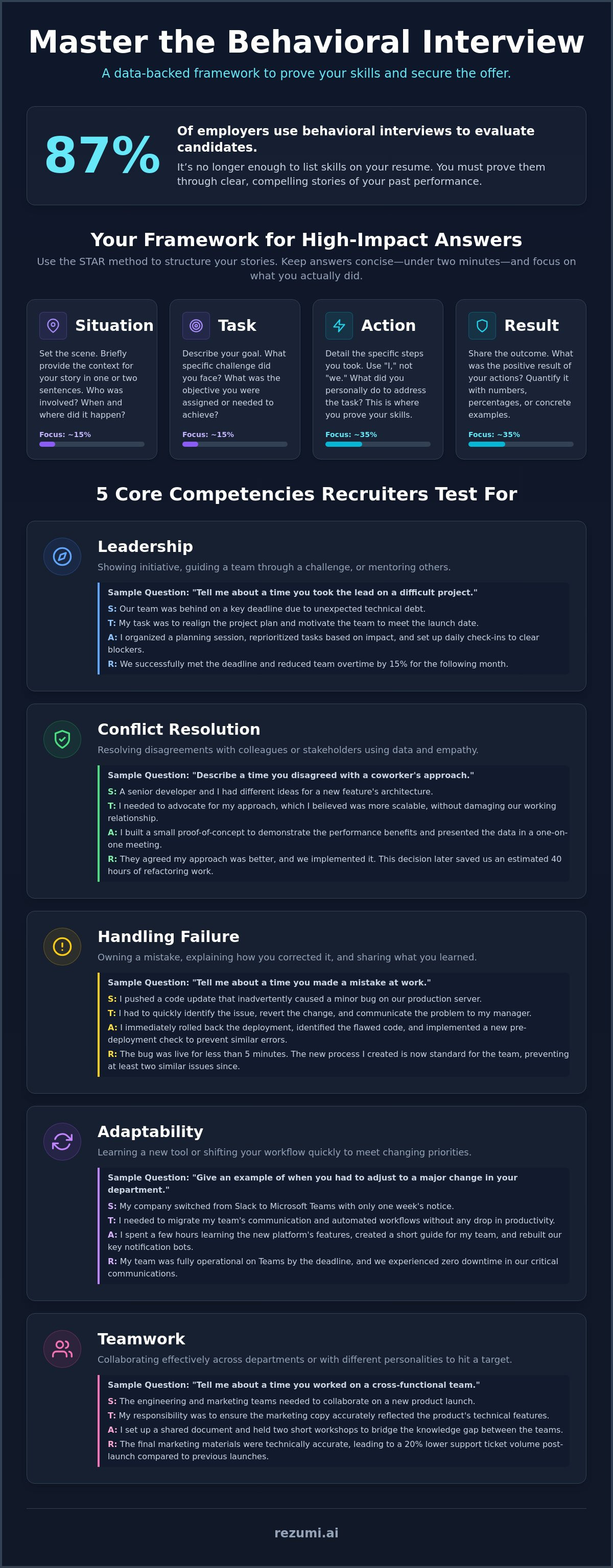
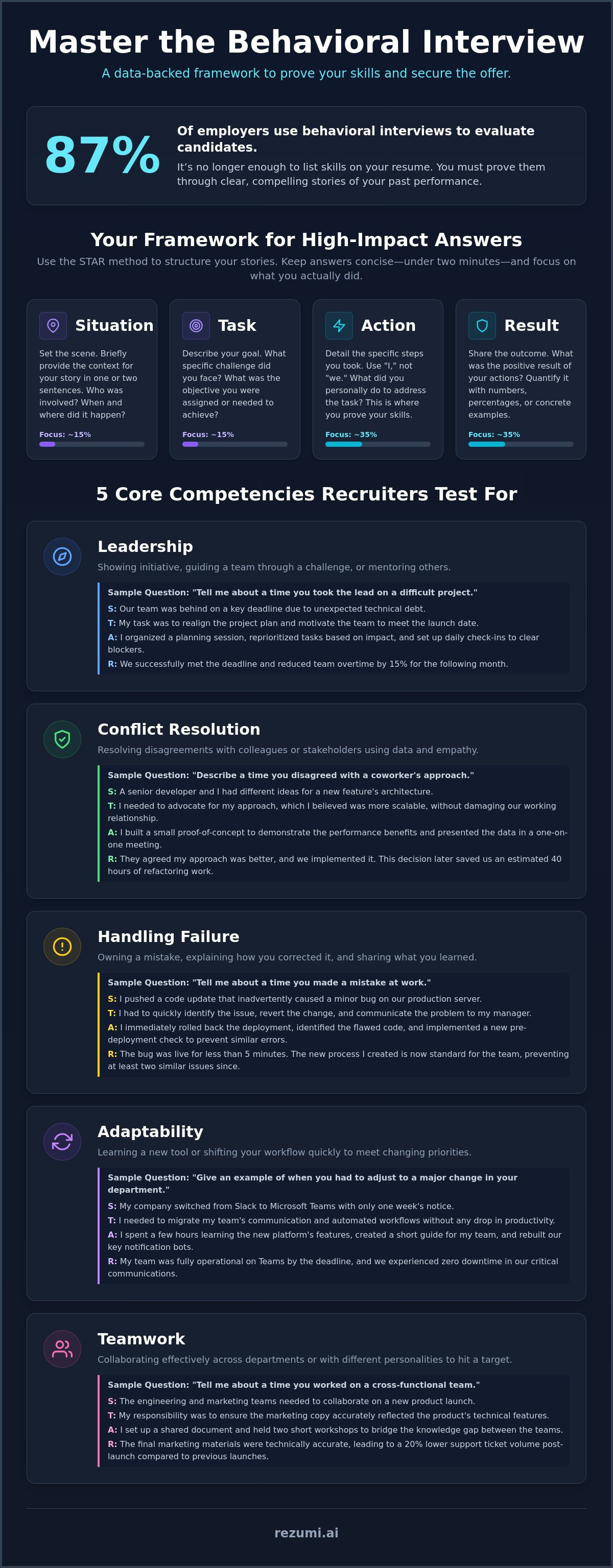
87% of employers now use behavioral interviews as their primary way to evaluate candidates. It is no longer enough to list skills on a page. You must prove them through stories. If you have ever felt your mind go blank during a behavioral questions interview, you are not alone. The pressure to quantify results and discuss past failures can feel overwhelming in a high-stakes meeting.
You can replace that anxiety with a data-backed strategy. We will show you how to transform your past experiences into compelling evidence that secures your next North American job offer. This is about moving from uncertainty to control. You need a system that works as hard as you do.
This guide provides a clear framework for building your stories and a list of ready-to-use examples. We help you handle high-stakes questions with calm authority. You will learn to package your history into a professional narrative that recruiters cannot ignore.
Key Takeaways
- Understand why recruiters use specific prompts to evaluate your soft skills and decision making.
- Apply the STAR method to structure your responses and keep every story under two minutes.
- Prepare for your next behavioral questions interview by building a library of examples for conflict and adaptability.
- Transform past failures into evidence of growth to prove your accountability to North American hiring managers.
- Practice with AI Interview Prep tools to get instant feedback on your pacing and story structure.
Understanding Behavioral Interview Questions and Why They Matter
87% of employers now use behavioral interviews as their primary tool for skills-based hiring. Recruiters use these specific prompts to strip away your rehearsed answers. They want to see how you handle pressure and people in real time. These prompts typically start with phrases like "Tell me about a time" or "Give me an example." In 2026, the focus has shifted toward high-impact soft skills. Companies prioritize emotional intelligence (the ability to manage your emotions and others) and AI literacy over simple technical knowledge. Your goal is to prove you can solve the specific problems the company faces right now.
North American firms, particularly in the US and Canada, value directness and quantifiable results. They don't want vague descriptions of your duties. They want to hear about the specific actions you took and the measurable impact of those actions. This is why the behavioral questions interview is so effective. It forces you to move beyond your job title and discuss your actual contributions. By 2026, hiring managers are trained to spot generic answers. They look for the nuance in your stories to see if you truly understand the complexities of modern work.
The Psychology Behind the Behavioral Pattern
The logic is simple: your past behavior is the most reliable predictor of your future performance. This is the foundation of Understanding Behavioral Interview Questions and why they dominate North American hiring. Companies have moved away from "what you know" to "how you work." They need to ensure you align with their internal culture. A candidate who knows the software but cannot resolve a team conflict is a liability. You are being tested on your ability to adapt to a changing workplace. In a standard tech interview, you can expect to face several of these prompts. It is a psychological assessment disguised as a conversation.
Identifying the Core Competencies Recruiters Test
Recruiters look for evidence in five main areas. You must prepare stories that demonstrate leadership, conflict resolution, failure, adaptability, and teamwork. You can use this list to audit your experience:
- Leadership: Showing initiative without being asked or guiding a team through a transition.
- Conflict: Resolving disagreements using data and empathy rather than emotion.
- Failure: Owning a mistake, explaining the correction, and sharing what you learned.
- Adaptability: Learning a new AI tool or shifting your workflow quickly to meet a deadline.
- Teamwork: Collaborating effectively across different time zones or departments to hit a target.
You should map these competencies directly to the job description you found. Every bullet point on your resume is a potential starting point for a story. Ensure your resume format highlights these skills clearly so the recruiter knows which questions to ask. When your written history matches your spoken stories, you build immediate trust. This alignment is the key to mastering the behavioral questions interview process. You are not just telling stories; you are providing data points for their decision-making engine.
The STAR Method: Your Framework for High-Impact Answers
The STAR method is your blueprint for a successful behavioral questions interview. It stands for Situation, Task, Action, and Result. This structure ensures your stories are logical and easy to follow. Most candidates fail because they provide too much context and not enough evidence. You must keep your answers concise and under two minutes to maintain the recruiter's interest. Focus 60 percent of your answer on the Action and Result phases. This shift in focus moves the conversation from what happened to what you achieved. Avoid rambling by sticking to one specific event rather than talking in generalities.
Breaking Down the STAR Components
To master this framework, you must treat each component as a distinct phase of your story. Precision is more important than length. Use these guidelines to build your responses:
- Situation: Set the scene in two sentences. Provide just enough context so the listener understands the environment.
- Task: Describe the specific challenge you faced. Clearly state what was at stake and what you were responsible for achieving.
- Action: Detail the exact steps you took to address the challenge. Use "I" instead of "we" to highlight your personal contribution and technical skills.
- Result: Share the final outcome. This is the payoff where you prove that your actions led to a positive, measurable change.
Refining the Result with Quantifiable Data
Adjectives are subjective, but data is objective. Hiring managers in North America look for hard evidence of your impact. Saying you "saved time" is a weak claim. Stating you "reduced processing time by 15 percent" is a verified achievement. When you are Answering Tough Questions, focus on metrics that align with business goals. Common metrics include revenue growth, cost reduction, efficiency gains, and employee retention. These details prove you understand how your work affects the bottom line. This level of specificity is a core part of strategic interview tips for 2026. It transforms a simple story into a professional case study.
Building these stories takes practice. You can view our AI coaching options to start practicing your STAR responses with real-time feedback. Refining your delivery now ensures you stay calm when the stakes are high.
Top Behavioral Interview Questions and Answer Examples
You have the STAR framework. Now you need the specific stories that prove your value. In a behavioral questions interview, the examples you choose define your professional brand. Recruiters in 2026 don't want generic "hard worker" stories. They want evidence of your ability to function in a hybrid, tech-heavy environment. You must prepare for questions that test your grit and your ability to work with others. Even if you aren't applying for a management role, you must show leadership by taking ownership of your results. Every answer should reflect the realities of the modern workplace.
Handling Workplace Conflict and Teamwork
Conflict is inevitable in high-performance teams. Recruiters ask about disagreements to see if you prioritize the business over your ego. When asked, "Tell me about a time you disagreed with a supervisor," don't focus on the personality clash. Focus on the professional resolution. A strong answer shows you can use data to advocate for a better path. For example, if you disagreed with a project timeline, explain how you presented a resource-allocation chart to prove the deadline was high-risk. This shows you're a strategic partner, not just an employee. You can find more structured prompts in San Jose State University's guide to behavioral interviews to help you categorize your experiences.
To show empathy while staying firm, explain your rationale. "I understood the manager's goal was speed, but my data showed that a 10 percent increase in testing time would prevent a 30 percent failure rate later." This approach proves you value the company's success more than being right.
Demonstrating Adaptability in a Hybrid World
85 percent of workers now consider remote or hybrid work their top priority. This makes "learning agility" the most important trait for 2026 hires. When a recruiter asks you to "Describe a time you had to pivot your strategy quickly," they are testing your tech-literacy and resilience. Don't just say you're flexible. Prove it with a specific shift in project scope or a remote collaboration challenge. Perhaps a new AI tool was introduced mid-project, or a team member in a different time zone went offline. Your answer should highlight how you mastered the new tool or adjusted the workflow without losing momentum. This shows you can handle the friction of a modern, distributed workforce. Recruiters want to see that you don't just survive change; you optimize it.
This commitment to continuous improvement can be demonstrated through professional development or even high-level technical hobbies; for example, mastering the intricate skills of classic car restoration with Restomod Academy shows a recruiter you have the focus and drive to learn complex new systems from scratch.
Answering Tough Questions: Failure, Mistakes, and Pressure
Hiring managers use high-stress questions to find your breaking point. The "Failure" question is not a trap. It is a test of your accountability and growth mindset. Never say you have never failed. This signals a lack of experience or a lack of honesty. Instead, choose a real mistake from your past where the resolution was successful. You must keep the tone positive even when you are discussing a negative situation. This is a critical moment in any behavioral questions interview. It is your chance to show you are a professional who takes ownership.
Mastering the "Tell Me About a Failure" Question
Identify a mistake that happened early enough in a project to have a clear fix. You want to avoid failures that caused irreparable damage to a client relationship. Focus on the "Post-Mortem." This is the formal process of analyzing what went wrong to ensure it never happens again. Recruiters in 2026 look for this "learning loop" as a sign of seniority; for instance, you can check out StatusPulse to see how modern organizations use status pages to maintain transparency during such operational hurdles. Show how this failure made you a more effective professional. For example, if you missed a minor bug in a software release, explain how you built a new automated validation script to catch it in the future. You aren't just admitting a fault. You are demonstrating a technical solution to a human error. This proves you can optimize systems under stress.
Performing Under High Pressure
Recruiters often ask: "Give me an example of a time you worked under a tight deadline." They want to see ruthless time management and the ability to stay calm. Don't just say you worked late. Show how you used data to prioritize your workload. In the 2026 job market, it is expected that you will take about 20 interviews to secure one hire. This means your pressure stories must be sharp and impactful to stand out from the competition. Use a clear before and after scenario to illustrate your focus.
- Before: The team was juggling five high-priority tasks with no clear hierarchy, leading to a 20 percent delay in delivery.
- After: You implemented a triage system based on project ROI. You reassigned minor tasks and finished the core deliverables 12 hours before the deadline.
This structure provides the proof recruiters need. It shows you can manage your own time and influence the team's output. By focusing on the strategy rather than the stress, you position yourself as a leader who remains in control when things go wrong.
For professionals in demanding roles, staying sharp during a career transition often requires managing your health alongside your schedule. Resources like Blue Collar Fit are designed to help workers maintain the stamina needed for long shifts and the mental clarity required for high-stakes interviews.
Strategic Preparation with AI Interview Coaching
Building your stories is the first step. Delivering them under pressure is the second. In a high-stakes behavioral questions interview, your ability to stay calm determines your success. You shouldn't rely on outdated methods like practicing in a mirror. Modern hiring requires a more sophisticated approach. Use AI tools to simulate the exact environment of a real interview. This technology allows you to identify flaws in your delivery before you meet a recruiter.
Data-driven feedback is the key to improvement. AI analyzes your pacing, word choice, and STAR structure in real time. If you ramble for three minutes, the system flags it. If you forget to quantify your results, the tool prompts you for data. This iterative process ensures your stories are refined and concise. It also helps you align your answers with ATS-optimized keywords from your resume. When your spoken words match the skills on your profile, you build instant credibility. Practice makes your delivery feel natural rather than rehearsed. You move from memorizing lines to internalizing your professional value.
How Rezumi AI Interview Prep Sharpens Your Answers
The Rezumi platform is engineered for specific results. You start by uploading the job description for the role you want. Our AI then generates tailored questions based on that specific company's needs. As you speak, the AI Interview Prep tool analyzes your STAR responses for completeness. It checks if you clearly defined the Task or if you skipped the Result. You get a score for every answer, allowing you to track your progress. Access to these advanced features is included in the standard Rezumi pricing plans. This is the final step in moving from uncertainty to total control over your career path.
The Final Interview Readiness Checklist
Before you enter the virtual room, you must be fully prepared. Confidence comes from having a data-backed strategy. Use this checklist to ensure you are ready:
- Hero Stories: Verify your three main stories cover different competencies like leadership and conflict.
- Tech Check: Test your microphone, lighting, and internet stability. 85 percent of workers prefer remote roles, so your virtual presence must be professional.
- Data Points: Memorize the specific numbers (percentages, dollar amounts) for your Results phase.
- Mock Sessions: Complete at least three AI-powered sessions to stabilize your pacing.
You have the framework. You have the stories. Now you have the tools to execute. Mastering the behavioral questions interview is a repeatable process. When you combine your experience with AI-driven optimization, you become the candidate that recruiters cannot ignore.
Secure Your Offer with Data-Backed Confidence
You have the framework and the stories to succeed in any high-stakes environment. By using the STAR method and focusing on quantifiable results, you move from being just another candidate to being a proven solution. Mastering a behavioral questions interview is about replacing anxiety with a repeatable, data-backed strategy. You are now ready to handle the toughest prompts with calm authority and professional poise.
The North American market is competitive, but you have a strategic advantage. You can refine your speaking pace and word choice using real-time feedback designed for current hiring standards. Practicing with tailored questions that match your specific job description ensures you never draw a blank when the stakes are highest. It's time to turn your preparation into a performance that recruiters won't forget.
Take the final step toward your next career milestone today. You have done the hard work of building your professional experience. Now, you have the tools to let that expertise shine through in every answer you give. Your next job offer is waiting, and once you've secured it, you can read more about celebrating your personal journey with a custom song gift.
Frequently Asked Questions
What is the most common behavioral interview question?
"Tell me about a time you handled a conflict with a coworker" remains the most frequent prompt. Recruiters use this to test your emotional intelligence and ability to maintain productivity during disagreements. It is a staple of the behavioral questions interview because it reveals your personality under stress. Focus your answer on the professional resolution rather than the drama of the situation.
How long should my STAR method answers be?
Aim to keep your responses between 90 and 120 seconds. This range is long enough to provide specific evidence but short enough to keep the recruiter engaged. If you talk for more than two minutes, you risk rambling and losing the impact of your result. Use a timer during your practice sessions to stabilize your pacing.
Can I use the same story for different behavioral questions?
You should avoid repeating the same story during a single interview. Prepare at least three to five unique "hero stories" that showcase different competencies like leadership, adaptability, and problem solving. Using the same example multiple times suggests you have limited experience or haven't prepared enough variety for the role.
What if I cannot think of an example during the interview?
Ask for a moment to reflect if you draw a blank. It is perfectly professional to say, "That is a great question. Let me take a second to think of the best example." A 10 second pause is much better than rushing into a disorganized story. If you still can't find a perfect match, offer a story that is closely related to the skill they are testing.
How do I quantify my results if I do not work in sales or finance?
Focus on frequency, scale, or efficiency. If you don't have revenue numbers, mention that you "managed a team of six" or "reduced project turnaround time by 15 percent." You can also use feedback scores or the number of stakeholders you influenced. Even "soft" roles have data points like the number of support tickets resolved or the percentage of tasks completed ahead of schedule.
Should I talk about a personal failure or a professional one?
Always choose a professional failure for a behavioral questions interview. Personal stories can blur professional boundaries and make the interviewer uncomfortable. A workplace mistake allows you to demonstrate your accountability and your ability to fix a process. Focus on what you learned and how you changed your workflow to prevent the error from happening again.
Is it okay to bring notes to a behavioral interview?
Brief bullet points are acceptable as a memory aid. You can keep a list of your "hero stories" on your desk for virtual meetings or in a professional folder for in person talks. Do not read from them directly. Use them as quick triggers to ensure you hit every part of your STAR structure without missing key data points.
How do behavioral questions differ for senior leadership roles?
Senior questions focus on strategic influence and long term organizational impact. Instead of asking how you solved a specific technical problem, recruiters will ask how you led a department through a major transition. The focus shifts from individual execution to how you manage budgets, influence stakeholders, and build high performance cultures.
Disclaimer
This article is provided for general informational purposes only and does not constitute professional, legal, financial, or career advice. While Rezumi strives for accuracy, we make no warranties as to the completeness or reliability of this content. Hiring practices, ATS behavior, and job-market conditions vary by employer, industry, and region — always verify against your specific situation. Any action you take based on this article is at your own risk.