Radiology Technician Jobs in Switzerland: Recognition and Interview Guide (2026)
The average salary for a radiology technologist in Switzerland reached CHF 85,800 in 2026, making it one of the most lucrative healthcare markets in Europe. You've likely seen these numbers and started dreaming of a career in the Alps. However, the gap between your current license and a Swiss hospital offer can feel like a mountain of paperwork. Between the Swiss Red Cross (SRC) recognition and the high language requirements, it's easy to feel stuck before you even apply.
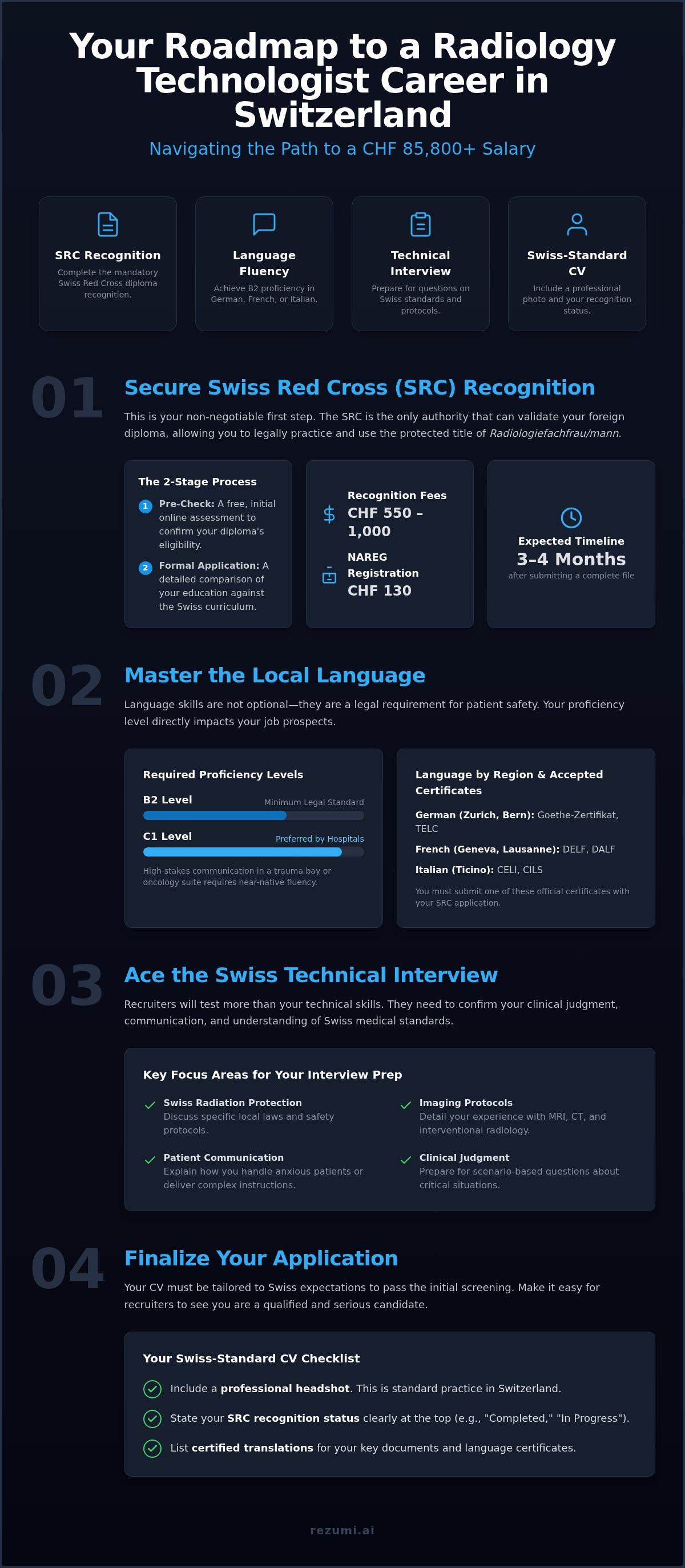
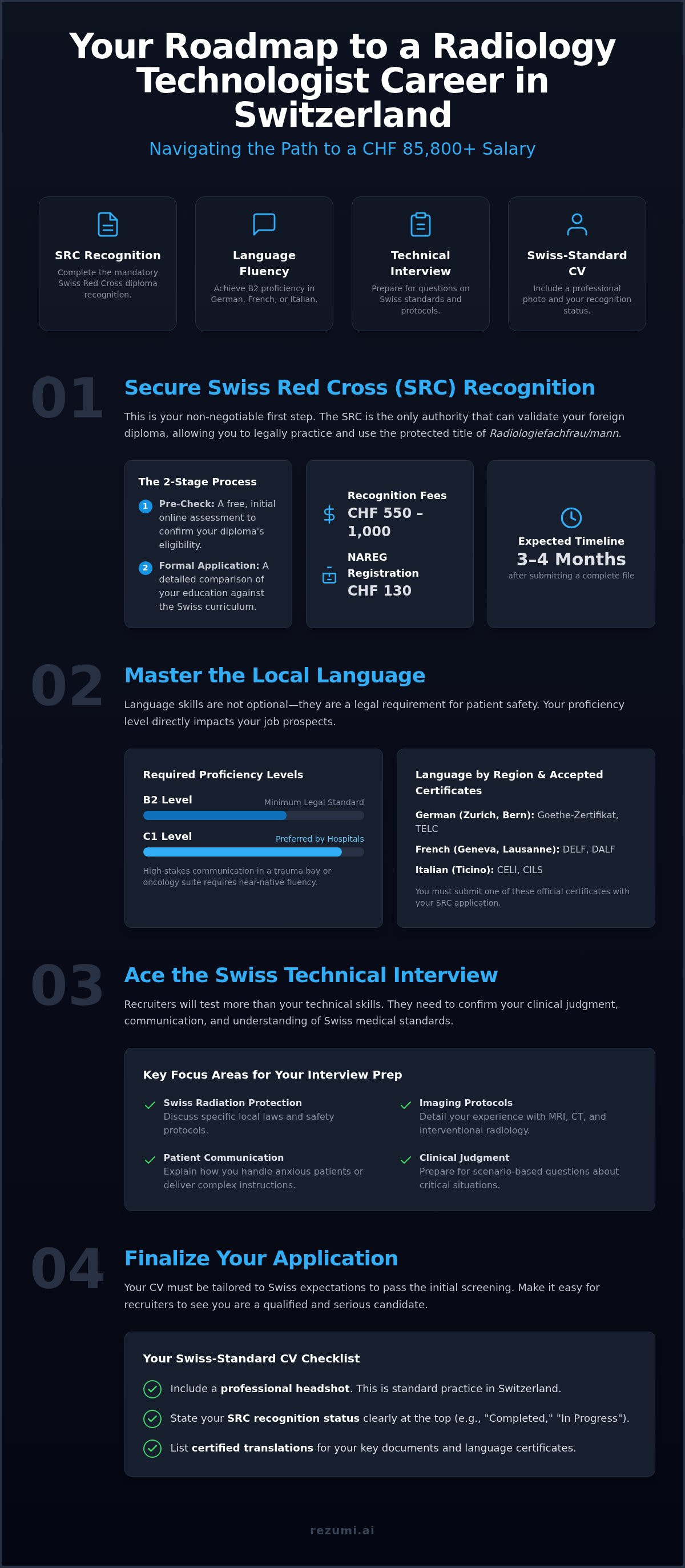
You understand that technical excellence is only half the battle. To succeed, you need to master the specific radiology technician interview questions that Swiss recruiters use to test your clinical judgment and language fluency. This guide shows you how to manage the CHF 550 to CHF 1,000 recognition fee, meet the mandatory B2 proficiency standard, and present your skills in a way that resonates with Swiss medical directors. We will cover every step from filing your initial NAREG registration to signing your first contract.
Key Takeaways
- Secure your legal right to work by completing the Swiss Red Cross (SRC) recognition process. It's a necessary step that includes paying the required fees and finishing your NAREG registration.
- Meet the mandatory B2 language proficiency standards. It's a non-negotiable requirement for patient safety in any Swiss hospital or clinic.
- Prepare for radiology technician interview questions by focusing on Swiss technical standards. You'll need to discuss radiation protection and specific imaging protocols in detail.
- Build a Swiss-standard CV that includes a professional photo. State your current recognition status clearly so recruiters can process your application quickly.
Understanding SRC Recognition for Radiology Technicians
You cannot legally step into a Swiss radiology department without the Swiss Red Cross (SRC) stamp of approval. The SRC is the sole authority responsible for recognizing foreign diplomas in non-university health professions. If you hold a degree from outside Switzerland, this process is your first and most critical hurdle. It ensures your training aligns with the high standards expected in the Radiographer Profession across the Swiss cantons. Without this recognition, you're prohibited from using the protected titles of Radiologiefachfrau or Radiologiefachmann.
Think of this as a dual-track journey. While the SRC handles your legal right to practice, you must simultaneously prepare for the clinical reality of the job. Recruiters will expect you to be deep into the recognition process before they even ask you radiology technician interview questions during a screening call. Showing that you've already started your application signals that you're a serious, high-intent candidate who understands the Swiss system.
The Two Stages of Recognition
The process begins with a free online pre-check. This initial assessment determines if your specific diploma is eligible for recognition in Switzerland. It's a binary result: you either move forward or you don't. Once you pass the pre-check, you enter the formal application phase. This is where the SRC conducts a granular comparison of your education against Swiss curricula.
If the SRC identifies gaps in your training, they'll issue compensatory measures. You might need to complete an adaptation period in a Swiss hospital or pass an aptitude test. These aren't failures; they're structured paths to bring your skills up to local standards. Don't let these requirements slow your momentum. Use this time to refine your technical vocabulary so you're ready when radiology technician interview questions turn toward complex Swiss protocols.
Required Documentation and Costs
Precision is mandatory when submitting your dossier. You'll need certified translations of your degree and transcripts into German, French, or Italian, depending on where you plan to work. The SRC also requires documented proof of your professional experience in diagnostic or interventional radiology. In 2026, the fees for this procedure range from CHF 550 to CHF 1,000. You must also pay a separate fee of CHF 130 to be listed in the National Register of Healthcare Professions (NAREG).
Expect the entire procedure to take between 3 and 4 months after you submit a complete file. Because Swiss hospitals prioritize efficiency, having your SRC paperwork in order is just as important as having a polished resume. It's the ultimate proof that you're ready to contribute to a high-performance medical team from day one.
Language Requirements for Working in Swiss Hospitals
You cannot work in a Swiss hospital without proving you speak the local language. Swiss law is strict about this requirement. You must hold a certificate at the B2 level or higher in the language of the canton where you intend to work. While B2 is the legal minimum, most head physicians prefer C1. High-stakes communication in a trauma bay or oncology suite leaves no room for translation errors or hesitation.
Your location dictates your study plan. If you're targeting Zurich, Bern, or Basel, you need German. If Geneva, Lausanne, or Neuchâtel are your goals, French is mandatory. Ticino requires Italian, though this region has fewer international openings. Don't assume English will get you through the day. Even if the medical team speaks it, your patients often won't be bilingual. You must be able to comfort a patient in their native tongue during a difficult scan.
Choosing Your Language Track
Select a recognized certification to validate your skills. For German cantons, the Goethe-Zertifikat or TELC are the gold standards. For the Romandie region, focus on the DELF or DALF. These certificates are mandatory for your SRC recognition file. Without them, your application will stall immediately. Most hospitals won't even grant an initial screening until they see your language credentials or proof that you're enrolled in a B2 exam.
Bridging the Gap to Medical Fluency
Everyday fluency isn't enough for clinical success. There is a massive gap between ordering a coffee and explaining a contrast media injection. You must learn the specific shorthand used in Swiss digital health records. Practice giving MRI and CT instructions that are clear and calming. You should be able to explain radiation risks using plain language so a patient with no medical background can understand it.
This skill is often tested when you face Radiologic Technologist Interview Questions during your second-round meeting. Recruiters listen for your ability to simplify complex physics without losing the core safety message. They want to see how you handle linguistic pressure under stress.
Swiss recruiters will use radiology technician interview questions to gauge how you handle these interactions. They might ask you to simulate a patient briefing in German or French during the interview. They want to see if you can maintain technical accuracy while being empathetic. If you're worried about how your skills translate to a new market, you can explore our interview prep tools to practice these scenarios before the high-stakes call. Preparing your technical answers in advance ensures that language barriers don't hide your professional expertise.
Preparing for Technical Radiology Interview Questions
Swiss medical culture values technical rigor above all else. Your interviewers will likely be senior technologists or radiologists who prioritize patient safety and radiation hygiene. They aren't looking for vague answers. They want to hear about your specific experience with ALARA (As Low As Reasonably Achievable) principles and how you apply them in a high-volume environment. When you prepare for radiology technician interview questions, focus on your ability to justify every exposure you make.
Recruiters in Switzerland also look for candidates who understand the full diagnostic chain. It isn't enough to just push buttons. You must show that you understand the "why" behind specific protocols for MRI, CT, and Mammography. This clinical logic is what separates a technician from a high-level technologist in the eyes of a Swiss department head.
Core Technical Questions to Practice
Prepare for scenarios that test your split-second decision-making. You'll likely be asked: "How do you handle a patient with a suspected MRI contraindication?" Your answer must demonstrate a systematic approach. Mention checking the implant's make and model, consulting the safety database, and communicating clearly with the radiologist. It's about maintaining the safety chain without slowing down the department's workflow.
Another common prompt is: "Explain your process for optimizing image quality while minimizing dose." In Switzerland, dose management is a legal and ethical priority. Focus on your ability to adjust kVp and mAs settings based on patient habitus. Finally, be ready to describe your experience with contrast media administration. Specifically, explain how you screen for renal function and manage potential allergic reactions. These radiology technician interview questions are designed to see if you can maintain technical excellence under pressure.
Swiss Hospital Standards
Swiss facilities lead the world in adopting cutting-edge technology. You'll need to demonstrate proficiency with modern Radiology Information Systems (RIS) and Picture Archiving and Communication Systems (PACS). Mention your familiarity with AI-assisted imaging trends, such as automated lesion detection or noise reduction algorithms. Showing that you're tech-savvy gives you a distinct advantage over candidates who only know the basics.
Quality assurance (QA) is another pillar of Swiss imaging. Expect to discuss your role in daily or weekly equipment calibrations. Swiss hospitals often involve technologists in complex interventional cases, so highlight any experience you have in the angio suite or operating room. If you find it difficult to articulate these technical processes in a new language, you can use AI Interview Prep to refine your explanations. Practicing these answers ensures you sound like the expert you are, even when the pressure is on.
Mastering Patient-Focused Scenarios and Soft Skills
Technical expertise is only half of the Swiss equation. In a country where private clinics and public hospitals compete on service quality, your ability to provide a premium patient experience is vital. Recruiters use specific radiology technician interview questions to probe how you handle the human side of imaging. They want to see if you can stay calm when a patient panics during a long MRI sequence or if you can show empathy to an elderly patient who is confused by the machinery.
Swiss medical culture places a massive premium on professional distance and precision. You aren't just a button pusher. You're a representative of the hospital's reputation. During the interview, your body language and tone will be scrutinized just as much as your clinical answers. Being direct, maintaining eye contact, and showing a deep respect for patient privacy are non-negotiable traits for success in this market.
Common Behavioral Scenarios
Expect your interviewers to use the STAR method (Situation, Task, Action, Result) to evaluate your past performance. A common prompt is: "Describe a time you had to calm a claustrophobic patient before an MRI." Your answer should highlight your communication skills. Explain how you used the intercom to provide constant updates or how you offered a panic button to give the patient a sense of control. This shows you prioritize patient comfort without compromising the department's schedule.
You may also face questions about managing a heavy workload. Swiss hospitals are highly efficient, but they never sacrifice safety for speed. If asked how you handle a back-to-back schedule, emphasize your methodical approach to prep and your ability to stay focused under pressure. Finally, be prepared to discuss a mistake you made. Swiss employers value honesty and accountability. Describe the error, how you corrected it immediately, and what protocols you put in place to ensure it never happened again.
Cultural Fit in the Swiss Workplace
Cultural alignment is often the deciding factor between two equally qualified candidates. You must demonstrate that you can work seamlessly within a multi-disciplinary team of nurses, physicists, and radiologists. Show that you respect the established hierarchy and follow hospital protocols to the letter. In Switzerland, punctuality is a form of respect. Arriving even two minutes late to an interview can be a disqualifying factor.
To frame your answers effectively, you can review the Rezumi guide on interview tips. It provides a blueprint for commanding professional conversations and presenting your background with confidence. Remember that Swiss hospitals value professional distance. While you should be warm and empathetic with patients, your interactions with colleagues should remain polished and formal until a closer relationship is established. Mastering these subtle social cues will make you stand out as a candidate who is ready to integrate into the Swiss workforce.
Finalizing Your Application for the Swiss Market
Your application for a Swiss hospital isn't just a resume; it's a complete professional dossier. In Switzerland, recruiters expect to see a professional photo, your SRC recognition status, and copies of your diplomas immediately. If you omit these components, your file will likely be discarded before a human ever reads about your experience. Swiss hospitals use sophisticated software to screen candidates, so your documents must be formatted for both human eyes and machine algorithms.
Precision is the standard in Swiss healthcare. This means your application must be error-free and logically organized. Swiss employers value stability and detailed documentation, so providing a comprehensive view of your career is the only way to secure an interview. By presenting a complete dossier, you signal that you're ready to meet the high standards of the Swiss medical system.
Optimizing Your Swiss CV
Swiss CVs follow a very specific logic that differs from North American norms. You should place your technical modalities, such as MRI, CT, and PET, clearly at the top of the first page. This allows a busy department head to see your clinical value in seconds. You also need to state your language levels explicitly, using the Common European Framework of Reference for Languages (CEFR) scale like B2 or C1.
Choosing the right resume format is critical for passing through hospital ATS systems. Swiss recruiters prefer a clean, chronological layout that highlights your professional growth and longevity. Ensure your contact information includes your Swiss work permit status if you have one, or clearly state that you're an international applicant seeking sponsorship. This transparency saves time and builds trust with potential employers.
The Power of Tailoring
Generic applications don't work in the Swiss medical market. You must adapt your profile for the specific department you're applying to, whether it's a pediatric unit or a high-volume trauma center. Mentioning your willingness to work on-call or night shifts can give you a massive advantage. Many Swiss hospitals struggle to fill these slots, so highlighting your flexibility makes you a high-priority candidate.
Tailoring also prepares you for the next stage of the hiring process. When you align your CV with the hospital's specific equipment and patient demographic, you're essentially pre-answering the radiology technician interview questions you'll face later. Recruiters will see that you've done your homework and are a serious contender. To get an edge on the competition, you can sign up for Rezumi pricing plans to access advanced ATS optimization tools. These tools ensure your technical skills are translated into the exact keywords Swiss recruiters are searching for.
Finally, don't forget your Arbeitszeugnisse, or employment certificates. In Switzerland, these documents are vital for any healthcare role. They provide a detailed evaluation of your performance and behavior from previous employers. If you're coming from a market that doesn't use them, try to provide detailed letters of recommendation that mirror this formal structure. A complete dossier is your ticket to a high-paying role in one of the world's best healthcare systems.
Launch Your Swiss Radiology Career Today
Moving your career to Switzerland is a high-stakes transition that requires both legal compliance and clinical readiness. You now have a clear roadmap for securing Swiss Red Cross recognition and meeting the mandatory B2 language standards. By focusing on specific radiology technician interview questions related to ALARA principles and patient-focused scenarios, you can transform from an international applicant into a top-tier candidate. Hospitals in Zurich and Geneva are looking for professionals who combine technical precision with cultural awareness.
Success in the Swiss market depends on your ability to tailor your technical expertise to local hospital standards. Your preparation doesn't end with a translated diploma. It continues with rigorous practice and a perfectly optimized dossier. Global professionals are already using advanced tools to bridge the gap between their current licenses and a signed Swiss contract. You have the skills and the plan. Now it's time to execute and secure your future in one of the world's most advanced healthcare systems.
Your journey to the Alps starts with a single, well-prepared step. We're here to ensure every part of your application reflects the expert you are. Build your confidence and your career today.
Frequently Asked Questions
How long does the Swiss Red Cross recognition take for radiology technicians?
It takes approximately 3 to 4 months for the Swiss Red Cross (SRC) to process your recognition application. This timeline starts only after they receive your complete file, including all translated diplomas and work certificates. You should start this process at least half a year before your planned move to account for document collection and translation time. Proper preparation prevents long delays in your Swiss job search.
Can I work in Switzerland as a radiology tech with only English?
No, you cannot work in a clinical setting with only English because Swiss law requires proficiency in a national language. You must provide proof of at least a B2 level in German, French, or Italian to secure SRC recognition. While some research focused roles might use English, patient facing hospital positions require local language skills. This ensures patient safety and clear communication within the medical team.
What is the average salary for a radiology technician in Switzerland in 2026?
The average salary for a radiology technologist in Switzerland is approximately CHF 80,000 per year as of 2026. Depending on your experience and the canton, the typical range falls between CHF 56,860 and CHF 96,902. Technicians with over 20 years of experience can earn upwards of CHF 92,000. This reflects the high value Swiss hospitals place on senior clinical expertise and technical specialization.
Do I need to redo my radiology training in Switzerland?
You usually don't need to redo your entire training if your foreign degree is deemed equivalent by the SRC. If gaps are found during the recognition process, you might be asked to complete compensatory measures. These often involve a short adaptation period in a Swiss hospital or a specific aptitude test rather than a full multi year degree program. Most international degrees from accredited institutions are recognized with minimal extra requirements.
What are the most common MRI interview questions for Swiss hospitals?
Swiss recruiters often ask radiology technician interview questions about MRI safety screening and specific sequence optimization. Expect to explain how you handle metallic implants or manage patient claustrophobia during long scans. They want to hear technical details about your familiarity with 1.5T and 3T systems. Demonstrating your ability to follow strict safety protocols without supervision is key to passing the technical screening.
Is a B2 language certificate enough to get a work visa?
A B2 certificate is required for professional recognition, but a work visa (B Permit) requires a signed employment contract. You must first get your credentials recognized and then secure a job offer from a Swiss hospital or clinic. Once you have a contract, your employer usually assists with the residency and work permit application through the cantonal authorities. Language skills are just the first step in the legal process.
How do I explain my foreign work experience to a Swiss recruiter?
Focus on translating your past responsibilities into Swiss technical standards and modalities. When answering radiology technician interview questions, use specific examples of the equipment you've operated and the volume of patients you've managed. Swiss recruiters value stability and technical precision. Provide detailed descriptions of your clinical rotations and any specialized certifications in CT or Mammography to prove your readiness for the Swiss market.
Which cantons have the highest demand for radiology technicians?
Demand is highest in major healthcare hubs like Zurich, Bern, and Geneva due to their large university hospitals and private imaging centers. These cantons offer the most opportunities for international recruits but also have the strictest language requirements. Smaller cantons also face shortages, though they might have fewer openings at any given time compared to the primary urban centers. Researching specific cantonal needs can help you target your application.
Disclaimer
This article is provided for general informational purposes only and does not constitute professional, legal, financial, or career advice. While Rezumi strives for accuracy, we make no warranties as to the completeness or reliability of this content. Hiring practices, ATS behavior, and job-market conditions vary by employer, industry, and region — always verify against your specific situation. Any action you take based on this article is at your own risk.