Sample Interview Question and Answer: The 2026 Strategic Guide
Your interview is not a casual conversation. In 2026, it's a high-stakes data-verification session where recruiters check if your verbal stories match your ATS-optimized resume. If you feel a sense of dread about freezing up during these meetings, you're not alone. Many candidates struggle to bridge the gap between their written experience and the cultural expectations of North American hiring managers. This guide offers a proven sample interview question and answer framework to help you speak with the same precision found in your application.
It's frustrating when your spoken answers don't reflect the high quality of your resume. You need a strategy that replaces anxiety with control, especially in a market with 7.6 million open job vacancies. This guide shows you how to master the most common questions using data-backed structures that North American recruiters expect. We'll cover fill-in-the-blank templates and the STAR method (Situation, Task, Action, Result) to ensure you stay consistent. By the end of this article, you'll have the tools to align your verbal performance with your optimized career profile.
Key Takeaways
- Treat every interview as a verification session where your spoken stories confirm the data on your optimized resume.
- Structure your introductory pitch using a Past, Present, and Future model to keep your professional summary concise and relevant.
- Focus on the "Result" phase of the STAR method to show North American recruiters the tangible value you bring to their team.
- Study a specific sample interview question and answer to prepare for high-stakes topics like career gaps or your reasons for leaving a role.
- Finish the meeting strong by asking strategic questions about team culture and success metrics to show you are ready for the job.
The Strategic Framework for Every Interview Answer
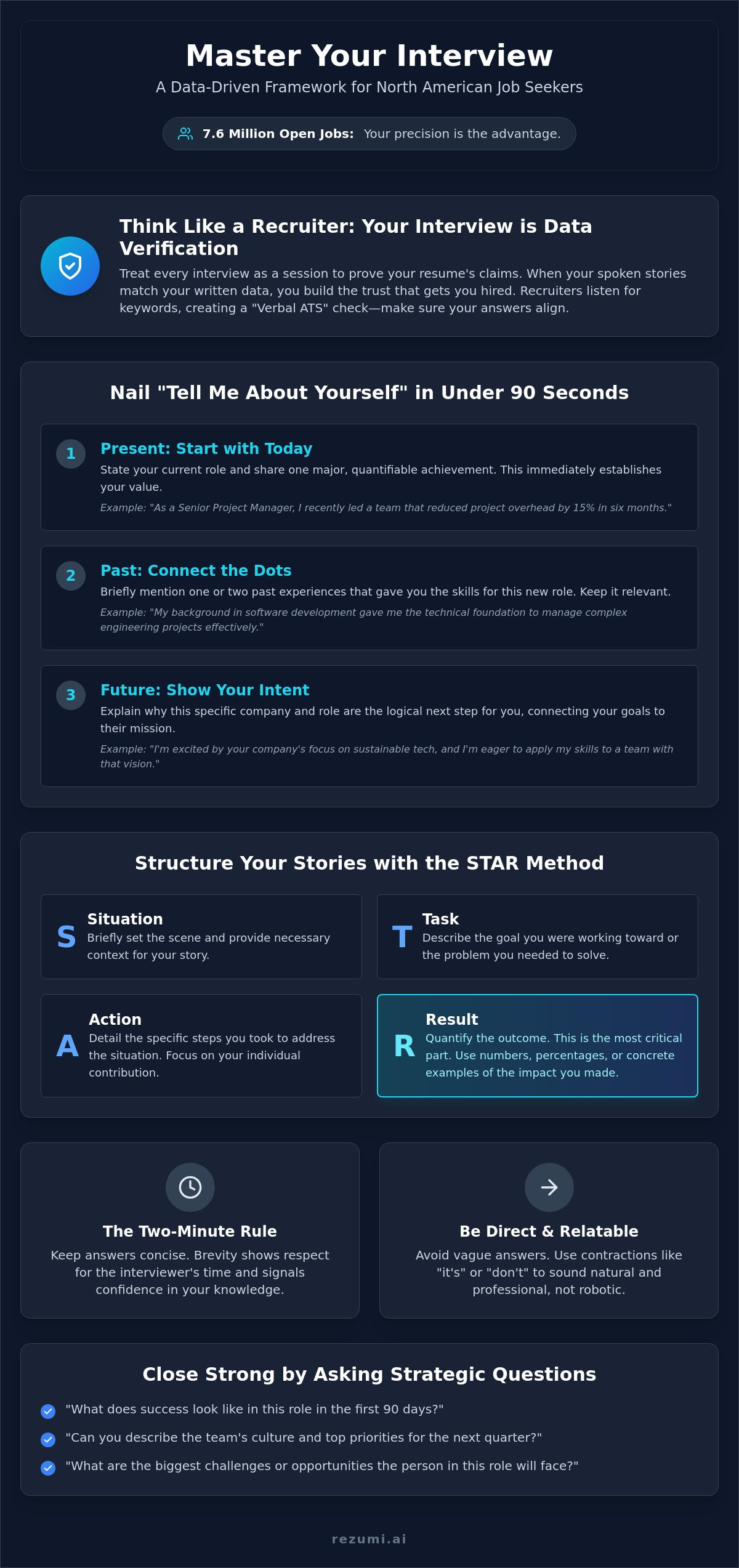
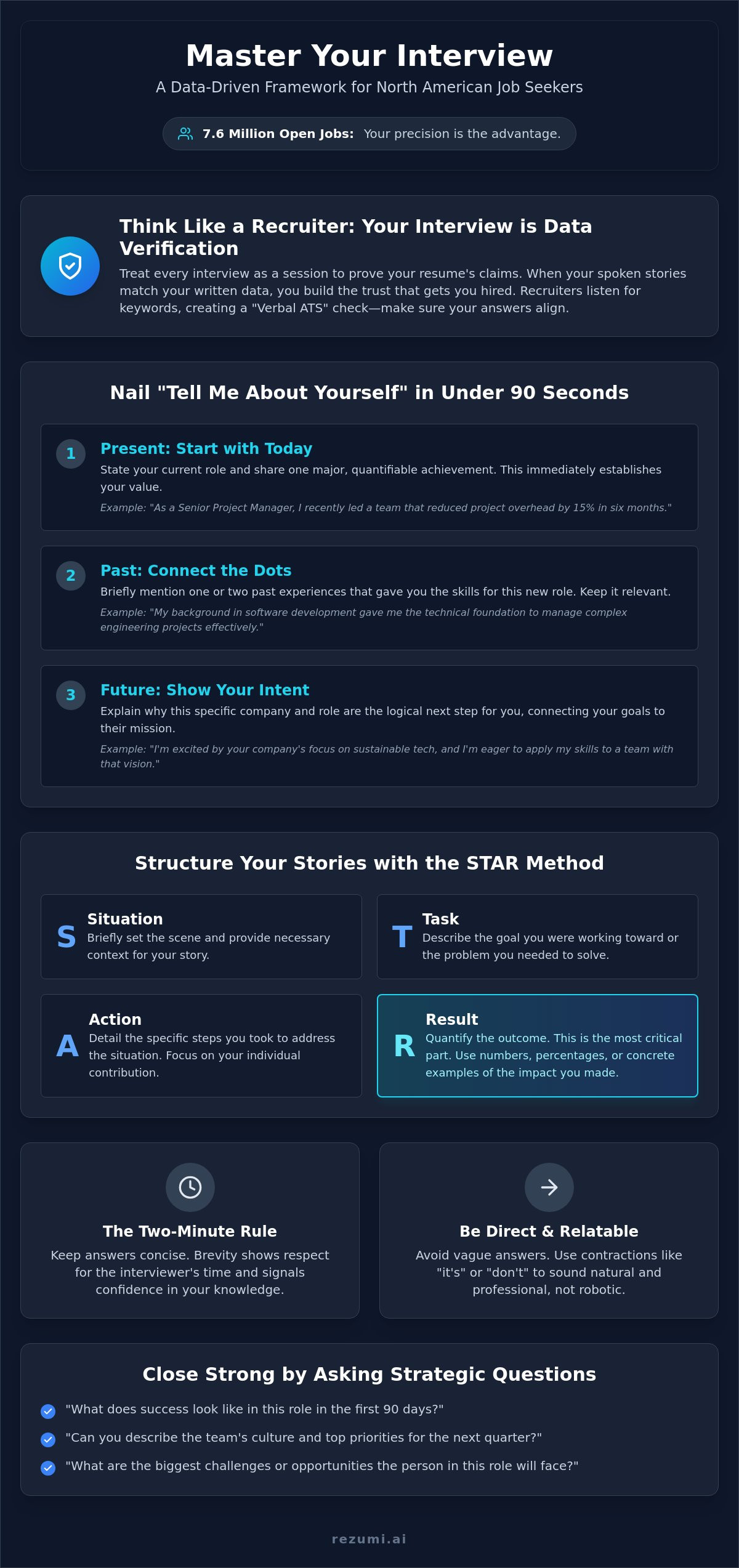
The interview is a high-stakes meeting where a recruiter verifies the data points on your resume. Think of it as a framework for every interview you'll ever have. If your resume claims you increased department efficiency by 15%, the recruiter expects you to explain exactly how you did it. Consistency is the primary trust builder in this process. When your verbal answers match your written records, you prove that you're a reliable professional. In a market with 7.6 million job openings, standing out requires this level of precision.
Recruiters in the US and Canada often use a "Verbal ATS" approach. They listen for specific keywords that align with the job description. If they don't hear the right technical terms or soft skills, they might assume you're not a fit for the role. This is why a generic sample interview question and answer won't help you if it doesn't align with your specific application. You must tailor your speech to mirror the optimization you've already done on your resume to confirm you're the candidate they're looking for.
Aligning Answers with Your ATS Resume Score
Identify the top three skills that triggered your interview invite. These are usually the high-score keywords found in your ATS Resume Optimization report. For each skill, prepare one concrete story that proves your expertise. Don't just list your duties. Instead, describe a problem you solved and the result you achieved. Rezumi helps you find these keywords early so you can build your stories around what recruiters actually value. This alignment ensures your verbal "sample interview question and answer" strategy is as high-performing as your resume score.
The Directness Factor in North American Hiring
In North American markets, brevity is a sign of respect. Giving vague answers or talking in circles can signal a lack of confidence. Follow the two-minute rule for your responses. If an answer takes longer than two minutes, you're likely sharing too much detail. You want to sound natural but polished. Using contractions like "don't" or "can't" helps you avoid sounding like a stiff robot. It makes you appear more relatable and professional. Focus on direct, outcome-focused communication to keep the recruiter engaged and focused on your results.
Answering Common Introductory Questions
Your opening answer is your first chance to validate your resume data. When a recruiter asks you to tell them about yourself, they want a curated professional pitch, not a life story. Reciting your resume in chronological order is a mistake that loses recruiter attention. Instead, use a structure that focuses on your current impact and future potential to build immediate trust.
A high-performing sample interview question and answer for this opener follows a simple three-part formula: Present, Past, and Future. Start with your current role and one major win. Briefly mention the experience that led you here. End by explaining why this specific company is the logical next step for your career. This approach keeps your answer under 90 seconds and ensures you don't lose the recruiter's interest.
The 60-Second Professional Pitch Template
Your pitch should be a reflection of your ATS-optimized profile, which is your resume designed to pass through the Applicant Tracking Systems that companies use to filter candidates. Start by stating your current title and a quantifiable achievement, such as managing a team of ten or reducing costs by 12%. Transition into your background by highlighting one or two skills that directly relate to the job description. Finally, connect your expertise to the specific challenges the company is currently facing. This shows you've done your homework and are ready to contribute from day one.
Connecting Your Goals to Company Mission
The questions "Why do you want to work here?" and "What do you know about us?" are direct tests of your research. You can find the company's hidden mission by looking at the specific language in the job posting and their recent press releases. If they emphasize "customer-centricity," your answer should reflect your history of improving client satisfaction scores. Match your career trajectory to their growth plan to show you're a long-term investment. In a market with 7.6 million job openings, showing this level of intentionality is vital.
For more details on researching employers, check out our guide on Strategic Interview Tips. When you align your personal goals with their corporate mission, you build immediate credibility. You can refine these answers using our AI Interview Prep tool to ensure your delivery is as sharp as your strategy. This level of preparation is what separates finalists from the rest of the applicant pool.
Behavioral Questions and the STAR Method
Behavioral questions are the core of North American interviews. Recruiters ask these because they believe your past actions predict your future performance. To answer these effectively, you must use the STAR method. This stands for Situation, Task, Action, and Result. While the first three parts set the stage, the Result is what actually wins the job. North American hiring managers are looking for the bottom line. They want to know exactly how your presence made the company better, faster, or more profitable.
Consider this sample interview question and answer for a conflict scenario. When asked about a time you faced a workplace disagreement, don't focus on the drama. Instead, describe a situation where a teammate disagreed with your project timeline. Your task was to realign the team without missing the deadline. You took action by organizing a data-driven meeting to prove your timeline's accuracy. The result was a successful launch that occurred three days ahead of schedule, which saved the department $2,000 in overtime costs.
For a project management question, the structure remains the same. If you're asked to describe a major project, start with the specific challenge. For example, you might have orchestrated a migration to an integrated health solution like One Health Connect for 500 users. Your specific action could be designing a tiered rollout plan to minimize risks. The result should be a specific metric, such as completing the migration with zero system downtime and a 95% user satisfaction rate. This level of detail proves you can handle high-stakes responsibilities.
Quantifying Your Results
You must use hard numbers to be taken seriously. Percentages, dollar amounts, and time saved are the language of successful professionals. If you don't have exact data, provide a conservative estimate based on your observations. For instance, you could say you "reduced processing time by approximately 15%" based on weekly reports. A single sentence like "I reduced client churn by 10% in six months" carries more weight than a paragraph of vague descriptions. Metrics provide the proof recruiters need to trust your claims.
For professionals in the car rental sector, highlighting your experience with specialized tools like RateHighway to automate rate management is an excellent way to provide the quantifiable results that recruiters demand.
Likewise, a sports performance coach might discuss their use of ArmIQ to track arm health and optimize training loads, demonstrating a commitment to data-driven decision-making.
The Action Phase: Highlighting Your Specific Contribution
Avoid the "we" trap during your interview. While teamwork is important, the recruiter is hiring you, not your former colleagues. Focus on what you specifically did to drive the project forward. Use active verbs that show authority and technical skill. Words like "engineered," "orchestrated," or "slashed" are much more impactful than "helped" or "worked on." You can find more high-impact verbs in our ATS Resume Optimization guide. Matching these verbal action words to your resume ensures your story stays consistent and powerful.
Navigating Difficult and High-Stakes Questions
High-stakes questions determine if you have the emotional intelligence required for senior roles. You aren't just giving a sample interview question and answer; you're demonstrating professional maturity and composure. Recruiters in North America value honesty over scripted perfection. If you try to hide a career gap or a weakness, they'll sense the inconsistency with your resume data. Address these topics directly to maintain your credibility and keep the interview on track.
The Weakness Framework: Growth Over Perfection
Stop saying you're a perfectionist. Recruiters see this as a dishonest answer that avoids the question. When you prepare a sample interview question and answer for your weaknesses, focus on genuine growth. Pick a real technical skill or soft skill you've worked to improve. Describe the specific steps you took to fix it, such as completing a certification or asking for targeted feedback. Show the current result of your effort. For example, if you struggled with public speaking, mention the workshop you attended and how you now lead monthly team presentations. This shows you're proactive and capable of self-improvement.
When asked why you're leaving your current role, keep the focus on your career trajectory. Avoid complaining about former managers or toxic environments. Frame the move as a search for new challenges that fit your specialized skills. If you have a resume gap, explain it briefly without making excuses. Focus on what you did during that time, like upskilling or consulting. This keeps the conversation focused on your future value rather than past setbacks.
Salary Negotiation in the First Interview
Salary transparency is now a legal standard in many North American regions. As of July 2026, laws in Virginia and Maine require employers to disclose pay ranges in job postings. Research shows that 82% of U.S. workers are more likely to apply when the pay is listed. If a recruiter asks for your expectations before you've seen an offer, use the pivot technique. State that you're focused on finding the right fit and would like to discuss compensation once you understand the full scope of the role. You can point to models of transparent value, like Rezumi Pricing, to show you value clear expectations. This keeps your negotiation power high until you've proven your worth.
The Closing Strategy: Questions and AI Preparation
The final five minutes of your meeting are just as critical as the first five. When a recruiter asks if you have any questions, saying "no" is a major missed opportunity. You must have three to five thoughtful questions ready to go. This isn't just about gathering information. It's about demonstrating that you're already thinking like a high-performing member of their team.
Your closing strategy should focus on the future. While you've spent the interview providing a sample interview question and answer for their inquiries, now it's your turn to lead the conversation. High-impact questions show that you're interested in more than just a paycheck. They prove you're looking for a place where you can make a measurable impact and grow alongside the company.
Questions That Make You Look Like a Leader
Avoid asking about benefits or vacation time during the initial interview rounds. Instead, ask questions that focus on success and department challenges. These questions position you as a problem-solver who is ready to hit the ground running. Consider these options:
- "What does success look like in this role after six months?" This shows you are results-oriented and focused on long-term goals.
- "How does the team handle conflicting priorities?" This demonstrates your interest in workflow, efficiency, and team dynamics.
- "What is the biggest challenge the department is facing right now?" This allows you to briefly explain how your specific skills can solve that problem.
Using Rezumi for AI-Driven Mock Interviews
Confidence comes from repetition. You can use our AI Interview Prep tool to run mock interviews that simulate the high-stakes environment of a North American hiring session. These tools identify filler words like "um" or "uh" that can make you sound unsure of your expertise. They also analyze your tone to ensure you sound authoritative and professional. Practicing your STAR stories until they feel natural allows you to focus on the recruiter's reactions rather than struggling to remember your own experience.
Once the meeting ends, your work isn't quite finished. You must send a professional thank you note within 24 hours to stay ahead of other candidates. This note should reference a specific topic from your conversation to reinforce your interest and show you were listening. Use our Interview Follow Up Email Template to ensure your message is polished and prompt. This final step keeps your name at the top of the recruiter's mind as they move toward a hiring decision.
Command Your Career Path with Precision
Success in the 2026 job market requires more than just showing up. You've learned that every sample interview question and answer must serve as proof of the skills listed on your resume. By mastering the STAR method and preparing strategic questions for your recruiter, you transition from a passive candidate to a proactive leader. Consistency is your greatest asset. When your verbal stories align with your ATS-optimized profile, you build the trust necessary to secure an offer.
Don't leave your performance to chance when you can use technology to refine your delivery. Rezumi offers instant AI feedback on your delivery and provides answer structures tailored for North American hiring standards. These tools ensure your verbal responses are as optimized as your resume. You have the experience and the strategy. Now, it's time to execute with confidence and secure the role you deserve.
Frequently Asked Questions
How do I answer "Tell me about yourself" in an interview?
Lead with your current professional identity and one major achievement that relates to the job description. Use the Present, Past, Future model to keep your pitch under 90 seconds. This ensures you're providing a high-quality sample interview question and answer that feels like a natural extension of your resume data. You want to show the recruiter that your career path leads directly to their specific needs.
What are the most common behavioral interview questions?
In 2026, recruiters prioritize questions about adaptability, initiative, and problem-solving. You'll likely hear "Tell me about a time you had to learn a new tool quickly" or "Describe a situation where you took the lead without being asked." These questions test if you can handle the current market where versatility is highly valued. Prepare stories that show you can thrive in a cautious hiring environment by being a self-starter.
How should I explain a gap in my resume during an interview?
Address the gap directly and pivot immediately to the skills you gained or maintained during that time. Whether you were caregiving, traveling, or upskilling, explain it in one sentence and then describe how you stayed current with industry trends. This transparency builds trust and prevents the recruiter from making their own assumptions. Focus on your readiness to return to a full-time role with fresh perspectives.
What is the STAR method for answering interview questions?
The STAR method is a storytelling framework that covers Situation, Task, Action, and Result. It's the standard for North American interviews because it forces you to provide concrete evidence of your skills. Always spend the most time on the "Result" phase. Use specific numbers or percentages to show exactly how your actions benefited your previous employer and solved their problems.
How do I talk about my salary expectations in the first round?
Check the job posting first, as new laws in states like Virginia and Maine now require employers to list pay ranges. If asked for a number, provide a range based on market data for your specific city and role. You can also ask the recruiter what the budgeted range for the position is. This ensures your expectations are aligned before you invest more time in the interview process.
What are some good questions to ask the interviewer at the end?
Ask questions that reveal the day-to-day reality of the role and the manager's leadership style. You might ask, "How do you provide feedback to your team?" or "What is the most important goal for this department in the next quarter?" These questions show you're thinking about long-term success. It demonstrates that you're evaluating the company just as much as they're evaluating you.
How can I prepare for an interview if I am an introvert?
Focus on deep preparation and use your listening skills to your advantage. Introverts often excel at providing thoughtful, detailed answers when they've practiced their STAR stories in advance. Schedule "recharge time" before and after the meeting to ensure your energy levels stay high. Remember that being a good listener is a valuable trait that many North American managers look for in team members.
How do I handle a question I do not know the answer to?
Don't panic or try to guess; instead, explain the process you would use to find the answer. You can say, "I haven't encountered that specific scenario yet, but here is how I would approach solving it." This demonstrates your problem-solving logic and your honesty. Recruiters value candidates who can admit what they don't know and show a clear path toward finding a solution.
Disclaimer
This article is provided for general informational purposes only and does not constitute professional, legal, financial, or career advice. While Rezumi strives for accuracy, we make no warranties as to the completeness or reliability of this content. Hiring practices, ATS behavior, and job-market conditions vary by employer, industry, and region — always verify against your specific situation. Any action you take based on this article is at your own risk.