Situational Interview Questions: The 2026 Strategy for North American Jobs
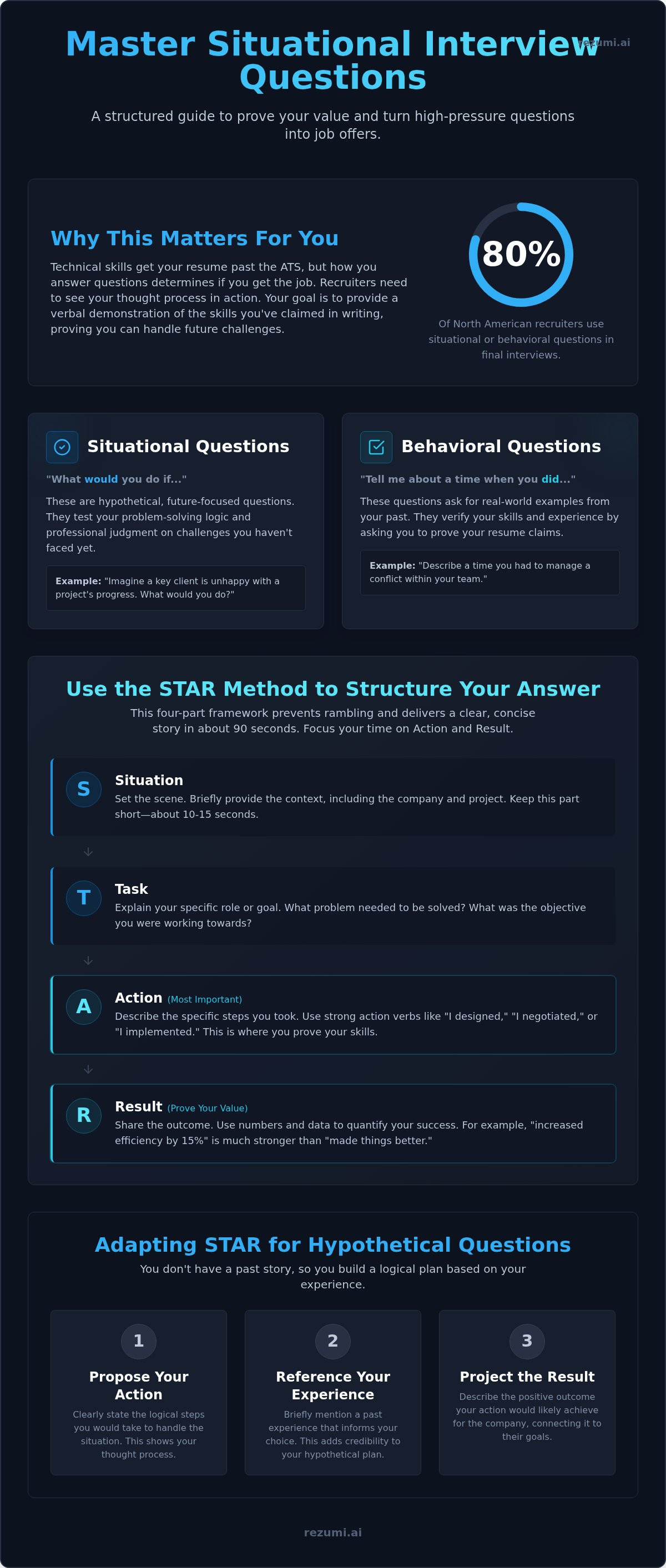
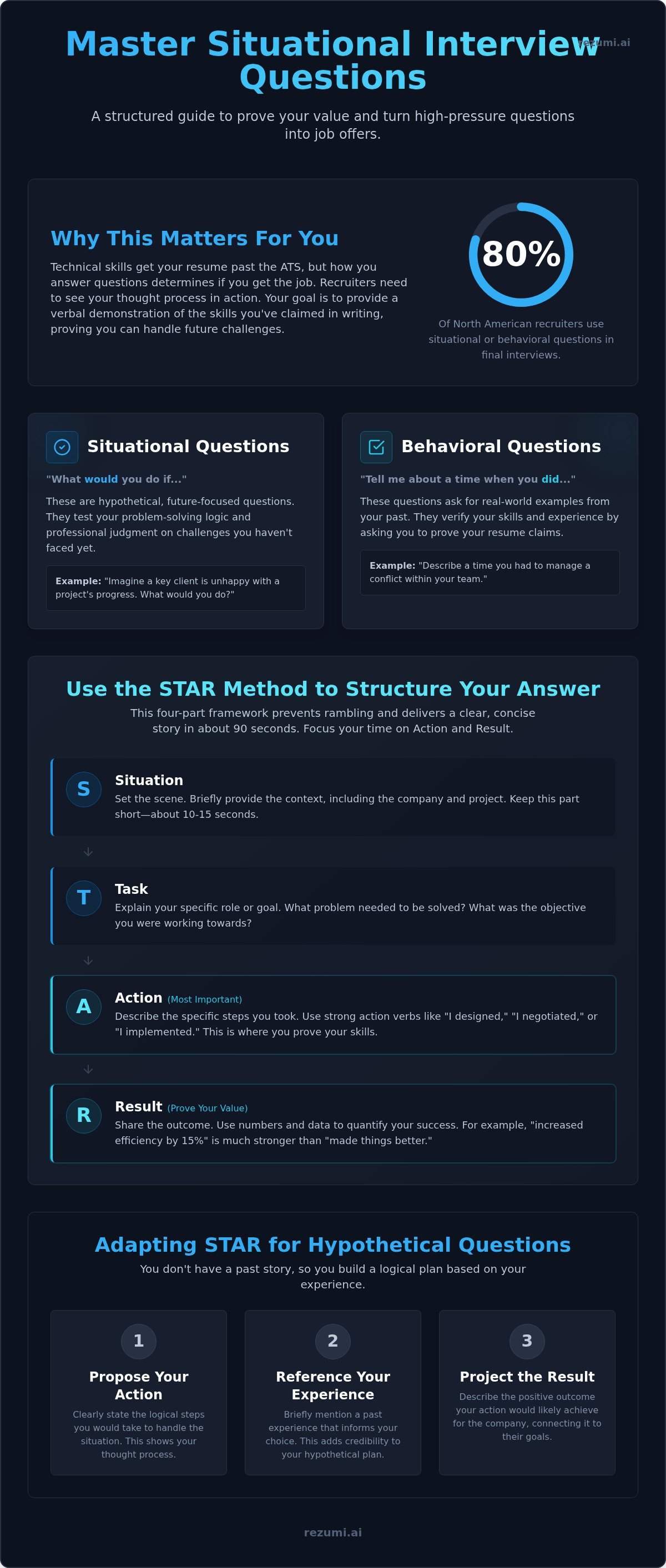
Eighty percent of North American recruiters use behavioral or situational interview questions during the final hiring round. This high number shows that your technical skills are only half the battle. You must also prove you can handle future workplace challenges based on your past actions. It's a high-stakes moment where silence or rambling can cost you the job.
You likely know the feeling of freezing when a recruiter asks how you'd manage a sudden project shift. It's common to forget key details or struggle to tell the difference between situational and behavioral prompts. You want your verbal delivery to be as polished as your resume, but the pressure makes it hard to stay organized and clear.
You'll learn how to answer situational interview questions with confidence using a structured system that recruiters in the US and Canada respect. This article provides a clear framework for every response. You'll gain a reliable method to align your interview answers with your resume claims while keeping your delivery sharp and professional. We'll cover the specific strategies you need to handle any curveball with ease.
Key Takeaways
- Understand why 80 percent of North American recruiters use situational interview questions to test your problem-solving skills.
- Use the STAR method to build a structured framework that prevents rambling during high-pressure moments.
- Identify the most common workplace scenarios recruiters ask about so you aren't caught off guard.
- Ensure your spoken answers match the claims on your ATS-optimized resume to build trust with the hiring team.
- Practice your delivery with AI Interview Prep to get real-time feedback on your performance and confidence.
Mastering Situational Interview Questions in the 2026 Job Market
Situational interview questions ask you to explain how you would handle a specific work scenario that hasn't happened yet. These are future-oriented prompts. Recruiters in the US and Canada use them to test your critical thinking and soft skills in real time. They want to see your thought process when you face a new challenge. Most of these questions start with phrases like "What would you do if" or "Imagine a situation where you have a conflict with a client."
Your goal is to provide a logical, structured response. It isn't just about the result you describe. It's about showing the recruiter how you reach that result. This is your chance to prove you can think on your feet. It's the verbal verification of the skills you've listed on your resume. If your resume says you are a problem solver, these questions are how you prove it. You are moving from a static list of bullet points to a dynamic demonstration of your talent.
Situational vs. Behavioral Questions
It's easy to confuse these two types of questions, but they serve different purposes. Situational questions are hypothetical. They focus on your future actions and your potential to grow. Behavioral questions ask for real examples from your past work history. One asks what you *would* do, while the other asks what you *did* do. Recruiters use both to verify the skills you listed on your resume. Combining your past success with your future strategy creates a complete picture of your professional value. It shows you aren't just reciting a script.
Why North American Recruiters Value These Scenarios
Hiring managers in North America look for more than just technical ability. They need to know how you prioritize tasks under pressure. Situational questions reveal your professional judgment and whether your problem-solving style matches the company culture. A situational interview question is essentially a test of your professional judgment. They show if you can stay calm when things go wrong. These scenarios help recruiters filter out candidates who look good on paper but struggle in a dynamic work environment.
Preparing for these questions is the second step of your job search. Passing the ATS gets you in the room, but your verbal delivery keeps you there. You need a system to ensure your answers are consistent and impactful. This alignment between your written claims and your spoken words is what secures the job offer. Practice helps you avoid the anxiety of high-pressure moments. It turns a stressful interrogation into a controlled professional conversation.
Using the STAR Method to Structure Your Responses
The STAR method is a four-part framework that keeps your answers organized. It's the industry standard for a reason. It prevents rambling and ensures you hit every key point without wasting the recruiter's time. In 2026, recruiters expect concise answers that last about 90 seconds. If you talk for three minutes, you've already lost their attention. You must focus your energy on the Action and Result sections of the framework. These two areas prove your actual worth to a potential employer.
The Four Parts of a Winning Story
A structured story is more memorable than a list of tasks. Break your response into these four distinct phases to maintain control of the narrative:
- Situation: Give a brief 10-second overview of the context. State the company name and the specific project background.
- Task: Explain the specific goal you needed to achieve. Define the problem that required a solution.
- Action: Describe the exact steps you took to solve the problem. Use active verbs like "designed," "negotiated," or "built."
- Result: Share the outcome using real numbers or data points. Mentioning a 15 percent increase in efficiency is better than saying things "got better."
Adapting STAR for Hypothetical Situations
When you face situational interview questions, you don't have a past story to tell yet. You have to build one based on your professional logic. Start by explaining the specific steps you would follow. This is your proposed Action. Briefly mention a past experience that informs your future choice. This adds weight to your hypothetical plan and builds trust. End by describing the positive result your action would likely create for the company.
Reviewing Common Situational Interview Questions will help you see where these patterns fit. You can then practice these structures until they feel natural. If you want to see how your timing stacks up against professional standards, check out our AI interview prep tools. Getting instant feedback on your pace ensures you don't exceed that 90-second limit. It turns a stressful moment into a display of professional control.
Common Situational Questions and Professional Answers
Most situational interview questions fall into predictable categories like conflict, deadlines, or mistakes. Recruiters use these to see how you'll behave when things don't go as planned. You should prepare for the "disagreeing with a coworker" scenario as it appears in almost every interview cycle. When you craft your answer, focus on professional resolution and company goals rather than personal feelings. Your response must show that you are proactive and willing to take ownership of any situation.
Handling Workplace Conflict and Pressure
When a recruiter asks how you would resolve a disagreement with a team member, they are looking for emotional intelligence. You should explain a process that involves active listening and data-based decision-making. Don't just say you'd "talk it out." Describe how you'd identify the root cause of the conflict and suggest a solution that keeps the project on track. This shows you value the company's success more than being right.
You may also be asked how you'd manage a sudden change in project scope. In this case, your answer should highlight your ability to pivot without losing momentum. Explain how you would re-prioritize your current tasks and communicate the impact on deadlines to your manager. If you are dealing with tight deadlines, show how you handle pressure without sacrificing work quality. Mention specific tools or methods you use to stay organized, such as project management software or daily check-ins. Learning How To Answer Them helps you stay calm when these high-pressure questions come up.
Dealing with Mistakes and Ethical Dilemmas
Integrity is a top priority for North American hiring managers. If you are asked what you would do if you noticed a peer making a serious error, your response should be measured and professional. Explain that you would first approach the coworker privately to discuss the mistake and offer support. If the error poses a risk to the company or a client, you must show you are willing to follow the proper reporting channels. This demonstrates that you protect the business interests while maintaining professional relationships.
When discussing what you would do if you missed a critical deadline, focus on transparency and immediate corrective action. You shouldn't make excuses or blame others. Instead, explain that you would inform your supervisor immediately and provide a clear plan to finish the work. This level of honesty builds trust. It proves that you can handle situational interview questions by showing you are a reliable professional who owns their mistakes and fixes them quickly.
Connecting Your Stories to Your ATS Optimized Resume
Your interview is the final audit of your professional claims. It's the moment where you turn static text into living proof for a hiring manager. Recruiters in the US and Canada look for consistency between your written application and your verbal delivery. If your resume says you're an expert in "Conflict Resolution," but you can't provide a clear example, you lose credibility instantly. Building this trust is the most important part of the final hiring round.
Before you step into the room, identify the top keywords in your ATS resume. ATS (Applicant Tracking System) is the software companies use to scan and filter resumes. If the software flagged you for a specific skill, the recruiter will likely use situational interview questions to test that exact competency. You must choose stories that highlight those specific keyword skills to ensure your narrative remains cohesive and strong.
Building a Strategic Story Bank
You don't need a new story for every possible question. Instead, create 5 to 7 versatile stories that cover different categories like leadership, technical problem-solving, and teamwork. This "story bank" allows you to adapt quickly to whatever the recruiter asks. Ensure each story has a quantified result to prove your impact. Use real numbers like a 20 percent increase in sales or $10,000 saved in project costs. This data makes your claims undeniable and memorable.
You should also map your stories to the resume format you used for your application. If you used a chronological format, your stories should follow a clear timeline of your career growth. If you used a functional format, focus your stories on broad skill sets rather than specific dates. This alignment shows that you have a deep understanding of your own professional history and value.
Verifying Your Skills for Hiring Managers
Action-oriented language is your best tool during the interview. Use high-impact verbs like managed, developed, and solved in your answers. These words suggest movement and successful outcomes. Avoid vague claims like "I am a good communicator." Instead, replace them with the specific actions you took to improve a team's communication flow. This approach proves that your skills are not just words on a page but tools you use every day to solve business problems.
Recruiters use situational interview questions to see if you can apply your resume skills to future challenges. When you describe your actions, focus on the "how" and the "why" behind your decisions. This level of detail shows you have the professional judgment needed for senior roles. It moves the conversation from a basic Q&A to a strategic discussion about how you will help the company succeed.
Sync your resume and interview strategy now
Refining Your Performance with Rezumi AI Interview Coaching
Practice is the only way to ensure your performance matches your potential. Rezumi AI Interview Prep allows you to practice your situational answers in a safe space. You get instant feedback on your tone, speaking pace, and content clarity. This data allows you to see exactly where your delivery falters before you ever meet a recruiter.
The AI helps you trim fluff and focus on the most impactful parts of your story. It analyzes your responses to situational interview questions to ensure your logic is sound and your timing is precise. You should practice until your delivery feels natural and professional. This transition from rehearsed to natural is what wins over hiring managers.
Eliminating Filler Words and Pre-Job Nerves
Confidence is often undermined by subtle habits you don't even notice. The AI identifies filler words that make you sound less certain of your skills. Eliminating these habits helps you speak with the authority of a top-tier professional. You can use mock interviews to build the muscle memory needed for the real room.
This repetitive practice replaces anxiety with a sense of controlled readiness. When you know your story is tight, the pressure of situational interview questions becomes manageable. You can focus on connecting with the recruiter instead of worrying about what to say next.
- Filler detection: Remove "um" and "uh" from your professional vocabulary.
- Pace control: Ensure you don't speak too fast when you feel nervous.
- Tone analysis: Maintain a professional and confident sound throughout the session.
Final Steps for Interview Mastery
Readiness requires a combination of content and strategy. Combine your story bank with strategic interview tips for total readiness. You must check your verbal answers against the specific requirements found in the job description. This ensures every word you say adds value to your candidacy.
Consistency is what separates an average candidate from a top-tier hire in the North American market. It proves that you prepared for success with precision and data-backed tools. When your spoken words match your optimized resume, you create a powerful and believable professional brand.
Your journey to a new role doesn't end with a good resume. It continues through the final verbal verification of your talents. Visit the Rezumi pricing page to start your AI coaching session today. Taking this final step ensures that you walk into your next interview with a polished voice and the confidence to secure the offer.
Secure Your Next Offer with Data-Backed Readiness
Winning a job in the North American market requires more than just a strong resume. You've learned how to handle situational interview questions by using the STAR method to keep your answers concise and data-driven. Your verbal stories must mirror the keywords on your ATS-optimized resume to build recruiter trust. This consistency is what separates successful candidates from the rest of the applicant pool.
Preparation is the final step in your journey from uncertainty to control. Rezumi provides AI-driven coaching tailored for US and Canadian hiring standards. You get real-time feedback on your tone and content. This direct alignment with your resume keywords proves you are the right fit for the role. It replaces the anxiety of a difficult process with the reassurance of a strategic advantage.
You have the tools and the strategy to succeed. Take the final step and walk into your next interview with total confidence.
Frequently Asked Questions
What is the difference between situational and behavioral interview questions?
Situational questions focus on future hypothetical scenarios, while behavioral questions focus on real past actions. Situational prompts often start with "What would you do if," while behavioral ones start with "Tell me about a time when." Both types allow you to demonstrate your professional judgment in different ways. Recruiters use these to verify that your skills match the claims on your resume. Understanding this difference helps you prepare the right type of story for each prompt.
How do I answer situational questions with no work experience?
You can use examples from volunteer work, academic projects, or internships if you lack professional experience. Focus on transferable skills like leadership or problem-solving. Describe a time you managed a group project or resolved a conflict in a club. Recruiters want to see how you think and handle pressure, regardless of the setting. Be specific about your actions and the results you achieved to show your potential value.
Can I use the same story for multiple situational questions?
You should avoid using the exact same story twice in one interview. It's better to have a bank of 5 to 7 versatile stories that highlight different skills. If a story is very detailed, you might reference a different aspect of it, but repeating the same narrative makes your experience seem limited. Diverse stories prove you have a wide range of skills and can handle various workplace challenges with ease.
How long should a situational interview answer be in 2026?
Your situational interview questions should be answered in about 90 seconds. This timeframe is long enough to provide a structured response using the STAR method but short enough to keep the recruiter engaged. If you talk for more than two minutes, you risk losing their attention or rambling. Aim for a concise delivery that focuses on your specific actions and the positive results those actions would create for the team.
What should I do if I cannot think of an answer during the interview?
You should ask for a moment to think or request that the recruiter clarify the question. Taking 5 to 10 seconds to collect your thoughts shows maturity and professional control. If you still can't think of a specific past example, pivot to a hypothetical situational response. Explain how you would handle the scenario based on your current skills. This keeps the conversation moving and shows you can think on your feet.
Is the STAR method still the best way to answer questions?
The STAR method remains the most effective framework for answering interview questions in 2026. It provides a logical structure that recruiters in the US and Canada recognize and respect. By breaking your answer into Situation, Task, Action, and Result, you ensure that you cover all the necessary details. This structure prevents you from forgetting key points during high-pressure moments and helps you deliver a polished, professional response every time.
How do I prepare for a situational interview for a management role?
Focus your answers on delegation, strategic planning, and conflict resolution when interviewing for leadership positions. Management-level situational questions often involve difficult decisions about budget cuts or team performance issues. You must show that you can balance empathy with the company's bottom-line goals. Use stories that demonstrate your ability to lead others through change and deliver measurable results. This proves you are ready for the responsibilities of a senior role.
How does AI help me improve my situational interview answers?
AI provides a safe space to practice your delivery and receive instant feedback on your performance. It identifies filler words and analyzes your speaking pace to ensure you sound confident. By using AI interview prep, you can refine your answers to situational interview questions until they are sharp and professional. This technology allows you to practice as many times as needed, building the muscle memory required to succeed in a real high-stakes environment.
Disclaimer
This article is provided for general informational purposes only and does not constitute professional, legal, financial, or career advice. While Rezumi strives for accuracy, we make no warranties as to the completeness or reliability of this content. Hiring practices, ATS behavior, and job-market conditions vary by employer, industry, and region — always verify against your specific situation. Any action you take based on this article is at your own risk.