STAR Method Interview Questions: Strategic Answers for the 2026 Market
Your resume opens the door, but your stories close the deal. Most candidates fail because they treat behavioral interviews like a memory test. They are actually strategic sessions designed to validate your data. You likely know the frustration of having the right experience but losing your words when the pressure hits. It is common to feel like your verbal answers do not match the high quality of your resume. This guide helps you master star method interview questions so you can stop rambling and start winning. You will gain a repeatable framework to handle any behavioral prompt with calm confidence.
We are going to break down the STAR structure (Situation, Task, Action, and Result) to ensure your delivery is sharp and structured. You will learn how to align your past wins with North American hiring standards and use AI-driven practice to bridge the gap between your application and your voice. By the end of this article, you will have a clear path to turn every "tell me about a time" question into a professional demonstration of your value. Let's move from interview anxiety to a data-backed strategy that secures your next role.
Key Takeaways
- Learn to structure your answers using the STAR method to stop rambling and keep recruiters focused on your results.
- Master the most common star method interview questions by aligning your verbal stories with the data points found on your resume.
- Set the context quickly by limiting your situation and task descriptions to two sentences, leaving more time to explain your specific actions.
- Ensure your interview delivery matches your ATS-optimized resume to build trust and validate your claims with hiring managers.
- Use AI-driven practice to refine your delivery and get real-time feedback before you step into a high-stakes North American interview.
The Strategic Power of the STAR Method in 2026
Recruiters in the 2026 market don't just want to know what you did. They want to know how you did it. Behavioral questions are their primary tool for predicting your future success based on your past actions. When you face star method interview questions, the interviewer is testing if your verbal stories match the data on your ATS friendly resume. If your resume claims you saved a project, but your verbal answer is vague, you lose credibility instantly.
The STAR method framework provides the logical bridge you need to stay organized. It prevents the common trap of rambling. Most candidates talk for three minutes without ever reaching the point. Your goal is different. You want to deliver a punchy, data-backed narrative in under 90 seconds. This structure ensures you stay on track while giving the interviewer exactly what they need to hire you. It turns a stressful conversation into a strategic storytelling session.
What is a Behavioral Interview Question?
You can spot these questions by their specific openings. Listen for prompts like "Tell me about a time you failed" or "Give me an example of a difficult client." These aren't casual conversation starters. They are targeted tests for soft skills like leadership, adaptability, and conflict resolution. Recruiters are hunting for evidence. They don't want a list of your daily responsibilities. They want to hear about a specific moment where you took action. If you answer with "I usually handle tasks like this," you've already lost. You must point to a single, concrete event that proves you have the skills you claim to possess.
Why North American Recruiters Demand Structure
Hiring in North America is faster and more automated than ever. With high-volume roles, a recruiter might interview six people in a single afternoon. They don't have time to dig for the value in a messy story. If you can't get to the result quickly, they will move on to the next candidate. Using a structured approach shows you are a professional who respects their time. It also signals that you are ready for the modern workplace. In remote and hybrid environments, clear communication is a top-tier asset. When you provide a structured answer while preparing for star method interview questions, you're proving you can communicate complex ideas efficiently. This makes you a low-risk hire who is ready for high-stakes results.
Breaking Down the STAR Framework: Situation, Task, Action, and Result
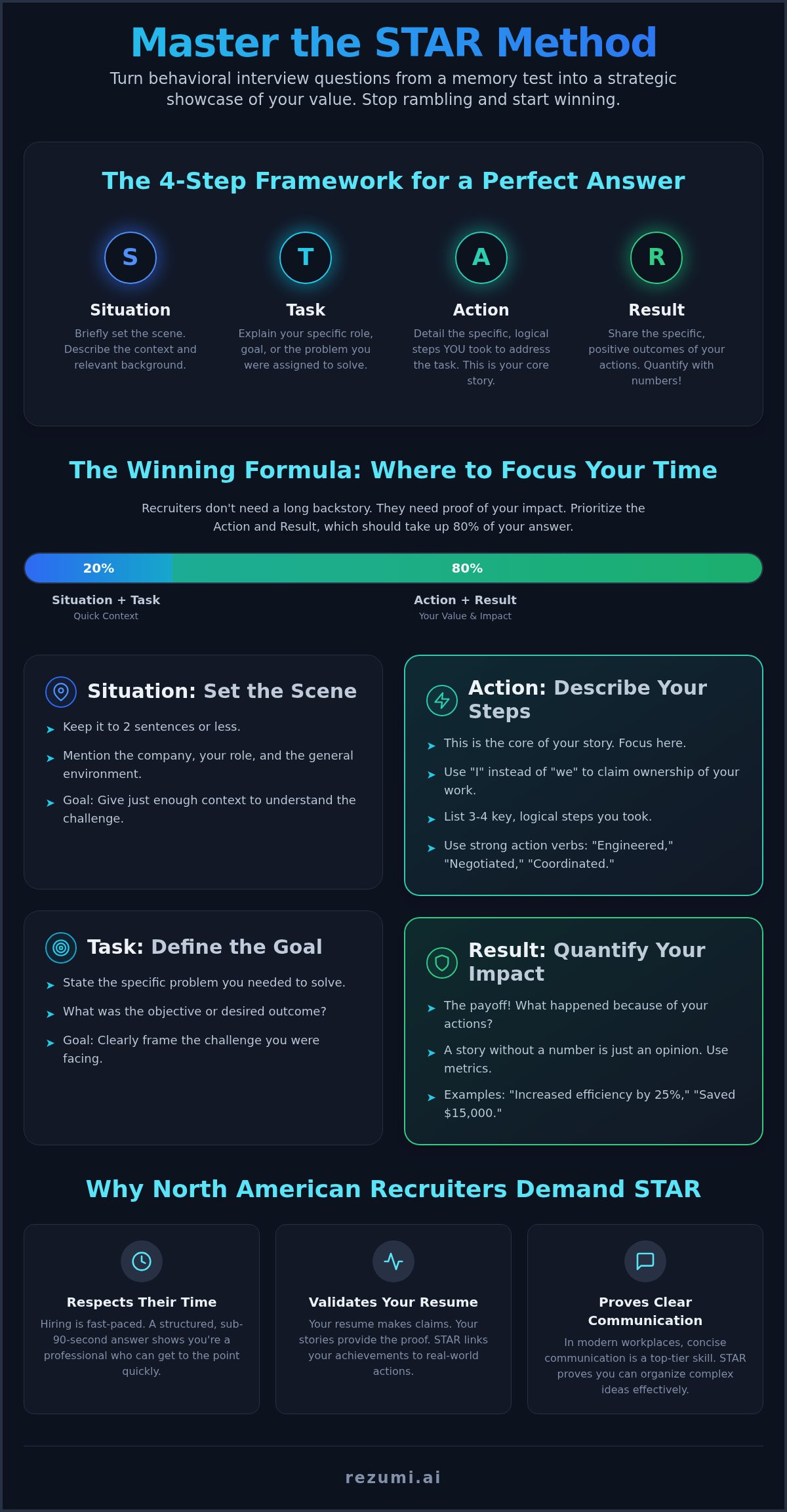
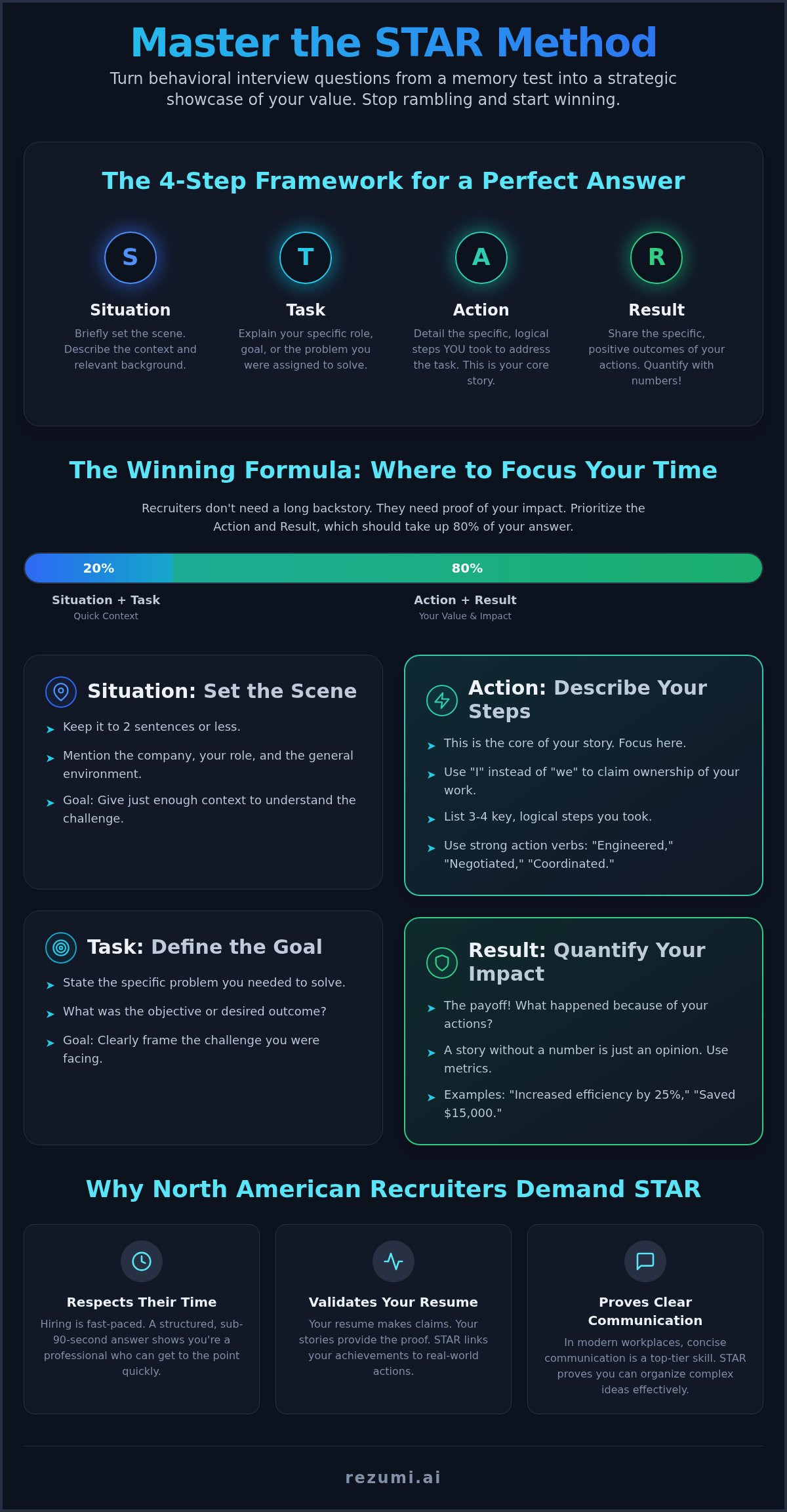
The STAR framework is not a list of four equal parts. To win the interview, you must prioritize the Action and Result stages, as these provide the proof recruiters need. While the Situation and Task provide context, they should only take up about 20% of your total answer time. When practicing star method interview questions, focus on the specific steps you took to drive success. This imbalance is intentional. It moves the conversation away from generalities and toward your unique professional value.
The Situation sets the stage. Keep it brief by stating the company, the timing, and the environment in two sentences or less. The Task identifies the specific problem or goal you faced. If you spend too much time here, you risk boring the interviewer before you get to the "how." Think of these as the foundation. They need to be solid but shouldn't be the main attraction of your story.
The Action is the core of your response. This is where you explain the technical steps, strategic decisions, and interpersonal tactics you used. Finally, the Result provides the payoff. It validates your story with concrete data or feedback. If you are responding to behavioral-based interview questions, the Result is what the recruiter writes down in their notes to justify hiring you.
Mastering the Action Phase
This phase is your opportunity to demonstrate your technical expertise and problem-solving skills. Use active, high-impact verbs like "coordinated," "engineered," or "negotiated" to describe your specific role. You must avoid saying "we" too often. While teamwork is important, the recruiter is hiring you, not your former department. Break your process down into a logical progression of three to four key steps. This makes your logic easy to follow and shows you can handle complex workflows without losing focus.
Quantifying Your Results
A story without a number is just an opinion. Whenever possible, include a specific metric to ground your success in reality. For example, instead of saying you improved efficiency, state that you reduced processing time by 22% or saved the company $5,000 in monthly overhead. If your role is less data-driven, use qualitative results. Mentioning that a project launched two weeks early or that you received a formal commendation from the CEO counts as a win. Always link this result back to the original task to prove you solved the problem you were assigned.
Refining these stories takes practice. To ensure your verbal delivery is as polished as your written application, consider using AI-driven interview coaching to get instant feedback on your structure.
Top STAR Method Interview Questions and How to Answer Them
Preparing for star method interview questions requires more than just memorizing your past. You must select stories that prove you fit the specific needs of a North American role. Recruiters look for patterns in your behavior to see if you will thrive in their company culture. They want to see how you handle pressure, people, and projects when things don't go as planned.
One of the most common prompts is, "Tell me about a time you faced a conflict with a coworker." Your payoff here is resolution, not drama. Focus on how you used active listening to find a middle ground. If you disagreed on a project timeline, explain how you compromised to meet the client's goal without missing the ship date. This shows you value the business outcome over being right.
When an interviewer asks you to "describe a situation where you had to work under a tight deadline," they are testing your prioritization skills. Don't just say you worked late. Explain how you audited your task list, delegated where possible, and hit the target. This proves you can manage your time effectively without burning out. Similarly, when asked to "give an example of a project where you took the lead," focus on coordination. As the University of Wisconsin-Madison explains the STAR method, your action must show your individual contribution to the team's success. Use "I" statements to clarify your specific role in guiding the group.
Answering the Failure Question Strategically
The "tell me about a time you made a mistake" question is a test of your professional maturity. Pick a real mistake from your past, but ensure it is not a core requirement of the job you want now. Spend only 20% of your answer on the error itself. Dedicate the remaining 80% to the corrective action you took and the lesson you learned. Explain the new systems or checklists you created to prevent that mistake from happening again. This approach showcases your self-awareness and your commitment to continuous growth.
2026 Context: Remote Collaboration and Hybrid Challenges
In the 2026 market, virtual leadership is a mandatory skill. You should prepare a story about solving a communication breakdown in a digital environment. Perhaps a Slack message was misinterpreted or a time zone difference caused a project delay. Highlight your proficiency with asynchronous work tools and virtual management. Explain how you maintain high productivity without direct physical supervision. This tells the recruiter you are a reliable professional who can excel in a modern, flexible workspace.
Synchronizing Your Answers with Your ATS Optimized Resume
Recruiters are looking for a match. They often have your resume open on a second screen while they listen to your answers. They are checking for consistency. If your verbal stories don't align with your written claims, they will view it as a red flag. Consistency builds the trust you need to secure a North American role. By 2026, many hiring managers will use AI tools to cross-reference your verbal responses against your application data in real-time. This means your narrative must be airtight.
When you prepare for star method interview questions, you should have your ats resume right in front of you. Use the same industry-specific keywords in your speech that you used in your application. If your resume highlights Project Lifecycle Management, make sure those exact words appear in your verbal Action phase. This confirms to the recruiter that you are the same high-performing candidate the system flagged. It proves you didn't just use keywords to get past a filter. It shows you actually possess the skills.
Reference the specific metrics you included in your profile. If your resume says you boosted efficiency by 20%, your story must prove exactly how that happened. These numbers act as anchors for your credibility. They turn vague claims into verifiable facts. When your verbal data matches your written data, you move from being a candidate to being a proven solution.
Keyword Integration in Verbal Stories
Identify the top three skills listed in the job description. These are the must-have requirements the recruiter is checking for during the call. Ensure at least one of your stories directly addresses each of these skills. You don't need to sound like a robot. Use natural language while keeping the technical accuracy intact. This synchronization makes it easy for the recruiter to check off their requirements. It makes their job simpler. It makes your hiring more likely.
Building Credibility Through Consistency
Accuracy matters. Don't guess your dates. Don't fumble your titles. Avoid contradicting the information found on your document. If you have gaps in your history, explain them with direct confidence. Focus on your current readiness rather than making excuses. It's helpful to keep brief notes in parentheses next to your job titles to remind yourself of key numbers and dates. This prevents you from freezing up under pressure. A calm, consistent delivery is the final step in validating your professional brand.
The AI Advantage: Practicing Your Delivery for Real Results
Theory alone does not win job offers. You can memorize every detail of the STAR framework, but if your delivery is shaky, the recruiter will hesitate. High-stakes interviews in the 2026 market require more than just technical knowledge. They require a polished, confident presence that validates your resume. Practicing star method interview questions in a vacuum is a mistake. You need a feedback loop that identifies your weaknesses before you sit down with a hiring manager.
AI coaching tools have replaced the outdated "practice in a mirror" advice. While a mirror shows your facial expressions, it cannot track your pacing or detect filler words. Recording your answers through an automated system helps you see exactly where you lose momentum. You might discover that you use "um" or "right" every ten seconds. These verbal crutches distract from your message. By refining your timing, you ensure your story stays within the optimal 90-second window. This keeps the interviewer engaged and proves you can communicate complex ideas with efficiency.
Consistency is your greatest asset. If your verbal delivery matches the high quality of your ATS-optimized resume, you build instant credibility. AI tools allow you to repeat your stories until the structure becomes second nature. This repetition removes the anxiety of the "tell me about a time" prompt. You stop searching for words and start delivering results. It turns the interview from a test of memory into a demonstration of professional readiness.
Using AI to Simulate Pressure
Real improvement happens when you simulate the actual pressure of the call. You can input a specific job description into an AI tool to generate custom behavioral questions tailored to that role. This ensures your practice is relevant and focused. After you record your response, review your performance score to see where you can tighten your narrative. You can use Rezumi AI Interview Prep to get real-time feedback on your tone, speed, and keyword alignment. This data-driven approach removes the guesswork from your preparation.
Final Preparation Checklist
Technical polish is just as important as your verbal delivery. Before your next video call, run through these essential steps to ensure a professional environment:
- Check your lighting and background to ensure you are the focal point of the screen.
- Test your internet connection five minutes before the call starts to avoid technical delays.
- Have your interview tips guide open for a quick mental refresh.
By combining the STAR framework with advanced AI practice, you bridge the gap between being a candidate and being the new hire. You aren't just answering questions. You are commanding the room with data-backed confidence.
Secure Your Role with Strategic Storytelling
Success in the 2026 job market depends on your ability to prove the data on your resume. You have learned how to use the STAR framework to turn generic answers into high-impact evidence. By focusing on the Action and Result phases, you provide the concrete proof that North American recruiters demand. This strategy ensures you remain consistent with your ATS-optimized profile while demonstrating your professional maturity.
Mastering star method interview questions is the final step in your application journey. You now understand the importance of keyword synchronization and the power of AI-driven practice to eliminate filler words. These tools move you from a place of uncertainty to a position of total control. You aren't just hoping for a positive outcome; you are executing a data-backed plan that validates your expertise.
Your career goals are within reach. Use these strategies to validate your experience and walk into your next interview with absolute confidence. You have the skills and the framework to succeed. You are ready to secure the role you deserve.
Frequently Asked Questions
What is the most common STAR method interview question?
"Tell me about a time you faced a challenge at work" is the most frequent prompt. It serves as the foundational behavioral question for almost every North American interview. Recruiters use this to evaluate your problem-solving logic and your ability to remain productive under pressure. This question allows you to demonstrate resilience while showing how you move from a problem to a concrete solution without wasting time.
How long should a STAR method answer be?
Your response should last between 60 and 90 seconds. This duration is long enough to provide detail but short enough to maintain the recruiter's interest. Spend only 20 seconds on the Situation and Task to leave more time for your Actions and the Result. If you speak for more than two minutes, you risk losing the listener's focus and sounding unorganized during the conversation.
Can I use the same story for multiple interview questions?
No, you should avoid using the same example twice in one interview. It suggests you have a narrow range of experience. Prepare five to seven versatile stories that you can pivot to answer different star method interview questions. This keeps your delivery engaging and comprehensive. It also allows you to showcase different skills like leadership, conflict resolution, and technical expertise across several answers.
What if I cannot think of a specific example for a STAR question?
Ask for a moment to reflect or pivot to a related experience. You can say, "I haven't encountered that exact situation, but I managed a similar challenge when..." This shows you can adapt quickly. It is always better to provide a structured, related story than a vague, hypothetical response. Recruiters value your ability to find relevant past actions that prove you can handle future tasks.
How do I handle a question about a mistake or failure?
Select a genuine mistake that does not involve a core skill for the new role. Focus 80% of your answer on the corrective steps you took and the lesson you learned. This demonstrates professional growth and proves you have the self-awareness to improve your performance over time. You want to show that you take responsibility for your actions and can build systems to prevent future errors.
Is the STAR method still relevant for senior-level roles in 2026?
It is essential for senior leaders who must prove their value in complex, data-driven environments. In 2026, stakeholders demand evidence of strategic decision-making and remote leadership. The STAR framework allows executives to deliver the high-level metrics and narratives required to secure senior positions. It ensures that even high-level discussions remain grounded in verifiable facts and tangible business outcomes rather than just vague leadership theories.
How do I practice the STAR method using AI?
Record your responses using AI interview tools to get real-time feedback on your performance. These systems track your pacing, identify filler words, and ensure your verbal stories align with your resume keywords. This practice builds the confidence you need to handle star method interview questions during a live call. It turns a stressful experience into a repeatable process where you know exactly how you sound to a recruiter.
What is the difference between the STAR and CARL methods?
The CARL method includes a specific "Learning" section at the end of the story. While STAR (Situation, Task, Action, Result) focuses on the outcome, CARL (Context, Action, Result, Learning) emphasizes your takeaways. Both work well, but STAR remains the standard for result-oriented North American hiring. You can always add a brief sentence about what you learned to a STAR answer to provide that extra layer of maturity.
Disclaimer
This article is provided for general informational purposes only and does not constitute professional, legal, financial, or career advice. While Rezumi strives for accuracy, we make no warranties as to the completeness or reliability of this content. Hiring practices, ATS behavior, and job-market conditions vary by employer, industry, and region — always verify against your specific situation. Any action you take based on this article is at your own risk.