What Is a Good Resume Score? The 2026 Guide to Landing Interviews
99 percent of Fortune 500 companies use AI to screen your application before a human ever sees it. You have likely spent hours tailoring your experience, only to receive zero response. It is frustrating to feel like your career is being ghosted by a machine that does not understand your value. You need to know why your resume score is low and what specific number will actually get you an interview.
You can take control of this process by hitting the 80 percent threshold. This guide explains exactly how these algorithms evaluate your background and how to reach that target score. We will break down North American ATS standards and provide actionable steps to fix a low score. You are about to replace the anxiety of the job search with a clear, data-backed strategy for success in 2026. We move past the conflicting advice to give you the precise facts you need to land the role.
Key Takeaways
- Aim for a resume score of at least 80 percent to move your application past automated filters and into the hands of a hiring manager.
- Understand how technical parseability and keyword alignment work together to determine if a computer can read your experience accurately.
- Identify why scores under 50 percent usually signal major formatting errors that cause your resume to be ghosted by machines.
- Align your job titles with industry standards to improve your ranking in modern recruitment search results.
- Transform generic duty lists into quantified achievements using specific numbers and data to prove your professional impact.
What Is a Resume Score and Why Does It Matter?
Your resume score is a numerical value assigned by an AI tool to measure how well your CV aligns with a specific job description. It acts as a predictor for whether an Applicant Tracking System (ATS) will rank you as a top candidate. High scores usually lead to more interviews because they signal high relevance to automated hiring software. If you want to stop being invisible, you need to understand the math behind the machine. A resume score is a diagnostic tool that measures both technical parseability and content quality.
The system is not your enemy. It is a filter. When you upload a file, the software strips away your design to find the raw data it needs to rank you against hundreds of other applicants. This process happens in seconds. If the software cannot find what it is looking for, a human recruiter will never even know you applied. Understanding your score is the first step toward taking back control of your career trajectory.
The Gatekeeper Role of the Applicant Tracking System
Most large employers in the US and Canada utilize platforms like Workday or Greenhouse to manage their hiring pipelines. These systems are the primary gatekeepers. They assign an internal score to your profile before a human ever sees your name. The software looks for three specific things:
- Technical compatibility: Can the system extract your work history without errors?
- Keyword density: Do you use the exact terminology found in the job posting?
- Structural logic: Is your experience presented in a way the algorithm understands?
If your score is too low, your application stays at the bottom of the digital pile. You might have the perfect background, but if the machine cannot verify it, you are effectively disqualified.
Why 75 Percent of Resumes Never Reach a Human Recruiter
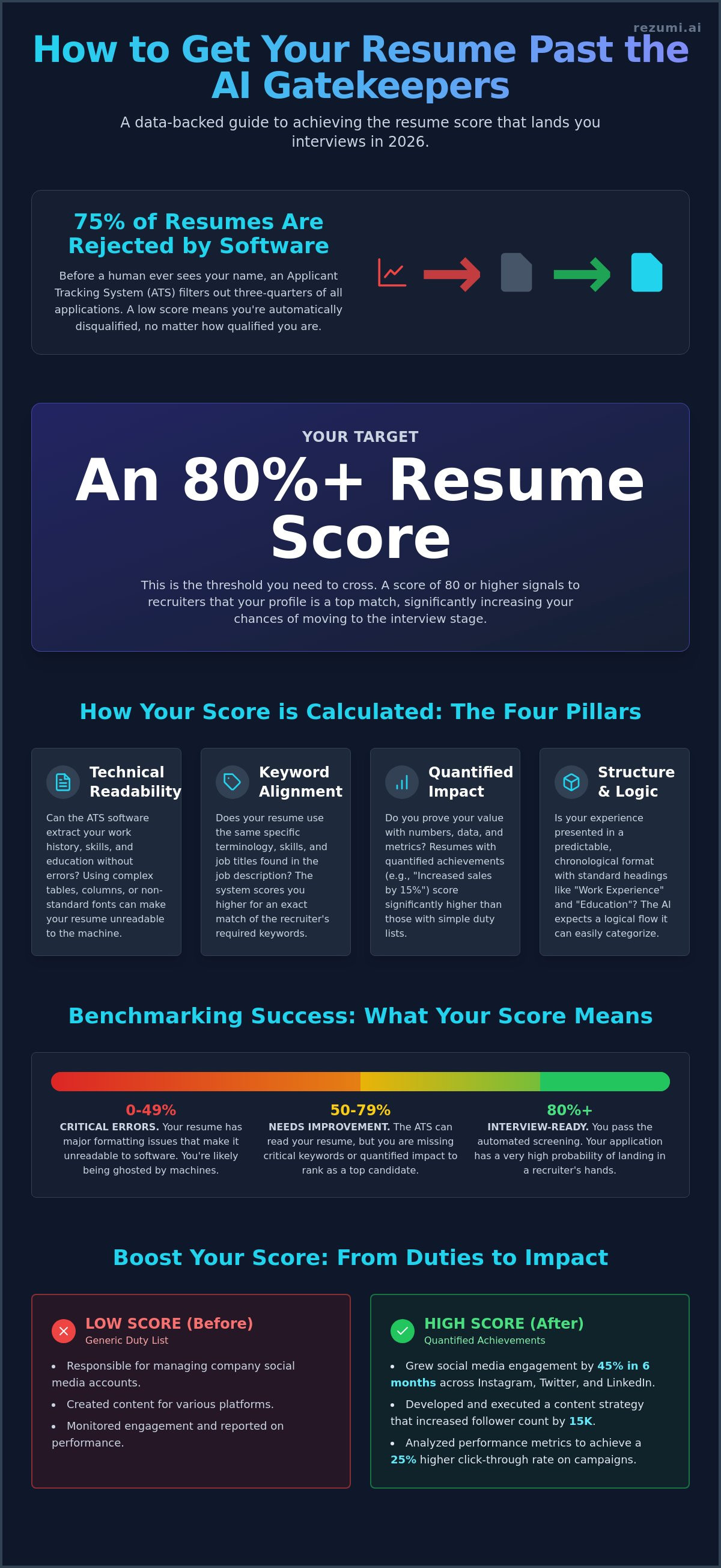
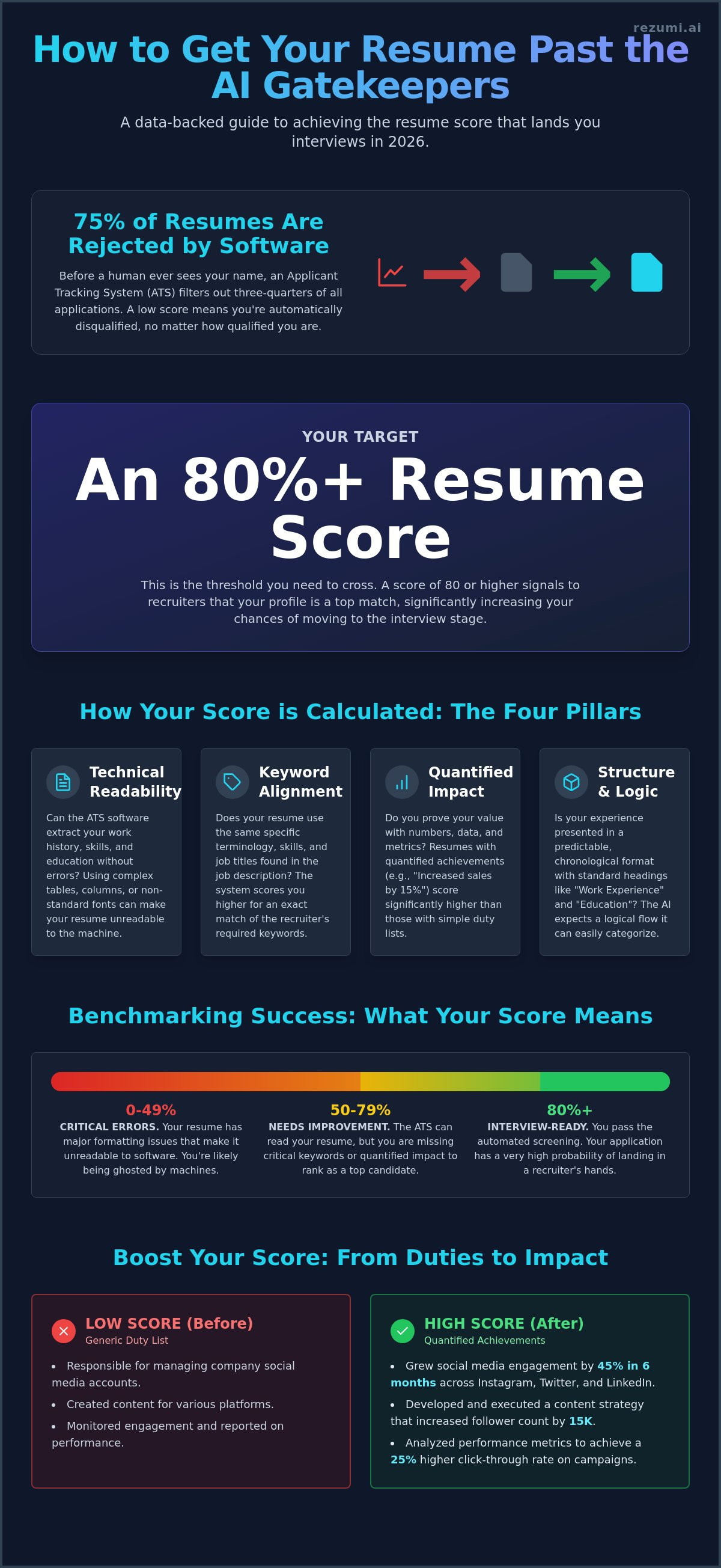
In 2026, the volume of applications per role has reached record levels. Machines now manage the load through AI-first screening. Statistics show that roughly 75 percent of resumes are rejected by software before a recruiter opens the file. This shift means that manual review is often reserved only for the top 5 or 10 percent of candidates. According to industry data, 55 percent of HR leaders now use algorithms to support their final hiring decisions.
Technical ghosting is the most common reason for this high rejection rate. This happens when the system cannot read your formatting or fails to find the right keywords. To understand how to avoid these common traps, you can read The High-Stakes Guide to ATS Resume Optimization. You are no longer just writing for a person; you are writing for an algorithm that values precision and alignment over creative flair. By focusing on your score, you ensure your hard work actually reaches a human who can hire you.
Decoding the Algorithm: How Resume Scores Are Calculated
Your resume score is not a subjective grade. It is a mathematical result derived from four distinct pillars: technical parseability, keyword alignment, impact metrics, and formatting standards. When an algorithm scans your file, it looks for data points it can verify and categorize. If your document lacks these markers, the machine simply cannot calculate a high ranking for you. You must build your document with the algorithm's logic in mind to ensure you aren't filtered out before a human sees your name.
The first hurdle is technical parseability. This measures whether the computer can extract your work history without errors. According to research on Optimizing Your Resume for Applicant Tracking Systems, these platforms electronically scan and rank your experience based on how well it fits the job description. If the system encounters a formatting error, it might skip entire sections of your career history. This causes your resume score to plummet regardless of your actual qualifications.
Technical Compatibility: Can the Machine Read You?
Scanners are programmed to find specific data in specific places. They look for standard headings like Work Experience, Education, and Skills. If you use creative titles like "My Journey" or "Where I've Been," the machine may fail to categorize the information correctly. To ensure your file is readable, follow these rules:
- Stick to standard headings: Use industry-recognized terms that AI expects.
- Avoid complex elements: Tables, text boxes, and images often break the parsing process.
- Use clean layouts: Stick to modern, sans-serif fonts that are easy for OCR (Optical Character Recognition) to process.
For a deeper look at specific layout requirements, check out our guide on What Does ATS-Friendly Actually Mean in 2026?. Simple is almost always better when it comes to machine readability.
Content Strength: The Impact and Brevity Factor
Once the machine reads your text, it evaluates the quality of your content. Algorithms check for high-impact action verbs that demonstrate leadership and execution. Words like "managed," "developed," or "executed" carry more weight than passive phrases like "responsible for." The system also looks for quantified achievements. If you mention that you "increased sales," the machine wants to see a percentage or a dollar amount to back it up. Data provides the proof that machines and humans both value.
Brevity is another critical factor. Modern scoring systems penalize long, rambling paragraphs that hide your core skills. If your bullet points are more than two lines long, you risk losing points for lack of clarity. Rezumi analyzes these patterns to ensure your resume is concise and impactful. You can check our optimization plans to see how we help you refine these metrics for maximum visibility.
Benchmarking Success: What Is a Good Resume Score?
A competitive resume score is 80 percent or higher. This number is not just a grade. It is a signal to hiring software that your experience is a direct match for the role. While specific ranges vary between platforms, most North American systems categorize your application into one of four tiers. Knowing where you stand allows you to fix critical errors before you hit the submit button. You don't want to guess if your experience is visible; you want to know it is.
- 0 to 50 (Critical): Your resume likely has major formatting issues. The machine cannot extract your data, or you have missed almost every required keyword.
- 51 to 70 (Average): You have the basic qualifications, but you aren't beating the competition. In a stack of 200 applicants, you will remain buried in the middle.
- 71 to 85 (Competitive): This is the target zone. You have enough alignment to trigger a recruiter review in most industries.
- 86 to 100 (Elite): You are in the top tier of applicants. Your document is perfectly optimized for both technical parsing and content relevance.
The 80 Percent Rule for North American Job Markets
In high-volume markets like New York, Toronto, or Chicago, recruiters do not have time to look at every average applicant. They often set their software to only show candidates who hit a specific threshold. This is usually 80 percent. If you fall below this mark, your application may never move from the "Received" pile to the "Qualified" folder. Aiming for this benchmark is essential for visibility in 2026. Our guide on AI Resume Optimizer Canada explains how to reach these high targets in competitive local markets. You need to prove to the machine that you are a safe bet before a person will take a chance on you.
Why a 100 Percent Score Is Not Always the Goal
You might feel tempted to chase a perfect 100 percent score, but this can backfire. Over-optimizing often leads to keyword stuffing. This makes your sentences sound robotic and unnatural. Remember that the machine is only the first hurdle. Once you pass the filter, a human hiring manager has to read your work. If they see a list of terms that doesn't make sense, they will reject you regardless of your score. The goal is to pass the machine while remaining readable for a person. Balance is more important than a perfect mathematical result. Focus on reaching the 80 to 90 percent range to ensure you satisfy both the algorithm and the recruiter.
Five Practical Steps to Improve Your Resume Score Today
Increasing your resume score does not require a complete rewrite. You can make specific, high impact changes in minutes that significantly improve how AI scanners rank your profile. These five steps focus on the mechanical and content alignment that modern systems prioritize in 2026. By following this sequence, you move from a generic application to a targeted, high performance document.
- Step 1: Standardize your job titles. If your current company uses creative titles like "Sales Ninja," change it to "Sales Representative" to match the job description.
- Step 2: Quantify every bullet point. Replace vague duties with data-driven results to prove your value to the algorithm.
- Step 3: Flatten your layout. Remove sidebars, columns, and graphic elements that cause parsing errors.
- Step 4: Mirror the hard skills. Identify the top 5 technical skills in the job ad and place them clearly in your skills section.
- Step 5: Verify with a real-time engine. Use a professional tool to confirm your changes actually moved the needle.
Quantifying Achievements with Real Numbers
"Increased sales" is a low-score phrase, while "increased sales by 22 percent" is a high-score phrase. Numbers act as anchors for both AI and human readers because they provide objective proof of your performance. When an algorithm sees a percentage or a dollar sign, it recognizes a result rather than just a task. This data helps the machine categorize you as a high achiever rather than a passive participant.
Before: Managed a team of developers and finished projects on time.
After: Directed a team of 12 developers to deliver three software products 15 percent under budget.
Fixing Formatting Errors Without Starting Over
You don't need a fancy design to win. Use standard fonts like Arial or Calibri and simple bullet points to keep the scanner happy. Don't put your contact information in the header or footer because many ATS platforms cannot read those areas. This simple mistake can lead to your application being discarded because the recruiter has no way to call you. You have worked too hard to let a technical glitch stop your progress.
Stick to a single column layout to ensure the machine reads your experience in the correct order. You should also check out The Truth About Free ATS Resume Checkers to avoid tools that give inaccurate feedback. Many free checkers use outdated logic that does not reflect 2026 standards. If you are ready to see exactly where you stand with precise data, view our optimization plans to get started today.
Secure More Interviews with Rezumi’s Scoring Engine
Rezumi provides more than just a number. It gives you a roadmap for success. You can tailor your application to any job description in seconds to achieve a maximum score. Our platform is built specifically for the North American market standards of 2026. This means your document is ready for the specific algorithms used by major employers in the US and Canada. You are no longer guessing what a recruiter wants; you are using data to prove you are the best fit.
Success in a modern job search requires a strategic partner. We have engineered our tools to navigate the hidden mechanics of automated hiring. By using our scoring engine, you replace the uncertainty of the application process with a structured path to achievement. You move beyond generic templates and into a bespoke experience designed for high performance results.
Real-Time Feedback for Real-World Success
Our profile editor highlights errors as you type. You don't have to wait for a final report to see where you stand. You see your resume score rise in real time as you add keywords and quantify your achievements. This immediate feedback allows you to refine your content without wasting hours on manual edits. It creates a sense of calm confidence because you know your resume is ready before you ever hit the submit button.
This automated guidance ensures you never miss a critical technical benchmark. If a job description requires a specific certification or software skill, our engine alerts you to the gap immediately. You can then address the issue and watch your ranking improve instantly. This speed and accuracy are what give Rezumi users a distinct advantage in a crowded market.
Moving from Scored Resume to Interview Ready
A high score gets you the call, but your preparation gets you the job. Once you have reached the 80 percent threshold, you must shift your focus to the conversation. Rezumi helps you move beyond the score with AI-driven coaching. Our platform helps you prepare for the next phase of the hiring cycle with tools built for 2026 standards:
- ATS Resume Optimization: Ensure your document passes every technical filter with ease.
- AI Cover Letter Generator: Create a matching narrative that reinforces your high-scoring profile.
- AI Interview Prep: Practice your responses to industry-specific questions before the real meeting.
You have the experience. We have the technology to make it visible to the people who matter. You can explore Rezumi pricing to access premium optimization tools today. Take control of your job search and stop letting machines dictate your career path. Your next interview is waiting. It is time to turn your technical alignment into a signed job offer.
Command Your Career Path with Data
The gatekeeper is no longer a recruiter with a stack of papers. It is an algorithm that demands precision. You now understand that hitting the 80 percent threshold is the baseline for visibility in 2026. By fixing technical formatting errors and quantifying your impact with real numbers, you move to the top of the digital pile. Your resume score is the definitive metric that determines whether a human ever sees your experience.
Rezumi serves as your strategic partner in this automated system. We provide AI-powered feedback tailored specifically for US and Canadian employers. Our platform includes real-time ATS compatibility checks trusted by global professionals. You don't have to wonder why you aren't getting calls anymore. You can see the gaps and fix them instantly.
Check your resume score and optimize your application with Rezumi.
You have the skills and the drive to succeed in your next role. We have the technology to ensure your hard work is recognized by the machines and the people behind them. It's time to take control of your job search and land the interview you deserve.
Frequently Asked Questions
Is a 70 percent resume score good enough to get an interview?
A 70 percent score is usually not enough for competitive roles in major North American markets. While it shows you have basic qualifications, many systems are set to filter for the top 10 percent of candidates. This often means you need to hit at least 80 percent to move into the qualified folder. If your score is stuck at 70, you likely have keyword gaps or formatting errors that need fixing before you submit.
How do I check my resume score for free?
You can check your resume score by using online AI optimization platforms that offer a free initial scan. These tools compare your document against a specific job description to identify missing keywords and technical errors. Be careful with free checkers that use outdated logic from before 2026. For the most accurate results, use a tool built for modern North American hiring standards that provides a detailed breakdown of your ranking.
Can a resume score be wrong?
Yes, a score can be misleading if the scanning tool uses a different algorithm than the employer's system. Some checkers might penalize you for creative formatting that a modern ATS can actually read. However, if multiple reputable tools give you a low score, you likely have a technical issue. Use these numbers as a diagnostic guide to improve your visibility rather than an absolute measure of your talent.
Does a high resume score guarantee an interview?
No, a high score only guarantees that a human recruiter will see your application. Once you pass the automated filter, a hiring manager will evaluate your experience based on cultural fit and specific achievements. A score of 95 percent means you have perfectly aligned your resume with the job ad's requirements. It gets you through the digital gate, but your interview performance is what ultimately secures the job offer.
How often should I check my resume score?
You should check your resume score every single time you apply for a new position. Since every job description uses different keywords and requirements, a resume that scores 85 percent for one role might only score 60 percent for another. Tailoring your document for each application is the only way to maintain a high ranking. Consistent checking ensures that your technical alignment remains strong across different employers and industries.
Why is my resume score different on different websites?
Different websites use unique algorithms and weight certain factors more heavily than others. One tool might prioritize keyword density, while another focuses on technical parseability and formatting. This is why you may see a 10 point difference between platforms. Stick to a tool that aligns with the specific ATS standards used by the companies you are targeting to get the most relevant feedback for your search.
Do recruiters actually see my resume score?
Recruiters rarely see a score out of 100, but they do see a ranked list of candidates. The ATS sorts applicants based on how well their profiles match the job description. If your internal score is low, you will appear at the bottom of the list where recruiters are unlikely to click. By optimizing for a high score, you ensure your name appears at the very top of their dashboard.
What is the most important factor in a resume score?
Technical parseability is the most critical factor because the machine cannot score what it cannot read. If your layout is too complex, the system will fail to extract your work history. Once your file is readable, keyword alignment becomes the next priority. You must include the specific hard skills and job titles found in the job ad to prove to the algorithm that you are a relevant match.
Disclaimer
This article is provided for general informational purposes only and does not constitute professional, legal, financial, or career advice. While Rezumi strives for accuracy, we make no warranties as to the completeness or reliability of this content. Hiring practices, ATS behavior, and job-market conditions vary by employer, industry, and region — always verify against your specific situation. Any action you take based on this article is at your own risk.