How to Tailor Your Resume to a Job Description in 2026
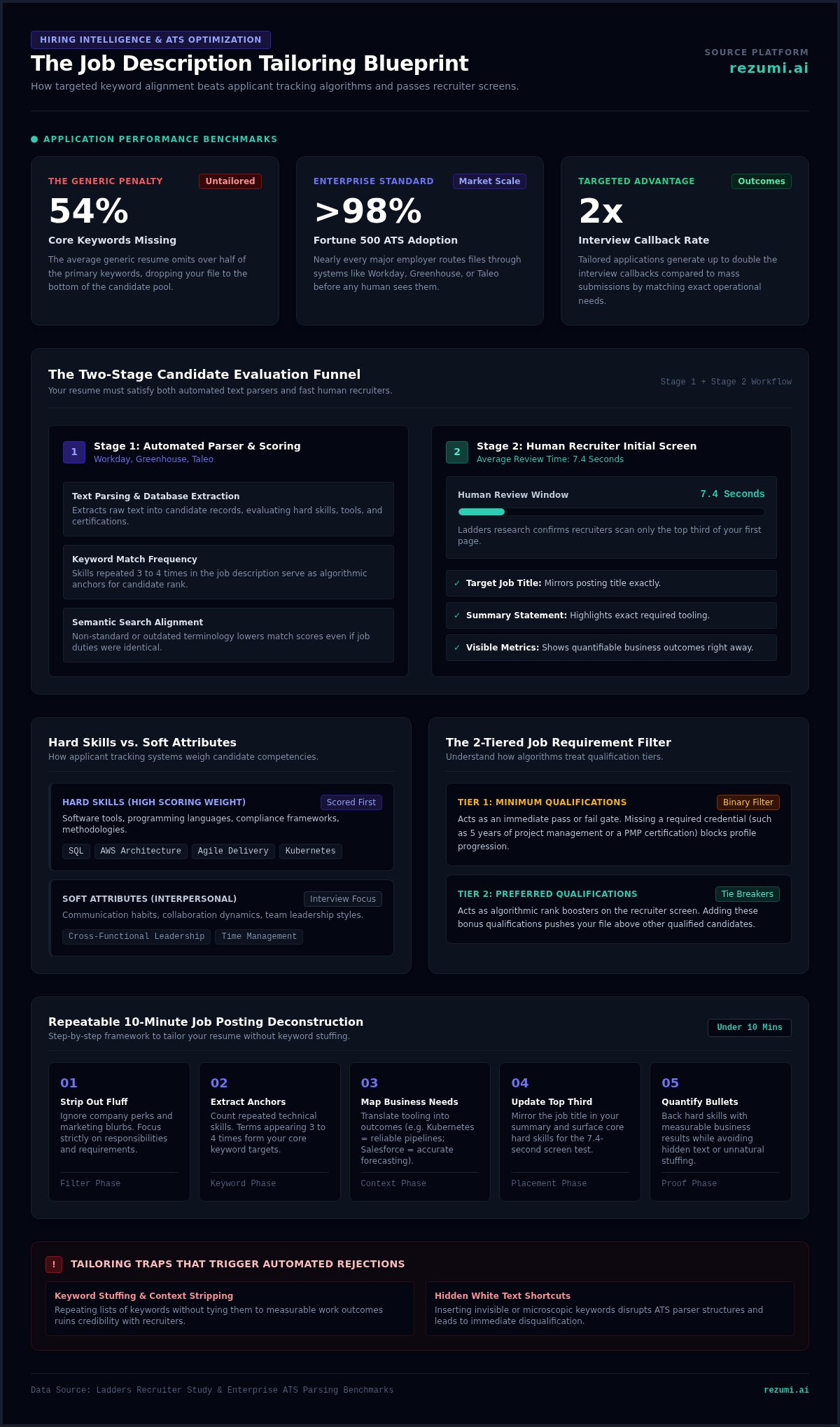
The average untailored resume misses 54 percent of the core keywords found in a target job posting. When you submit a generic application, applicant tracking systems like Workday or Greenhouse quietly rank your file at the bottom of the applicant stack. The fastest way to get noticed is to tailor resume to job description priorities so your relevant skills surface immediately.
You already know the frustration of spending hours tweaking bullet points late at night, only to receive automated rejection emails or total silence. Guessing which terms matter and worrying about automated filters drains your energy and stalls your progress.
You don't need to rebuild your document from scratch for every opening. You will learn a repeatable framework to break down any job posting in under ten minutes, highlight your measurable outcomes, and satisfy both automated parsers and human recruiters scanning your file for seven seconds. Here is your step-by-step strategy to turn target postings into consistent interview invitations.
Key Takeaways
- Align your work history with direct business outcomes so hiring teams see immediate proof of your value.
- Learn how to deconstruct job postings in minutes and tailor resume to job description requirements without guessing which skills matter.
- Use a structured five-step method to adjust your summary, skills list, and quantifiable bullet points efficiently.
- Avoid dangerous shortcuts like keyword stuffing and hidden text that disrupt parsers and damage recruiter trust.
- Speed up your application workflow with ATS Resume Optimization to pinpoint missing keywords and check your match score before applying.
Why You Must Tailor Your Resume to Every Job Description
Tailoring is not about copying text. It is about strategic alignment with an employer's operational priorities. When you tailor resume to job description requirements, you translate your past achievements into the exact language the hiring team uses to measure success.
Over 98 percent of Fortune 500 companies route incoming applications through applicant tracking systems (ATS) like Workday, Taleo, and Greenhouse. Submitting a single generic document across multiple roles guarantees failure. Research shows that targeted applications generate up to double the interview callback rate of mass submissions because they address the company's specific operational needs from the first sentence.
How Modern Applicant Tracking Systems Filter Unmatched Resumes
Applicant tracking systems do not immediately delete unmatched files. Instead, they parse raw document text into database records, score keyword relevance, and rank applicants in order of match quality. Recruiters then filter the candidate pool by core competencies, certifications, and tooling.
Modern enterprise platforms use semantic search to evaluate context alongside hard skills. If your resume describes identical responsibilities using outdated or non-standard terms, the algorithm scores your application lower. Your profile gets buried at the bottom of the candidate stack, long before a hiring manager opens the file.
The Human Recruiter Six-Second Screen Test
Beating the algorithm is only step one. Data from Ladders shows that recruiters spend an average of just 7.4 seconds reviewing a candidate profile during their initial review. They focus almost entirely on the top third of your first page.
To pass this quick evaluation, your summary statement, target role title, and primary hard skills must mirror the language in the posting. When a recruiter spots familiar terminology and clear metrics immediately, they see an exact match. That alignment keeps them reading and turns a seven-second glance into an interview invitation.
How to Deconstruct a Job Posting to Find Critical Keywords
Every job description outlines a specific business problem. When an engineering team asks for Kubernetes experience, they need reliable deployment pipelines. When a sales director requests Salesforce pipeline reporting, they need predictable quarterly revenue forecasting. To tailor resume to job description requirements effectively, you must translate those functional responsibilities back into underlying business needs.
Start by ignoring generic marketing blurbs and standard company perks. Focus exclusively on the requirements, core responsibilities, and qualifications sections. Count how often specific technical skills appear throughout the text. When a skill shows up three or four times, it serves as a primary algorithmic anchor for automated filters.
Categorizing Hard Skills Versus Soft Attributes
Applicant tracking algorithms assign high scoring weights to verifiable competencies. Group your extracted terms into two distinct categories:
- Hard skills: Concrete software tools, coding languages, compliance frameworks, and industry methodologies (such as SQL, AWS architecture, or Agile project delivery).
- Soft attributes: Interpersonal dynamics and communication habits (such as cross-functional leadership or time management).
Always prioritize hard skills across your summary and bullet points. Soft skills matter during face-to-face interviews, but algorithms score your candidacy on technical capability first. Learn how parsing works in our complete guide to ATS resume optimization.
Identifying Core Requirements Versus Preferred Nice to Haves
Treat every qualification section as a two-tiered filter. Enterprise systems use minimum qualifications as immediate binary filters. If an opening requires five years of project management experience and a PMP credential, your profile must state those credentials clearly to advance.
Preferred qualifications act as ranking tie-breakers among qualified applicants on the recruiter's screen. If you have those bonus skills, include them in your skills section or work history to gain an algorithmic advantage. If you want to check your keyword alignment instantly across target roles, you can explore Rezumi platform options to evaluate your match rate in minutes.
A 5-Step Method to Tailor Your Resume Without Keyword Stuffing
Keyword stuffing ruins your credibility with recruiters. Repeating terms out of context might trick older scanners, but modern algorithms flag awkward repetition and human reviewers reject it instantly. To tailor resume to job description requirements cleanly, follow a structured sequence that highlights your impact while maintaining a readable, single-column layout as outlined in our guide to top resume formats.
- Align your header title with the exact target position.
- Rework your summary to highlight relevant past wins.
- Reorganize your core competencies around required tooling.
- Rewrite bullet points using verified metrics and action verbs.
- Run a final formatting audit to ensure parsing accuracy.
Customizing Your Professional Summary for Immediate Relevance
Your summary anchors the top third of your page. Replace generic objective statements with your current functional title, total years of relevant experience, and three core capabilities that solve the employer's immediate challenges. Keep this section under four lines so recruiters can verify your seniority and domain fit within seconds.
Transforming Experience Bullets with Action Verbs and Metrics
Every bullet point must connect an action directly to a measurable outcome. Use the standard formula: active verb + core task + quantifiable business result. Weave the target role's required technologies directly into these project descriptions.
- Before (Generic): Responsible for managing sales pipelines and updating CRM records for the team.
- After (Tailored): Directed enterprise pipeline tracking in Salesforce, accelerating quarterly deal velocity by 22% across 14 mid-market accounts.
Realigning Your Skills Inventory for Modern ATS Scanners
Structure your core competencies section into distinct categories such as Enterprise Platforms, Technical Methodologies, and Analytics. Mirror the exact phrasing used in the job description (for instance, use "PostgreSQL" rather than simply "Databases").
Categorizing your skills ensures parsers extract each skill accurately into the appropriate profile field. To test how cleanly your revised draft matches specific corporate postings, explore options on the Rezumi pricing page to run automated ATS checks before you submit.
Tailoring Mistakes That Trigger Rejections and How to Avoid Them
Careless optimization can hurt your job search faster than submitting a generic document. When you tailor resume to job description requirements, you must protect your credibility. Roughly 23% of resume screening rejections stem from complex formatting choices like tables, callout boxes, and multi-column designs that scramble text during parsing.
Stick to a single-column layout with clean standard headings. Beyond formatting errors, avoid cutting corners through manipulation or exaggeration. Faking competencies damages your reputation because technical inaccuracies quickly unravel during screening conversations.
The Hidden Danger of Keyword Stuffing and White Font Tricks
Some applicants attempt to outsmart filters by pasting the entire job description into the footer using white text. Modern applicant tracking engines strip out all styling, colors, and margins upon upload. The system converts your document into unformatted plain text, exposing those hidden paragraphs directly to recruiters.
Stuffing identical keywords across every bullet point also backfires. Parsers detect unnatural frequency spikes, and human recruiters instantly reject stiff, awkward phrasing. Strategic alignment means demonstrating how you used a skill, not repeating the word twelve times.
Balancing Automated Optimization with Human Readability
Your resume has to pass automated screening without alienating the person making the final call. Write bullet points that are clear, concise, and accessible at an eighth-grade reading level. When describing technical wins, highlight the business value instead of burying your contribution under dense corporate jargon.
Supporting Your Tailored Resume with a Matching Cover Letter
A tailored application does not stop at your resume. Reinforce your application by pairing your document with an aligned cover letter that addresses specific strategic goals or current initiatives mentioned in the posting. Check practical layouts and framing strategies in our 2026 cover letter guide.
Automate Your Tailoring Workflow with Rezumi ATS Optimization
Applying to competitive North American employers requires both speed and precision. Manually rewriting bullet points for dozens of job applications takes valuable hours every week, which leads to job search fatigue. When you tailor resume to job description benchmarks using intelligent automation, you eliminate guesswork while protecting your time.
Rezumi analyzes target postings against your background to pinpoint exact keyword gaps instantly. Real-time scoring updates reveal how well your experience matches employer expectations before an automated parser screens your submission. Using the Profile Editor, you can adjust content quickly and export ATS-compliant PDFs engineered specifically for systems like Workday, Taleo, and Greenhouse.
From Job Posting to Optimized Application in Minutes
Paste the target job description directly into your workspace. Rezumi's ATS Resume Optimization module separates critical technical requirements from secondary qualifications and cross-references them with your work history.
The system suggests targeted adjustments to your accomplishment bullets and skills inventory, matching employer terminology while preserving your true experience. You maintain complete control over your professional story while cutting tailoring time down to minutes per application.
Preparing for the Next Stage of the Hiring Process
A tailored resume does more than pass automated filters; it sets the agenda for your upcoming recruiter screening calls. Hiring managers use your submitted bullet points to shape their questions, so your spoken answers should align directly with your written achievements.
Review the exact metrics and tools you highlighted on paper before joining your screening call. To practice articulating your results under pressure, explore proven frameworks in our strategic interview tips guide.
Take Control of Your Career Applications Today
Sending generic documents into corporate databases costs you interviews and stalls career growth. You do not need to spend late nights struggling over formatting rules or wondering whether an algorithm will read your file.
Take charge of your job search with a structured system designed to align your experience with modern hiring standards. Visit the Rezumi pricing plans page to start optimizing your resume and secure consistent interview callbacks.
Turn Every Target Application Into an Interview Call
Landing consistent callbacks comes down to strategic alignment rather than endless spray-and-pray applications. When you tailor resume to job description requirements, you translate your past career impact into the exact terminology hiring teams search for. Aligning your professional summary, backing bullet points with verified metrics, and avoiding formatting traps ensures your profile ranks high in initial searches.
Rezumi streamlines this process in a centralized workspace built specifically for North American recruitment standards. With real-time scoring feedback, you can test your draft against employer benchmarks and export clean documents engineered to pass Workday, Taleo, and Greenhouse filters.
You don't need to stay stuck in a cycle of automated rejections. You already did the hard work of building your professional skills. Take control of your application workflow today, present your strongest achievements clearly, and step into your next interview with total confidence.
Frequently Asked Questions
How do I tailor my resume to a job description quickly?
You can tailor resume to job description requirements in minutes by focusing on your summary and core competencies list rather than rewriting your entire career history. Use an automated tool like Rezumi ATS Resume Optimization to extract keywords instantly. Next, align your professional headline to the specific role and reorder your existing bullet points so your most relevant project wins appear first.
Can ATS tell if I copy and paste words from the job description?
Yes, applicant tracking systems and human recruiters can tell when text is copied verbatim. Pasting full sentences or whole bullet points from the posting flags your submission for low originality and keyword stuffing. Modern parsers evaluate natural language structure. Instead of lifting sentences word for word, adapt the core technical terms into your own voice by attaching them directly to measurable projects.
What percentage of keywords should match the job description?
Aim for roughly a 70% to 80% match rate across critical hard skills and core competencies. You don't need a 100% score to earn an interview callback. In fact, forcing an exact match often creates awkward phrasing that repels human reviewers during screening. Prioritize all mandatory technical tools and certifications first, then include secondary qualifications where you possess genuine hands-on experience.
Should I change my resume job title to match the job posting?
You should align your headline or target title with the posting, but keep your official employment history accurate. If a previous employer used an unusual title like "Customer Delight Specialist," write "Customer Success Manager (Internal Title: Customer Delight Specialist)" on your resume. This adjustment helps automated parsers categorize your experience correctly while ensuring your employment background checks pass without discrepancies later.
Is it necessary to tailor my resume for every single job application?
Yes, if you want consistent callbacks from competitive employers. Submitting a single generic document forces software to guess how your past duties match open requisitions. When you tailor resume to job description specifications, you ensure your file surfaces at the top of recruiter searches. Focus on applying to fewer positions with targeted, high-scoring applications rather than blasting generic documents into the void.
What happens if I lack some of the required skills in the job description?
Focus on adjacent competencies and transferable tools if you meet the core requirements. Most job descriptions outline an employer wishlist rather than an absolute checklist. If an employer requests a tool you haven't used, highlight equivalent software you know well within the same domain. Emphasize your underlying methodology, demonstrate rapid learning in past positions, and show how quickly you adopt new technical systems.
How do I tailor my resume when changing careers to a new industry?
Reframe your past achievements around functional competencies that solve your new target industry's business problems. Group your accomplishments by operational capabilities like vendor management, data analysis, or process delivery instead of highlighting niche industry jargon. Rewrite your summary statement to explain your transition story clearly, connecting your past track record to the operational goals outlined in the target posting.
Disclaimer
This article is provided for general informational purposes only and does not constitute professional, legal, financial, or career advice. While Rezumi strives for accuracy, we make no warranties as to the completeness or reliability of this content. Hiring practices, ATS behavior, and job-market conditions vary by employer, industry, and region — always verify against your specific situation. Any action you take based on this article is at your own risk.