How to Write a Cover Letter for an Internship in 2026
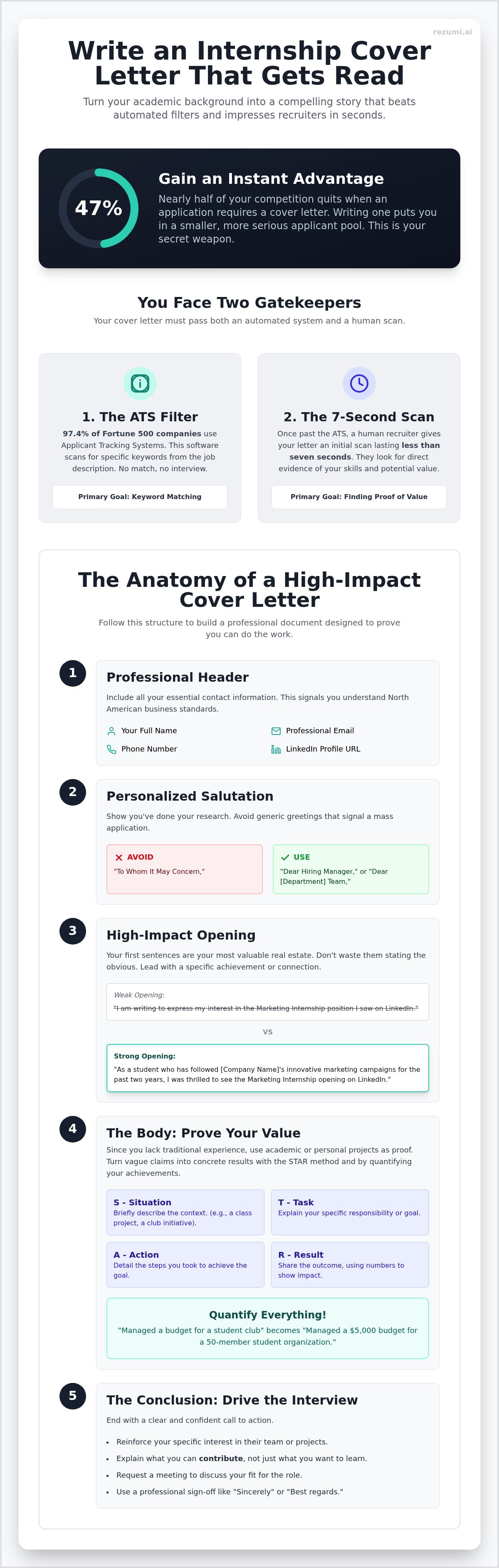
Nearly half of your competition will quit an application the moment they see a cover letter requirement. Recent data shows that 47.3% of job seekers skip applications that ask for one, which makes learning how to write a cover letter for an internship your secret weapon. This creates a massive opening for you to stand out in a smaller, more serious applicant pool.
You likely feel like a generic candidate because you don't have years of professional experience yet. It's frustrating to feel like your GPA is the only value you have to offer or that an ATS will reject you before a human even looks at your name. You want to show you're ready for the role without sounding like a robot. You need a way to bridge the gap between your education and the professional world.
This guide teaches you how to build a high-impact letter that clears ATS filters and proves your potential to North American recruiters. We'll give you a clear template to follow, show you how to use AI for speed without losing your voice, and explain how to translate classroom projects into real-world results. You'll walk away with the confidence that your application will actually be read.
Key Takeaways
- Discover how to write a cover letter for an internship that clears the Applicant Tracking Systems (ATS) used by almost every Fortune 500 company.
- Learn to use the STAR method to turn your academic projects and volunteer work into concrete evidence of your professional value.
- Map your specific skills to the top requirements of a job description to catch a recruiter's eye during their seven second scan.
- Use the Rezumi AI Cover Letter Generator to create personalized applications quickly while maintaining a human, professional tone.
Why Your Internship Cover Letter Needs an ATS Strategy
Your cover letter is not just a polite greeting. It's a digital filter. In 2026, 97.4% of Fortune 500 companies use an Applicant Tracking System (ATS) to manage the massive flood of internship applications. This software acts as the first gatekeeper for North American roles. It scans and ranks your materials based on how well they match the specific job description. If you don't hit the right markers, a human recruiter will never see your name.
Even if you pass the initial software screen, you face another hurdle. Recruiters at top firms spend less than seven seconds on an initial scan. They aren't reading for deep subtext or general passion. They're looking for specific proof that you can handle the tasks assigned to you. Generic templates fail here because they use vague, "safe" language. They don't trigger the specific keywords needed for a specialized role. Learning how to write a cover letter for an internship means treating this document as a strategic tool. It's your best chance to include the keywords that your resume might lack due to limited work history.
The North American Hiring Reality in 2026
Application volumes have reached record highs as students compete for a 3.9% increase in available intern spots. This competition means automated filters are more strict than ever. Companies look for specific technical skills even in roles designed for learning. They want interns who can contribute to projects immediately. To get a passing score, your letter must reflect the job description exactly. If the listing asks for "Python data analysis," don't just say you "know coding." Precision is the only way to beat the algorithm and move your application to the top of the pile.
Keywords: The Secret Language of Internships
Finding the right keywords is the core of how to write a cover letter for an internship. You must identify "hard skills" like software proficiency and "soft skills" like collaborative problem solving within the job posting. Always use the exact phrasing found in the internship listing. If they call a requirement "stakeholder communication," don't change it to "talking to people." However, you must avoid the danger of keyword stuffing. Don't just list words in a long, meaningless block. Integrate them naturally into sentences that describe your academic accomplishments. This shows the ATS you have the skill and shows the recruiter you know how to apply it.
The Anatomy of a Successful Internship Cover Letter
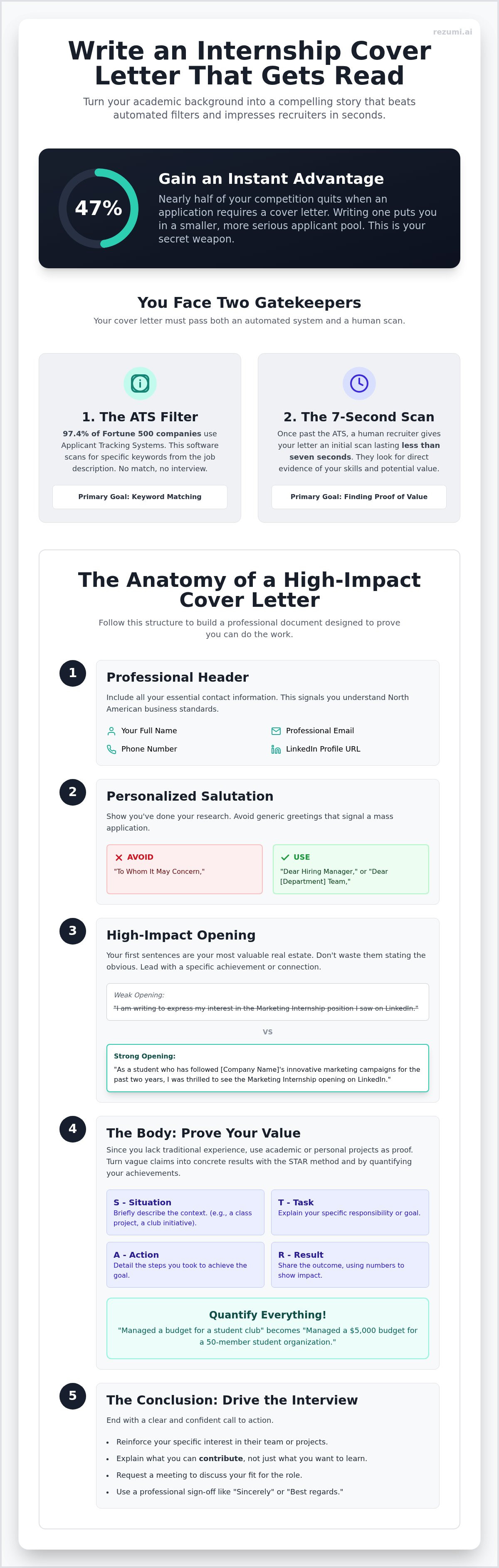
A high-impact cover letter follows a specific, logical architecture. It is not a creative writing exercise. It is a professional document designed to prove you can do the work. Your header must include your name, phone number, professional email, and LinkedIn profile. Follow this with the date and the company's contact details. This structure signals that you understand North American business standards before the recruiter reads a single word of your pitch.
Personalization starts with the salutation. Avoid generic phrases like "To Whom It May Concern." They suggest a lack of effort. Research the company website or LinkedIn to find the name of the hiring manager or the head of the internship program. If you cannot find a name, "Dear Hiring Manager" or "Dear [Department] Team" is acceptable. This small detail shows you are a candidate who does their homework.
The Opening: Grabbing Attention Fast
Most students start with "I am writing to apply for..." which is wasted space. The recruiter already knows why you are writing. Instead, lead with a specific achievement or a genuine connection to the brand. Mention the exact internship title and the platform where you found the listing. This creates immediate context and shows you are targeting this specific role rather than sending out mass applications. If you want to master how to write a cover letter for an internship, you must treat the first two sentences as your most valuable real estate.
The body of your letter is where you build your case. Since you may lack traditional office experience, focus on academic rigor or personal projects. Describe a time you solved a problem using the skills mentioned in the job description. Use numbers to provide scale. If you managed a budget for a student club, state the dollar amount. If you built an app, mention the number of users or the specific languages used. This data turns vague claims into concrete proof of your potential.
The Conclusion: Driving the Interview
Your closing paragraph should reinforce your interest in the specific team or project. Do not just say you want to learn. Explain what you can contribute to their current goals. End with a clear call to action by requesting a meeting or a brief call to discuss your fit for the role. Use a professional sign-off like "Sincerely" or "Best regards." This confident approach sets you apart from candidates who wait passively for a response.
Consistency is key across all your application materials. If your letter is strong but your resume is messy, you will lose the recruiter's trust. You can check professional templates to ensure your design matches your high-quality writing. Following these steps for how to write a cover letter for an internship ensures your application is cohesive, professional, and ready for a human review.
How to Show Value When You Have Zero Experience
You don't need a previous office job to prove you're a professional candidate. Recruiters look for potential, but they require evidence to back it up. Transferable skills from your degree or volunteer work are your most valuable currency. When learning how to write a cover letter for an internship, you must stop describing yourself as a student. Start presenting yourself as a strategic partner who has already practiced the necessary skills in an academic setting. This mindset shift is the first step toward beating the "no experience" paradox.
Your coursework prepares you for internship tasks if you frame it correctly. Use the STAR method to structure your examples. This acronym stands for Situation, Task, Action, and Result. It forces you to move beyond vague claims of "hard work" and toward specific, measurable achievements. By focusing on your soft skills like communication and problem solving through this lens, you provide the data points that North American recruiters crave. It turns a simple class assignment into a case study of your competence.
Turning School Projects into Professional Wins
Treat every major class project like a professional job assignment. If you developed a marketing plan or built a database for a course, that is practical experience. Describe the tools you used specifically, such as Python, Excel, or Photoshop. Mentioning these by name helps your letter pass the software filters we mentioned earlier. Always highlight the results. Whether it was a top grade, a finished product, or a presentation to faculty, these outcomes prove you can finish what you start. This level of detail shows that you're ready to contribute from day one.
The Power of Extra-Curricular Activities
Club leadership is a direct substitute for project management experience. If you organized an event or led a team, you've already handled the logistics that interns deal with daily. Sports or hobbies can also demonstrate discipline and teamwork. The secret is to quantify your impact whenever possible. Instead of saying you "helped with finances," state that you "managed a budget of $500 for the Chess Club." These numbers provide a sense of scale that passion alone cannot offer. This approach is the most effective way to master how to write a cover letter for an internship when your resume feels thin.
Writing Your Cover Letter Step by Step
Building a high-impact document requires a methodical approach. You cannot simply start typing and expect a result that clears ATS filters. Following a structured process for how to write a cover letter for an internship ensures you hit every requirement without wasting time on filler text. Start with the job description and work backward to your own experiences.
Step 1: Analyze the job description. Identify the top three requirements the company emphasizes. These are usually found in the first few bullet points of the "Responsibilities" or "Qualifications" section. Step 2: Map your projects. Choose one academic or volunteer project that proves you can handle each of those three requirements. Step 3: Write a strong opening. Mention a specific company goal or a recent project they launched. This shows you're focused on their needs rather than just your own career growth.
Step 4: Draft your body paragraphs. Use active, high-impact verbs like "coordinated," "developed," or "analyzed." These words suggest movement and success. Step 5: Proofread for North American standards. Ensure you're using US or Canadian spelling, such as "optimized" instead of "optimised." Small errors in grammar can signal a lack of attention to detail that recruiters at top firms will notice immediately.
Common Mistakes to Avoid
The biggest error students make is repeating their resume word-for-word. Your cover letter should provide the story behind the bullet points, not a list of them. You must also avoid being too humble. Use phrases like "I achieved" or "I led" instead of "I was part of a team that achieved." While teamwork is important, the recruiter needs to know exactly what you did. Finally, never send a generic letter. Since 47.3% of job seekers skip cover letters entirely, a tailored letter is your best chance to stand out.
Formatting for Professionalism
Visual presentation matters as much as the content. Keep your letter to one page maximum, ideally between 250 and 400 words. Use a standard, clean font like Arial or Calibri at 10 or 12 points to ensure readability on both screens and paper. Always save your final file as a PDF (Portable Document Format). Use a clear naming convention like Jane_Doe_Cover_Letter.pdf so the recruiter can find your file easily in their system. This level of organization mirrors the professional habits expected of a high-performing intern.
Scaling Your Applications with the Rezumi AI Cover Letter Generator
Applying for one internship is a project. Applying for twenty is a full-time job. You shouldn't spend four hours on a single document when 46.8% of job seekers already use AI tools to move faster. The Rezumi AI Cover Letter Generator solves the speed problem without sacrificing quality. It connects your existing resume data directly to the job description to create a bespoke draft. This ensures you hit the specific keywords mentioned earlier while maintaining a professional anatomy.
The software scans the job listing to find the technical and soft skills you might have missed. It then integrates these naturally into your draft. This process removes the guesswork from how to write a cover letter for an internship. You get a document that is engineered for both software filters and human eyes. However, you must always provide a final human touch. Review the draft to ensure it captures your specific voice and the unique value you offer. AI provides the foundation, but you provide the soul.
Tailoring at Speed
Efficiency is your greatest advantage in a competitive market. You can generate a bespoke letter for five different internships in minutes. Use the AI Cover Letter Generator to match your tone to the company culture. A startup might require a more energetic voice, while a financial firm needs a polished, conservative style. The tool adjusts these variables automatically. It also ensures your letter is ATS-friendly before you hit send. This gives you the control to apply broadly without losing the personalization that recruiters demand.
Next Steps: Beyond the Cover Letter
A great letter is only one part of the equation. You must ensure your entire application package is ready for the North American market. Check your resume score to confirm your layout and content meet 2026 standards. Once you secure the meeting, prepare for the interview with AI-driven coaching. This practice builds the confidence you need to speak about your school projects effectively. Sign up for a Rezumi workspace to track every application in one place. Moving from uncertainty to a data-backed strategy is the fastest way to land your first role.
Mastering how to write a cover letter for an internship is about balancing technology with your personal story. Use these tools to handle the repetitive work so you can focus on the final refinements. This strategic approach ensures your application doesn't just clear the filters but actually convinces a human to hire you.
Secure Your Future in the 2026 Job Market
The transition from the classroom to the boardroom starts with a strategic document. You've learned that beating the ATS isn't about luck. It's about using the secret language of keywords and mapping your school projects to real business needs. By following these steps, you've gained a massive advantage over the 47.3% of candidates who skip the cover letter entirely. You're no longer just another applicant. You're a candidate with a plan.
Learning how to write a cover letter for an internship is the difference between an empty inbox and a full interview schedule. You don't have to spend hours on every application to get results. You can use technology to maintain high standards while moving at the speed of the modern market. Our platform provides AI-powered keyword matching and ATS-optimized templates that meet every North American market standard. This ensures your application is both technically perfect and personally compelling.
You have the skills and the potential to succeed in your target role. Now you have the data-backed strategy to prove it to recruiters. Take control of your application process today and start sending letters that actually get noticed. You're ready to make your mark.
Frequently Asked Questions
How long should an internship cover letter be?
Your cover letter should be one page maximum and contain between 250 and 400 words. Keeping it concise ensures the recruiter can scan your key points during their initial seven second review. Focus on three main body paragraphs that map your skills to the role. Long letters often hide your best achievements in walls of text. A crisp, focused document shows you respect the reader's time and know how to communicate efficiently.
Do I need a cover letter if it is not required?
You should always send a cover letter even if the job posting lists it as optional. Since 47.3% of candidates skip this step, submitting a tailored letter gives you an immediate competitive advantage. It provides the context your resume lacks and allows you to include critical keywords for the ATS. Treat the optional tag as a test of your interest and professional effort. This is your best chance to prove your potential.
Should I mention my GPA in a cover letter?
Only mention your GPA if it is 3.5 or higher or if the job listing specifically asks for it. In 2026, employers increasingly prefer practical proof of skills, such as project portfolios, over traditional metrics. If your GPA is lower, focus your letter on specific class projects or volunteer work instead. Use the space to show what you can do rather than just what you scored on a test.
How do I address a cover letter if I do not know the recruiter's name?
Use "Dear Hiring Manager" or "Dear [Department] Team" if you cannot find a specific name after checking LinkedIn and the company website. Avoid outdated phrases like "To Whom It May Concern" because they feel cold and generic. Addressing the specific team shows you understand the company structure. This small detail maintains a professional tone while proving you've done your research on the organization you want to join.
Can I use the same cover letter for multiple internships?
You should never use the exact same cover letter for multiple roles. Each job description has unique keywords that the ATS uses to rank your application. A generic letter will miss these specific markers and result in a lower match score. Understanding how to write a cover letter for an internship means tailoring the body paragraphs to solve the specific problems mentioned in each individual listing.
What should I do if I have no experience at all?
Focus on your academic projects, volunteer work, and club leadership if you have no formal job history. Use the STAR method to describe how you solved problems in a classroom setting. This is the core of how to write a cover letter for an internship when starting from scratch. Treat your degree as your full time job and explain how your specific coursework prepares you for the tasks at hand.
Is it okay to use AI to write my cover letter?
It is perfectly acceptable to use AI to build your initial draft and find missing keywords. In fact, 46.8% of job seekers already use these tools to speed up their applications. The key is to use it for optimization rather than just automation. Always review the final text to ensure it sounds like a human wrote it and accurately reflects your personal experiences. AI handles the structure; you handle the authenticity.
Should I include my home address on a cover letter?
Do not include your full street address on a modern cover letter. Including your city and state or province is enough for North American recruiters. This protects your privacy and reflects current digital application standards. Focus your contact section on your phone number, professional email, and LinkedIn profile link instead. These are the details recruiters actually use to reach out and schedule your interview.
Disclaimer
This article is provided for general informational purposes only and does not constitute professional, legal, financial, or career advice. While Rezumi strives for accuracy, we make no warranties as to the completeness or reliability of this content. Hiring practices, ATS behavior, and job-market conditions vary by employer, industry, and region — always verify against your specific situation. Any action you take based on this article is at your own risk.