Sociologist Interview Questions: Master Answers and Secure Your Next Role
Landing a high-level sociology role rarely comes down to quoting theory. It hinges on your ability to explain complex human behavior to decision-makers who do not speak your academic language. When hiring managers ask tough sociologist interview questions, they are testing your research rigor, your ethical judgment, and your ability to turn raw data into actionable strategy.
You already know your methodology. The real friction happens when you have to balance qualitative depth with quantitative tools under pressure, or defend contentious research topics without losing your cool. It is easy to feel caught between academic standards and corporate expectations.
You can bridge that gap with a structured strategy. This guide breaks down essential sociologist interview questions across academia, think tanks, and market research, giving you clear response models to present your field methods in plain English. We will examine actual question prompts, explore what interviewers really want to hear, and show you how to articulate your value with total confidence.
Key Takeaways
- Learn what hiring panels look for, including how you defend research methodology under real-world project constraints.
- Break down essential sociologist interview questions to translate dense statistical tools and fieldwork into clear, practical outcomes.
- Use the STAR framework to explain complex research projects without overwhelming non-specialist interviewers with academic jargon.
- Prepare for sensitive behavioral and ethics questions using targeted mock simulations that refine your verbal delivery before interview day.
What Hiring Panels Look for in Sociologist Interviews
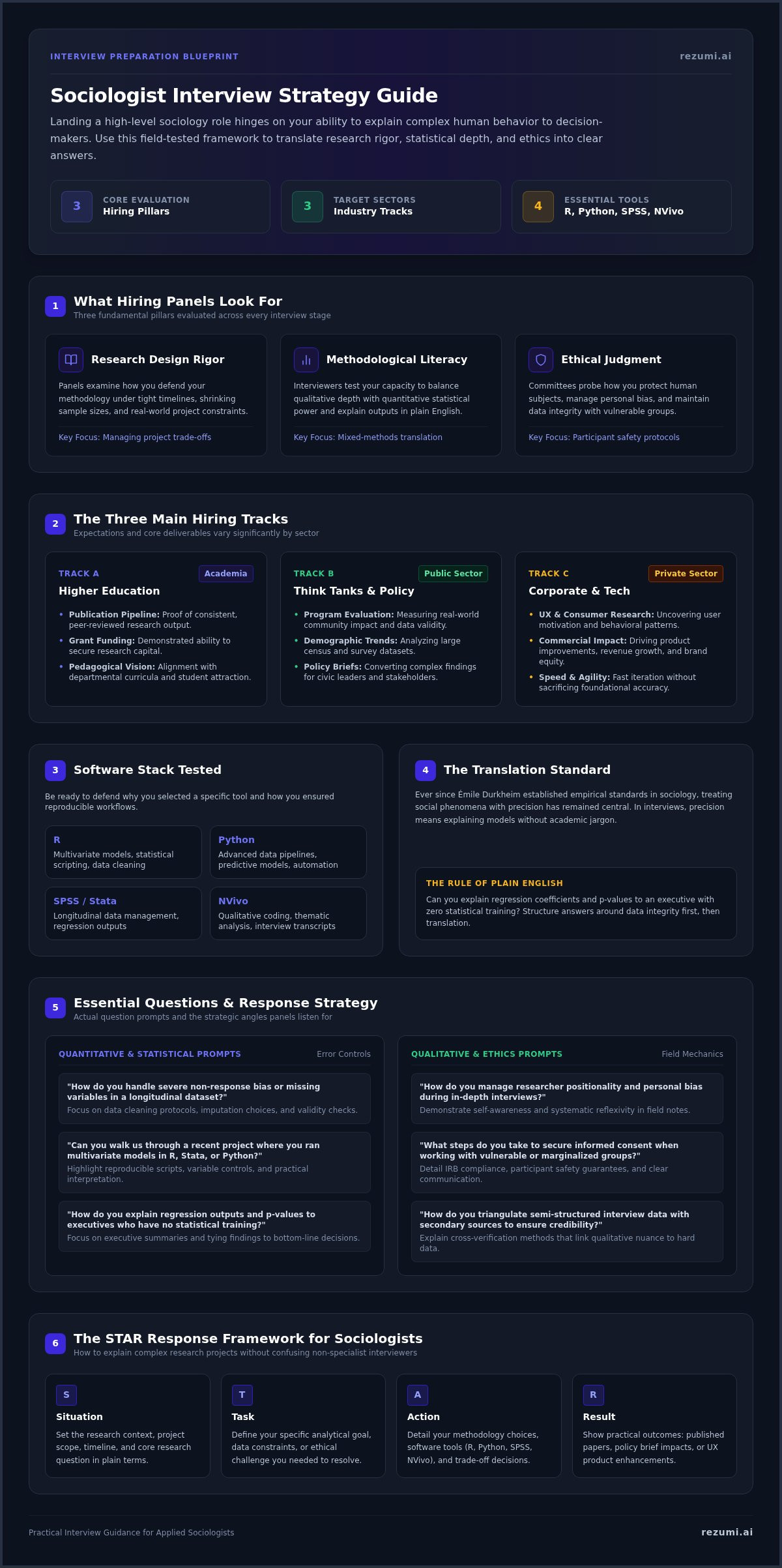
Hiring managers evaluate three core pillars when assessing sociological talent: research design rigor, quantitative and qualitative literacy, and ethical judgment. They do not just want to hear what you studied. They want to see how your analytical thinking solves practical problems. The specific criteria shift depending on the work environment, but every hiring panel expects you to justify your choices under pressure.
The Three Main Hiring Tracks for Modern Sociologists
Your preparation must reflect the specific track you are targeting, as expectations vary widely across sectors:
- Higher Education: Academic search committees focus on your publication pipeline, pedagogical philosophy, and ability to secure grant funding. They want proof that your research agenda aligns with departmental goals and attracts prospective students.
- Think Tanks and Public Policy: Government agencies and non-profit institutes prioritize program evaluation, community engagement, and data integrity. They need specialists who can translate complex demographic trends into clear policy briefs for civic leaders.
- Corporate and Technology Sectors: Private firms recruit sociologists as user experience (UX) researchers, demographers, and consumer strategists. These teams evaluate how quickly you can convert behavioral research into product improvements, revenue growth, or brand equity.
Core Competencies Tested Across Every Interview Stage
Regardless of the sector, standard sociologist interview questions probe your ability to communicate data clearly. Panels regularly test whether you can explain advanced statistical models, such as multivariate regressions, to non-technical stakeholders without confusing them. Ever since Émile Durkheim established foundational standards in The Rules of Sociological Method, treating social phenomena with empirical precision has remained central to the discipline. In an interview, demonstrating that precision means explaining your process in plain English.
Expect hiring teams to scrutinize your tool stack alongside your ethics. Interviewers often ask detailed questions about your direct experience with software like R, Python, SPSS, or NVivo. Be ready to explain why you chose a specific tool for a past project and how you resolved human-subject ethical hurdles during data collection.
Practicing these answers out loud will sharpen your responses. Targeted preparation bridges the gap between passing an automated screening and securing a firm offer.
Essential Sociologist Interview Questions on Methodology and Analysis
Methodology interview questions test operational reasoning under real-world constraints, not textbook definitions. Anyone can recite the difference between random and stratified sampling. Panels want to see how you protect data validity when timelines collapse, sample sizes shrink, or survey response rates drop.
When preparing your responses, focus on trade-offs. Show why a mixed-methods design made sense for a specific question, or explain how you balanced ethnographic nuance against large-scale statistical power. Grounding your answers in actual trade-offs proves you can manage real research budgets and timelines.
Questions on Quantitative Research and Statistical Analysis
Interviewers ask quantitative questions to test your error controls and tool proficiency. Expect technical prompts like:
- "How do you handle severe non-response bias or missing variables in a longitudinal dataset?"
- "Can you walk us through a recent project where you ran multivariate models in R, Stata, or Python?"
- "How do you explain regression outputs and p-values to executives who have no statistical training?"
Structure your answer around data integrity first, then translation. Explain how you clean raw numbers, write reproducible scripts, and convert statistical findings into clear executive summaries. If you need a structured refresher on answering analytical prompts, explore our strategic interview tips to sharpen your communication style.
Questions on Qualitative Fieldwork and Ethics
Qualitative questions probe your self-awareness, participant safety protocols, and field mechanics. Expect interviewers to ask:
- "How do you manage researcher positionality and personal bias during in-depth interviews?"
- "What steps do you take to secure informed consent when working with vulnerable or marginalized groups?"
- "How do you triangulate semi-structured interview data with secondary sources to ensure credibility?"
Show that ethics drive your research design rather than serving as an afterthought. Reference established ethical standards, such as those highlighted in the American Sociological Association career resources, to demonstrate your commitment to participant privacy and data security. You can run mock sessions on these scenarios through an AI Interview Prep subscription to ensure your ethical justifications sound natural and confident before the live interview.
Behavioral Questions for Sociologists and Strategic Response Models
Hiring teams use behavioral prompts to test what happens when your findings clash with leadership assumptions or when your project timeline collapses. Academic researchers often stumble here by focusing purely on theoretical theory instead of business impact. When panels ask behavioral sociologist interview questions, they want concrete proof that you can protect research integrity while remaining pragmatic, diplomatic, and calm.
Frame your past experiences around organizational results. Whether you are speaking to a corporate product lead or a policy director, show how your social insights altered an executive decision, refined a target demographic, or prevented a costly strategic mistake.
Answering Questions About Conflicting Data or Disputed Findings
Stakeholders usually embrace research until it contradicts their roadmap. When an interviewer asks how you handle pushback on uncomfortable findings, walk them through your audit trail rather than reacting defensively. Use this three-step response strategy:
- Validate your methodology: Explain that your first move was auditing your sample criteria, data hygiene, and analysis scripts to confirm precision.
- Reframe the finding as an asset: Position counter-intuitive demographic trends as valuable shields that prevent leadership from investing in flawed initiatives.
- Deliver collaborative solutions: Present clear adjustments rather than dropping raw problems in their lap. Give decision-makers two or three viable paths forward based on your evidence.
Handling Tight Budgets, Deadlines, and Scope Creep
Fieldwork rarely unfolds in ideal conditions. Institutional Review Board approvals hit administrative backlogs, survey drop-off rates spike, and clients demand extra questions without adding funds. Interviewers want to know if you can adapt without sacrificing data validity.
Share a concrete example of managing constraints. Walk them through how you adjusted recruiting targets when a specific demographic proved hard to reach, or how you pruned secondary survey questions to keep respondent fatigue low. Proving that you can deliver reliable research under tight financial or scheduling limits sets you apart from purely theoretical candidates.
How to Structure Sociologist Interview Answers Using the STAR Method
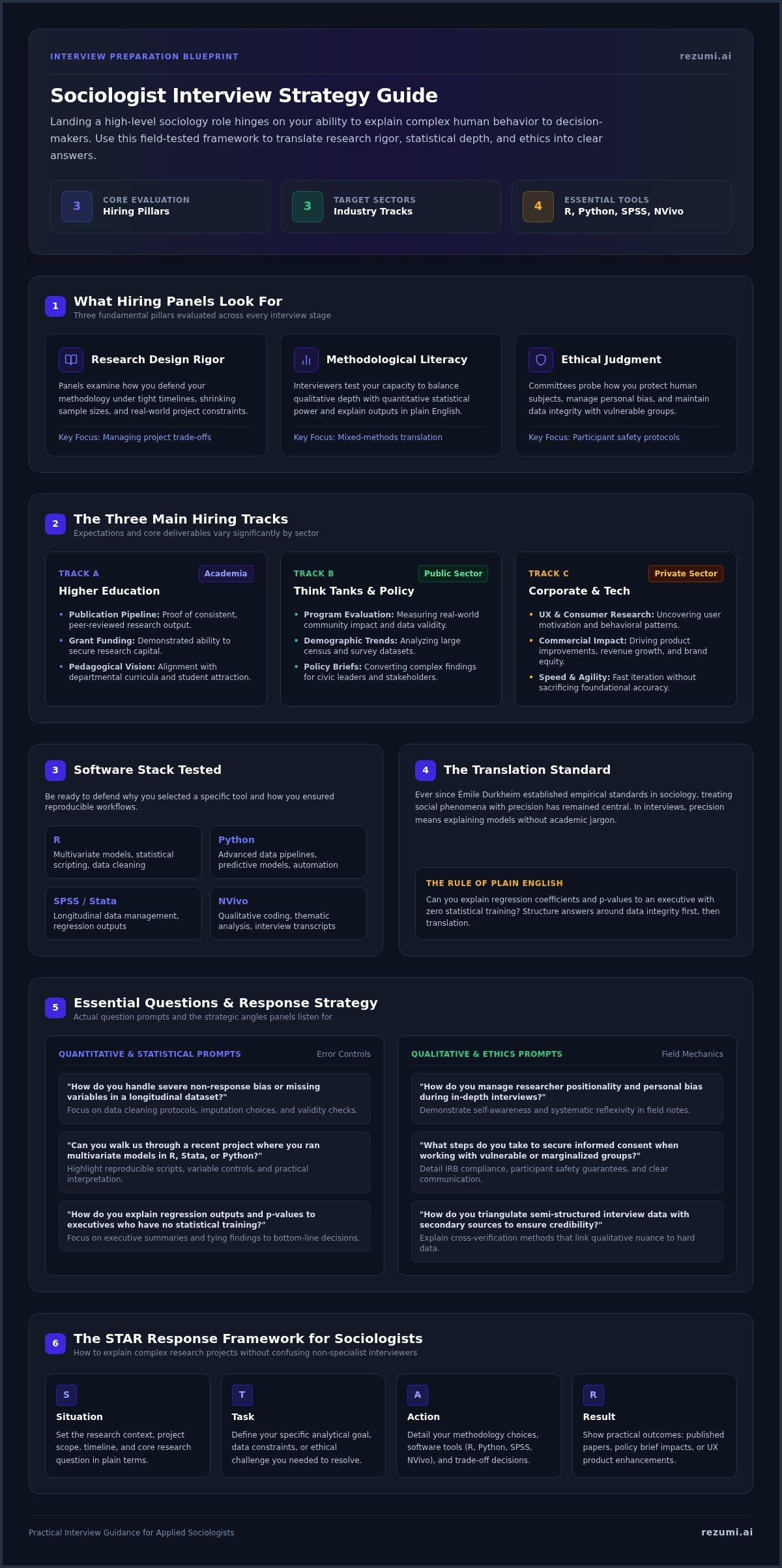
The STAR framework (Situation, Task, Action, Result) keeps technical research explanations clear, concise, and persuasive. Complex demographic inquiries can easily turn into long-winded lectures if you lack a disciplined speaking framework. Using STAR ensures you address the core elements of sociologist interview questions in under three minutes without skipping crucial methodology details.
Tailor the four components directly to analytical and social research environments:
- Situation: Define the research problem and demographic scope quickly. Identify the core population group and project parameters in two sentences.
- Task: State your specific hypothesis, team role, timeline limitations, and resource limits.
- Action: Detail your research design, sampling methods, and analytical tools. Highlight how you collected, cleaned, and interpreted the data.
- Result: State the tangible outcome. Highlight policy modifications, executive roadmap shifts, peer-reviewed publications, or grant awards.
Before-and-After Example: Explaining a Complex Field Project
Consider how framing changes when answering a prompt about evaluating community retention:
Before (Unstructured Academic Response): "I spent several months exploring urban social disorganization theory across several neighborhoods. I conducted dozens of interviews and analyzed local census trends to observe how community members interacted with municipal services."
After (STAR Model): "A non-profit needed to understand why youth engagement dropped across three urban community centers (Situation). I was brought on as lead analyst to identify engagement bottlenecks within twelve weeks (Task). I designed a mixed-methods study combining 45 semi-structured interviews with logistic regression analysis on attendance trends using R (Action). My findings revealed transportation and scheduling barriers, prompting program leaders to adjust operating hours and boost program attendance by 28 percent over six months (Result)."
Aligning Interview Stories with Your Resume Accomplishments
Your verbal anecdotes must reinforce the achievements stated on your application. Mismatched metrics between what you say and what you wrote on paper trigger doubts about your credibility. If you need to refresh your document structure, review our guide on choosing the best resume format to highlight quantifiable outcomes.
Audit your project descriptions using ATS resume checker strategies before submitting applications. Clear alignment between your written bullet points and interview responses positions you as an organized, high-impact candidate.
Mock Interview Practice and Follow-Up Strategies to Win the Offer
Practicing under pressure separates confident candidates from those who freeze. When you rehearse answers to sociologist interview questions aloud, you strip out academic filler and tighten your timing. Speaking your methodology into an audio recorder or live simulator ensures your technical reasoning sounds direct and conversational.
Combine timed speaking practice with structured follow-ups. Taking ownership of both ends of the interview cycle ensures you leave a memorable, professional impression on every panelist.
High-Impact Questions Sociologists Should Ask the Interview Panel
An interview is a two-way evaluation. Asking sharp questions reveals your operational maturity and signals that you care about tangible research impact. When the committee opens the floor, ask targeted questions such as:
- "How does leadership currently integrate sociological research into strategic business decisions or policy initiatives?"
- "What tools, computational software budgets, and review board procedures do your research teams currently use?"
- "What specific deliverables or data milestones will define success during my first six months in this role?"
Post-Interview Execution and AI-Powered Rehearsal
Preparation requires dynamic practice rather than passive memorization. Run through rapid-fire practice rounds to condition yourself against unexpected curveballs on research ethics, missing data, or sample limitations. Review Rezumi plans and pricing to access AI interview preparation tools tailored for analytical and research-heavy roles.
Once the meeting concludes, send a focused thank-you note within 24 hours. Reiterate how your methodological skills solve their exact organizational challenges. You can adapt our proven interview follow up email template to maintain momentum and position yourself as the top candidate for the offer.
Turn Your Research Expertise Into Job Offers
Winning an offer comes down to clear communication and methodological confidence. When you face complex sociologist interview questions, hiring panels want to see how you manage project constraints, defend ethical boundaries, and translate findings into practical decisions. Structuring your responses with the STAR method ensures non-specialist stakeholders immediately grasp the impact of your work.
You do not have to guess how your answers sound under pressure. Rezumi provides automated feedback on answer structure and delivery clarity, built specifically for North American hiring standards. Combining resume optimization with AI interview practice gives you complete command over your career narrative from application to offer.
You already possess the analytical skills and field experience. With the right rehearsal, you can walk into your next panel ready to prove your value and secure your next role.
Frequently Asked Questions
What are the most common sociologist interview questions asked across all sectors?
Core sociologist interview questions center on research design, sample selection, and data interpretation. You will often hear: "How do you decide between qualitative interviews and quantitative surveys?", "How do you handle low response rates?", and "How do you explain statistical findings to non-specialists?" Interviewers ask these prompts to see if you can manage real-world constraints while maintaining methodological precision across diverse projects.
How do I explain complex sociological research to a corporate interview panel?
Lead with the business problem instead of the theoretical framework. Frame your demographic analysis or user behavior study around revenue growth, customer retention, or risk reduction. Skip the academic jargon and replace terms like "epistemology" or "social stratification" with clear phrases like "user patterns" or "market segmentation." Decision-makers care about how your data informs their product strategy, not how well you quote theory.
What technical software proficiency should I highlight during a sociologist interview?
Emphasize a balance of quantitative and qualitative tools aligned with the role. For quantitative analysis, highlight your proficiency in R, Python, SPSS, or Stata, focusing on reproducible data cleaning and statistical modeling. For qualitative fieldwork, discuss coding transcripts in NVivo or ATLAS.ti. Mentioning data visualization platforms like Tableau or Power BI also proves you can build executive dashboards that non-technical teams can interpret instantly.
How should I answer questions regarding research ethics and institutional review boards?
Treat ethics as an active research asset rather than bureaucratic red tape. Walk the panel through your protocols for participant confidentiality, informed consent, and secure data storage. Reference recognized professional standards, such as the American Sociological Association Code of Ethics, to show your commitment to integrity. Emphasize how you anticipate risks early so your studies protect vulnerable subjects without causing operational project delays.
Can I use academic thesis research as evidence during private-sector job interviews?
Yes, but you must translate it into an applied case study. Treat your thesis as an end-to-end research project where you managed timelines, budgets, and participant recruitment. Focus on your methodology, sample size, and analytical problem-solving rather than deep literature reviews. When addressing private-sector sociologist interview questions, show how the analytical skills behind your thesis directly solve the company's current operational challenges.
What questions should a sociologist ask the hiring panel at the end of an interview?
Ask questions that uncover how the team uses research. You might ask: "How does leadership implement research insights into strategic product or policy roadmaps?", "What tools and computational infrastructure are available to the team?", and "What primary research metrics will determine success during the first six months?" These inquiries show strategic curiosity and demonstrate that you are evaluating their organizational fit as closely as they evaluate you.
Disclaimer
This article is provided for general informational purposes only and does not constitute professional, legal, financial, or career advice. While Rezumi strives for accuracy, we make no warranties as to the completeness or reliability of this content. Hiring practices, ATS behavior, and job-market conditions vary by employer, industry, and region — always verify against your specific situation. Any action you take based on this article is at your own risk.