20 Common Interview Questions and AI-Powered Answers for 2026
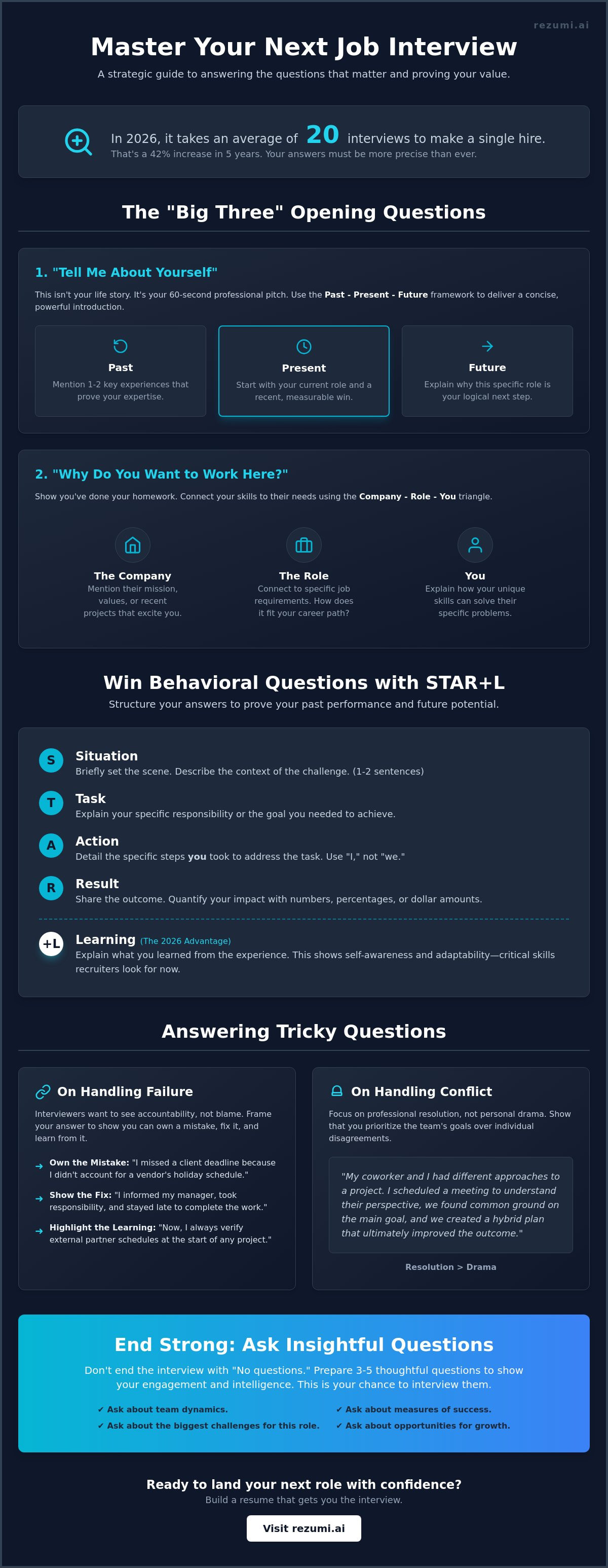
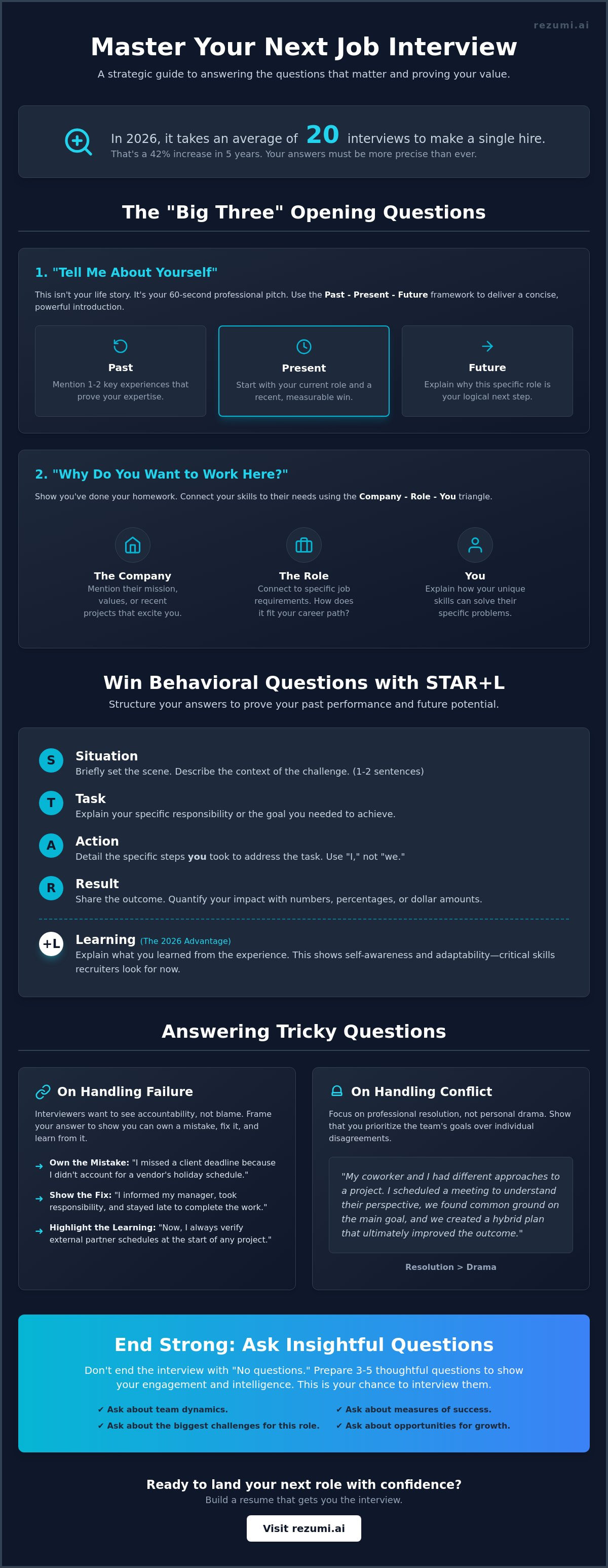
In 2026, it takes an average of 20 interviews to make a single hire. This is a 42% increase from just five years ago. You aren't just competing against other qualified people. You're fighting against a hiring system that demands more precision than ever before. It's normal to feel anxious about being put on the spot. You might worry about sounding like a rehearsed robot or struggling to explain why you're the best fit for the job.
We know how high the stakes feel when you finally land that meeting. You want to feel in control of the conversation, not just survive it. This guide shows you how to master the most common interview questions using specific answer examples and strategic frameworks. We'll give you the exact tools you need to win your next role with confidence. You'll get a clear look at what recruiters actually want to hear (and what they don't). We're breaking down the "Big Three" questions, modern behavioral prompts, and the data-backed ways to prove your value without the stress.
Key Takeaways
- Learn to master common interview questions by framing your answers around what recruiters actually value in a candidate.
- Use the five-step STAR method to provide clear evidence of your skills and predict your future performance.
- Apply the "Weakness + Workaround" method to demonstrate self-awareness without compromising your professional standing.
- Handle tricky conversations about salary and long-term career goals using frameworks that protect your interests.
- Build a list of high-impact questions to ask at the end of your meeting so you don't end on a silent note.
The Big Three: Answering the Most Common Interview Questions
Recruiters use common interview questions as a baseline to measure your professional fit against their internal standards. These questions aren't just filler conversation. They are strategic tools designed to reveal your communication style, your priorities, and how you handle pressure. By understanding the overview of the job interview process, you can see that these questions act as a filter. They separate candidates who simply have the skills from those who can articulate their value clearly.
Tell Me About Yourself: The 60-Second Pitch
Your opening statement sets the pace for the entire meeting. Most candidates make the mistake of reciting their life story. Don't do that. You need a professional brand sentence that defines your impact immediately. For example: "I am a results-driven operations manager who specializes in cutting overhead costs without sacrificing team output." Lead with your identity as a problem solver.
Use the Past-Present-Future framework to keep your answer tight. Start with your current role and a recent win. Mention one or two key experiences from your past that prove your expertise. End by explaining why this specific role is your logical next step. If you are a mid-level manager, your script might look like this:
"Currently, I lead a team of 12 at TechStream where I recently optimized our project delivery cycle, reducing turnaround time by 15%. Before this, I spent five years at Global Logistics refining my approach to supply chain management. My background has prepared me to scale operations for a high-growth company like yours, which is why I am excited about this Director of Ops role."
Why Do You Want to Work Here?
Win this question by using the Company-Role-You triangle. This method connects the company mission, the specific requirements of the job, and your unique skills. Research the company values on their website first. If they value "radical transparency," mention how that aligns with your leadership style. This shows you have done your homework and aren't just looking for any paycheck.
Connect your skills to a problem they are currently facing. If the company is expanding into North American markets, focus on your experience with regional compliance. Your answer should sound like a solution to their specific needs. Try this script: "I've followed your recent expansion into the Pacific Northwest. My experience managing 10 regional launches last year means I can help your team hit its Q4 targets without the usual growing pains."
Behavioral Questions: Using the STAR Method to Win
Recruiters ask behavioral questions because they want to see how you think. They don't want to hear what you might do in a perfect world. They want to know what you actually did when things went wrong. These are some of the most common interview questions you will face in 2026. Your answers show if you have the soft skills that technology cannot replace.
To win these questions, you must use the STAR method. This stands for Situation, Task, Action, and Result. In the modern hiring market, high performing candidates add a fifth step: Learning. This proves you are capable of professional growth and self-correction. Use this five step progression to organize your thoughts:
- Situation: Briefly describe the context. Keep this to one or two sentences.
- Task: Explain the specific challenge or goal you needed to meet.
- Action: Detail the exact steps you took to solve the problem. Always use "I" instead of "we" here.
- Result: Share the outcome. Use real numbers like percentages or dollar amounts to show impact.
- Learning: Explain what you took away from the experience. This is the most important part for 2026 hiring because it shows adaptability.
Handling Conflict and Failure
When an interviewer asks "Tell me about a time you failed," they are checking for accountability. Don't blame your team or your boss. Own the mistake and show how you fixed it. A strong answer sounds like this: "I once missed a client deadline because I didn't account for a vendor's holiday schedule. I told my manager immediately and stayed late to finish the work myself. Now, I always verify external schedules before setting project dates."
You may also face questions about coworker conflict. Focus on the resolution rather than the drama. Explain how you moved past a disagreement to achieve a business goal. For more specific scenarios, check out our Behavioral Interview Questions Guide. Following these Interview Tips from the Dept. of Labor will also help you stay professional during these tough conversations.
Demonstrating Initiative and Leadership
Leadership isn't just a title. You can show leadership by taking initiative on a project or improving a broken process. When you answer "Tell me about a time you took the lead," use real numbers to prove your success. Instead of saying you "improved efficiency," say you "reduced processing time by 22%."
Numbers prove your impact in a way that words cannot. They give the recruiter a clear picture of what you can do for their company. You can find deep-dive training on this in our article on Mastering the STAR Technique. If you want to practice these frameworks with real-time feedback, you can explore our AI Interview Prep tools to refine your delivery before the big day.
The Professional Self: Strengths and Weaknesses
Your strengths are only valuable if they solve the employer's specific problems. These are some of the most common interview questions because they test your self-awareness and alignment with the role. Don't give generic answers that could apply to anyone. Use the UC Davis guide to interview questions to see how these fit into the broader evaluation process. You need to prove that you understand your own professional value and how to manage your growth.
Identifying Your Core Strengths
You must map your strengths directly to the keywords found in the job description. If a job posting asks for "client relations," don't just say you're "good at talking." Translate that into "strategic stakeholder communication." This shows you speak the language of the business. Every strength you claim needs a Proof Point. This is a specific number or achievement from your career that proves you aren't just making it up.
A strong script for your greatest strength looks like this: "My greatest professional strength is strategic stakeholder communication. At my last job, I managed five different department heads to launch a new software update. Because of my clear communication plan, we hit our launch date 14 days early and stayed under budget."
Discussing Weaknesses Without Fear
Never say you don't have any weaknesses. It makes you look arrogant or unobservant to a recruiter. You should also avoid the "perfectionism" trap. In 2026, hiring managers see perfectionism as a red flag for poor time management or an inability to prioritize. Instead, use the Weakness + Workaround method. State a real (but non-critical) weakness and the specific tool or habit you use to manage it.
Choose a weakness that is a work in progress. Here are three safe examples that won't disqualify you:
- Public speaking: If your role is primarily technical or behind the scenes.
- Delegating tasks: A common and honest hurdle for new or mid-level managers.
- Specific technical skills: Mentioning a software you are currently learning, like advanced data visualization.
Try this script for your weakness: "My greatest weakness is public speaking to large groups. I recognized this was a gap in my leadership skills last year. I started taking a monthly workshop to improve my delivery. Now, I volunteer to lead our small team meetings to practice my skills in a controlled setting." If you want to see how your strengths look on paper before the interview, you can check our ATS Resume Optimization tools to ensure your profile is aligned with the job's needs.
Career Goals and Motivation Questions
Recruiters ask about your future because they want to know if you'll provide a return on their investment. They aren't looking for a promise of lifelong loyalty. Modern hiring managers know that the average professional stays in a role for two to three years. They want to see that your personal growth aligns with the company's immediate needs. Being honest about your career path builds trust. It shows you've thought about your trajectory and aren't just looking for any open door. These are common interview questions that test your drive and your realism.
The Five-Year Plan
When an interviewer asks where you see yourself in five years, they are looking for a balance. You need to show ambition without sounding like you're using the company as a temporary stepping stone. Focus on the skills you want to master and how those skills will benefit the team. If you want to move into leadership, say so. But make sure you explain how you'll win for the company in your current role first.
Try a script like this: "In five years, I plan to be a subject matter expert in data operations. I want to have led at least three major cross-departmental projects here. My goal is to eventually move into a senior management role where I can use my technical background to mentor new hires and improve our overall team efficiency." This answer shows you're thinking about your growth within their walls.
Salary and Expectations
Talking about money can feel like a trap. You don't want to lowball yourself, but you also don't want to price yourself out of a job. The best strategy is to deflect the question until you have a firm offer in hand. You can say: "I'm very interested in the role and would like to focus on the fit first. I'm sure we can reach a fair agreement once we decide I'm the right person for the team."
If they insist on a number, use market data for North American standards. Research what professionals in your city and industry are actually making. This gives you a data-backed range rather than a random guess. You can check out Rezumi Pricing to find tools that help you research market rates and keep your profile competitive. Having a clear understanding of your value ensures you don't lose your edge during the final stages of the hiring process. Honesty about your needs, backed by data, is the most professional way to handle this high-stakes conversation.
What Motivates You?
This question is a test of your professional values. Don't just say "money" or "benefits." While those are important, they don't tell a recruiter how you'll perform on a Tuesday afternoon when a project is behind schedule. Connect your motivation to the impact of your work. If you're a developer, maybe you're motivated by solving complex logic puzzles. If you're in sales, perhaps it's the thrill of hitting a difficult target. Align your answer with the company's mission to show you're a cultural fit.
The Strategy: Closing the Interview and Asking Questions
Ending an interview with "I have no questions" is the worst way to finish your meeting. It signals a lack of preparation or a lack of interest in the actual work. You have spent the last hour answering common interview questions to prove your technical skills. Now, you must prove your strategic thinking. Recruiters want to see that you are already imagining yourself in the role. They want to know you are assessing them just as much as they are assessing you. This is your final chance to show you aren't just a candidate, but a partner.
High-Impact Questions to Ask
Don't ask passive questions about office snacks or the general environment. Use "power questions" that focus on performance and team dynamics. This shows you are ready to hit the ground running. Here are three high-impact questions to use:
- "What does success look like in this role after six months?" This forces the manager to define their expectations clearly. It also shows you are focused on delivering results rather than just showing up.
- "How does the team handle technical roadblocks or shifting priorities?" This reveals how the team actually functions under pressure. It tells the interviewer you understand that work isn't always a straight line.
- "What is the one thing the previous person in this role could have done better?" This identifies the specific pain points you need to solve. It allows you to position yourself as the direct solution to their problems.
The Final Impression
Before you leave, you need to deliver a 30-second closing statement. This is your chance to summarize why you are the best fit for the role. Mention a specific skill you discussed and tie it back to the business needs. For example: "Based on our conversation about your need to scale the dev team, my experience hiring 15 engineers last year makes me a direct match for this challenge." This ensures your resume and your interview performance are perfectly aligned. It leaves the recruiter with a clear, data-backed reason to hire you.
Your strategy shouldn't end when you walk out the door. A professional follow-up email is mandatory in the North American market. It keeps you at the top of the recruiter's mind while they evaluate other candidates. You can use our Interview Follow Up Email Template to handle this next step with precision. If you want to refine how you deliver these final moments, our Mock Interview Guide provides the structure you need to practice. Mastering these closing steps turns a good interview into a signed job offer. Remember that every word you say after the formal questions end still counts toward your final score.
Command Your Career Path in 2026
Preparation is the difference between a missed opportunity and a signed offer. You now have the frameworks to handle common interview questions with precision. By using structured responses like the STAR method and focusing on recent wins, you turn a stressful meeting into a strategic conversation. Remember to back every claim with real numbers. This proves your value to North American recruiters immediately. Confidence comes from knowing exactly what to say before you walk into the room.
You have the tools to replace vague answers with data-backed results. You aren't just surviving the conversation; you are leading it. We provide AI-driven interview coaching and ATS-optimized resume scoring to ensure you are ready for every stage of the process. Our platform is built specifically for North American hiring standards to give you a clear advantage. Master your next interview with Rezumi AI coaching. The market is competitive, but you are now better prepared than most candidates. Take these strategies and go secure the position you deserve.
Frequently Asked Questions
How do I answer "Tell me about yourself" in a job interview?
Use the Past-Present-Future framework to keep your pitch under 60 seconds. Start with your current role and a major recent win to establish immediate value. Briefly mention a relevant past experience that prepared you for this role, then explain why this specific position is your logical next step. This structure prevents rambling and ensures you lead with your strongest professional brand statement.
What is the best way to explain a gap in my resume during an interview?
Address the gap directly and briefly without over-explaining. State the reason, such as family care, a personal project, or upskilling, and then immediately pivot back to your current readiness. For example, you can say you took time off to master a new technical skill and are now ready to apply that expertise to help their team hit their targets.
How should I answer "What are your salary expectations?"
Deflect the question until you have a firm offer or provide a range based on current market data. You can state that you are focused on the fit of the role first and are sure you can reach a fair agreement later. If they insist on a number, provide a range based on North American standards for your specific role and city to show you've done your research.
What are the most common behavioral interview questions?
Behavioral questions usually start with the phrase "Tell me about a time when." They focus on how you handled conflict, managed a failure, or took the lead on a project. These are common interview questions because they allow recruiters to predict your future performance by looking at your past actions and your ability to learn from them.
How can I prepare for a video interview in 2026?
Test your technology in advance and ensure your lighting is front-facing to avoid shadows. Since 87% of companies now use AI in their recruitment process, your delivery must be clear and your environment must be professional. Maintain eye contact by looking directly at the camera lens rather than the screen to build a stronger connection with the interviewer.
What should I do if I do not know the answer to a question?
Don't panic or try to guess the answer. It's better to admit you haven't faced that exact scenario and then explain the process you would use to find the solution. You can say: "I haven't encountered that specific issue yet, but here is the logical process I would follow to solve it." This demonstrates your problem-solving skills under pressure.
How many questions should I ask at the end of the interview?
Aim to ask three to five high-impact questions. This shows you are engaged and seriously evaluating if the company is the right fit for your career goals. Focus on questions about success metrics, team challenges, and how the company handles shifting priorities. This moves the conversation from a one-sided interrogation to a professional partnership.
Is it okay to bring notes to a job interview?
Yes, bringing a notebook shows that you are organized and prepared. You can use your notes to reference specific data points, such as percentages or dollar amounts, that prove your impact in previous roles. It's also helpful to have your prepared questions written down so you don't forget them during the high-pressure closing moments of the meeting.
Disclaimer
This article is provided for general informational purposes only and does not constitute professional, legal, financial, or career advice. While Rezumi strives for accuracy, we make no warranties as to the completeness or reliability of this content. Hiring practices, ATS behavior, and job-market conditions vary by employer, industry, and region — always verify against your specific situation. Any action you take based on this article is at your own risk.